
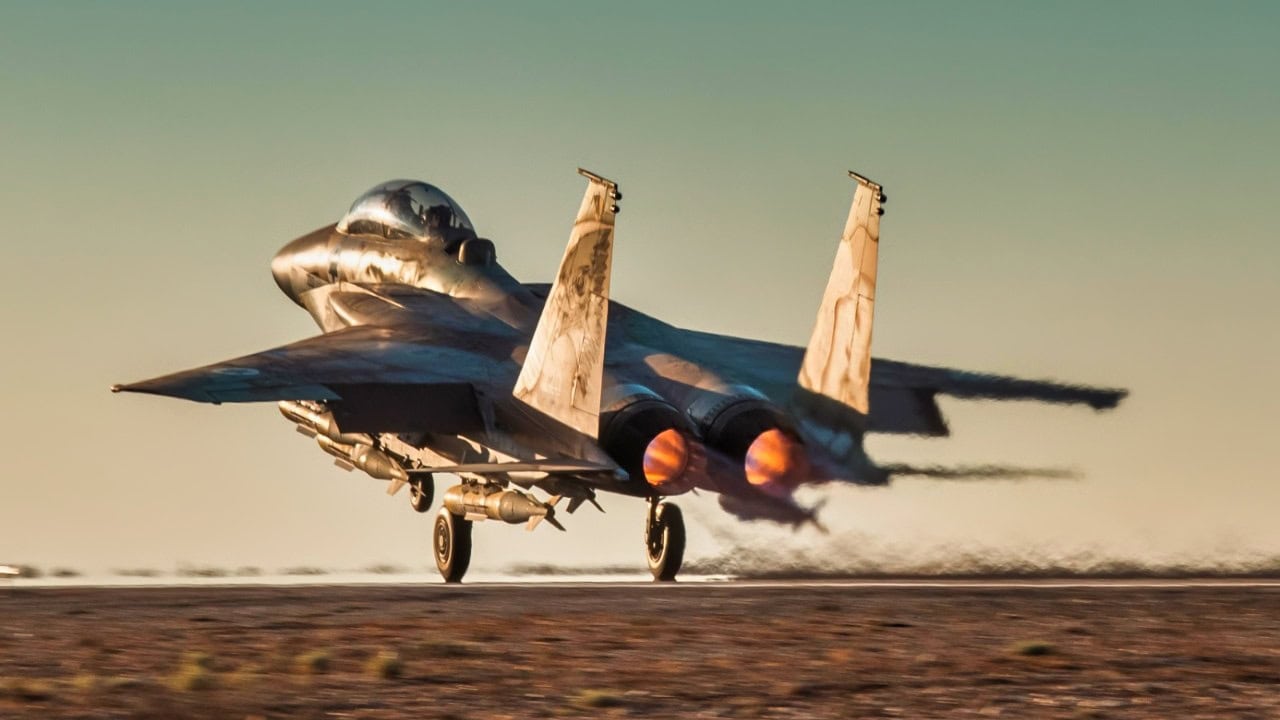
Summary and Key Points: In May 1983, an Israeli fighter pilot flew ten miles and landed his jet with one wing torn completely off — a feat the aircraft’s own manufacturer insisted was impossible until the photographs arrived. The physics of how he did it became a lesson taught to engineering students: at enough speed, a plane’s own fuselage can fly like a wing. This is the story of that landing, the trainee who refused to eject, and the strange forty-year afterlife of the aircraft that survived it.
A Fighter Pilot Landed His F-15 With One Wing Torn Off in 1983. The Manufacturer Said It Was Impossible Until the Photos Arrived
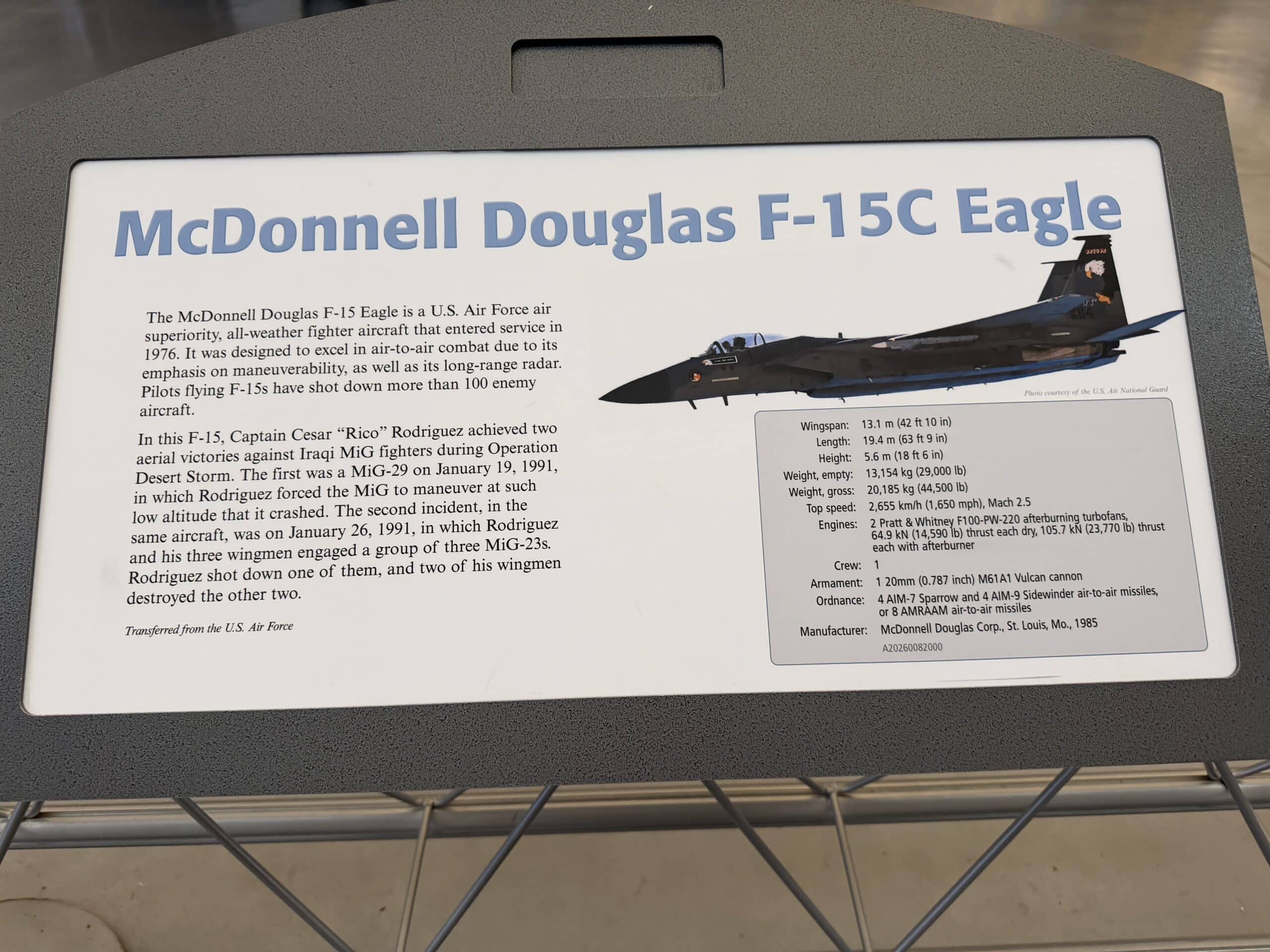
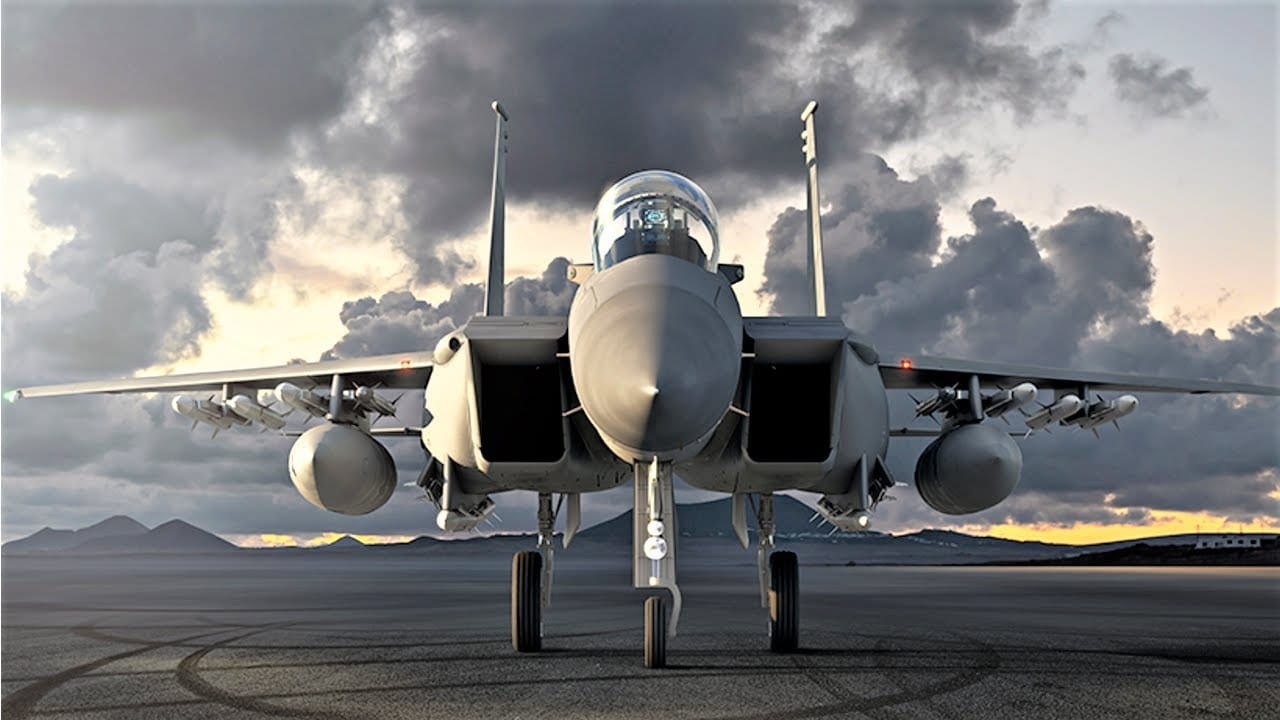
F-15C Smithsonian 19FortyFive Photo
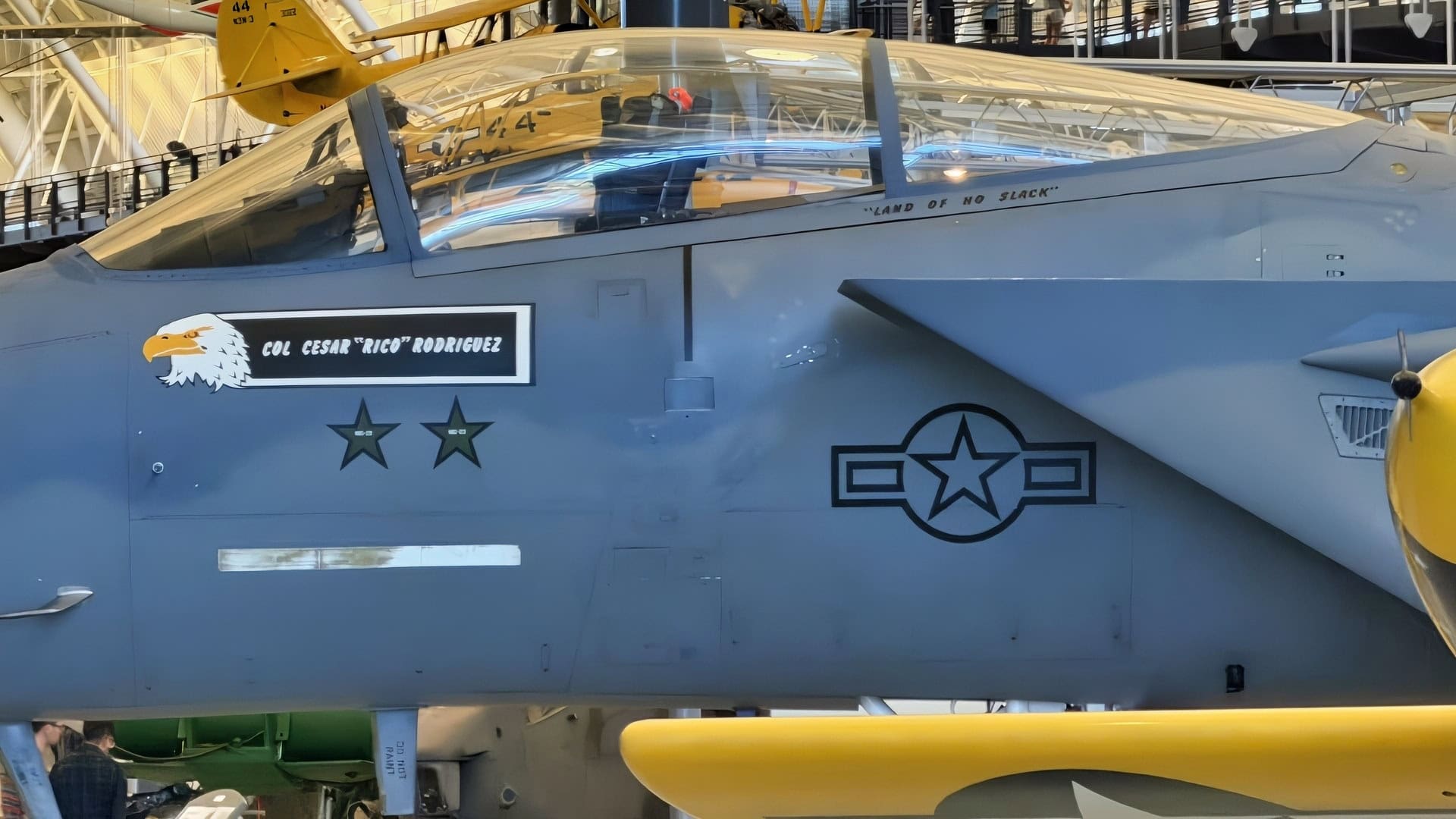
F-15C Smithsonian 19FortyFive Photo
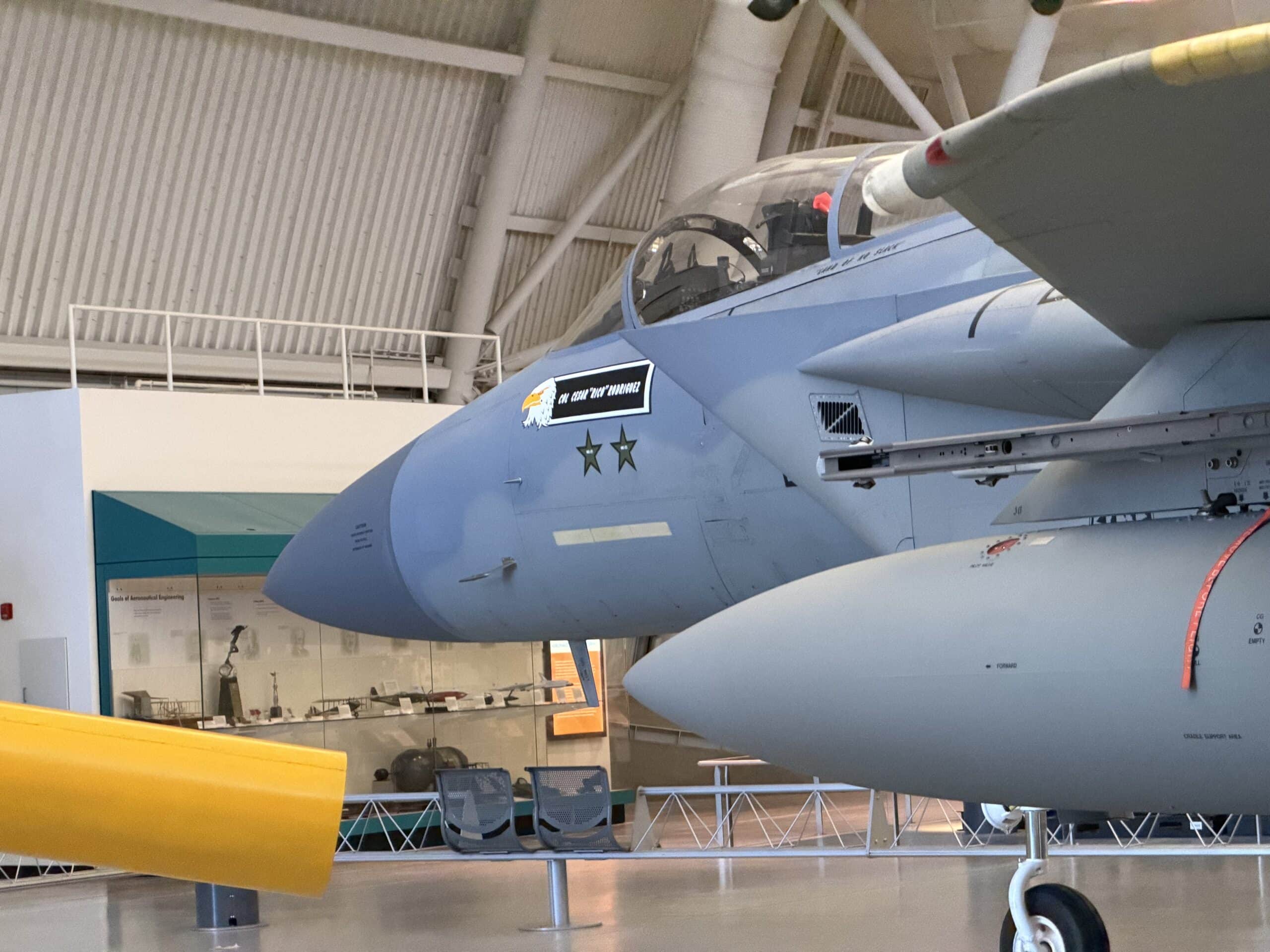
F-15C at the Smithsonian. 19FortyFive Image.
Somewhere between 13,000 and 14,000 feet over Nahal Tzin in the Negev desert, Zivi Nedivi had just called a simulated missile shot when his F-15D and an A-4 Skyhawk arrived in the same piece of sky, belly to wing, where neither pilot could see the other. The collision announced itself with a heavy jolt, then a fireball where the Skyhawk had been. The A-4 disintegrated; its pilot was thrown clear by the ejection system and survived. The F-15 rolled into a violent spin, and from the back seat, instructor Yehoar Gal ordered an ejection.
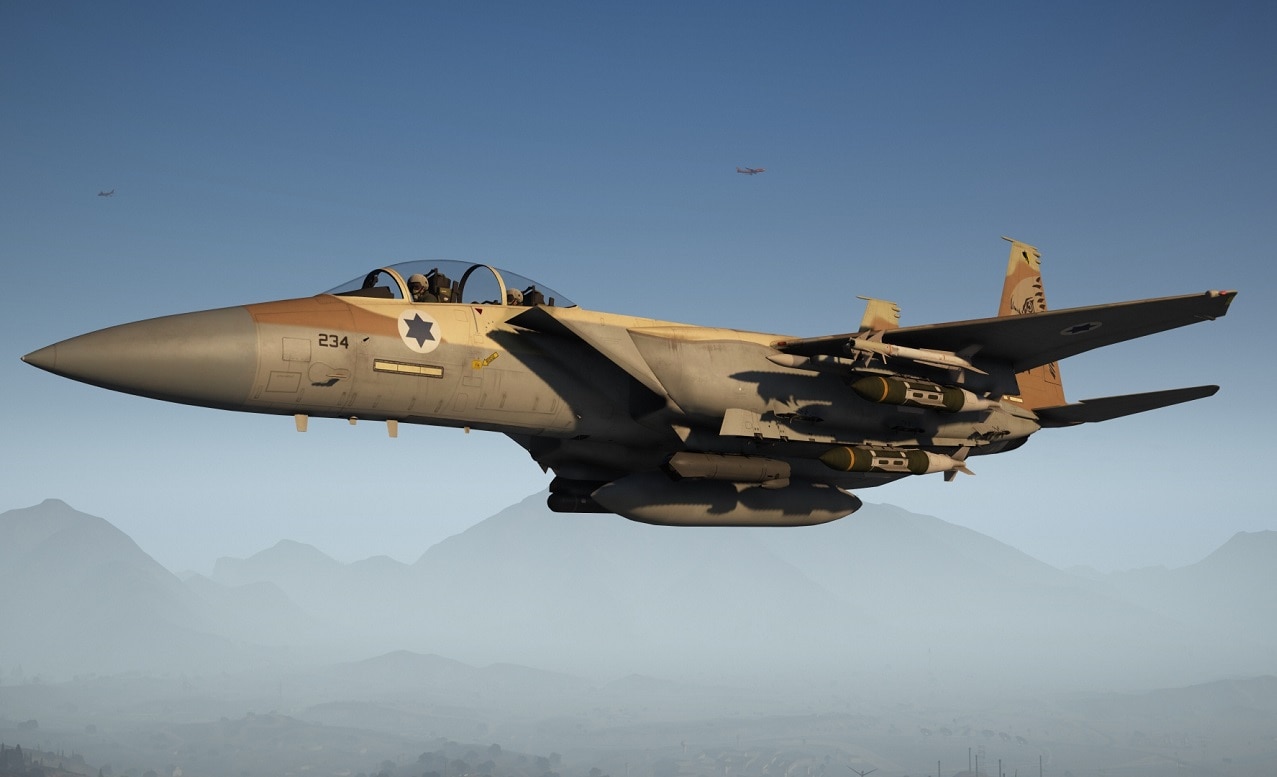
F-15I Ra’am. Image Credit: Creative Commons.
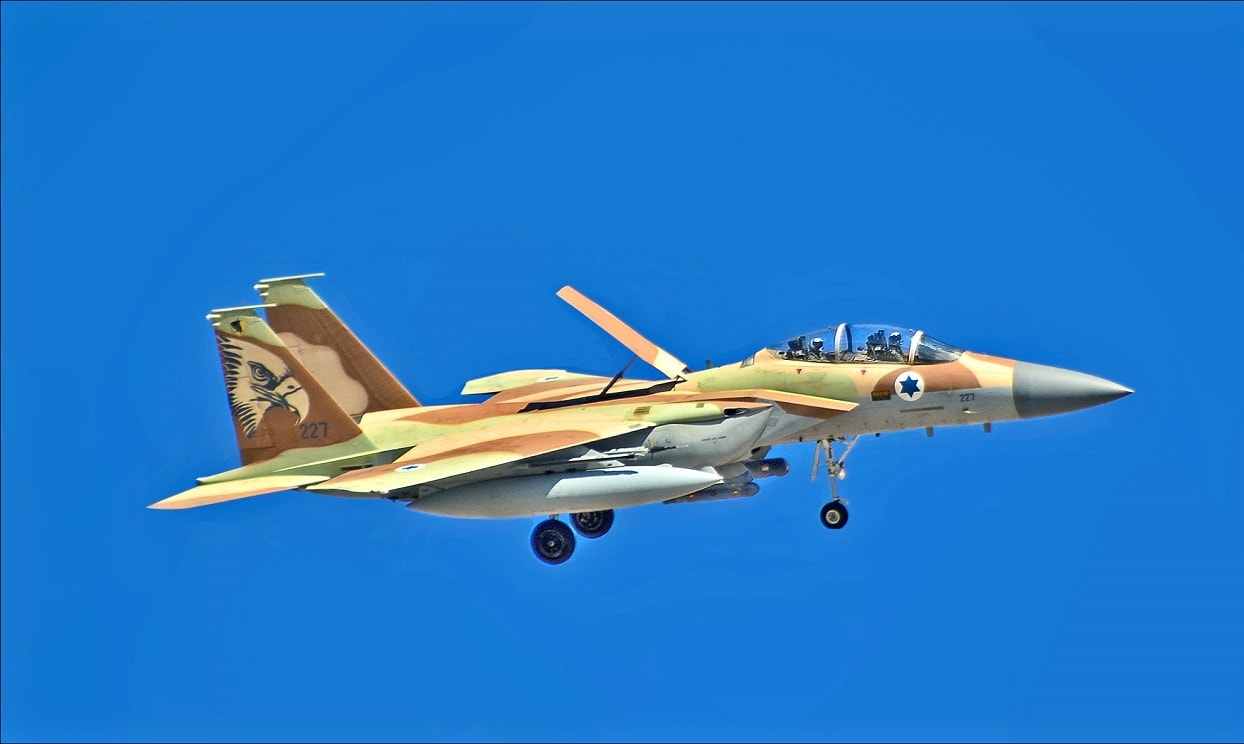
Image: Creative Commons. Image is of a F-15I.
Nedivi, the student in the front seat, happened to outrank his teacher, and he made a different call. He shoved both throttles into afterburner, the opposite of anything the manuals suggest for a spinning fighter, and the nose came up.
Sky Blazer: The MiG Killer That Lost Its Wing
The airplane fighting for its life that morning already had a reputation. F-15D number 957, a two-seat Baz — Falcon, the Israeli name for the Eagle — of 106 Squadron, carried the Hebrew name Markia Shchakim, Sky Blazer, and kill markings earned the previous summer, when Israel’s F-15 force tore through the Syrian air force over Lebanon without losing a jet.
Shlomo Aloni’s squadron history of the Israeli Eagle credits 957 itself with three victories in that campaign, a MiG-21 and two MiG-23s, though some accounts round the tally to four. The point stands either way: this was a proven killer of a jet, barely a decade into the type’s existence, assigned that day to the humbler work of teaching.
The exercise was airfield defense, a standard dissimilar-combat setup: two F-15Ds from the 106th and 116th squadrons playing defenders against four A-4N Skyhawks flying as aggressors.
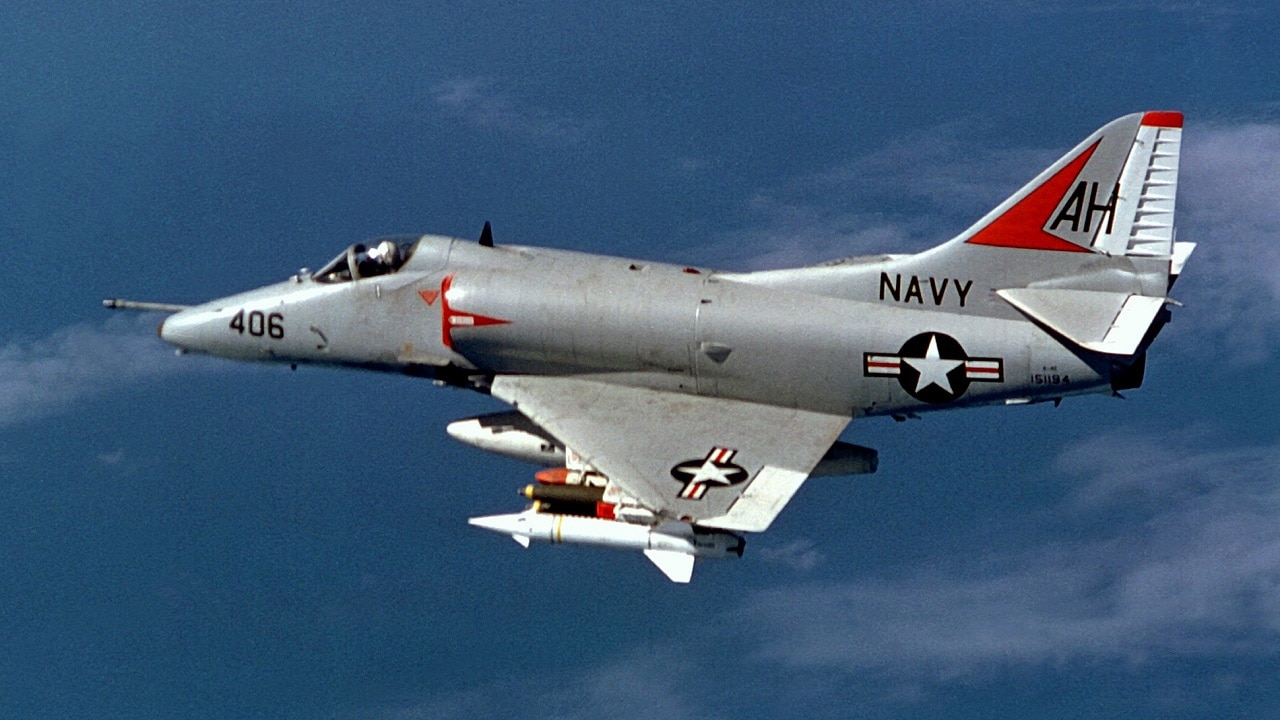
A U.S. Navy Douglas A-4E Skyhawk (BuNo 151194) from Attack Squadron 164 (VA-164) “Ghost Riders” en route to a target in North Vietnam on 21 November 1967. VA-164 was assigned Attack Carrier Air Wing 16 (CVW-16) aboard the aircraft carrier USS Oriskany (CVA-34) for a deployment to Vietnam from 16 June 1967 to 31 January 1968. The aircraft was piloted by Cmdr. William F. Span, executive officer of VA-164 and was armed with six Mk 82 500 lb (227 kg) bombs and two AGM-12 Bullpup missiles. The A-4E 151194 is today on display at Pacific Coast Air Museum, California (USA), painted in the colours of Marine Attack Squadron 131 (VMA-131) “Diamondbacks”.
The Skyhawk was a generation older and no match for an Eagle one-on-one, but the aggressors had numbers and experience, and dissimilar training exists precisely because dogfights compress airplanes into small pieces of sky at closing speeds that no human can fully track.
The safety margins that usually keep training collisions theoretical ran out over the Negev, and what the A-4 took with it when it exploded was almost the entire right wing of the F-15, severed roughly two feet from the fuselage.
Ten Miles on One Wing
Neither man in the cockpit knew that. Fuel was pouring from the wing root and flash-vaporizing into a white plume that completely hid the damage; Nedivi asked his wingman to look him over, and the wingman could not see through the spray either.
What the instruments offered was a riddle: the fuel gauge for the wing tank read zero, which Nedivi took to mean the collision had somehow bled his tanks, until he remembered the fuel system’s one-way valves and concluded he might still have enough to reach a runway.
His own later summary of the decision, in an account of the flight he gave afterward, is the whole story in one sentence: “as long as the sucker flies, I’m gonna stay inside.”
Flying meant keeping it fast.
When he pulled the power back, the jet dropped into a spin again, and the afterburners brought it back up. Ramon Airbase lay about ten miles away, and Nedivi flew the approach at 250 to 260 knots — roughly twice the 130 knots of a normal F-15 landing — because below that speed the airplane stopped being an airplane.
He dropped the emergency arrestor hook, caught the cable about a third of the way down Ramon’s runway, and was carrying so much speed that the hook tore the jet entirely off. Sky Blazer ground to a stop on brakes and friction roughly twenty feet from the barrier at the far end.

A-4. Image Credit. Creative Commons.
Then came the moment the story is famous for. Nedivi turned in his seat to shake Gal’s hand, looked past him, and, for the first time, saw that there was nothing on the right side of the airplane. A two-foot stump stood where a wing should be. He said later that had he seen it in the air, he almost certainly would have ejected, because it was obvious no one could fly an airplane in that condition. He had just flown one for ten miles.
McDonnell Douglas Said It Was Impossible
The manufacturer agreed with his instincts at first. When the Israeli Air Force asked McDonnell Douglas about the incident, the company’s initial position was that an F-15 could not fly with one wing; the damage must have happened on the ground, in some taxiing accident.
Then the photographs arrived from Israel: a whole, otherwise healthy Eagle parked at Ramon, its right wing amputated at the root, fuel stains streaking the fuselage.
The engineers’ analysis, as Nedivi later relayed it in a History Channel documentary, turned the embarrassment into a design lesson: “you fly fast enough and you’re like a rocket. You don’t need wings.”
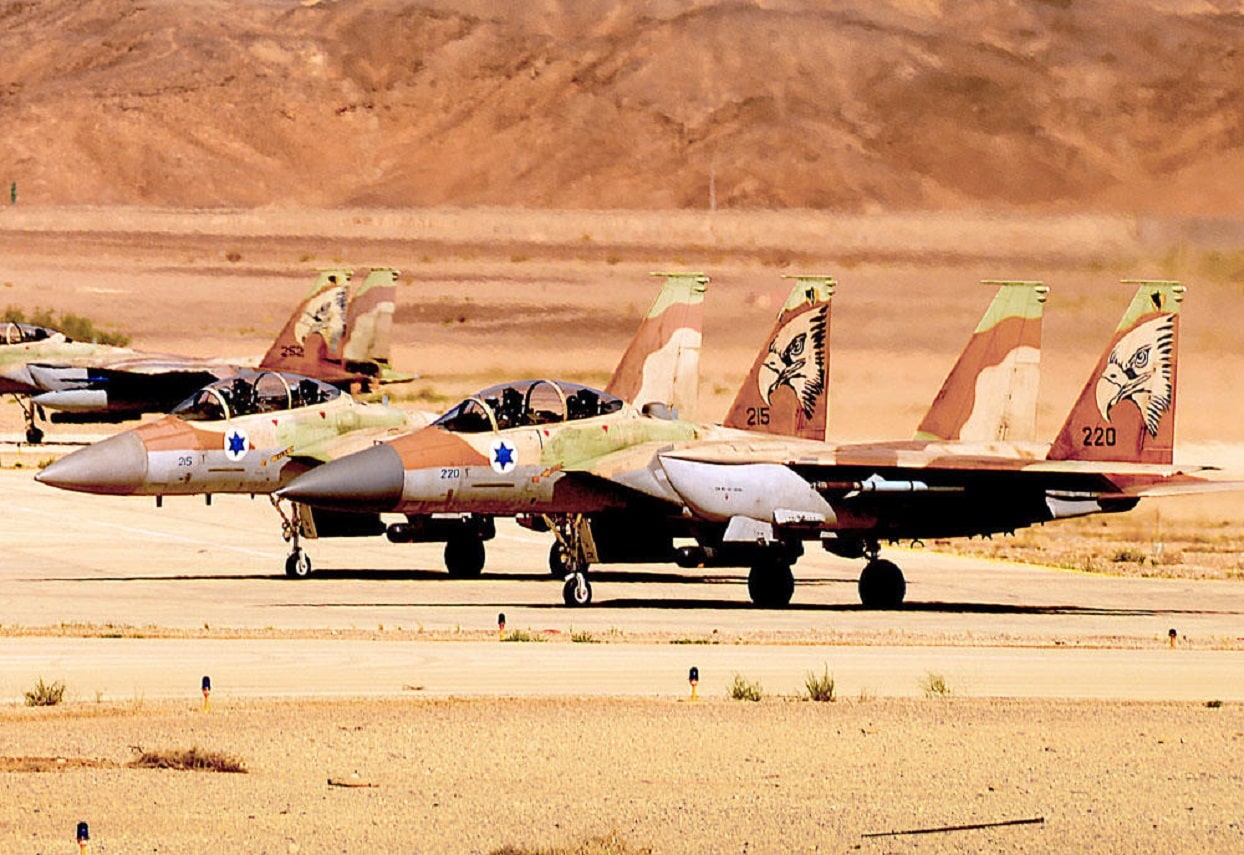
F-15I. Image: Creative Commons.
That is closer to real aerodynamics than to bravado. The F-15’s fuselage is unusually wide and flat, a deliberate design feature that makes the whole aircraft a lifting body; at high speed, the fuselage, the broad engine intakes, the stabilators, and the surviving left wing together generated enough lift to keep the wounded Eagle airborne, so long as the two F100 engines kept shoving it forward fast enough.
Nedivi had accidentally flight-tested the outer edge of the Eagle’s envelope and survived it. The most honest review came from a colleague: in Bertie Simmonds’ book on the F-15, Nedivi recalls an F-16 pilot friend who looked at the wreck and asked, “Can I transfer to F-15s?”
Repaired, Rearmed, and Back to War
What happened next separates this story from every other miracle-landing tale: the airplane went back to work.
Sky Blazer was trucked by road to the Israeli Air Force’s maintenance depot at Tel Nof, per Aloni’s account, fitted with a new right wing, and returned to 106 Squadron.
On November 19, 1985, the repaired jet shared in the destruction of a Syrian MiG-23 — the fighter that had landed on one wing- and added to its scoreboard afterward.
The episode became one of aviation’s great campfire stories, taught to engineering students as a lifting-body case study and even written into a video game, where a mercenary pilot who lands a one-winged F-15 earns the callsign Solo Wing Pixy.
The Baz fleet it belonged to simply refused to age out. Israel’s surviving A-through-D-model Eagles were upgraded repeatedly across the decades and still fly today with two squadrons at Tel Nof, some of them now older than the pilots strapping into them, part of a 66-strong Israeli F-15 force whose operators long claimed the type’s signature statistic: more than 100 air-to-air kills without a loss to an enemy aircraft.
Forty-One Years Later: Photographed on the Way to Iran
Which brings the biography to its strangest entry. On the night of October 25-26, 2024, Israel launched Operation Days of Repentance, waves of strikes against military targets in Iran, including the air-defense batteries guarding its nuclear and missile complexes.
Among the released photographs the Israeli military put out from that night, since archived publicly, is a two-seat F-15D on the line before the attack. The tail number is 957.
Sky Blazer, with three kills over Lebanon, one wing lost over the Negev, and a shared MiG in 1985, was photographed armed and ready for a strike on Iran, forty-one years after the landing its manufacturer called impossible.
The fleet’s war has only widened since then, and the airplane family finally has a successor on the way. Israel signed a $5.2 billion deal in November 2024 for 25 new-build F-15IAs, the Israeli version of the F-15EX, with deliveries beginning in 2031 at four to six a year; the Pentagon put the production contract, with options, at an $8.6 billion ceiling in December.
F-15EX Eagle II. Image Credit: Creative Commons.
And on May 3 of this year, after the air campaigns against Iran, Israel announced it would buy a second F-15IA squadron outright, with Defense Minister Israel Katz saying the lessons of the Iran fighting demanded air superiority “for decades to come.”
The jets that will eventually replace the Baz were ordered, in part, on the strength of what the Baz fleet just did.
Somewhere at Tel Nof, the squadron that includes fighter aviation’s strangest survivor keeps flying the war in which its replacement was purchased. The photograph from October 2024 shows 957 whole: two wings, weapons hung, heading for Iran.
The one from May 1983 shows a fighter jet with a two-foot stump where its right wing belongs, parked twenty feet short of a barrier — and explains why, when the first report reached St. Louis, nobody at McDonnell Douglas believed it.
About the Author: Harry J. Kazianis
Harry J. Kazianis (@Grecianformula) was the former Senior Director of National Security Affairs at the Center for the National Interest (CFTNI), a foreign policy think tank founded by Richard Nixon based in Washington, DC. Harry has over a decade of experience in think tanks and national security publishing. His ideas have been published in the NY Times, The Washington Post, The Wall Street Journal, CNN, and many other outlets worldwide. He has held positions at CSIS, the Heritage Foundation, the University of Nottingham, and several other institutions related to national security research and studies. He is the former Executive Editor of the National Interest and the Diplomat. He holds a Master’s degree focusing on international affairs from Harvard University.

