
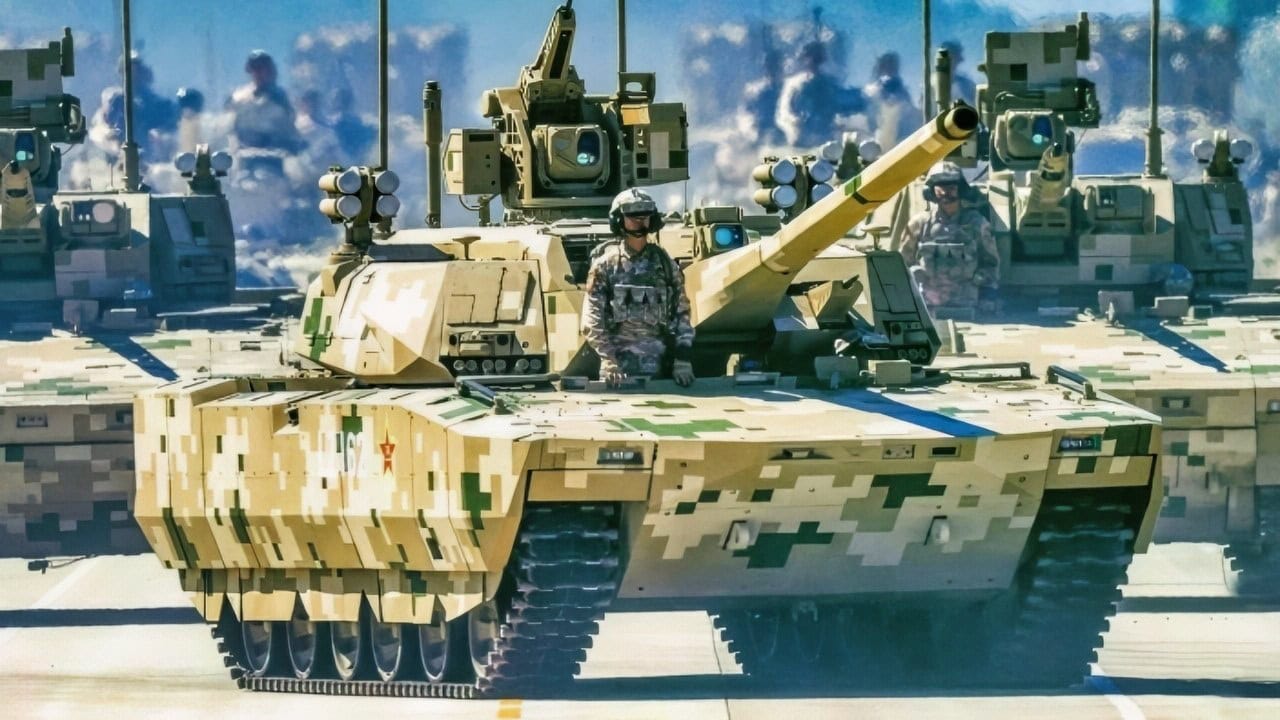
Key Points and Summary: One factory in Inner Mongolia has built every tank China has ever fielded. Over 68 years, Beijing went from assembling a licensed Soviet copy at that plant to rolling out a tank no other army has fielded — and along the way, the country quietly turned the world’s largest tank fleet into a smaller, more modern one. The story behind China’s armor is not the one the parades are built to sell.
China’s Tanks: An Industrial Story Like No Other
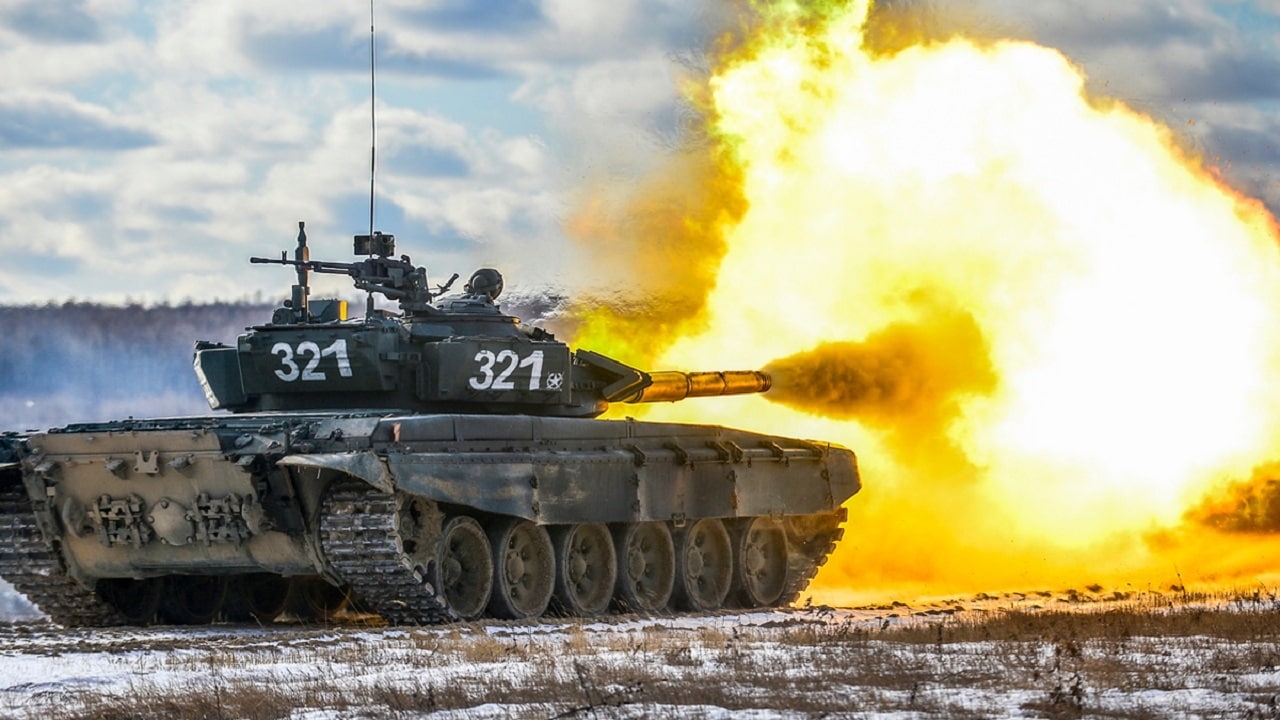
Russian T-90 tank firing its main gun. Image Credit: Russian Ministry of Defense.
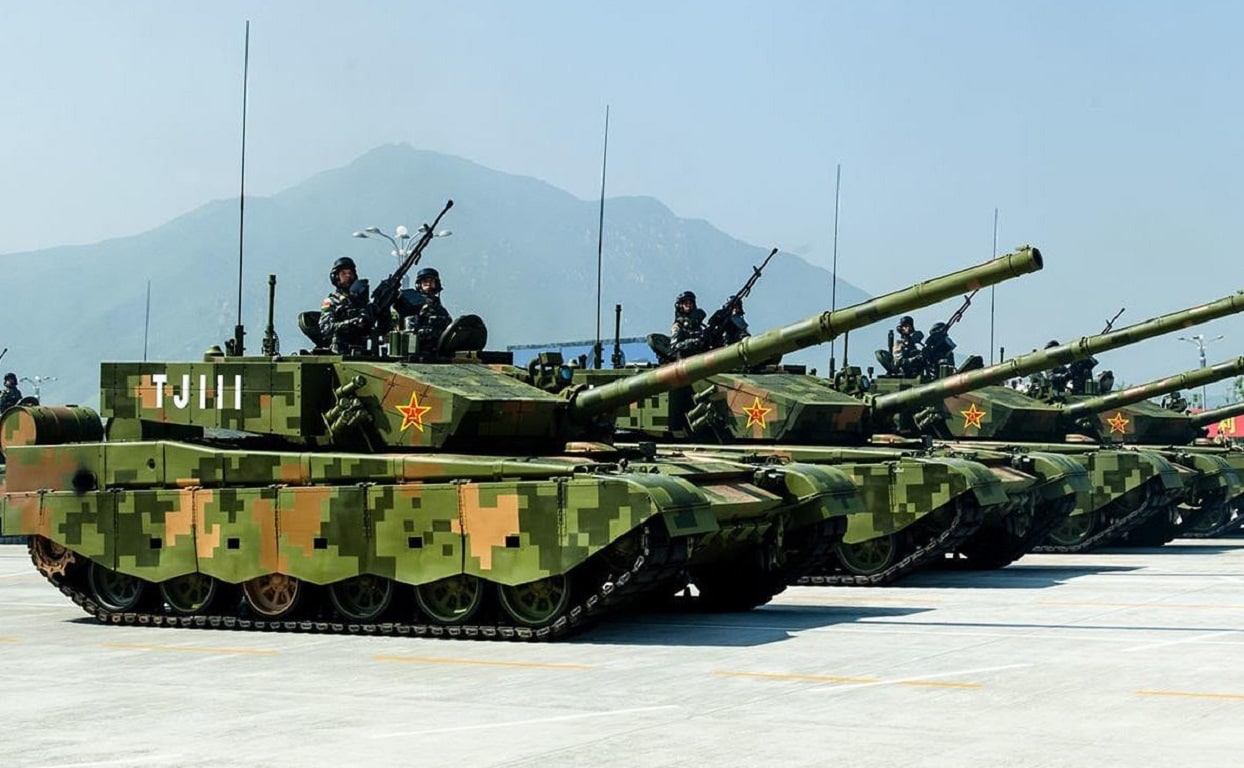
Type 99 Tank from China. Image: Creative Commons.
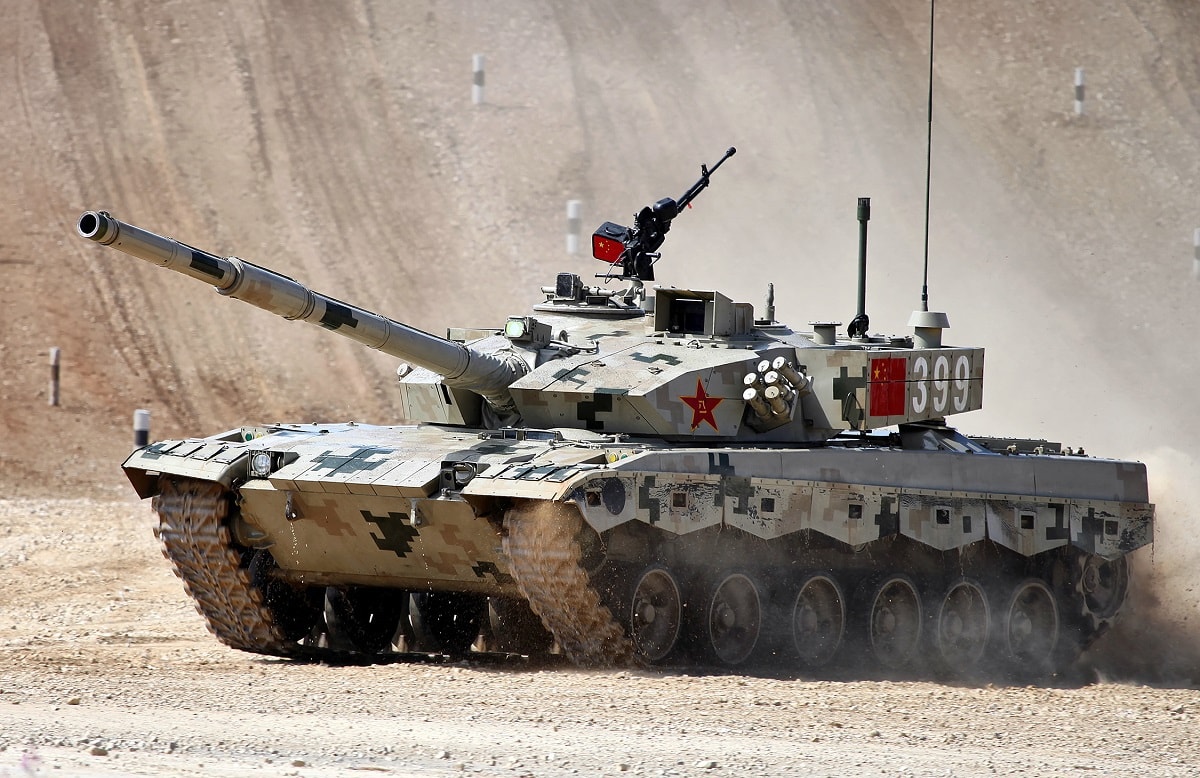
Chinese tank. Creative Commons Image.
On October 1, 1959, a formation of Chinese-built tanks crossed Tiananmen Square at the parade marking the People’s Republic’s tenth anniversary. They were copies of the Soviet T-54A, assembled at a new plant in Baotou, Inner Mongolia, that Soviet engineers had helped stand up. The design took its name from the year of its acceptance: Type 59.
On September 3, 2025, a tank called the Type 100 crossed the same square at the parade marking 80 years since Japan’s defeat. It carries no one in its turret, mounts a smaller main gun than the tanks it will serve beside, and comes out of the same Baotou complex where the first Type 59s were built. Between those two parades sits the entire history of Chinese armor, and it is not the story the raw numbers suggest.
From Soviet T-54A to Type 59: The License That Built a Tank Force
China entered the tank business under a license. Under the terms of Sino-Soviet cooperation in the 1950s, Moscow agreed in 1956 to help China build a tank plant, and the Baotou facility began producing a copy of the Soviet T-54A. The earliest examples were assembled from Soviet-supplied parts, with Chinese components phased in as the plant matured. Production ran into the mid-1980s and reached around 10,000 vehicles by most counts, making the Type 59 one of the most numerous postwar tanks built outside the Soviet Union.
The design also became the basis of a family. When Chinese troops captured a Soviet T-62 during the 1969 border clashes along the Ussuri River, its features fed an improved model, the Type 69. Western fire control and a 105mm gun option later produced the Type 79. Three designations, one lineage, all of it traceable to a Soviet drawing board. Those first-generation tanks formed the backbone of the People’s Liberation Army into the early 2000s, and exported versions fought in wars from South Asia to the Persian Gulf.
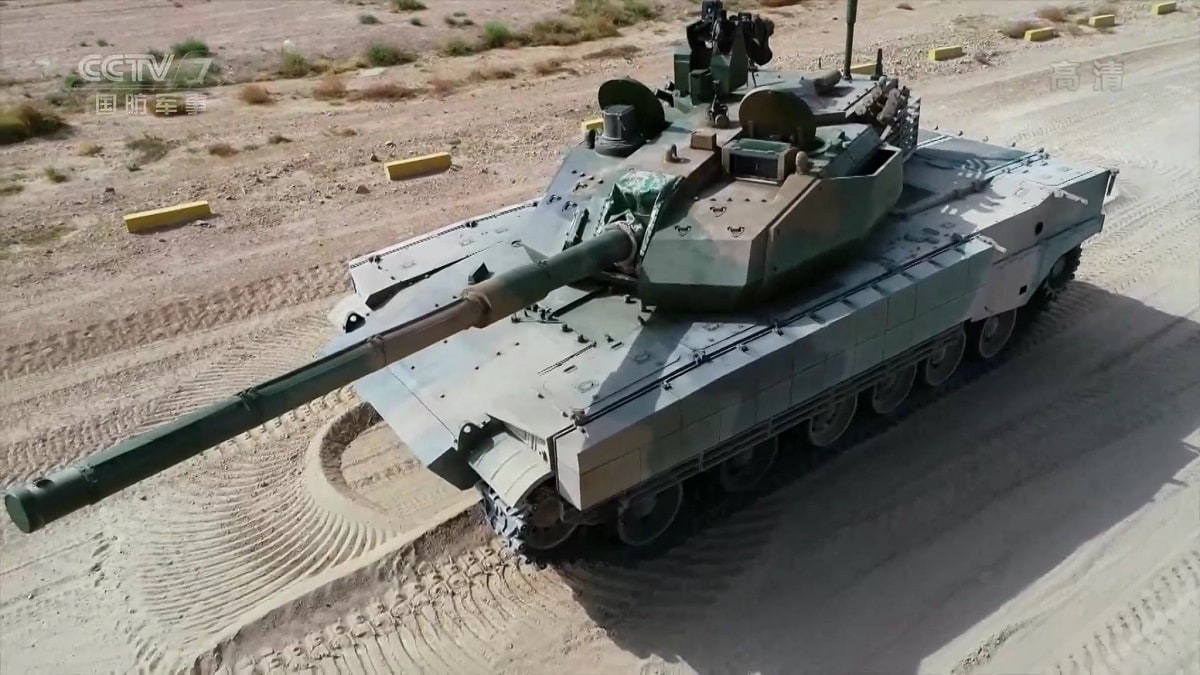
China’s Type 15 Light Tank: Image: CCTV.
The Gulf War Lesson That Produced the Type 96 and Type 99
In 1991, Iraqi armor built on that same Type 59 and Type 69 lineage met American and coalition tanks in Kuwait and southern Iraq and was destroyed in enormous numbers, often before Iraqi crews could locate what was shooting at them. Beijing read the result as a verdict on its own fleet. The tanks it had built by the thousands belonged to a generation that modern Western armor could kill almost without risk.
The response took most of a decade. The Type 96, accepted into service in 1997, gave the PLA its first 125mm smoothbore gun and a modern fire-control system in a tank cheap enough to buy in volume. The Type 99 followed in 2001 as the high-end counterpart, and its Type 99A upgrade, fielded from 2011, added a 1,500-horsepower engine, improved reactive armor, and laser countermeasures. The two-tier logic was deliberate: a relatively small force of expensive Type 99As for spearhead units, and a mass of Type 96s to equip everyone else. A third design, the Type 15 light tank, entered service in the late 2010s to put modern armor on the Tibetan plateau, where heavier tanks struggle.
The World’s Largest Tank Fleet Has Been Shrinking for 20 Years
The modernization is real. So it is a fact that rarely makes the headlines: the fleet has been getting smaller for two decades. In 1997, the PLA operated roughly 6,200 first-generation and 1,600 second-generation tanks, for a total of close to 7,800. By 2017, the International Institute for Strategic Studies put the fleet at about 3,390 third-generation tanks, 400 second-generation, and 2,850 aging Type 59s, which the institute called “effectively obsolete,” a total of roughly 6,640. IISS still ranked it the largest active-service tank force on earth. It was also almost 1,200 tanks smaller than it had been 20 years earlier, and the shedding of Type 59s has continued since.
That contraction is why published totals for Chinese armor scatter so widely, from around 4,000 genuinely modern vehicles to well over 6,000 when older hulls are counted. The number depends entirely on whether a 1950s design still on the books counts as a tank or a relic. The honest reading is that China traded raw mass for a modern core: fewer tanks, newer tanks, and a production base at Baotou that never stopped running.
Type 100 at the Victory Day Parade: A Smaller Gun for the Drone War
The newest product of that base rolled into public view at the September 3 parade in Beijing, with Vladimir Putin and Kim Jong Un watching from the rostrum. Chinese military officials had previewed fourth-generation tanks in the run-up, Al Jazeera reported, and the ground assault formation delivered them: the upgraded Type 99B, the new Type 100, and a Type 100 support vehicle sharing its hull.
Nearly everything about the Type 100 inverts 30 years of Chinese practice. Its estimated weight of 35 to 45 tonnes makes it far lighter than the 55-tonne-plus Type 99A. Its autoloaded main gun is a 105mm, a full caliber class below the 125mm that has defined Chinese tanks since 1997, with Chinese reports claiming that new propellant and penetrator technology lets the smaller round match bigger guns.
The turret is unmanned, with the three-man crew sealed in an armored capsule in the hull. A hybrid diesel-electric drive rated at nearly 1,500 horsepower reportedly allows short periods of near-silent electric movement. Two active protection launchers, cued by four phased-array radar panels, are designed to intercept missiles, rockets, and drones, including top-attack munitions, and the crew wears augmented-reality headsets fed by sensors that ring the vehicle. Hong Kong’s South China Morning Post reported that the design marks Beijing’s turn toward armored warfare organized around data, networks, and uncrewed systems rather than armor thickness, a reading of the drone-saturated fighting in Ukraine. Beijing classifies the vehicle as a fourth-generation tank, a label with no agreed international standard behind it.
In Service Since May: What the Type 100 Footage Proves and What It Can’t
The Type 100 did not stay a parade piece. In October 2025, China’s military newspaper PLA Daily described the tank operating in combined-arms battalion exercises alongside rocket artillery, electronic warfare units, and reconnaissance drones, quoting a tank commander, Sun Yongming, on armored warfare’s shift from close-range fighting to engagements beyond visual range.
On May 4 of this year, the PLA Ground Force released training footage that Army Recognition read as indirect confirmation that the tank had entered active service, barely eight months after its public debut.
What the footage cannot show is whether any of it works under fire. Every performance claim about the Type 100 originates in Beijing’s own materials, from the penetration figures to the beyond-visual-range networking, and none of it has been demonstrated against an opponent.
The Department of War’s annual China Military Power Report, released on December 23, notes that the PLA has not engaged in combat for decades. The last war China fought was against Vietnam in 1979, with Type 59s and their cousins, and it went badly enough in the northern mountains that the PLA has studied it ever since. Russia paraded an unmanned-turret tank of its own, the T-14, back in 2015 and has never managed to field it in numbers, a reminder that a revolutionary design on Chang’an Avenue is not the same thing as a revolutionary design in an armored brigade.
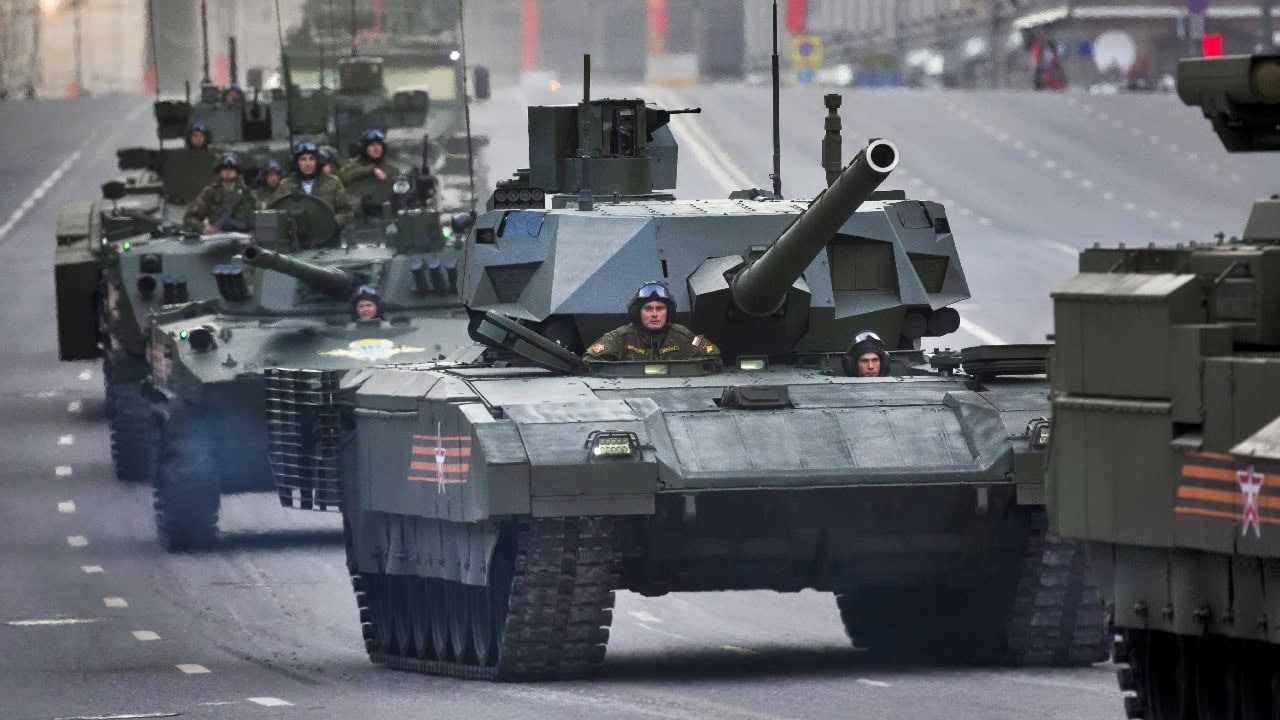
T-14 Armata Tank from Russia. Image Credit: Creative Commons.
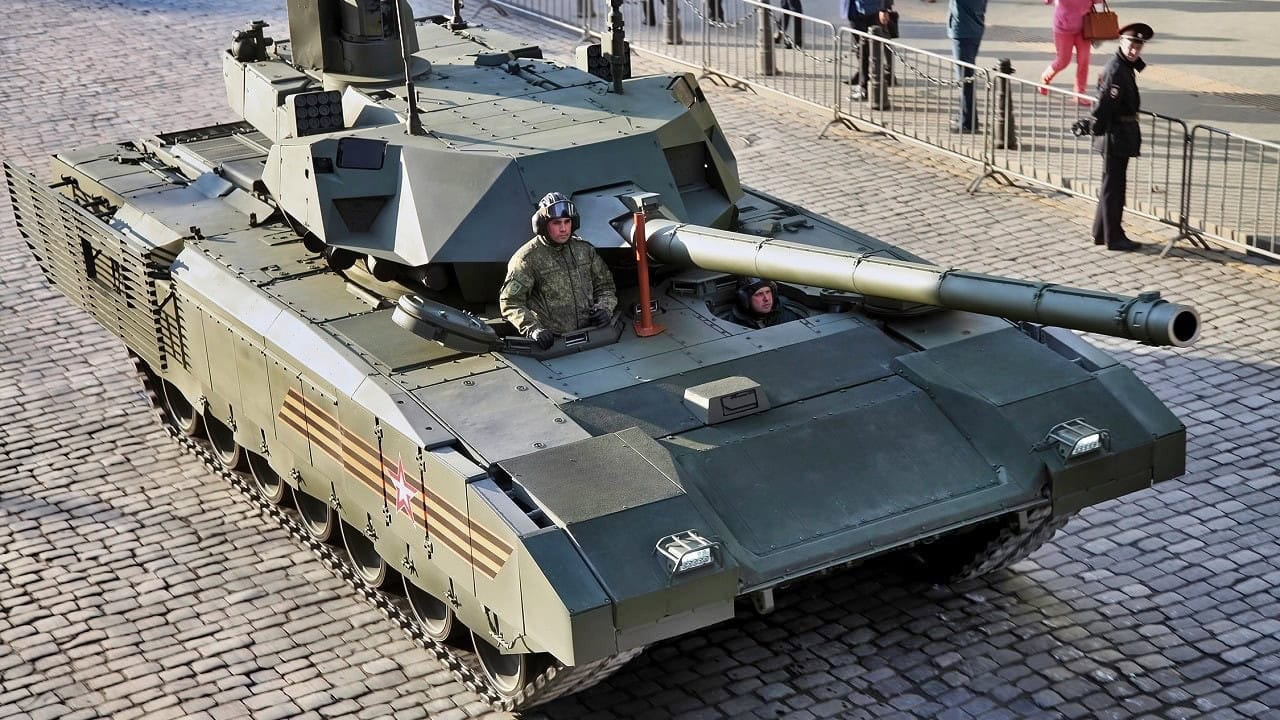
T-14 Armata Tank.
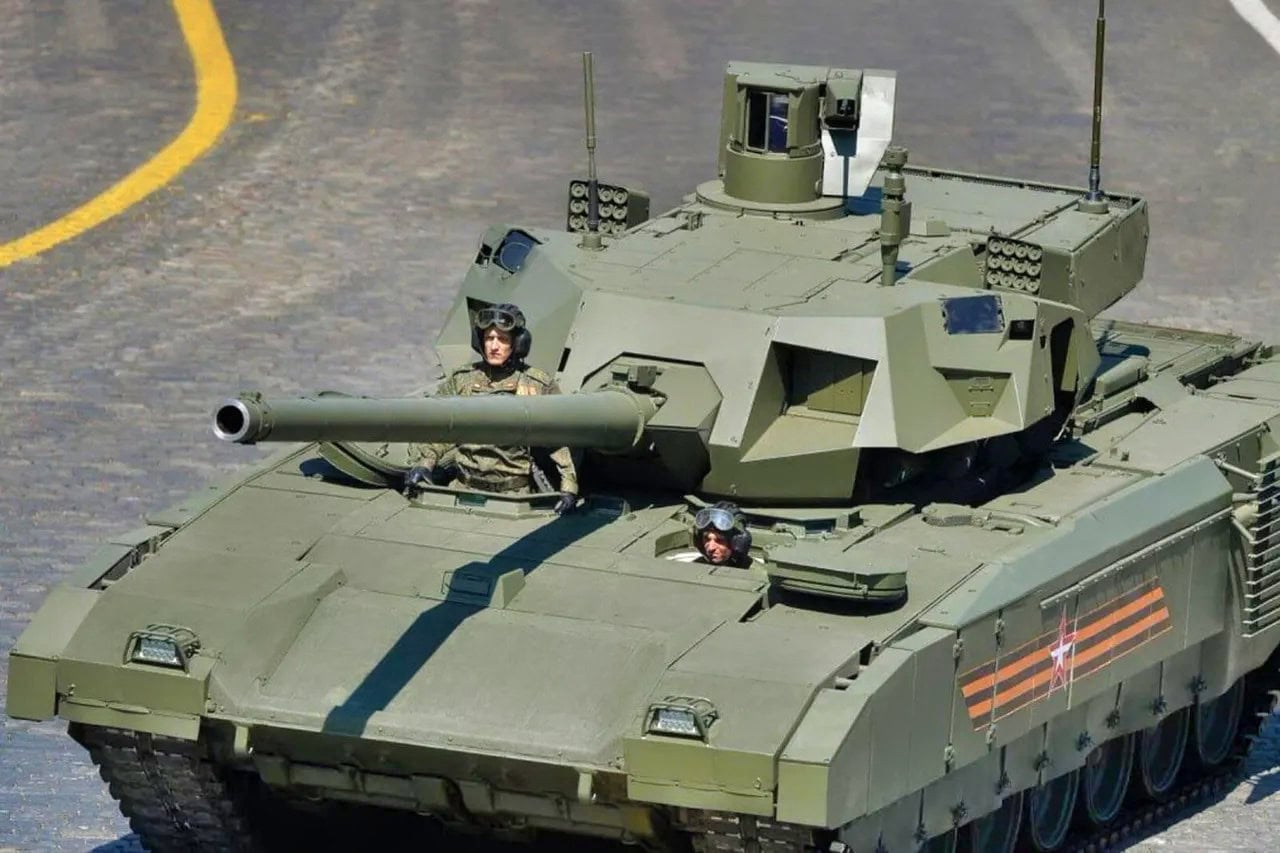
Russian T-14 Armata Tank. Image Credit: Social Media Screenshot.
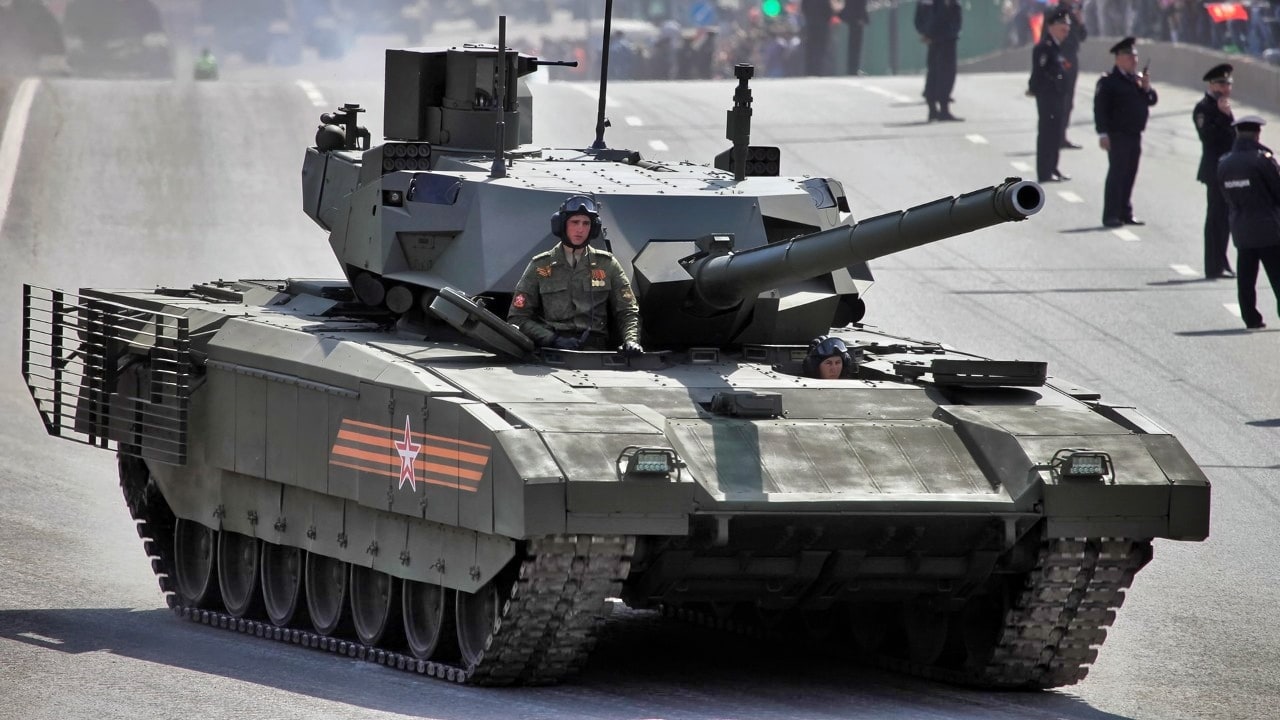
T-14 Armata Tank from Russia
As of today, things look like this: the world’s largest tank fleet still rides mostly on the Type 96 and Type 99, the Type 100 exists in training footage and official praise, and the plant at Baotou has now spent 68 years building every generation of the line, from a licensed Soviet copy to a machine no other army has fielded. The copy came first. Whether the original is any good is the question the next decade will answer.
About the Author: Harry J. Kazianis
Harry J. Kazianis (@Grecianformula) was the former Senior Director of National Security Affairs at the Center for the National Interest (CFTNI), a foreign policy think tank founded by Richard Nixon based in Washington, DC. Harry has over a decade of experience in think tanks and national security publishing. His ideas have been published in the NY Times, The Washington Post, The Wall Street Journal, CNN, and many other outlets worldwide. He has held positions at CSIS, the Heritage Foundation, the University of Nottingham, and several other institutions related to national security research and studies. He is the former Executive Editor of the National Interest and the Diplomat. He holds a Master’s degree focusing on international affairs from Harvard University.

