
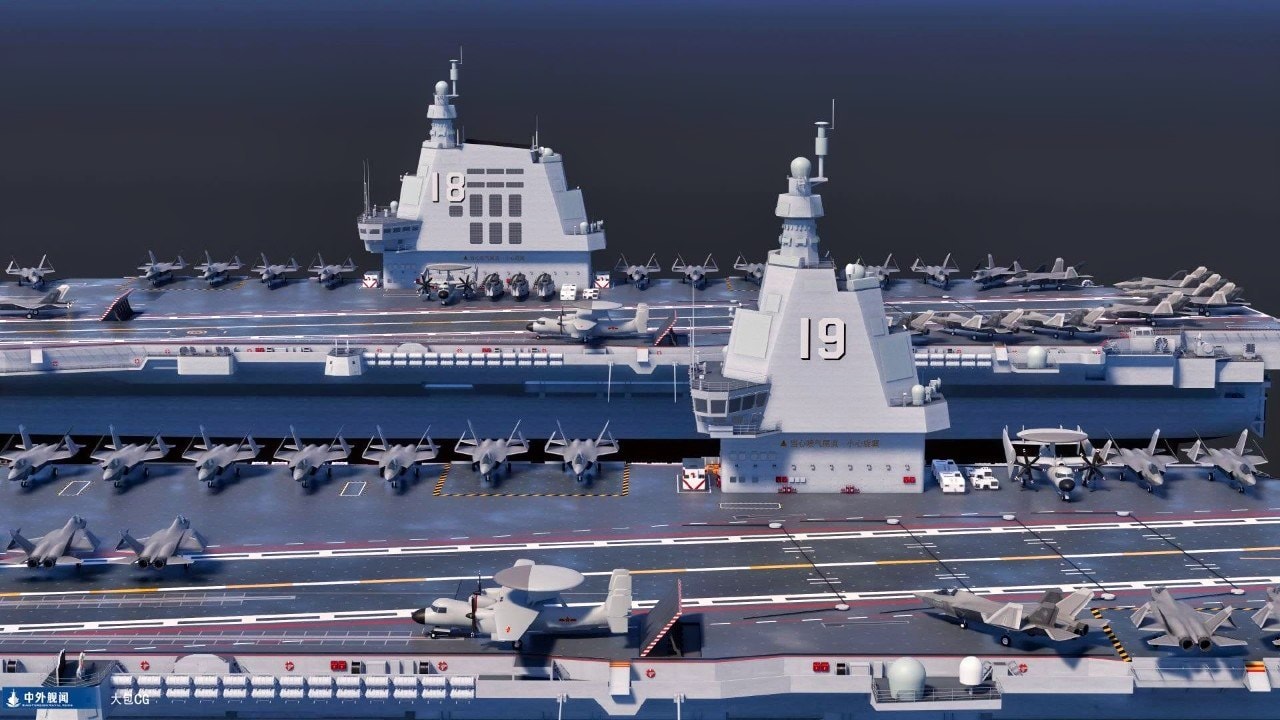
Summary and Key Points: The Pentagon’s latest unclassified assessment says the People’s Liberation Army Navy aims to produce six additional aircraft carriers by 2035, bringing the fleet to nine. China had three in commission as of July 31, 2026 — Liaoning, Shandong and Fujian, which entered service in November 2025 with electromagnetic catapults. A fourth carrier is under construction in Dalian. Naval News counted nine Type 903-series replenishment ships and two larger Type 901 fast combat support ships in service at the start of 2026.
Nine Chinese Aircraft Carriers Would Change the Indo-Pacific Before They Match the US Navy:
The Pentagon’s latest unclassified assessment says the People’s Liberation Army Navy aims to produce six additional aircraft carriers by 2035, bringing the fleet to nine. China had three carriers in commission as of July 31, 2026: Liaoning, Shandong, and Fujian.
Fujian entered service in November 2025 with electromagnetic catapults able to launch heavier aircraft than the ski-jump systems aboard China’s first two carriers. A fourth carrier is under construction at Dalian and will likely be larger and nuclear-powered, although Beijing has confirmed neither point.
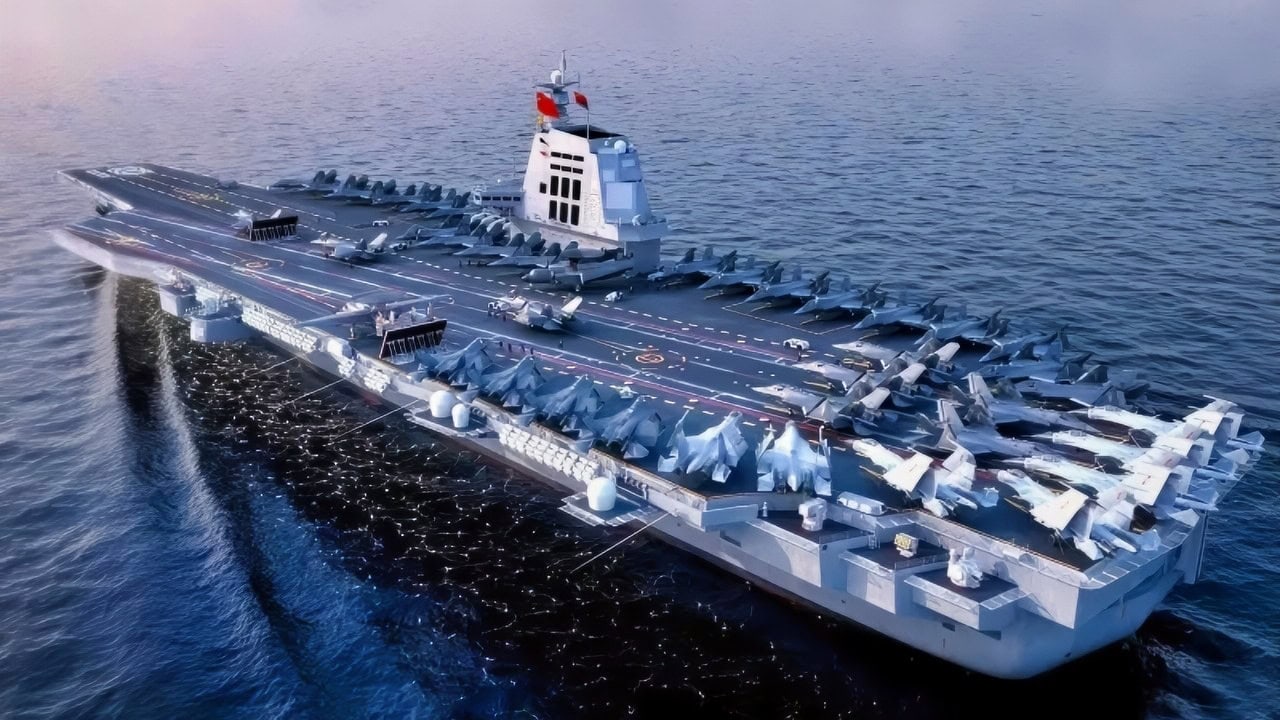
China Aircraft Carrier Mock Up Image.
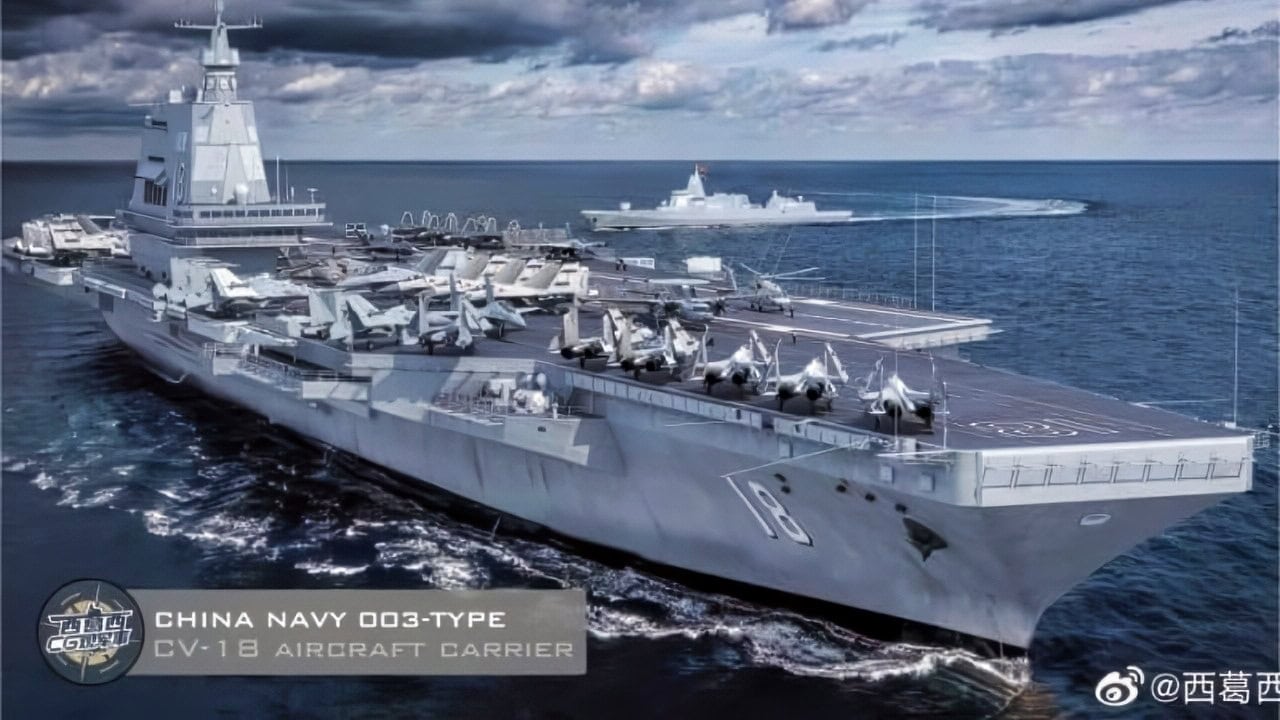
China Aircraft Carrier Type 003 Conventional Supercarrier. Image Credit: X Screenshot.
Nine hulls would not place nine strike groups at sea. Carriers rotate through maintenance, training, and deployment. A fleet of that size would still let China sustain several groups around Taiwan, the South China Sea, and the Western Pacific while retaining ships for training and repair.
That would alter the regional balance before China matched American carrier experience. The United States and its allies would have to monitor more areas and reserve more submarines, bombers, and long-range missiles for carrier tracking. China’s harder task is creating the air wings, crews, escorts, supply ships, repair system, and bases needed to turn nine decks into deployable formations.
Nine Carriers Would Make Chinese Naval Air Power Persistent
China is already increasing carrier activity. Japan’s Ministry of Defense counted five Chinese carrier deployments into the Pacific in 2025, up from two in 2022. Observed carrier-aircraft takeoffs and landings rose from roughly 320 to 1,460, and Liaoning and Shandong operated simultaneously on the Pacific side of Japan for the first time.
A larger fleet would provide the rotational depth behind the nine-carrier plan. Even with ships in overhaul or training, Beijing could place a group east of Taiwan, another in the South China Sea, and another farther into the Pacific without committing every available carrier. That would turn today’s episodic deployments into a continuing operational problem.
China already has land-based aircraft and missiles able to strike Taiwan from the west. Carriers matter most east of the island, where they could extend fighter cover, improve surveillance, and complicate the arrival of American and allied forces. The U.S. Navy maintains 11 carrier strike groups, including one in Japan, but those forces also cover other theaters.
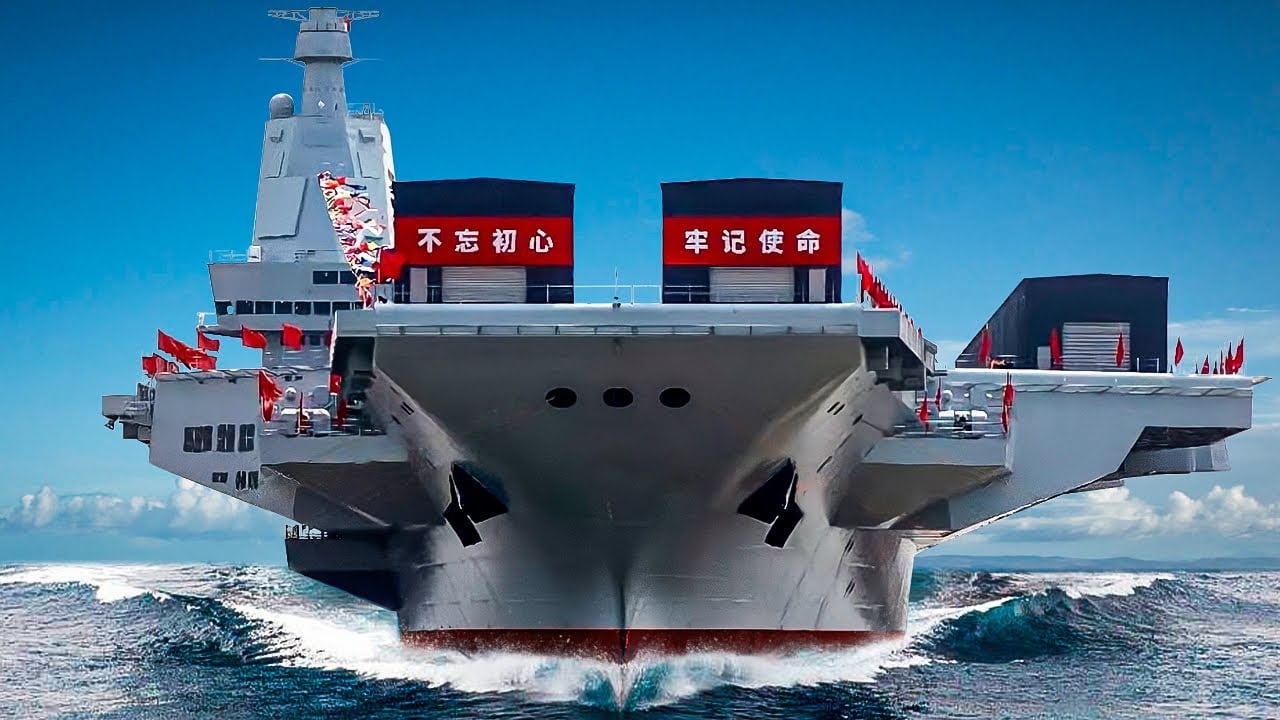
China Aircraft Carrier. Image Credit: YouTube Screenshot.
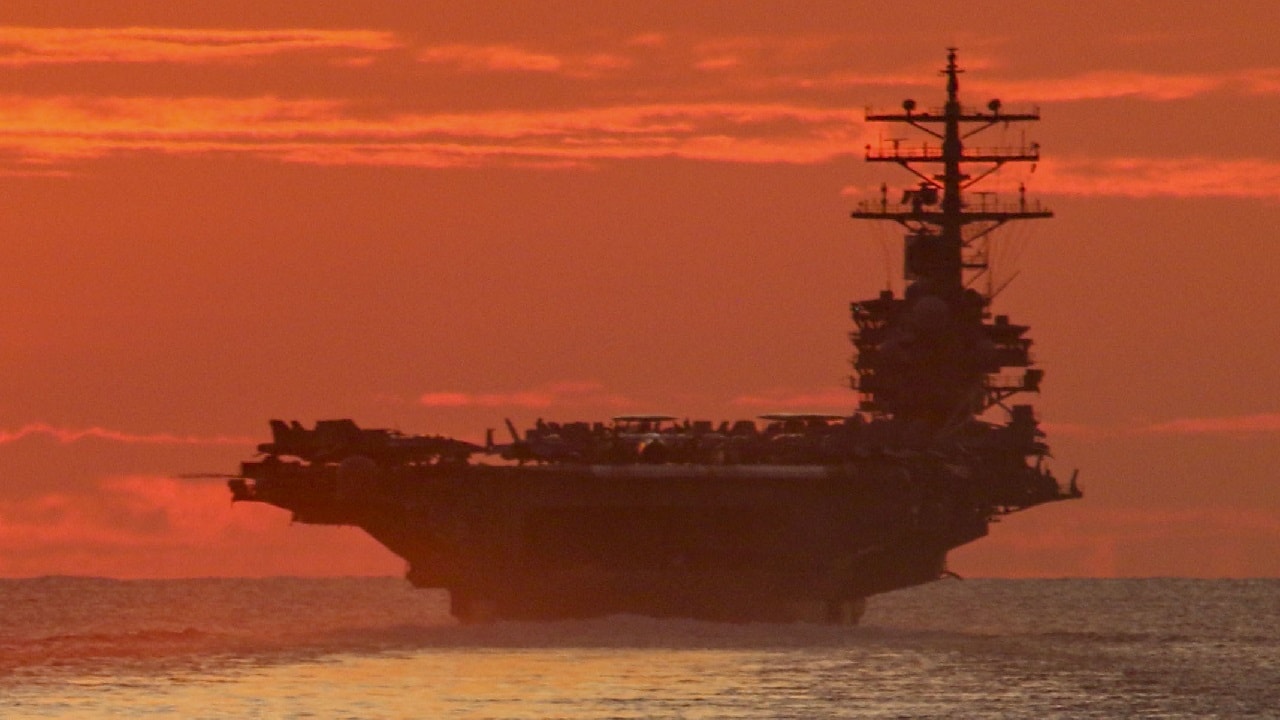
STRAIT OF MALACCA (June 18, 2021) The Navy’s only forward-deployed aircraft carrier USS Ronald Reagan (CVN 76) transits the South China Sea with the Arleigh Burke-class guided missile destroyer USS Halsey (DDG 97) and the Ticonderoga-class guided-missile cruiser USS Shiloh (CG 67). Reagan is part of Task Force 70/Carrier Strike Group 5, conducting underway operations in support of a free and open Indo-Pacific. (U.S. Navy Photo by Mass Communication Specialist 1st Class Rawad Madanat)
China Has to Build Air Wings as Fast as Hulls
Every carrier needs a complete carrier air wing, not a collection of parked fighters. The Pentagon expects Fujian’s air wing to include J-35 stealth fighters, J-15T multirole fighters, J-15D electronic-warfare aircraft, KJ-600 early-warning planes, Z-20 helicopters, and uncrewed systems. Each type requires pilots, maintainers, spare engines, weapons, and instructors.
The training pipeline is expanding. The International Institute for Strategic Studies reported in July 2026 that initial carrier-pilot training now appears to be conducted by China’s Naval Aviation University. That points to a direct pipeline rather than continued reliance on converting land-based pilots. It still takes years to qualify aviators for night operations, poor weather, aerial refueling, and repeated arrested landings.
China is also operating different carrier generations. Liaoning and Shandong use ski-jump launches, Fujian introduces catapults and fixed-wing early warning, and the Type 004 will likely add nuclear propulsion. The carrier experience gap will narrow only through repeated operations. Nine air wings would require hundreds of pilots and thousands of maintainers, controllers, deck personnel, and ordnance specialists, which is why the personnel requirement matters as much as the hull count.
Escorts and Replenishment Ships Are the Second Fleet
A carrier cannot defend itself across every threat axis. China needs Type 055 cruisers, Type 052D destroyers, frigates, attack submarines, and helicopters to protect each group against aircraft, missiles, and submarines. Those ships also have separate missions, leaving the escort requirement as another constraint.
Carrier-specific logistics remain limited. Naval News counted nine Type 903 and 903A replenishment ships and only two larger Type 901 fast combat support ships in service at the start of 2026. The Type 901 was designed mainly for carrier groups. The same assessment documented expanded berthing and maintenance infrastructure at Yulin on Hainan and Yuchi near Qingdao.
China is building a larger replenishment ship assessed as support for future carriers and bigger air wings. Such ships carry aviation fuel, precision weapons, aircraft parts, food, and ship fuel. Nuclear propulsion would remove the carrier’s propulsion-fuel requirement, but it would not fuel the escorts, refill magazines or sustain the air wing.
Homeports Are Expanding Faster Than Overseas Access
Yulin and Yuchi give China room to base several carriers and their escorts. Artificial-island facilities add airfields, berthing, missiles, and resupply inside the South China Sea. Those sites support operations close to mainland aircraft, sensors, and missile forces, but overseas access remains much thinner.
Farther west, China has a support base in Djibouti, while China and Cambodia opened a joint logistics and training center at Ream Naval Base in April 2025. Beijing is pursuing other forms of access, including facilities connected to commercial ports. Host governments would still control what those arrangements permit during a crisis.
A port visit is not the same as a defended naval base. A carrier group in the Indian Ocean needs secure communications, aviation ordnance, heavy repair, medical support and air defense. The Pentagon said China had not yet developed a systematic overseas command-and-control structure. The United States retains a deeper network through Japan, Guam, Australia, the Philippines, Singapore and Diego Garcia.
The Balance Would Shift Before China Equals American Carrier Skill
The United States would retain major advantages in nuclear propulsion, carrier aviation, airborne early warning, logistics, submarines, and allied basing. China would hold advantages of geography, shipbuilding capacity, and concentration. Its carriers would operate beside a large land-based missile and air force.
Nine carriers would force changes in American and allied planning. More submarines would be assigned to carrier hunting, Japan and the Philippines would need wider surveillance coverage, and Guam would face threats from mainland missiles and aircraft approaching from additional directions. Long-range anti-ship weapons, hardened fuel storage, and dispersed airfields would become more important.
CSIS assessed that China must build at least two carriers simultaneously to reach nine by 2035. The Type 004 remains several years from commissioning, and Fujian is still moving toward full combat readiness. Beijing has not disclosed the construction sequence, homeports or overseas support arrangements for the five carriers that would follow the Type 004.
About the Author: Harry J. Kazianis
Harry J. Kazianis (@Grecianformula) was the former Senior Director of National Security Affairs at the Center for the National Interest (CFTNI), a foreign policy think tank founded by Richard Nixon based in Washington, DC. Harry has over a decade of experience in think tanks and national security publishing. His ideas have been published in the NY Times, The Washington Post, The Wall Street Journal, CNN, and many other outlets worldwide. He has held positions at CSIS, the Heritage Foundation, the University of Nottingham, and several other institutions related to national security research and studies. He is the former Executive Editor of the National Interest and the Diplomat. He holds a Master’s degree focusing on international affairs from Harvard University.

