
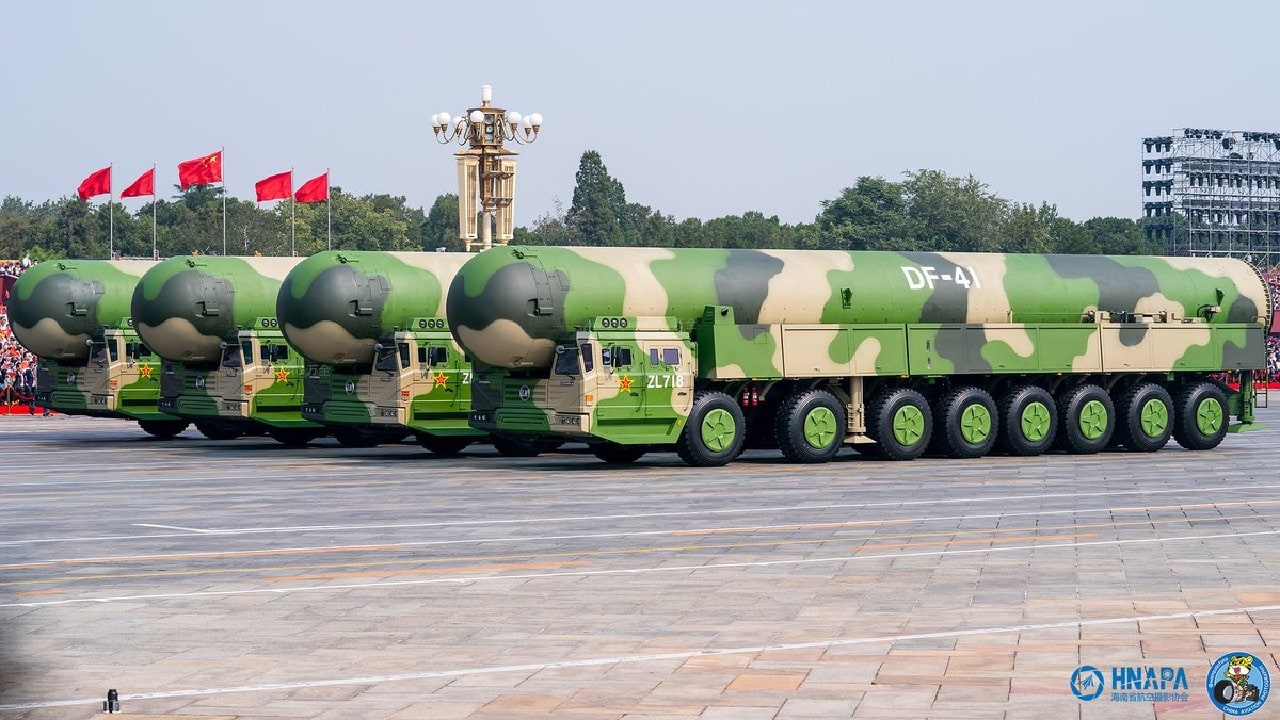
How Fast Is China Really Building Its Nuclear Arsenal? The Honest Answer, From 200 Warheads to 620 and Counting: China is expanding its nuclear arsenal faster than any other country on Earth, from roughly 200 warheads a few years ago to an estimated 620 today, with the Pentagon projecting more than 1,000 by 2030 and three vast new silo fields rising in its deserts. That much is established. But the honest answer to “how fast” is more interesting than the alarm suggests: the leading independent estimates cannot fully replicate the Pentagon’s numbers, the latest year’s growth may have slowed, and the scariest long-range projection has quietly vanished from the Pentagon’s own reports. Here is the full picture: speed, uncertainty, and what it means in the first year since 1972, with no treaty limiting anyone’s arsenal.
China’s Nuclear Arsenal Is Growing Fast: Why?
For half a century, China’s nuclear posture was the great exception among the major powers. While Washington and Moscow built tens of thousands of warheads, Beijing sat on a deliberately small force, roughly 200 warheads, for decades, enough, in its doctrine of minimum deterrence, to guarantee that any nuclear attack on China would be answered, and nothing more.
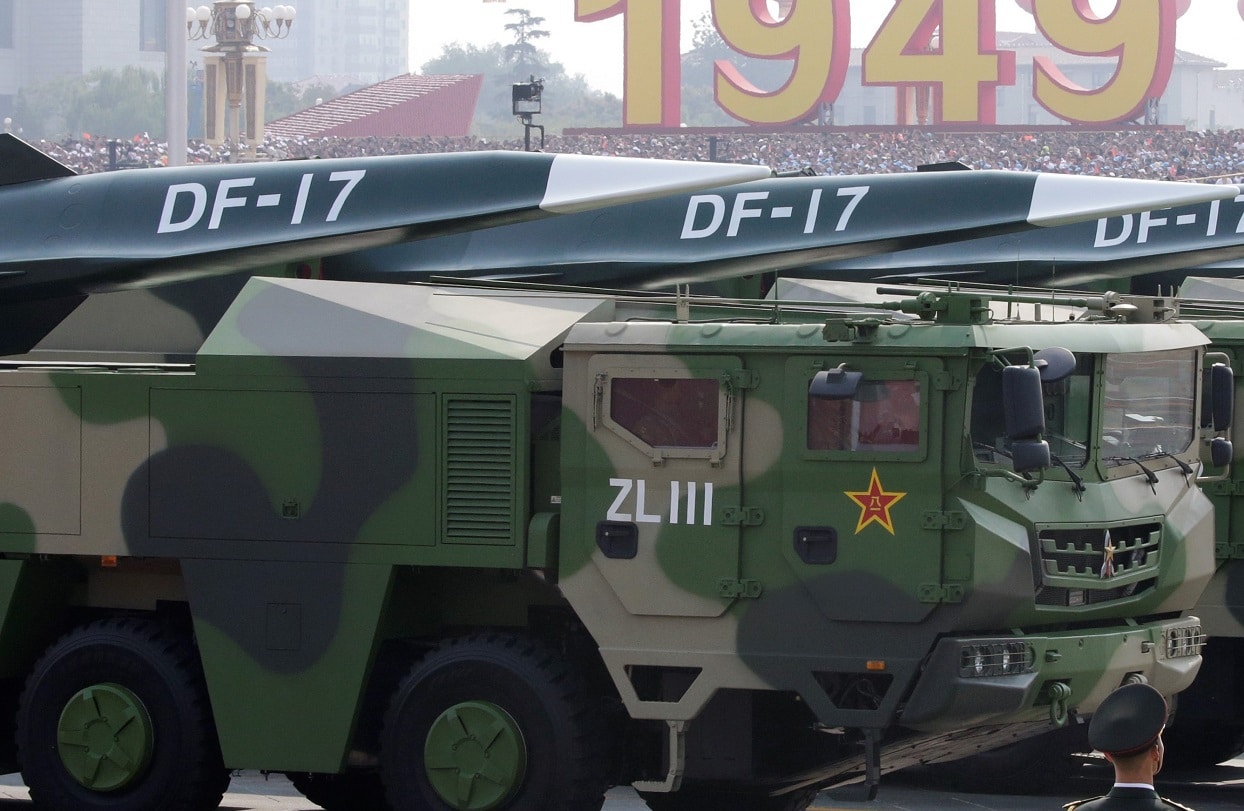
Image of DF-17 missile. Image: Creative Commons.
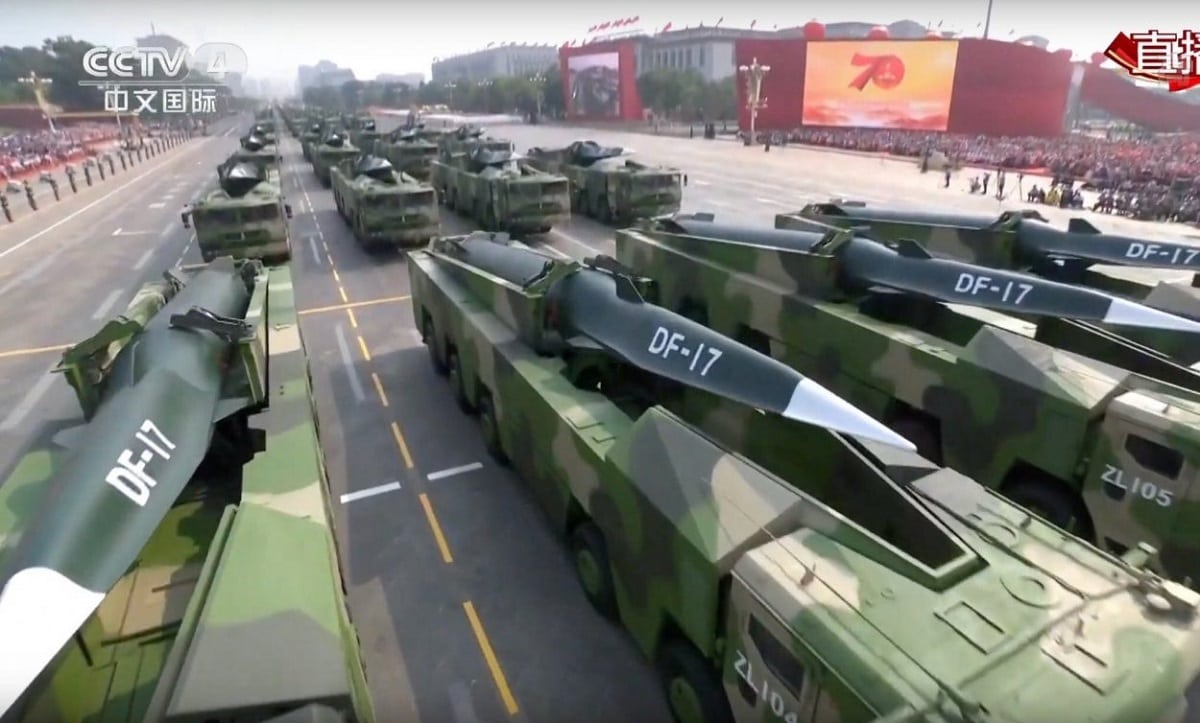
DF-17 Missiles
That era is over, and the speed of its ending is the most consequential shift in the global nuclear order since the Cold War. What follows is an attempt to answer the simple question of how fast China is building with the precision the subject deserves, because both the speed and the uncertainty are real, and most coverage honors only one of them.
The Numbers
Begin with the trajectory. In 2020, the Pentagon estimated China’s stockpile in the low 200s and predicted it would at least double within the decade, a forecast that seemed bold at the time and proved conservative. By January 2024, the Stockholm International Peace Research Institute put the arsenal at about 500. By January 2025, roughly 600. And in its 2026 Yearbook, released June 8, SIPRI estimates approximately 620 warheads, making China the fastest-growing nuclear arsenal among the world’s nine nuclear-armed states for the third consecutive year.
The Federation of American Scientists’ Nuclear Notebook on Chinese forces, the canonical open-source assessment, published its updated edition just nine days ago and lands on the same figure, roughly 620, with more warheads in production for delivery systems still being fielded. The sustained rate has averaged 80 to 100 new warheads a year since 2023, a pace no other country approaches. For scale, China already fields more warheads than Britain and France combined, and the Pentagon’s annual China military power report, which counted more than 600 operational warheads as of mid-2024, projects the arsenal will surpass 1,000 by 2030, a finding Beijing’s defense ministry dismissed as hype while declining to offer any figure of its own.
The Silos
The most visible artifact of the sprint is poured in concrete. Beginning in 2021, commercial satellite imagery revealed China constructing what amounts to a new strategic geography: by early 2025, roughly 350 new intercontinental ballistic missile silos will be completed or nearing completion across three large desert fields in the country’s north, near Yumen, Hami, and Ordos, plus three smaller complexes in mountainous areas to the east.
By this January, SIPRI assesses, China had loaded hundreds of missiles into the northern fields while finishing the eastern sites, and its bottom line deserves to be read twice: depending on how it structures its forces, China could have “at least as many ICBMs as either Russia or the USA” by the turn of the decade.
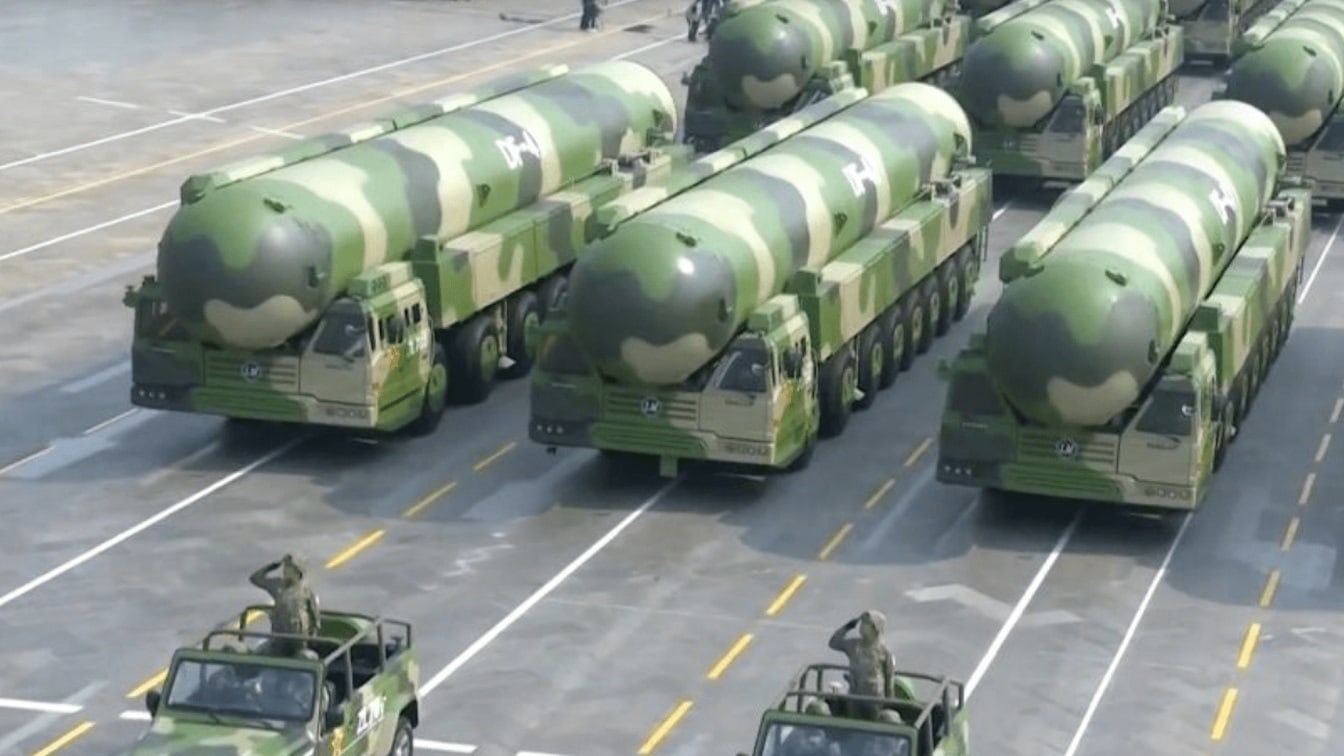
DF-41. Image Credit: Creative Commons.
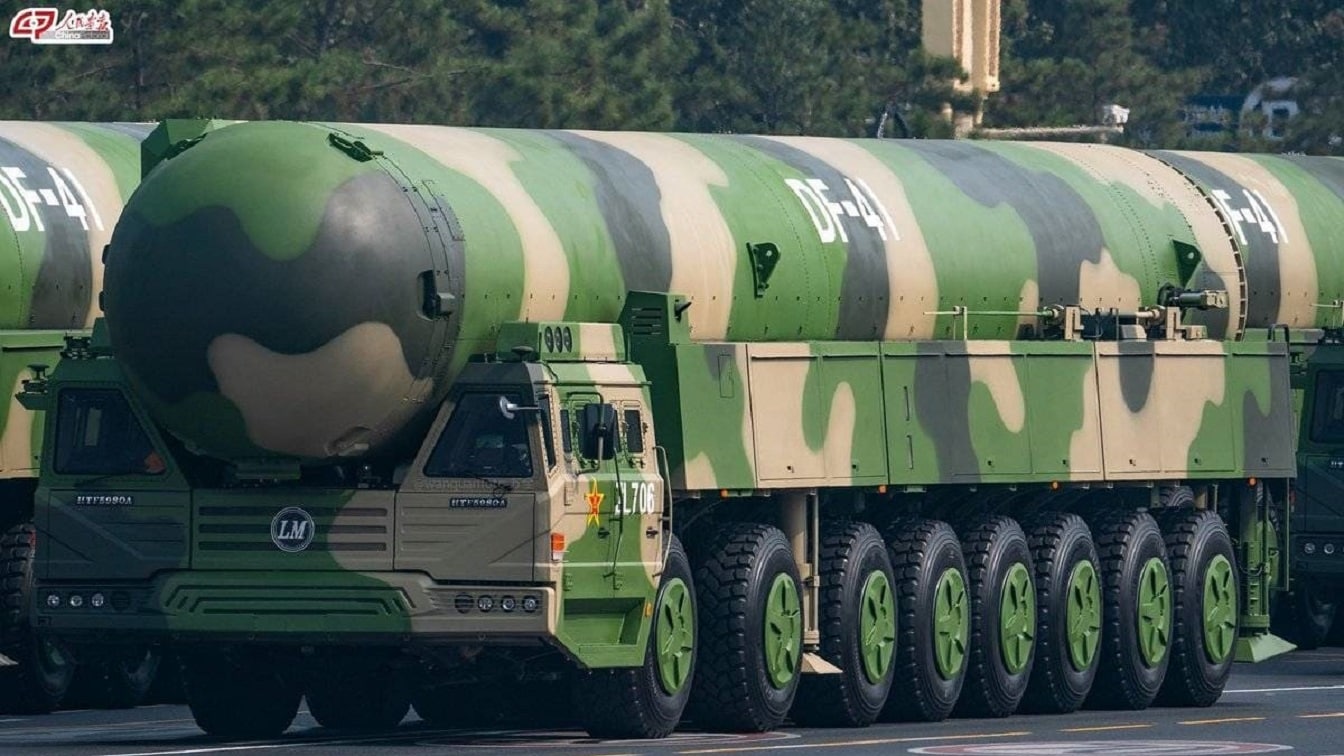
DF-41. Image Credit: Chinese Internet.
The buildout is qualitative as well. China has completed a genuine triad: the road-mobile DF-41 ICBM alongside the silo fields, the JL-3 submarine-launched missile now fully replacing the shorter-ranged JL-2 aboard its ballistic-missile submarines, per the Pentagon, and the H-6N bomber restoring an air leg, with new systems paraded through Beijing last September. The FAS researchers note a July 6 test that flew a JL-2 to its maximum range for the first time, and Western assessments describe a broader shift toward higher readiness, including the early-warning and launch-on-warning capabilities that a large silo force implies. This is not a bigger version of the old minimum deterrent. It is a structurally different force.
How Fast, Really?
Here is where an honest piece has to slow down because the estimates themselves disagree, and that disagreement is instructive. Three wrinkles, all from the primary sources rather than from skeptics.
First, the counting problem. The FAS Notebook states plainly that it cannot replicate the Pentagon’s warhead estimate from China’s reported and observable force structure unless it assumes warheads have already been loaded into a significant number of the new silos, an assumption satellites cannot confirm. Silos are visible from space; what sits inside them is not. The gap between “silos built” and “warheads fielded” is exactly where the Pentagon’s larger numbers and the independent trackers’ smaller ones diverge.
Second, the rate question. SIPRI’s own year-over-year increment tells a subtler story than the headlines: after two consecutive years of roughly 100-warhead jumps, its latest estimate rose by just 20, from 600 to 620. That could mean the sprint is flattening as delivery systems outpace warhead production, or simply that conservative counters are waiting for evidence before crediting more. Either way, “100 a year, forever” is an extrapolation, not an observation.
Third, and almost never reported: the Pentagon’s scariest number has quietly disappeared. Its 2022 report famously projected that China could field about 1,500 warheads by 2035, a figure that reorganized the entire Washington debate. The FAS researchers note that the Pentagon’s three most recent annual reports, including the latest, have all declined to repeat it.
The 1,000-by-2030 projection remains; the 1,500 endpoint has been allowed to lapse without explanation. None of this means the buildup is exaggerated in kind; the silos are real, the systems are real, and the direction is unambiguous. It means the honest range for “how fast” runs from the independently observable, about 620 and climbing, to the officially projected, 1,000-plus within four years, and that certainty about the upper bound is thinner than the discourse admits. For proportion, it also remains true that SIPRI counts a global inventory of some 12,000 warheads, of which the United States and Russia still hold nearly nine in ten; China’s sprint is the world’s fastest from what remains, for now, a distant third place.
Why Beijing Is Sprinting
The motive question is contested among serious scholars, and the piece that the debate deserves presents the schools fairly. The security-dilemma school, well represented in the academic literature, argues there is little evidence China’s strategy has changed at all: the expansion is best explained as shoring up a survivable second-strike force against exactly the things Beijing has watched Washington build, ever-better missile defenses and precision conventional and nuclear counterforce weapons that could threaten a small arsenal’s ability to retaliate.
On this reading, China is late to a race others started. A second school, associated with Carnegie’s Tong Zhao, locates the driver in politics: Xi Jinping has tied nuclear weight to great-power status, and the choice to sprint via quickly built silo fields rather than slower, more survivable mobile systems suggests the leadership prizes rapid visible mass, with Zhao noting that reported quality scandals, “missiles filled with water,” silo lids that failed to open, hint at an industrial base straining against political deadlines. A third, harder-edged school, influential in Washington, reads the buildup as preparation to deter or defeat American intervention in Taiwan, or, worse, as a bid alongside Russia for combined advantage.
And within China itself, French analysts document a live three-way debate over the proper pace, from go-slow minimalists to sprint-to-parity advocates, evidence that the endpoint may be less fixed than any foreign projection assumes. Beijing’s official position, for the record, has not moved: it reiterates an unconditional no-first-use pledge and a force kept to the minimum required, and a recent Foreign Affairs analysis argues it is unlikely to abandon that pledge, precisely because Beijing believes its conventional forces increasingly carry the burden in East Asia.
Why It Matters Now
Whatever the motive, the arithmetic lands on Washington as a problem no American planner has faced before: two nuclear peers at once. A Lawrence Livermore study group concluded the United States should “plan and prepare to deploy additional warheads” in response, and the bipartisan Strategic Posture Commission reached similar conclusions, though the same FAS analysis that documents the buildup also cautions that the “two-peer problem” may be less qualitatively new than its loudest framings suggest. What is unambiguously new is the vacuum around it.
New START, the last treaty limiting US and Russian strategic forces, expired this February with nothing to replace it, meaning 2026 is the first year in more than five decades in which no arms-control agreement constrains any nuclear arsenal on Earth, at precisely the moment the fastest buildup since the superpowers’ own is pouring concrete in the Gobi. China, outnumbered many times over, refuses to join numerical talks; Washington and Moscow, unconstrained, are positioned to grow rather than cut. Every incentive now points in the same direction.
The Verdict
Both truths deserve the last word together. China’s nuclear expansion is real, historically fast, and strategically transformative: a tripling in under a decade, a completed triad, and a silo build that could put Chinese ICBM numbers alongside America’s and Russia’s by 2030. And the precise speed is less certain than the alarm implies: independent counters cannot verify the Pentagon’s totals, the latest yearly increment has shrunk, and the 1,500-warhead specter has slipped out of the Pentagon’s own reporting.
The things to watch are specific, whether evidence emerges that the silos are being loaded at scale, whether next year’s increments re-accelerate or keep flattening, and whether any arms-control channel reopens in the first fully unconstrained era since arms control began in the early 1970s. The sprint is not in doubt. Its finish line is, and on that uncertainty, a great deal of the world’s nuclear future now rests.
About the Author: Harry J. Kazianis
Harry J. Kazianis (@Grecianformula) was the former Senior Director of National Security Affairs at the Center for the National Interest (CFTNI), a foreign policy think tank founded by Richard Nixon based in Washington, DC. Harry has over a decade of experience in think tanks and national security publishing. His ideas have been published in the NY Times, The Washington Post, The Wall Street Journal, CNN, and many other outlets worldwide. He has held positions at CSIS, the Heritage Foundation, the University of Nottingham, and several other institutions related to national security research and studies. He is the former Executive Editor of the National Interest and the Diplomat. He holds a Master’s degree focusing on international affairs from Harvard University.