
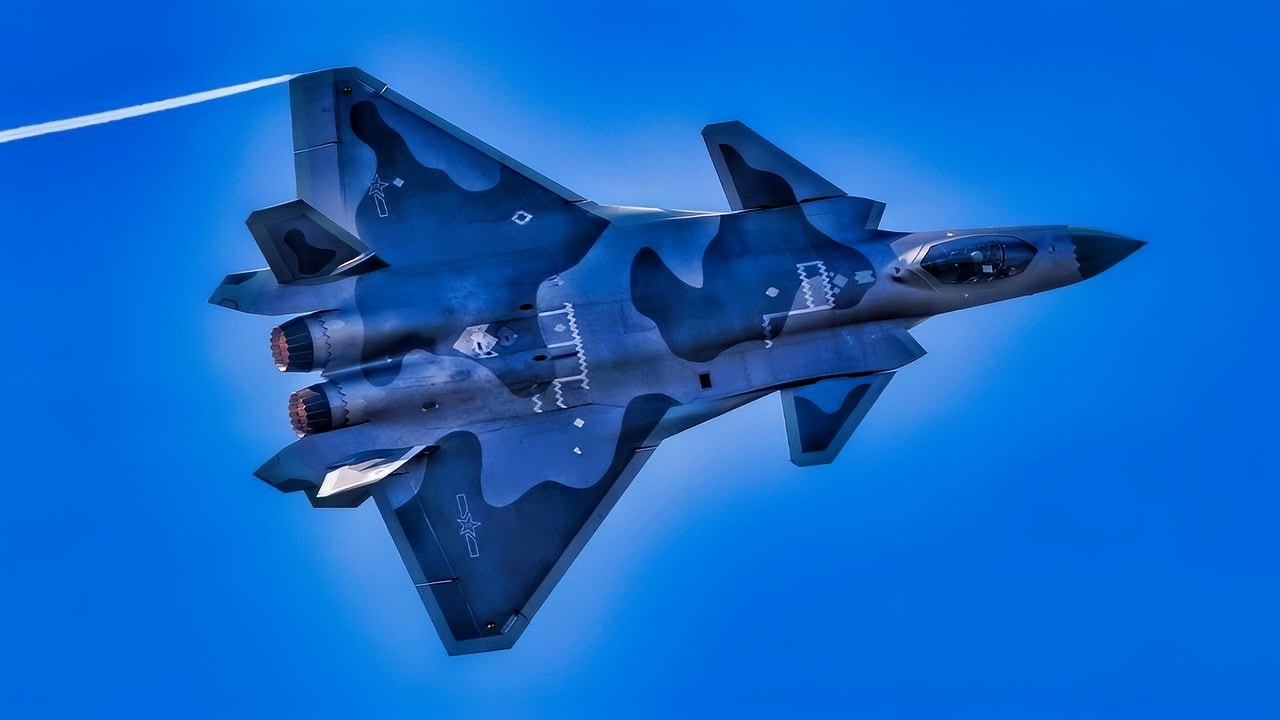
China is going all in on the J-20 Mighty Dragon. The People’s Liberation Army Air Force (PLAAF) may have as many as 500 stealthy fighters, and that number is going up each month.
The PLAAF loves the Mighty Dragon for its high speed, avionics, climbing ability, thrust, and radar evasion.
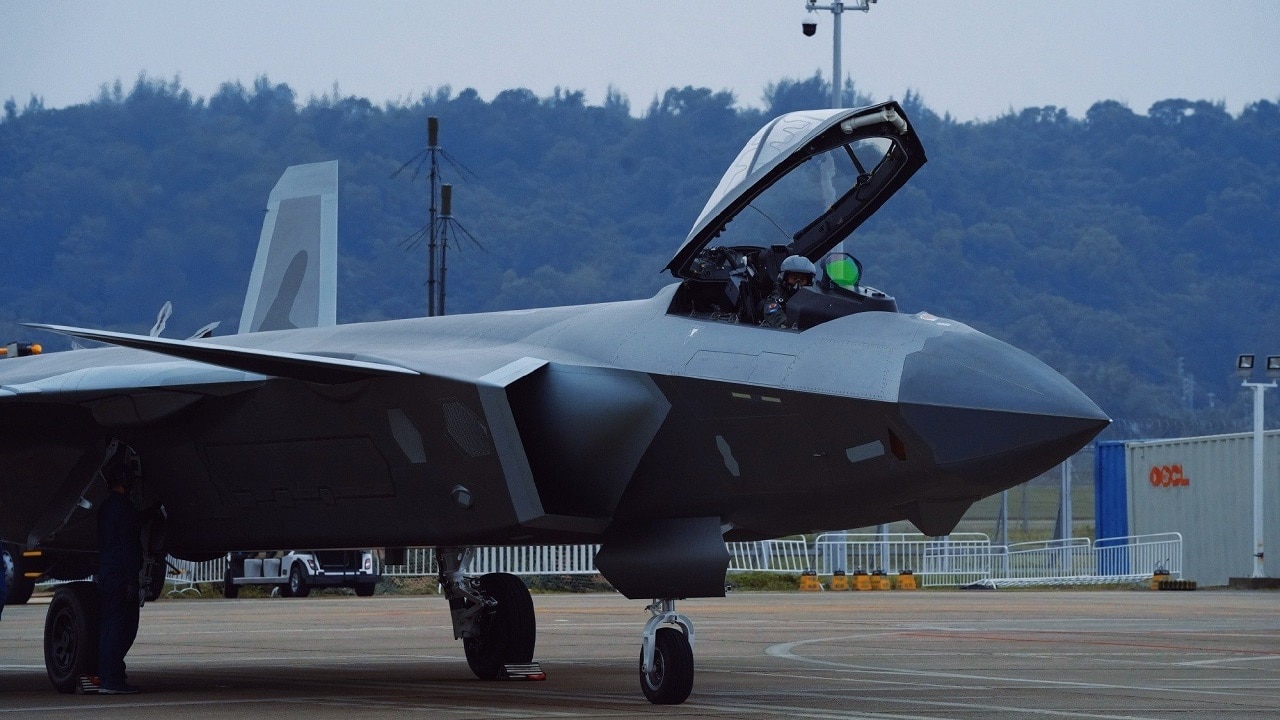
J-20 Creative Commons Photo.
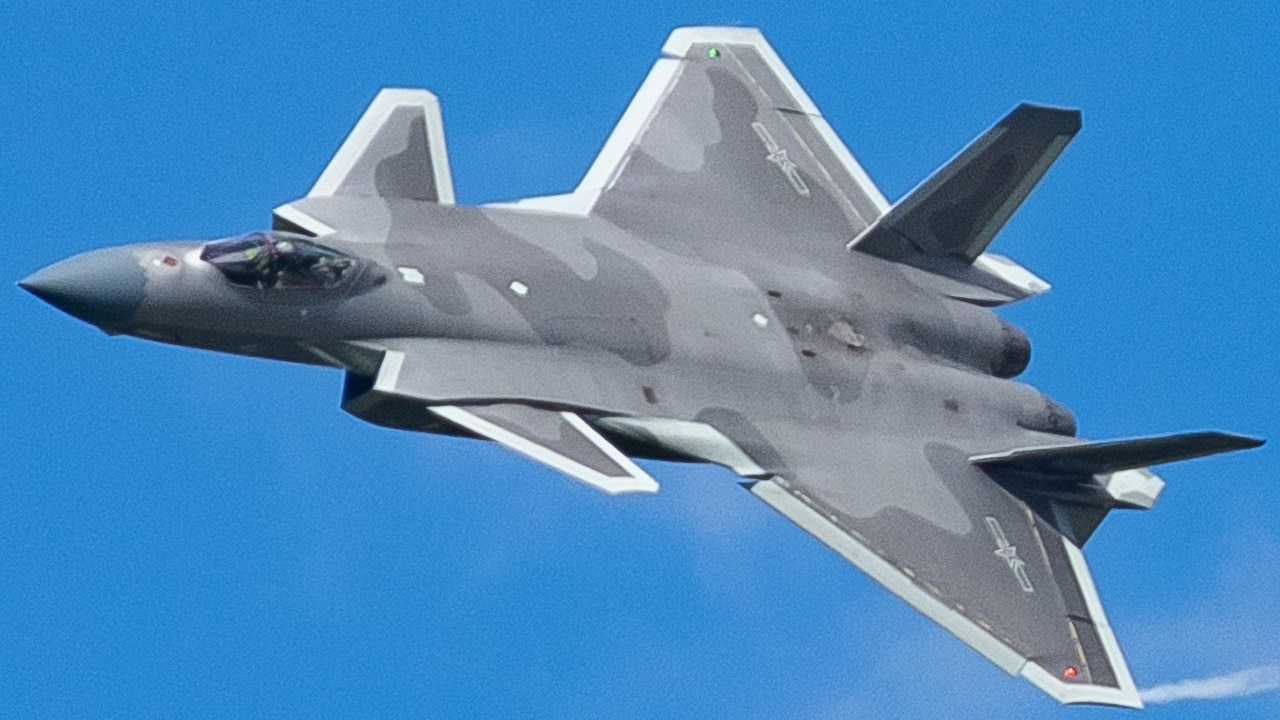
J-20 Fighter. Image Credit: Creative Commons.
While not as stealthy as the Americans’ F-35 and F-22, the J-20 is eclipsing the United States in numbers and perhaps even in pilot training one day.
Flying the J-20 in the Grey Zone
The J-20 is also chock-full of weapons and could pose a problem for U.S. strategy in the Indo-Pacific. Taiwan is also a conundrum.
The Chinese use grey zone warfare tactics in the Taiwan Strait. They send large numbers of fighter jets, including the J-20, and fly close to the island’s air defense identification zone. Meanwhile, the Chinese navy beefs up its presence near Taiwan.
China’s cognitive warfare is meant to psychologically torture Taiwan. They must deal with the constant fear of incessant J-20 deployments and are forced to scramble their own fighter jets in response.
The 80-20 Rule
Meanwhile, the United States is looking ahead to determine how it would address the high number of J-20s. This may be only an 80 percent solution for the Chinese versus the Americans.
Is the PLAAF Really That Good?
One reason for this lack of complete Chinese dominance is that PLAAF aviators have no combat experience.
One could argue that American pilots are battle-tested and better trained in real-world scenarios.
But the Chinese warplanes are now being flown in a more aggressive manner that could shock the Americans. The PLAAF has the numbers to be devastating in conflict.
Chinese Proxy Pakistan Believes Its Beijing-made Fighters Are Dominant
Even China’s non-stealth fighter jets are fighting well. A large dogfight in May 2025 between India and Pakistan featuring the Chinese-built J-10C flown by Pakistani pilots was a sight to behold.
Pakistan said it shot down at least one Dassault Rafale flown by India. New Delhi disputed this outcome vehemently and claimed its surface-to-air missiles eliminated a handful of J-10Cs instead.
While the outcome was uncertain depending on who you ask, one could conclude that the non-stealthy, older J-10C is still a prime instrument for Chinese allies.
Does this mean the J-20 could have the same success (or lack of success) in a dogfight? That depends on the Chinese aviator’s skill and expertise.
The PLAAF has come a long way since its pilots refused to fly in bad weather or at night 25 years ago.
China Flies in the Danger Zone Too
They have their own lengthy training periods with realistic one-on-one combat training scenarios. These aviators continue to improve, and rehearsals during grey zone tactics against Taiwan build expertise in flying under high pressure.
Authoritarian Capitalism Can Produce Many Fighter Jets
The J-20 had a surprisingly long development period. Introduced to the world in 2010, China’s fifth-generation fighter program is progressing well.
The program’s expense is immaterial to the PLAAF. There is no pesky Congress overseeing the program. Lawmakers in America poke and prod the F-35 and F-22’s cost overruns and delays.
Numbers are thus limited by budget constraints and manufacturing difficulty. Sometimes, defense acquisition in a centrally planned economy makes it easier to pump out airplanes.
This lack of government oversight can be problematic, though.
The J-20 lacks the stealth coatings and radar-absorbent materials of the F-22 and F-35.
The Americans believe they could easily down a single J-20. But what if you multiply that number by orders of magnitude? Could China produce double the number of J-20s by 2030? That is certainly doable.
This would mean that U.S. efforts in the Indo-Pacific must include allies such as Taiwan and Japan. These pilots would need to step up in an aerial shooting conflict with China as well.
Tying Up U.S. Carriers
China’s navy and coast guard are harassing the Philippines in the South China Sea, necessitating U.S. Navy carrier strike groups like the ships belonging to the USS George Washington, which has recently deployed near disputed islands close to the Luzon Strait.
The Chinese have thus tied up a U.S. carrier south of Taiwan. That keeps the number of F-35Cs and F/A-18 E/F fighter jets in a different part of the region.
The United States would need another carrier strike group north of Taiwan for sufficient deterrence. More U.S. fighters are required to challenge the J-20 flying from the Mainland.
F-15EX Eagle II Has an Answer
What about American non-stealthy fighters? The F-15EX Eagle II is being sent to Japan in greater numbers. This warbird is not fully radar-evasive, but it has fourth-generation “++” stealth features and could handle the number of J-20s quite well.
Thus, the United States is looking at a mix of aircraft during Day One and Day Two of a dogfight with China. This will increase the number of American jets available for aerial combat.
So the J-20 is an 80 percent solution for China. She clearly isn’t as good as the F-22 or F-35; however, she was never built to take on those fighters in a one-on-one matchup. The PLAAF can sustain huge losses, though, with 500 jets and perhaps 1,000 Mighty Dragons that could be built in the next four years.
China loves sheer numbers, and the U.S. Navy may not be able to keep enough carriers in the waters near China to match 500 J-20s.
That puts significant pressure on the U.S. Air Force and the new F-15EX to deliver the goods in the first 48 hours of warfare.
We’ll know quickly how American pilots react to the Mighty Dragon, and let’s hope they have the skill and expertise to overcome the high numbers of the J-20.
More: The F-22 Raptor Can’t Be Built Anymore
About the Author: Brent M. Eastwood, PhD
Brent M. Eastwood, PhD, has written over 3,500 articles on defense issues. He is the author of Don’t Turn Your Back On the World: A Conservative Foreign Policy and Humans, Machines, and Data: Future Trends in Warfare, plus two other books. Brent was the founder and CEO of a tech firm that predicted world events using artificial intelligence. He served as a legislative fellow for US Senator Tim Scott and advised the senator on defense and foreign policy issues. He has taught at American University, George Washington University, and George Mason University. Brent is a former US Army Infantry officer. He can be followed on X @BMEastwood.