
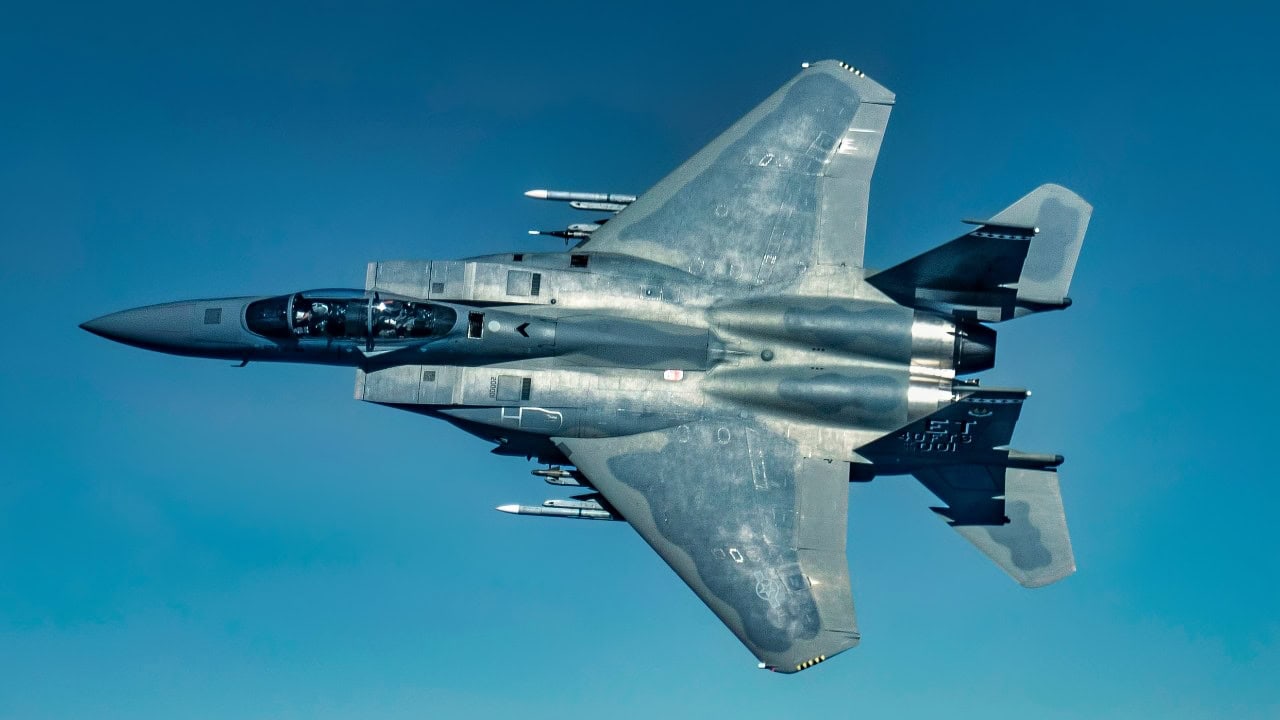
Riddle me this: Ask how many weapons the F-15EX Eagle II can haul, and you will get a different answer from every source: 12 hardpoints in one telling, 23 stations in another, 22 missiles in Boeing’s old marketing, numbers as high as 28 in the wilder renderings. This has honestly driven me crazy for years now. So, I decided to do a little deep dive.
All of them are describing the same airplane. This is my humble attempt at an audit of the most famous magazine in fighter aviation — what is structural, what has actually been demonstrated, and what was always a sales brochure of sorts.
The honest answer turns out to be better than the myth, because the proven number was enough to more than double the program. And that means Boeing has a clear winner in the F-15EX Eagle II.
Boeing F-15EX: The Airplane Under the Numbers
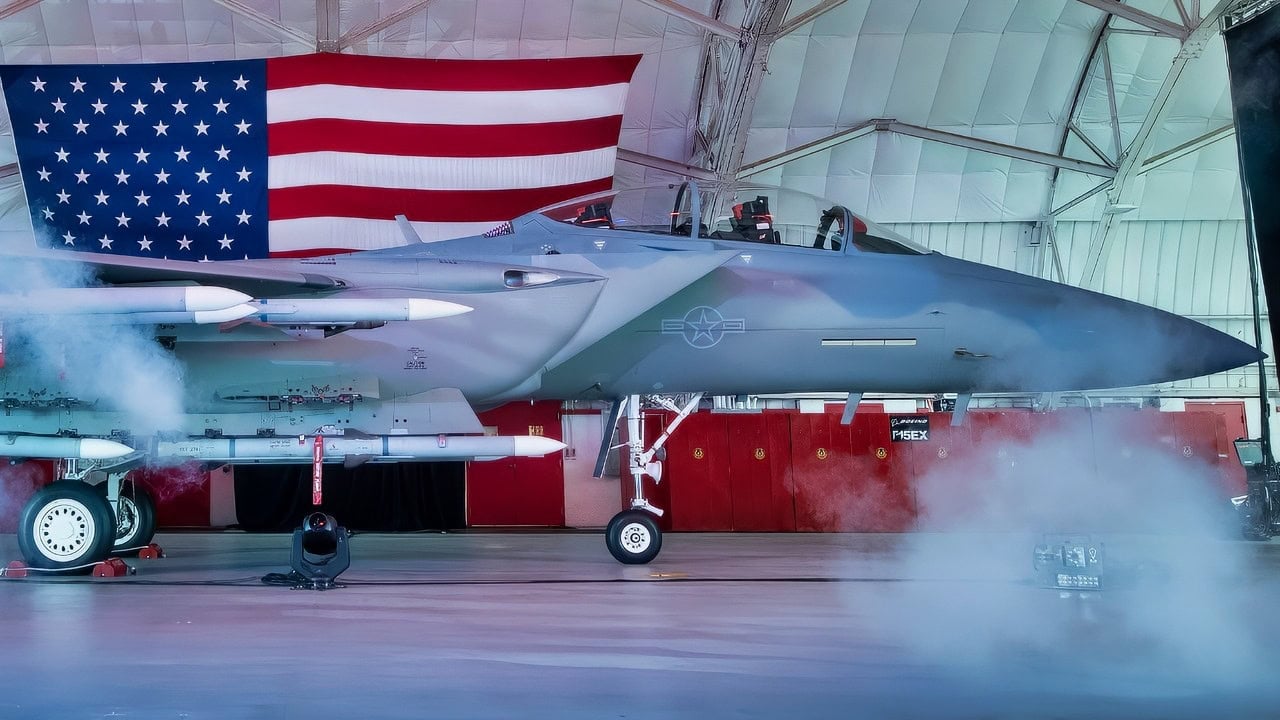
The Air Force’s newest fighter, the F-15EX Eagle II, was revealed and named during a ceremony April 7 at Eglin Air Force Base, Fla. The aircraft will be the first Air Force aircraft to be tested and fielded from beginning to end, through combined developmental and operational tests. (U.S. Air Force photo/Samuel King Jr.)

The F-15EX isn’t stealth, but it brings speed and massive payload—built for homeland defense, standoff strikes, and teaming with F-35s and drones.
A good place to start is with what is bolted to the jet. The Eagle II carries 23 external hardpoints in total, shared among weapons, fuel tanks, and targeting pods, under a payload ceiling of about 29,500 pounds, the highest weapons load of any American fighter by the manufacturer’s own accounting.
That is where the “23” figure comes from, and it is real, but it counts every attachment point on the aircraft. The missile arithmetic runs through a smaller set of stations, and the two most interesting ones have been hiding in plain sight for fifty years: stations 1 and 9, at the outer wings, were built into Eagles from the beginning but disabled because loading them risked aerodynamic flutter the old mechanical flight controls could not tame — a limit the EX’s digital fly-by-wire finally erased.
Freeing those stations is what moved the ceiling: the F-15C topped out at eight air-to-air missiles, four conformal and four underwing, and the two revived stations add four more, against six for an F-16 and eight for an F-22 in air-to-air trim.
The Number That’s Been Proven
Twelve is not a brochure figure, if you will; it has been fired. On November 29, 2022, two Eagle IIs of the 96th Test Wing flew out over the Gulf of Mexico and launched an AIM-120 AMRAAM from station 1 and an AIM-9X Sidewinder from station 9, the first live proof that the revived stations worked, in what the Air Force Materiel Command called a major step in demonstrating the jet’s missile capacity of 12.
Within a year, the full 12-AMRAAM loadout had been validated, and the test force had gone on to employ JASSM stealth cruise missiles from the same aircraft. And here is the detail that settles the argument: Boeing’s own official page today advertises “up to 12 AMRAAMs” — the seller itself has quietly settled on the demonstrated dozen.
The Marketing Numbers
So where did 22 come from? That took me a little time to track down.
From Boeing’s early sales pitch, the gap between the pitch and the purchase was documented in real time. When the Air Force announced the 12-missile tests, Air & Space Forces Magazine noted that Boeing “has previously advertised that the fighter can carry 22 air-to-air weapons,” that the Air Force’s armament center could not say whether that capability was even being acquired, and that Boeing did not respond to queries.
The 22-missile concepts relied on multi-missile rack arrangements that have never been fielded, and the figures as high as 28 that still circulate are the aggressive end of the same theoretical family.
The honest line is simple: nothing above twelve has ever been flown, bought, or demonstrated. Twelve is the record, and the record is enough, because no other fighter in the American inventory matches it. Again, Boeing has a winner on its hands.
The Stations No One Else Has
The air-to-air magazine is only half the audit.
In the strike role, the Air Force’s own reference spec credits the jet with a program of record that the fiscal 2027 request more than doubled, from 129 aircraft to 267, and the same spec lists a load of up to 24 air-to-ground munitions, from Small Diameter Bombs to JDAMs to JASSM.
And then there is the niche that explains the jet’s future better than any missile count: sheer size.
As the always-smart The War Zone put it when the Eagle II first crossed the Pacific, the EX’s ability to carry outsized weapons is well known, hypersonic missiles that are invariably bigger than anything a stealth jet’s internal bays can swallow, and the very-long-range air-to-air weapons the Pacific fight demands.
Boeing lists hypersonic carriage on the jet’s spec page outright. The doctrine follows from the hardware: the stealth fighters penetrate and sense, and the Eagle II hauls the magazine they cannot, lofting weapons from outside the threat rings the F-35s are busy mapping. That’s a heck of a one-two punch for sure.
The Magazine Won the Budget War
The proof that the load matters is what happened to the program. The F-15EX Eagle II began life planned at 144 aircraft, was slashed to 80 in 2022 when the Air Force wavered, crept back to 104 and then 129, and now stands at 267 in the latest budget, the rare fighter program that more than doubled on the argument of its weapons capacity alone. I honestly thing the Air Force should buy even more.
The jet crossed the Pacific for last summer’s REFORPAC exercise and operated there, by this site’s earlier reporting, with every hardpoint loaded, and Okinawa is next: 36 Eagle IIs will replace Kadena’s aging F-15C/Ds, a move slipped to next year by the Boeing strike, with the Air Force secretary telling Congress the first jets arrive in 2027 and the buildout finishes “by ’28 or ’29.”
The jet itself returned to Kadena on June 29 to keep the transition warm. The honest ledger stays honest: the Eagle II is not stealthy; it stayed home this spring when the stealth fleet opened the war over Iran, and the 22-missile poster jet was never purchased.
What was purchased, twice over, was the twelve-missile truck. And, again, that’s a powerhouse.
Boeing F-15EX Aerospace Bottomline
So the audited answer to the question is this: twelve air-to-air missiles, proven live; two dozen air-to-ground weapons on the books; nearly fifteen tons of total payload across 23 stations; and the one thing no count captures, the structural margin to lift the giant weapons, hypersonics and the coming very-long-range missiles, that no stealth bay on earth can hold.
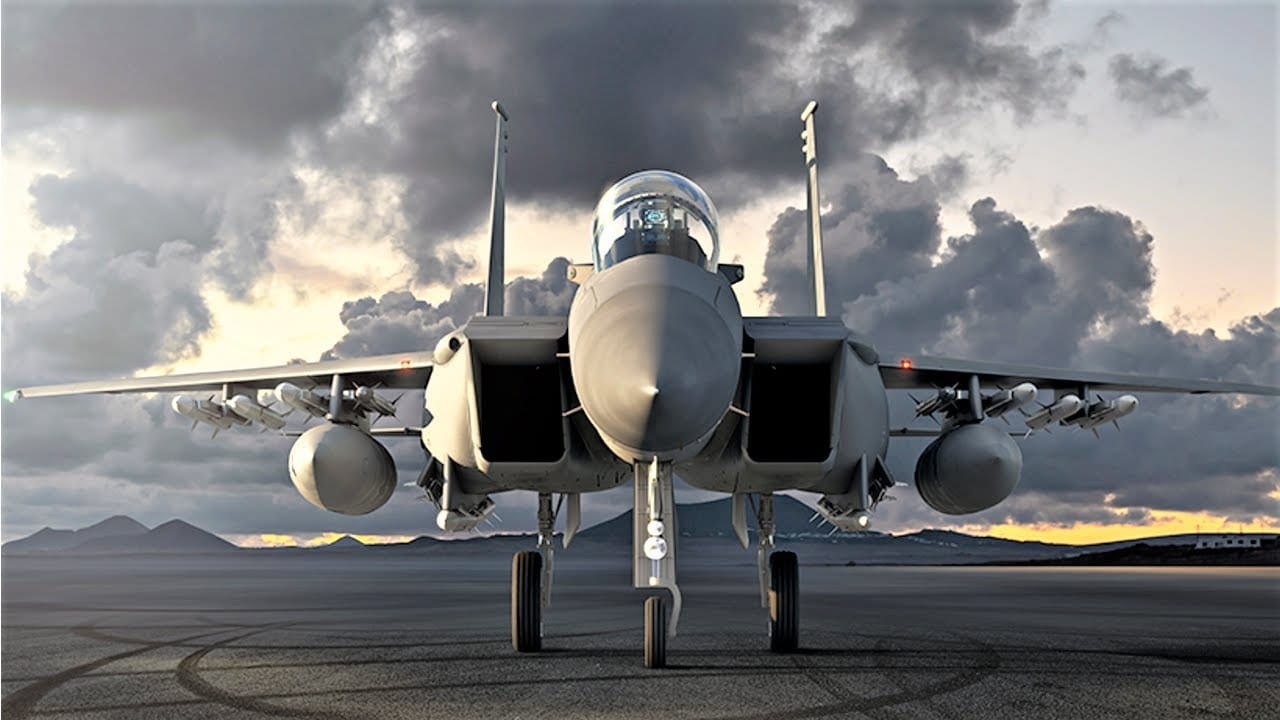
F-15EX Eagle II. Image Credit: Creative Commons.
The bigger numbers were always in the brochure.
The demonstrated dozen was the deal, and it turned out to be the best sales figure Boeing never advertised: enough to convince the Air Force, in an age of stealth, to double its order for a fifty-year-old silhouette with a brand-new magazine. And, again, I say that’s not enough.
About the Author: Harry J. Kazianis
Harry J. Kazianis (@Grecianformula) was the former Senior Director of National Security Affairs at the Center for the National Interest (CFTNI), a foreign policy think tank founded by Richard Nixon based in Washington, DC. Harry has over a decade of experience in think tanks and national security publishing. His ideas have been published in the NY Times, The Washington Post, The Wall Street Journal, CNN, and many other outlets worldwide. He has held positions at CSIS, the Heritage Foundation, the University of Nottingham, and several other institutions related to national security research and studies. He is the former Executive Editor of the National Interest and the Diplomat. He holds a Master’s degree focusing on international affairs from Harvard University.

