
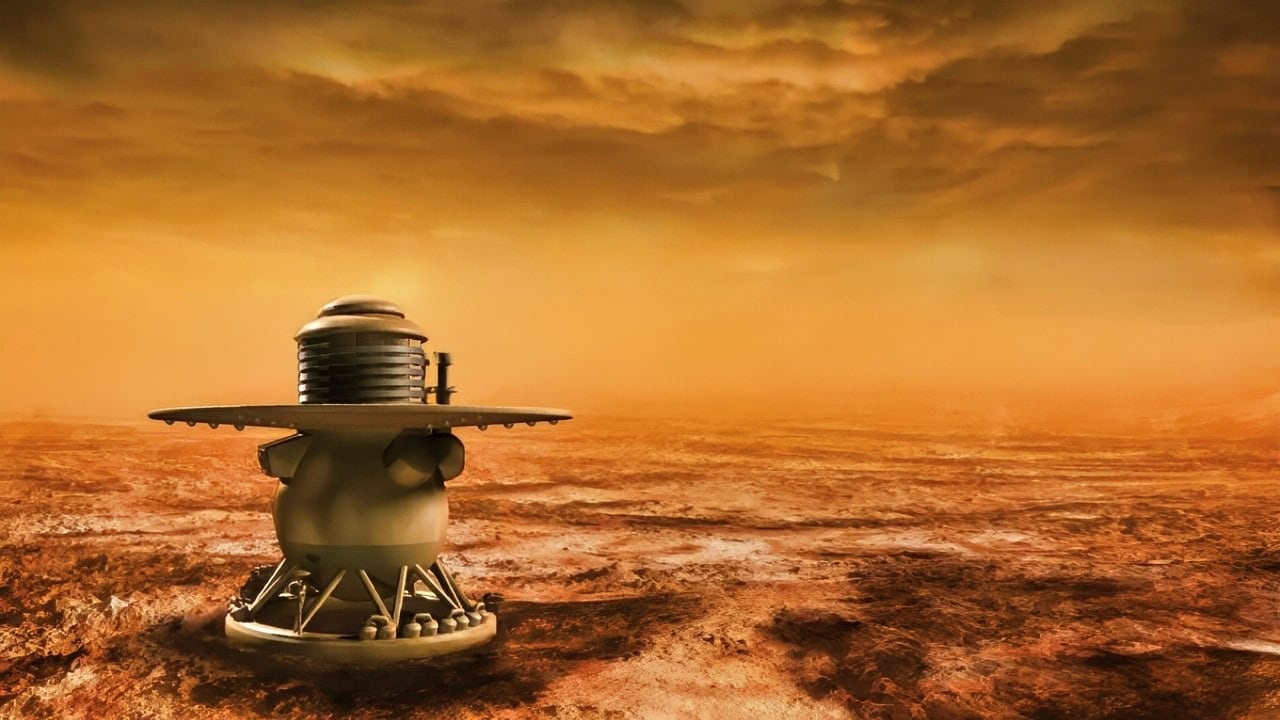
The story is true, and the photographs are sitting in NASA’s archive to prove it. On 5 March 1982, a Soviet lander called Venera 14 finished a four-month flight, fell through a cloud deck of sulfuric acid, and settled onto a plain of flat basalt in a place hot enough to melt lead and heavy enough to crush a submarine. It had been engineered to survive there for thirty-two minutes. It blew the covers off its cameras, photographed the horizon, then swung out a spring-loaded arm to test the hardness of the ground and pressed it firmly onto the lens cap it had just thrown away.
That is the part everyone remembers. The part almost nobody remembers is that the rest of the machine worked, and that what it measured in the hour it had left has never been matched by anyone since.
Space Shuttle Atlantis at Kennedy Space Center. Image taken by Harry J. Kazianis for 19FortyFive.
Venera 14 and Venus: The Hardest Place in the Solar System to Land
Venus is not difficult the way Mars is difficult. Mars is cold and thin and far, and a lander that arrives intact can work for years. The Moon is airless and still. Titan is frozen. Venus is the only surface in the solar system that cooks and crushes a machine at the same time.
The numbers explain the engineering. The surface temperature runs around 465 degrees Celsius, roughly 870 degrees Fahrenheit, hot enough to melt lead and hold it there. The atmospheric pressure is about 90 times Earth’s, the equivalent of standing roughly 900 meters beneath the ocean, approaching the crush depth of a military submarine. The air is 96.5 percent carbon dioxide, and the clouds overhead are sulfuric acid. Ten or so probes have ever reached that surface and returned data, all of them Soviet, all of them between 1970 and 1985, and the longest-lived of them lasted about two hours.
That is the environment the Venera 14 lander was falling into on the morning of 5 March 1982, and the reason its story is worth telling at greater length than the punchline allows.
Building a Thermos That Could Take Ninety Atmospheres
The engineers at the Lavochkin design bureau approached Venus less like spacecraft designers than like naval architects. The Venera landers were built as thick-walled, roughly spherical titanium pressure vessels, rated to withstand the external loads Venus would impose, wrapped in heavy thermal insulation, and topped with a heat shield. Inside sat a sealed instrument compartment.
The clever part was thermal, not structural. Before the descent vehicle separated from its carrier bus, the interior was pre-chilled to about minus ten degrees Celsius, and the compartment was packed with phase-change materials that would absorb heat as they melted, buying time, as an ice bath does. The whole design was a thermos flask with a laboratory inside, and the strategy was simply to start cold and race the heat inward.
Space Shuttle Atlantis at Kennedy Space Center. Image taken by Harry J. Kazianis for 19FortyFive.
The race could not be won. Everyone involved knew that. The only question was how many minutes of work the lander could extract before the Venusian atmosphere conducted enough heat through the insulation to push its electronics past their limits. The formal design life on the surface was thirty-two minutes. That figure was not a conservative floor set by cautious managers; it was a thermal calculation, the honest estimate of how long the physics would allow.
Every instrument had to be designed around that same constraint. The cameras had to scan and transmit quickly. The soil analysis had to happen in minutes, not hours. There was no possibility of a second attempt at anything, because there would be no repair and no rescue, only a slow rise in internal temperature until the machine stopped.
Twins, Five Days Apart
The Soviets did not send one of these. They sent two identical spacecraft, launched five days apart in late 1981 to exploit that year’s Venus window, each with an on-orbit dry mass of 760 kilograms. Venera 13 lifted off on 30 October, Venera 14 on 4 November, and both cruised for four months.
The descent was violent and counterintuitive. The landers hit the upper atmosphere at roughly eleven kilometers per second, shed most of that speed through aerobraking behind their heat shields, then deployed parachutes through the sulfuric acid cloud deck. And then, at about fifty kilometers altitude, they cut the parachutes away deliberately. Below that height, the atmosphere is so thick that a disc-shaped aerodynamic brake around the lander’s body provided all the drag needed for a survivable touchdown, and every extra minute spent drifting slowly through the hot lower atmosphere was a minute of the thermal budget burned before the science could begin. On Venus, you release the parachute in order to fall faster, because arriving sooner means working longer.
Space Shuttle Atlantis at Kennedy Space Center. Image taken by Harry J. Kazianis for 19FortyFive.
Venera 13 touched down first, on 1 March 1982, just east of a highland region called Phoebe Regio, and its site turned out to be a mix of flat platy rock and dark, fine-grained soil. Venera 14 landed four days later, about 950 kilometers to the southwest, on a basaltic plain.
What Venera 14 Found, and What It Measured Instead
The sequence on the surface was choreographed and fast. Pyrotechnic charges blew the protective covers off the camera windows, the panoramic telephotometers began their slow scans of the horizon, and the mechanical arm, spring-loaded, swung down to press into the ground and measure how much the surface compressed under load, a proxy for its bearing strength and structure.
The terrain Venera 14 photographed was different from its twin’s: flat, layered slabs of basalt-like rock with very little of the fine material that carpeted Venera 13’s site. Those images survive in NASA’s own catalog, where one frame is captioned as showing a lens cover near its center, and the other shows the test arm extended toward the surface.
Which is where the famous thing happened. The ejected cap had come to rest precisely where the arm was designed to touch down. The arm descended, pressed, and dutifully returned a clean, well-behaved measurement of the compressibility of its own discarded lens cover. The mechanical properties experiment, one of the mission’s objectives, yielded data on a piece of Soviet hardware on Venus rather than on Venus itself.
Proportion matters here because the joke tends to swallow the mission. The cameras worked. The chemistry worked. The lander survived somewhere between fifty-seven and sixty minutes, comfortably past its design life, and returned panoramas that remain among the only photographs ever taken from the surface of that planet. One instrument out of a suite was defeated by a piece of falling equipment. Everything else on a machine sitting inside a lead-melting oven did its job.
The Rocks That Are Still the Only Rocks We Have
The instrument that mattered most was the drill, and it deserves more attention than the arm that failed. Each lander carried a pyrotechnically driven boring device that ground into the surface, lifted a sample, and passed it through a sealed airlock into an internal chamber held at about thirty degrees Celsius and 0.05 atmospheres, a pocket of near-laboratory conditions maintained a few centimeters from an environment at ninety atmospheres and 465 degrees. Inside that chamber, an X-ray fluorescence spectrometer analyzed what the drill had brought in.
Space Shuttle Atlantis at Kennedy Space Center. Image taken by Harry J. Kazianis for 19FortyFive.
Both landers succeeded, and the results were not identical, which is the scientifically interesting part. The sample at Venera 13’s site came back as a potassium-rich alkaline basalt, classified in the literature as a weakly differentiated melanocratic alkaline gabbroid, broadly comparable to terrestrial leucitic basalts. Venera 14’s sample, 950 kilometers away, was closer to the tholeiitic basalts that floor Earth’s ocean basins. The results were published in 1984 in the Journal of Geophysical Research by a team led by Yuri Surkov of the Vernadsky Institute, and they established something no photograph could: that the Venusian crust is volcanic, and that its composition varies from place to place, exactly as a geologically active planet’s should.
Venera 13 outlasted its twin, working for two hours and seven minutes against a thirty-two-minute design life, returning a sequence of panoramas that became the first color photographs taken from the surface of another planet, along with the first acoustic recordings ever made on another world, a story told in its own right elsewhere on this site. But the chemistry is the part that has aged best. Decades later, reviews of Venus surface science still note the same uncomfortable fact: every direct, in-place measurement of the composition of Venusian surface material comes from these Soviet landers and the Vega probes that followed in 1985. There is no other dataset. There has not been a new one in forty years.
The Lens Cap’s Second Career, as a Venusian Scorpion
The cap has one more chapter, and it is stranger than the first.
In 2012, thirty years after the landing, a Russian planetary scientist published a paper arguing that the Venera imagery contained evidence of life, pointing to shapes in the frames that he described as living objects, including one he likened to a scorpion. The claim traveled quickly. It also collapsed quickly. When specialists examined the original data, the “creature” turned out to be an artifact of image processing, described by the researcher who reprocessed the archives as processed noise not present in the original frames. And the mysterious half-circle objects visible in several of the panoramas, the ones that had long puzzled casual viewers, were identified as exactly what they were: the ejected lens caps, including the one that had landed under Venera 14’s soil-testing arm.
Space Shuttle Atlantis at Kennedy Space Center. Image taken by Harry J. Kazianis for 19FortyFive.
So the cap ruined an experiment in 1982 and impersonated an alien in 2012. It is probably the most consequential piece of discarded hardware in the history of planetary science.
Why 1982 Is Still the Best Data Anyone Has
Nothing has landed on Venus since the Vega probes in 1985. That is the context that turns a forty-year-old mission from a curiosity into a working reference. When planetary scientists model the Venusian crust, they are still calibrating against numbers produced by two Soviet machines over a combined three hours of operation.
The return is coming, slowly and expensively. NASA’s VERITAS orbiter, a radar mapper built to see through the clouds, and its DAVINCI mission, an orbiter plus a descent probe aimed at the Alpha Regio highlands, will together be the first U.S.-led missions to Venus since Magellan three decades ago, with the European Space Agency’s EnVision orbiter, a roughly €610 million mission slated to fly on an Ariane 6, filling out what researchers have called a decade of Venus.
Getting all three there is not guaranteed. VERITAS was ordered to stand down in fiscal 2024 and slipped three years while NASA addressed workforce problems at the Jet Propulsion Laboratory, and it is now working toward a launch no earlier than 2031. The fiscal 2026 appropriation gave NASA’s planetary science division $2.54 billion, more than the administration had proposed but roughly $200 million below the prior year, with DAVINCI receiving $99 million to continue and VERITAS, in the words of one program official quoted this spring, “ramping up slowly.” EnVision, meanwhile, has a hard deadline: miss its window by 2033, and planetary alignment pushes it back at least three more years.
When DAVINCI’s probe finally falls through those clouds sometime in the next decade, its instruments will be checked against the ground truth that came back in March 1982, from two titanium thermos flasks that were supposed to last half an hour, one of which spent part of its brief life carefully measuring a lens cap.
About the Author: Harry J. Kazianis
Harry J. Kazianis (@Grecianformula) was the former Senior Director of National Security Affairs at the Center for the National Interest (CFTNI), a foreign policy think tank founded by Richard Nixon based in Washington, DC. Harry has over a decade of experience in think tanks and national security publishing. His ideas have been published in the NY Times, The Washington Post, The Wall Street Journal, CNN, and many other outlets worldwide. He has held positions at CSIS, the Heritage Foundation, the University of Nottingham, and several other institutions related to national security research and studies. He is the former Executive Editor of the National Interest and the Diplomat. He holds a Master’s degree focusing on international affairs from Harvard University.