
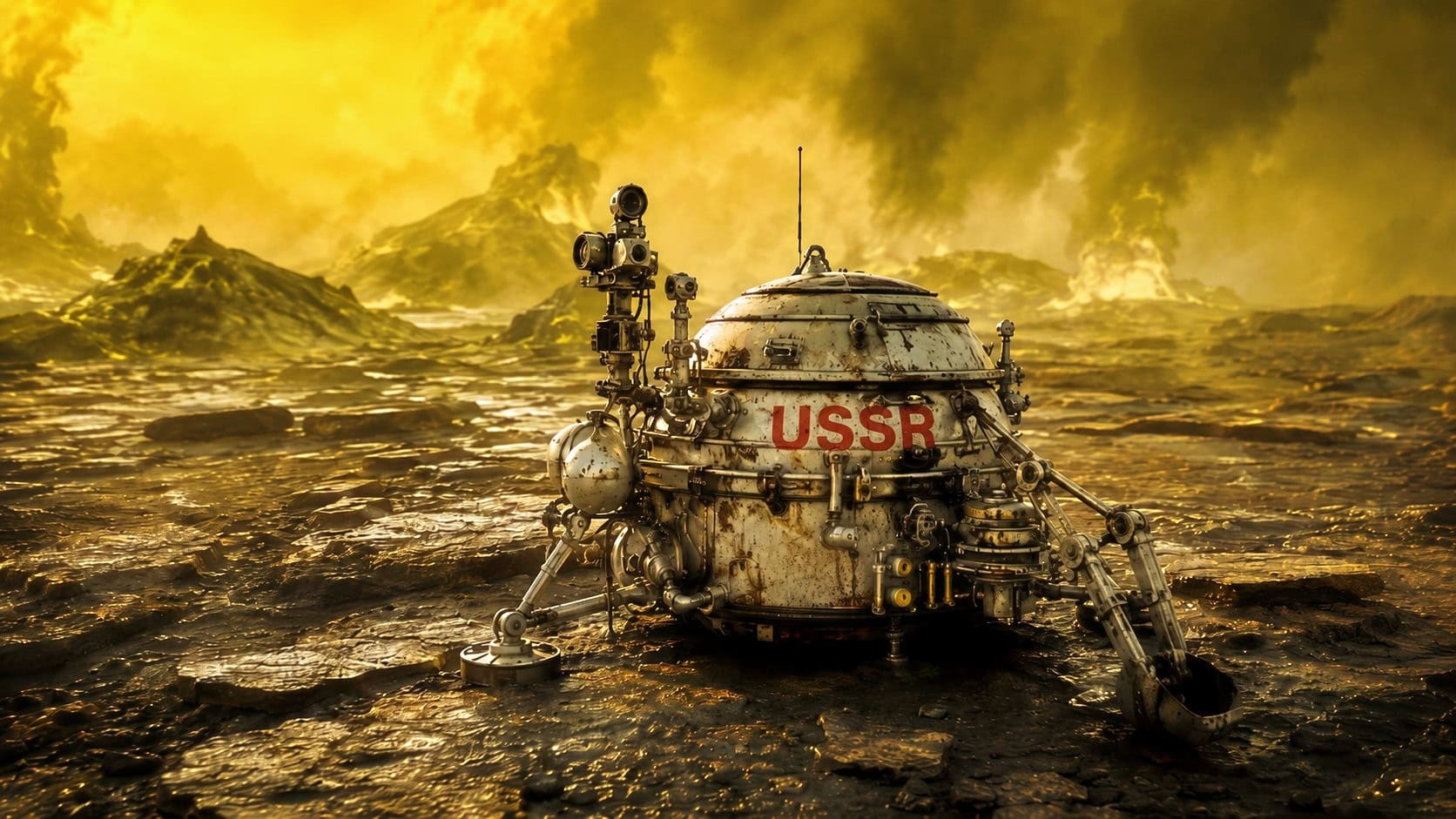
Exploring Venus is extremely challenging. A landing probe or lander must withstand crushing pressure, with atmospheric pressure roughly 90 times Earth’s, equivalent to being 1 kilometer deep in the ocean.
Venus’s surface is a barren, scorched, and violently crushed volcanic landscape. The surface’s vast plains are pockmarked by lava flows, massive volcanoes, and strange, flat-topped “pancake” domes.
The surface temperatures of Venus are marked by extreme temperatures that hover around 460°C to 475°C, which are easily hot enough to melt lead, and a very corrosive atmosphere.
Clouds of sulfuric acid and a predominantly carbon dioxide atmosphere quickly degrade equipment on Venus’ surface.
The Soviet Union, now Russia, is the only nation in history to successfully land and operate spacecraft on the surface of Venus, albeit for very short periods, due to the planet’s extreme conditions.
NASA was able to map the surface, but because of the sulfuric acid clouds, it had to rely on radar and couldn’t take pictures.
Russia’s Photos Of Venus’ Surface Are Stark…And Amazing
Russia, then the Soviet Union, launched nearly 30 spacecraft toward Venus between 1961 and 1984 as part of the Venera and Vega programs.
The Soviets’ missions included 16 primary Venera probes (numbered 1 through 16), several earlier failed flybys, and two Vega missions.
The Soviets were heavily focused on Venus because it was geographically the closest and most accessible planet, and their space program was tailored to handle its unique atmospheric pressure.
While NASA shifted its focus to the frozen surfaces of Mars and the Moon, the Soviets, in an unspoken agreement not to duplicate efforts, seized the opportunity to claim unexplored milestones and to dominate the exploration of the blast-furnace-hot Venus.
Venera 14 landed on March 5, 1982, operating for 57 minutes before the planet’s extreme surface conditions killed it, but not before capturing historic panoramic color images of the planet’s surface.
The photos showed volcanic rocks, a hazy yellowish-green sky, and flat basalt slabs.
Microphones on the lander recorded the wind, drill sounds, and mechanical activity from the probes themselves.
Russia’s final Venus mission was Vega 2, launched in December 1984; the Soviet Vega 2 mission explored Venus in June 1985 before intercepting Halley’s Comet.
The Soviets deployed a lander that soft-landed on June 15, 1985, surviving for 56 minutes, and deployed a balloon that floated in the Venusian atmosphere for over 46 hours.
The Soviets’ Venera 14 Lander
Venera 14 was a Soviet uncrewed space probe and lander that successfully touched down on the surface of Venus on March 5, 1982.
Soviet engineers knew that the surface conditions would destroy the lander in short order, so they designed it to operate just long enough to send back pictures of the surface and conduct atmospheric tests.
The lander was made of reinforced titanium, with a heavily insulated interior. It resembled a sort of deep-sea diving bell.
Designed to operate for only 32 minutes, the probe survived the planet’s extreme heat and crushing pressure for 57 minutes, successfully capturing panoramic surface photos and analyzing the soil.
The probe measured the scattered sunlight spectrum, atmospheric composition, and electrical discharges on its descent.
Using a spring-loaded mechanical arm to test the compressibility and chemical makeup of the Venusian ground. The probe was able to return the clearest color images of the planet’s surface.
The Venera 14’s Famous “Lens Cap” Glitch
Venera 14’s surface analysis had a famous and very unlucky mishap.
During its descent, the camera’s titanium lens cap was ejected and landed on the surface at the exact spot where the probe’s compression arm was programmed to strike.
When the arm deployed, it hammered the discarded titanium lens cap rather than the planet’s surface.
As a result, the probe’s telemetry mistakenly recorded the ground as having an incredibly high, rigid compression strength, though photographs from the lander later revealed the arm resting directly on the titanium cap.
The Vega 2 Lander, Russia’s Last Venus Mission
The multinational mission was comprised of scientists and instruments from Bulgaria, Czechoslovakia, France, East and West Germany, Hungary, Poland, the United States, and the Soviet Union, and marked a new era of international cooperation for the Soviet space program.
Launched in December 1984, the Soviet Vega 2 mission explored Venus and Halley’s Comet in June 1985. The Vega 2 lander survived for 56 minutes and deployed a balloon that floated in the Venusian atmosphere for over 46 hours, collecting atmospheric data.
Vega was thus named as it was a Russian acronym for Venus/Halley.
The Vega 2 lander touched down in the Aphrodite Terra region. It withstood extreme conditions of 91 atmospheres of pressure and 463°C (865°F) during soil sampling and analysis.
Eventually, the intense heat destroyed the lander’s components.
The weather balloon was deployed at an altitude of 30 miles (50 km) and then drifted on hurricane-force winds. It provided crucial atmospheric data, discovering surprising vertical air movements.
The world has largely forgotten Venus and the Soviet missions to reach it, despite the planet being the brightest star in our night sky. But those few images are likely to be the only ones the world will see in quite some time.
The Russians, however, have expressed plans on returning to Venus. Venera-17 (also known as Venera-D) is a reportedly upcoming Russian interplanetary mission to Venus led by Roscosmos.
Scheduled for launch between the early and mid-2030s, the mission features an orbital spacecraft, a lander, and a proposed balloon probe to study the planet’s atmosphere and harsh surface conditions.
Whether Russia could afford that in the future, given its poor economic health, is another question, but perhaps they can find a way for other countries to mutually support another Venus mission.
Like this article? Add Us As a Preferred Source on Google
About the Author: Steve Balestrieri
Steve Balestrieri is a National Security Columnist. He served as a US Army Special Forces NCO and Warrant Officer. In addition to writing on defense, he covers the NFL for PatsFans.com and is a member of the Pro Football Writers of America (PFWA). His work was regularly featured in many military publications.