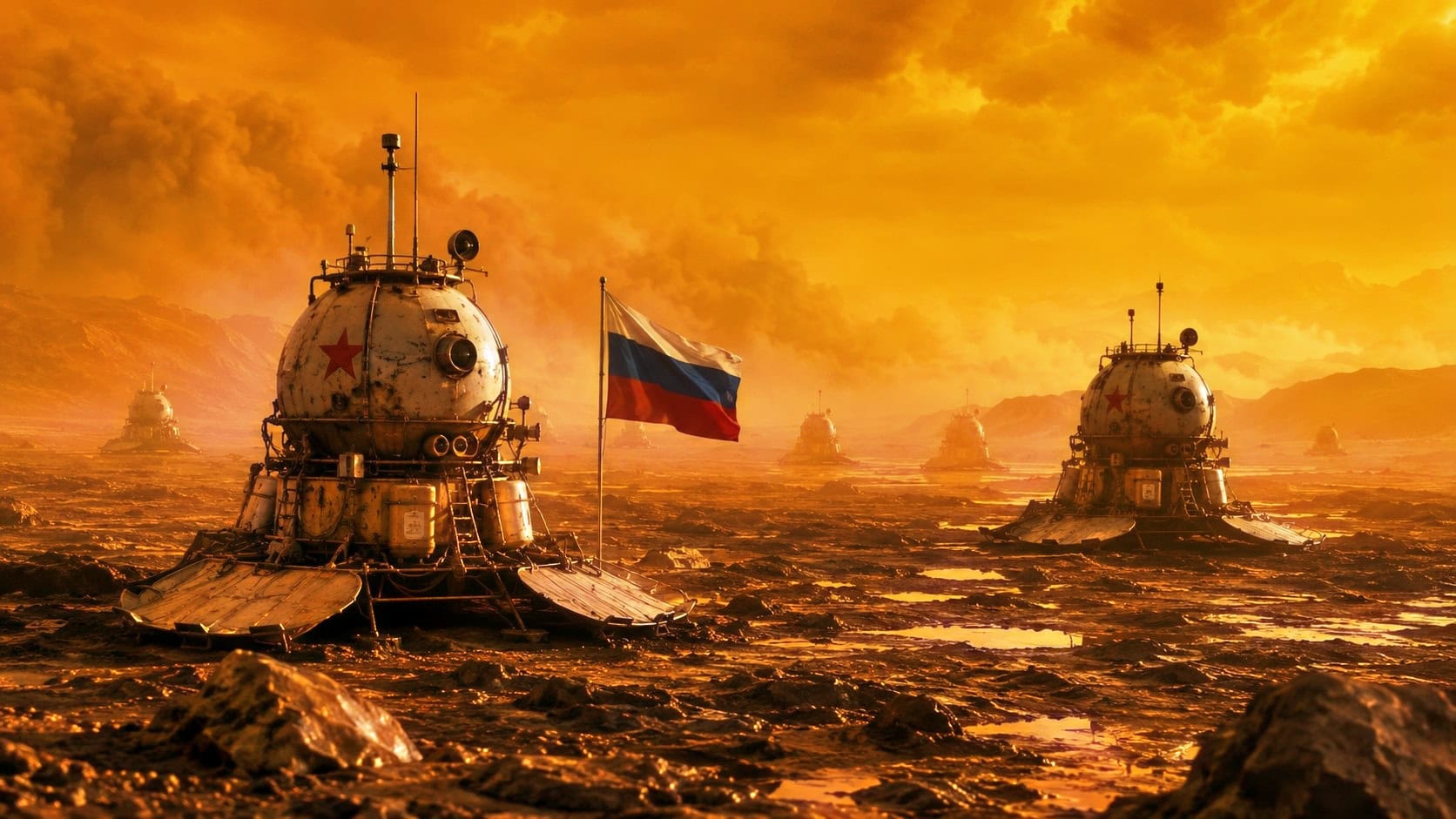
They say the Russians love hard places to live. Siberia is the most prominent example of this. Apparently, though, the Russians also like dangerous planets.
In this case, Earth’s “sister planet,” Venus. Yes, in 2020, Dmitry Rogozin, the head of Russia’s space agency, Roscosmos, declared that “Venus is a Russian planet.”
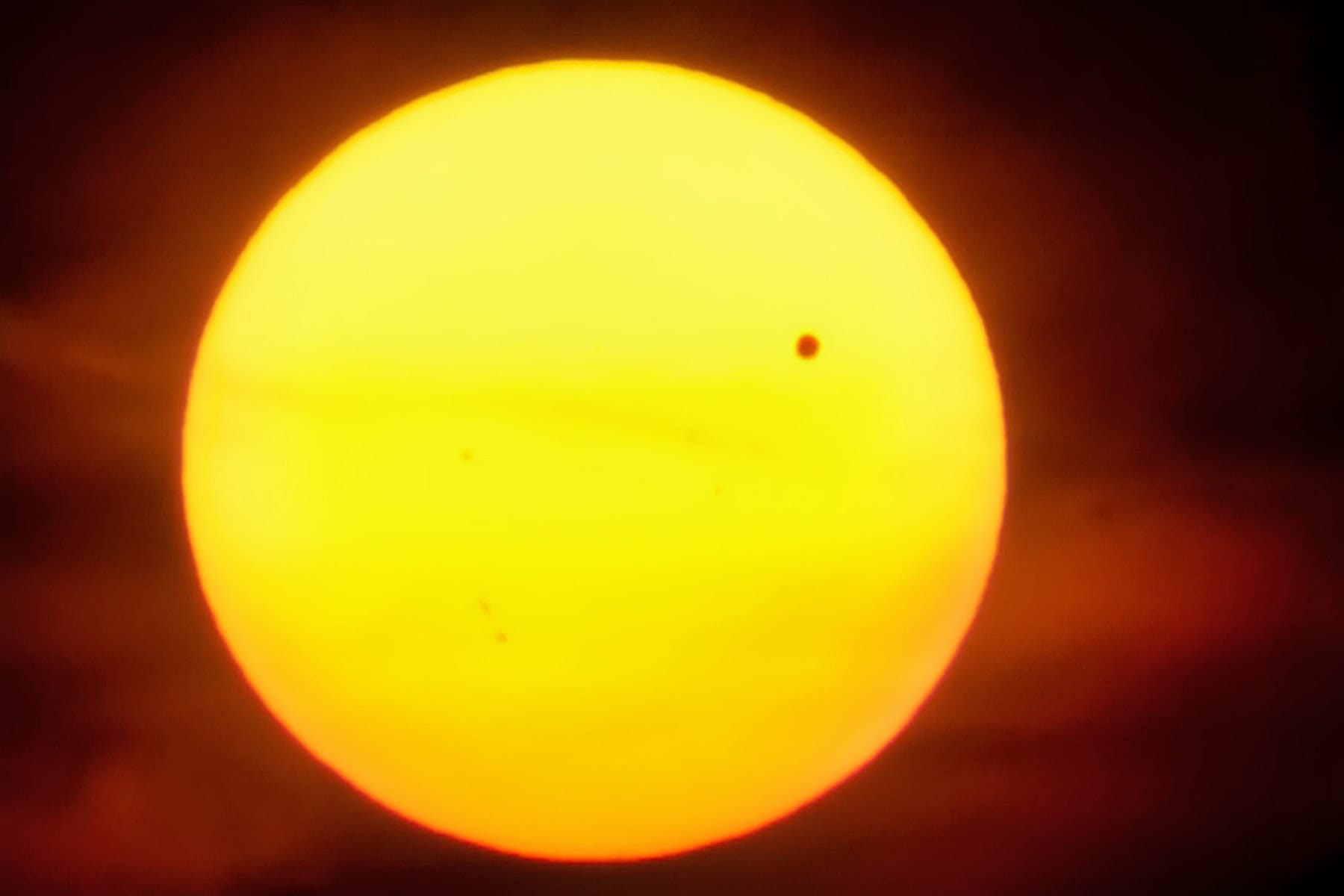
Venus Transit In Front of the Sun NASA Photo
This was before the Ukraine War. Most Western analysts heard that line and took it as a joke. The remark generated all manner of headlines and social media mockery.
After all, international law forbids any nation from owning a planet.
Of course, looking around the world in the last few decades, whether the US invasion of Iraq, the Chinese annexation of the South China Sea (SCS), or the Russian invasion of Crimea, who among us truly thinks international law is durable or meaningful in any way?
If a powerful country wants to take territory anywhere–and if they can take territory anywhere–they will. And no international legal standards will stop them.
That’s just the nature of the nation-state system.
What’s more, when it comes to Venus, Moscow has a stronger historical claim than any other country on Earth. No, their claim is not strong in a legal sense.
But it is strong in terms of achievement. You see, while the Americans spent the Cold War fixated on the moon and, later, Mars, the USSR quietly accomplished one of the most extraordinary campaigns of exploration in human history.
Soviet engineers became the first to reach Venus, the first to impact Venus, and the first to successfully analyze its mysterious atmosphere.
In fact, the old Soviet photos from the 1970s remain the only actual footage of the chaotic Venusian surface! Technically, humanity’s first physical encounter with another planet–not a moon, a planet–was not an American triumph.
It was a Soviet one.
Today, as China, Russia, and the United States all compete for influence on, in (subterranean warfare is becoming a thing today), above, or even beyond the planet Earth, Venus is once again becoming somewhat relevant to that discussion.
Understanding why requires revisiting one of the most overlooked chapters in the impressive history of human space exploration.
Venus: Humanity’s First Arrival on Another World
On March 1, 1966, the Soviet probe Venera-3 slammed into Venus after a journey lasting more than four months.
The spacecraft had suffered multiple failures before its arrival at Venus. Communications were lost before it reached the planet.
No scientific data survived the mission. Yet, Venera-3 achieved something no human technology had ever accomplished: it became the first manmade object to reach another planet.
That milestone came years before any successful Mars landings.
It represented the first time humanity physically extended its reach beyond the Earth-Moon System to touch another world.
The achievement was especially remarkable, given the technology of the era.
Soviet engineers guided a spacecraft tens of millions of miles through space using computers with only a fraction of the processing power of a modern smartphone.
For Moscow, Venus was a proving ground. For the rest of the world, it was a shocking achievement. For science, it marked the start of a long journey to unlock the secrets of this shrouded planet.
The Planet That Was Supposed to Be Earth’s Twin
Today, everyone knows that Venus is a hellish wasteland. Scientists in the 1950s and 1960s envisioned something very different.
Because Venus is roughly the same size as Earth and is concealed beneath dense cloud layers, many researchers believed it might be a tropical world.
Some even imagined oceans. Others believed humanity would find vast swamps and jungles.
Whereas Mars appeared barren, Venus looked alive.
The Venera program destroyed those assumptions. Beginning with Venera-4 and a succession of increasingly sophisticated probes, Soviet scientists gradually revealed the truth. Venus possessed an atmosphere composed overwhelmingly of carbon dioxide.
Surface pressures reached roughly 90 times Earth’s. Temperatures exceeded 900 degrees Fahrenheit (420 degrees Celsius). Sulfuric acid clouds swirled and dominated the atmosphere, too, creating a hellish nightmare of a world.
Conquering the Unconquerable
Most countries would have redirected their efforts elsewhere. The Soviets became obsessed with Venus, though. In 1970, Venera-7 accomplished another historic first.
It became the first spacecraft ever to transmit data from the surface of another planet.
The feat remains astonishing even by modern standards.
Just imagine building a machine capable of surviving temperatures hot enough to melt lead while enduring pressures equivalent to being submerged nearly a mile beneath Earth’s oceans.
That is precisely what Soviet engineers did.
Subsequent missions improved upon that achievement. Venera landers survived longer. Instruments became more sophisticated. Data quality improved dramatically.
Then came the photographs that rocked the world. For the first time in history, humanity saw the surface of another planet through images transmitted from that world’s ground.
The pictures remain haunting today. Scattered rocks sit beneath a yellow-orange-green sky. Jagged boulders stretch across the barren plains. The landscape resembles a volcanic wasteland trapped beneath an eternal sunset.
No nation has yet matched the Soviet Union’s accomplishments on Venus.
The only photographs ever taken from the planet’s surface came from old Soviet spacecraft. That is why Russian officials can credibly boast that, at least unofficially, Venus is a “Russian planet.”
Why Venus Matters Again
For decades after the collapse of the USSR, Venus faded from public attention.
Mars became the star of the space exploration community. NASA focused on automated rovers. Hollywood produced films about Martian colonists.
Entrepreneurs like Elon Musk have promised permanent settlement on the Red Planet. Venus became an afterthought. That is changing rapidly.
Venus may hold the key to understanding why Earth and Venus–two planets that began with similar characteristics–followed radically different evolutionary paths.
Both worlds formed in the inner Solar System. Both possess similar sizes and compositions. Yet one became a cradle of life while the other became a hellscape.
Understanding how Venus underwent a runaway greenhouse transformation may provide crucial insights into planetary evolution, atmospheric chemistry, and habitability.
Venus is not merely another planet. It is a laboratory for understanding how worlds form.
The Next Great Space Race
The deeper significance of Venus extends beyond science, as most space endeavors do. It centers around geopolitics.
Throughout history, great powers have competed to master new frontiers. The oceans, the polar regions, the skies, and eventually space all became areas of strategic competition.
Today, the United States is focused overwhelmingly on returning astronauts to the moon and eventually reaching Mars.
Meanwhile, Russia continues to view Venus as unfinished business. China has steadily expanded its planetary ambitions. Europe is planning new missions. Scientific interest is growing worldwide.
The result is a new race for influence beyond Earth.
That is why Rogozin’s comments from 2020 deserve more attention than they received. When he said Venus is a Russian planet, he was not merely celebrating Russian history.
He was reminding the world that Russia once dominated an entire frontier of exploration that the West had largely abandoned.
For 60 years, the achievements of the Venera program have remained one of humanity’s greatest forgotten triumphs.
They revealed an alien world, transformed planetary science, and demonstrated that even the most hostile environments can yield their secrets.
The moon still captures headlines.
Mars clearly holds the hearts of the world. But the next breakthroughs in planetary science–and perhaps even humanity’s future expansion into the Solar System–may come from the world hidden beneath Venus’ thick clouds.
And if they do, they will be built upon foundations laid by Soviet engineers long ago–and they could be exclusively discovered by Russian scientists.
About the Author: Brandon J. Weichert
Brandon J. Weichert is the Senior National Security Editor at 19FortyFive.com. He also manages The Weichert Brief on Substack. Weichert also hosts “National Security Talk” on Rumble. He is the author of four bestselling national security books, the most recent of which is A Disaster of Our Own Making: How the West Lost Ukraine (Encounter Books). Follow him via Twitter/X @WeTheBrandon.