
In June 1985, the Soviet Union did something that still sounds impossible. It flew two balloons through the clouds of another planet. Not landers built to ride out the surface, but drifting aerial probes, released high in Venus’s atmosphere into a deck of sulfuric-acid clouds where the winds tear along at more than 150 miles an hour. The balloons were meant to be a long shot. Instead, they rode those winds across the night side of Venus and into the daylight, traveling roughly a third of the way around the planet over nearly two days before their batteries died, returning the first direct measurements of the violent, churning layer where Venus makes its weather. They remain the only aerial vehicles ever flown in another planet’s atmosphere, a record that stood unbroken for 36 years until a small helicopter lifted off on Mars in 2021. The most surprising part is who built them. At the height of the Cold War, this Soviet triumph relied on a balloon experiment designed by the French and tracked by a global network of radio telescopes, including American dishes, making it one of the first truly international missions in the history of spaceflight.
UPDATE: This article now includes new images of the Vega mission from the Smithsonian take a few days ago by our reporting team.
The Vega Mission To Venus And A Comet
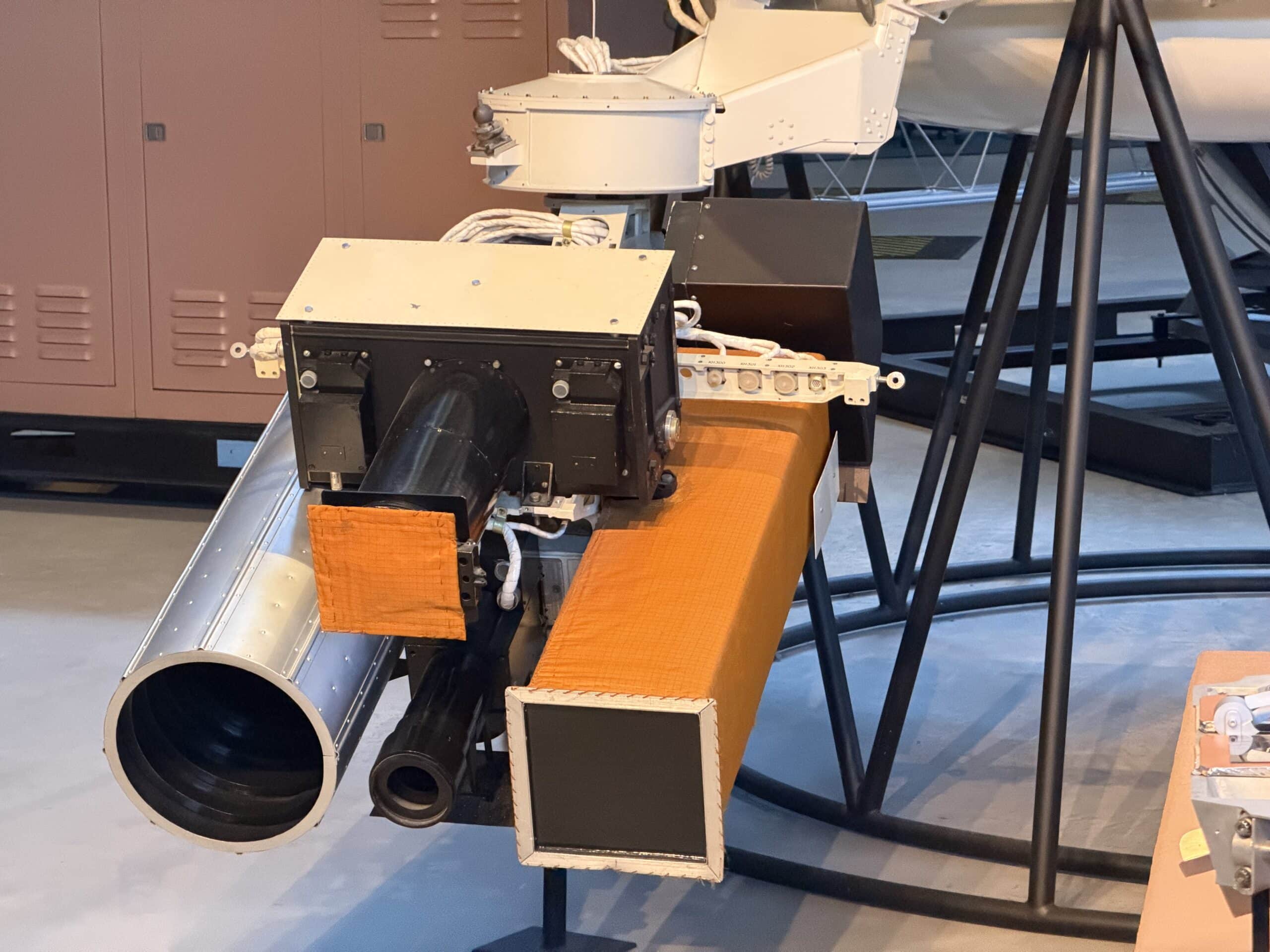
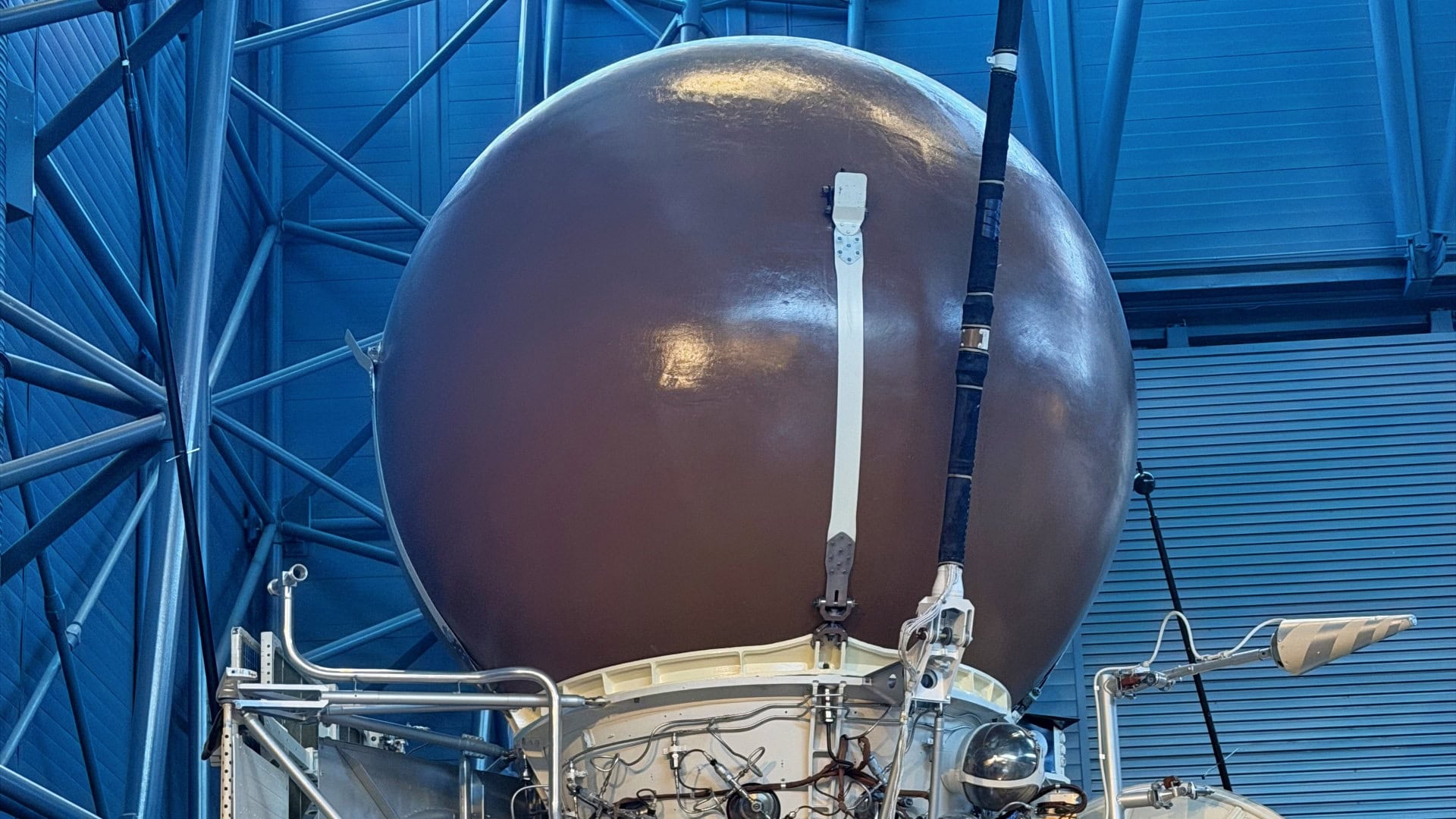
Vega Space Probe 19FortyFive Photo From Smithsonian Taken on June 30 2026
The mission was called Vega, a contraction of Venera and Gallei, the Russian words for Venus and Halley, because it was built to do two completely different things on one trip. The two spacecraft, Vega 1 and Vega 2, launched from Baikonur on Proton rockets on December 15 and 21, 1984. Each was a roughly 4,840-kilogram craft developed from the earlier Venera designs, and each carried a dual payload.
One part was a descent unit bound for Venus, a sphere containing both a lander and a balloon. The other part was a flyby bus that, after dropping its Venus cargo, would continue on to intercept Halley’s Comet. The comet leg was a late addition to the program, taken up after the United States canceled its own Halley mission in 1981. Vega 1 reached Venus on June 11, 1985, and Vega 2 on June 15, each releasing its descent unit into the atmosphere before the mothership swung past the planet.
Balloons Built To Survive Acid
The balloons were engineered for an environment that destroys ordinary machines. Each envelope was about 3.4 meters across when filled with helium and was made from a fluoropolymer skin from the Teflon family, chosen specifically to resist Venus’s sulfuric acid.
Below the balloon, a 13-meter tether carried an instrument gondola weighing just under 7 kilograms, for a total deployed mass of about 21.5 kilograms running on lithium batteries. Each balloon was pulled from its lander by parachute on the night side of the planet, dropped to about 50 kilometers as it inflated, then rose and stabilized near 54 kilometers, in the middle and most active layer of Venus’s three-tiered cloud system. That altitude was chosen for a reason that still drives Venus science today. The surface of Venus is a furnace at some 460 degrees Celsius under 90 atmospheres of pressure, but a few dozen miles up, conditions are startlingly mild.
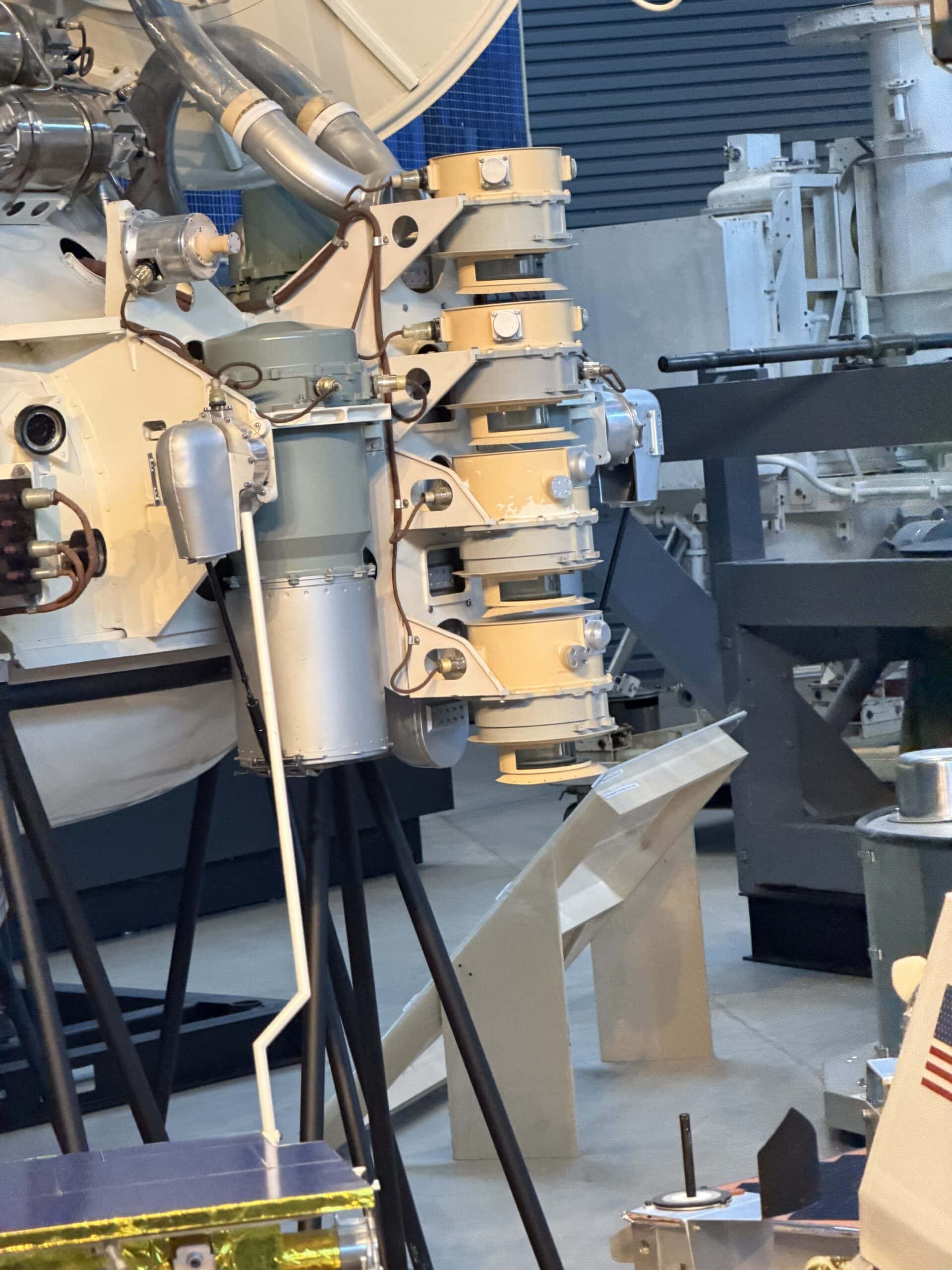
Vega Space Probe 19FortyFive Photo From Smithsonian Taken on June 30 2026
At the balloons’ float altitude, the temperature and pressure are roughly similar to conditions a few kilometers above Earth’s surface, making that layer the most Earth-like environment anywhere off Earth. The catch is that the air there is a cloud of sulfuric acid, laced with smaller amounts of hydrochloric and hydrofluoric acid, blown by hurricane-force winds.
A Third Of The Way Around Venus
What the balloons did next exceeded what their builders expected. Each one floated for about 46 hours, swept along by the super-rotating winds at speeds around 150 miles an hour, carried from the dark side of the planet into daylight. Vega 1’s balloon covered roughly 11,600 kilometers, and Vega 2’s about 11,100, each traveling about 30 percent of the way around Venus before its battery ran down and contact was lost. No one knows how much farther they drifted after they went silent.
The science came from listening to how the balloons moved. As they rode the winds, their motion revealed a surprising vertical component, revealing strong updrafts and downdrafts of air that earlier probes had not detected, including violent turbulence as the balloons passed over the highland region called Aphrodite Terra.
It was the first direct evidence of just how dynamic and churning the cloud layer of Venus really is, a place of vertical motion and weather rather than a smooth, uniform haze. National Geographic later called the Vega balloons the only aircraft humanity has ever flown on another world, balloons that harnessed the 150-mile-an-hour winds to drift a third of the way around Venus over nearly two Earth days.
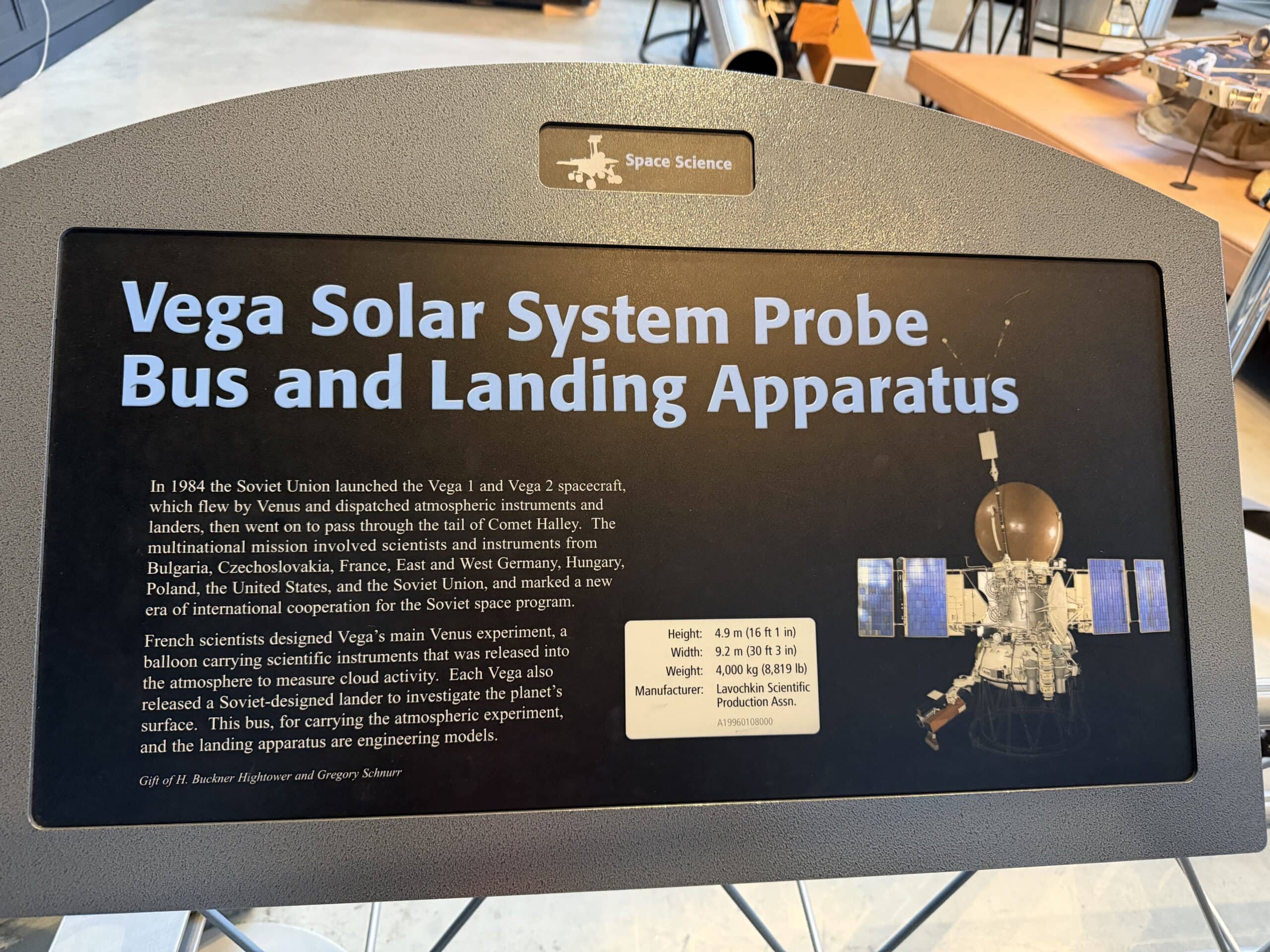
Vega Space Probe 19FortyFive Photo From Smithsonian Taken on June 30 2026
A Cold War Mission Tracked By American Dishes
The most remarkable thing about Vega is that it was never really a Soviet mission alone. The balloon experiment was designed largely by French scientists, with the physicist Jacques Blamont and France’s space agency, CNES, central to the effort, and the broader program drew in scientists and instruments from a dozen countries across both sides of the Iron Curtain, including France, Bulgaria, Czechoslovakia, Hungary, Poland, East and West Germany, Austria, and the United States.
Tracking the balloons across interplanetary distances required listening to their faint radio signals with enormous precision, using a technique called very long baseline interferometry. The job fell to a coordinated array of 20 radio observatories around the world.
Six of the antennas sat on Soviet territory and were run by the Soviet space institute, while fourteen coordinated by CNES made up an international network that included three of NASA’s giant Deep Space Network dishes. The first Vega signals were picked up at NASA’s Goldstone station in California on January 21, 1985, with the United States openly cooperating with France on the balloon experiment. A Soviet mission, running French-designed balloons, tracked in part by American antennas, all at the height of the Cold War.
The Landers And The Comet
The balloons were only one of the things each descent unit carried, and the rest of the mission worked too. The landers were close copies of the earlier Venera surface craft. Vega 2’s lander reached the surface and transmitted for about 56 minutes in conditions of roughly 91 atmospheres and 463 degrees Celsius, returning an analysis showing the surface rock was an anorthosite-troctolite, a type rare on Earth but found in the lunar highlands, suggesting some of the oldest terrain any Venera vehicle had sampled. Vega 1’s surface experiments were triggered prematurely by a hard jolt about 20 kilometers up, so its lander returned little surface data.
Then the motherships went to work on their second mission. Using the gravity of Venus to slingshot themselves onward, the same gravity-assist technique that sent Voyager 2 across the outer solar system, both Vega craft flew on to intercept Halley’s Comet in early March 1986. Vega 1 began returning images of the comet on March 4, capturing what amounted to the first close looks ever taken at a comet’s nucleus.
The two spacecraft encountered comet Halley on March 6 and March 9, passing within about 8,890 and 8,030 kilometers of the nucleus and returning roughly 1,500 images between them. The pictures showed a dark, potato-shaped body with bright jets that were warmer than expected, implying a thin, dark crust over an icy core.
That data did something larger than its own science. The European Space Agency was about to send its Giotto probe much closer to Halley, and it used the Vega images and tracking to pin down exactly where the comet’s nucleus was. ESA scientist Gerhard Schwehm later called the Vega craft their pathfinders, saying their images enabled his team to accurately determine the comet’s position, allowing them to target Giotto’s trajectory.
With the Vegas having scouted the way, ESA was able to guide Giotto even closer, and on the night of March 13-14, 1986, Giotto swept within about 596 kilometers of the nucleus. It was only with the first flyby data from this armada that scientists widely accepted the idea of a single, solid nucleus at a comet’s heart.
The Only Aircraft in Another World
For all that the comet flyby and the landers accomplished, the balloons hold the singular record. They were the first man-made aircraft to fly in the atmosphere of any planet other than Earth, and they remained the only ones until NASA’s Ingenuity helicopter lifted off on Mars in April 2021. Even now, Ingenuity is a rotorcraft on Mars, and no balloon has ever flown on another planet before or since Vega. As NASA’s Jet Propulsion Laboratory puts it, the Vega flights remain the only balloon-borne exploration of Venus’s atmosphere to date.
It is not for lack of interest. JPL has been developing Venus aerobots, robotic balloons, for over twenty years, and a prototype of a new variable-altitude balloon, built from Venus-compatible materials, completed controlled test flights in the Nevada desert in 2022, with the goal of one day circling Venus for at least 100 days.
The work is still active, with a fresh aerobot concept involving JPL, MIT, and industry partners presented at a 2026 conference, where researchers noted the super-rotating winds would carry such a craft around the planet’s night side in about 50 hours. Part of the reason the cloud layer keeps drawing proposals is the same reason it is so striking that Vega flew through it. With its Earth-like temperatures and pressures, that band of Venus is the leading candidate for searching for airborne microbial life, the focus of the ongoing debate over whether anything could survive in the planet’s clouds.
Forty years on, the Vega balloons still stand alone. Two small Soviet balloons, built with French instruments and followed by American dishes, drifted through the acid sky of another planet, rode its hurricane winds a third of the way around the world, and measured weather no one had ever sampled before.
No spacecraft has flown in the clouds of Venus since, and for four decades, nothing has matched what those two balloons did in the summer of 1985.
About the Author: Harry J. Kazianis
Harry J. Kazianis (@Grecianformula) was the former Senior Director of National Security Affairs at the Center for the National Interest (CFTNI), a foreign policy think tank founded by Richard Nixon based in Washington, DC. Harry has over a decade of experience in think tanks and national security publishing. His ideas have been published in the NY Times, The Washington Post, The Wall Street Journal, CNN, and many other outlets worldwide. He has held positions at CSIS, the Heritage Foundation, the University of Nottingham, and several other institutions focused on national security research and analysis. He is the former Executive Editor of the National Interest and the Diplomat. He holds a Master’s degree focusing on international affairs from Harvard University.