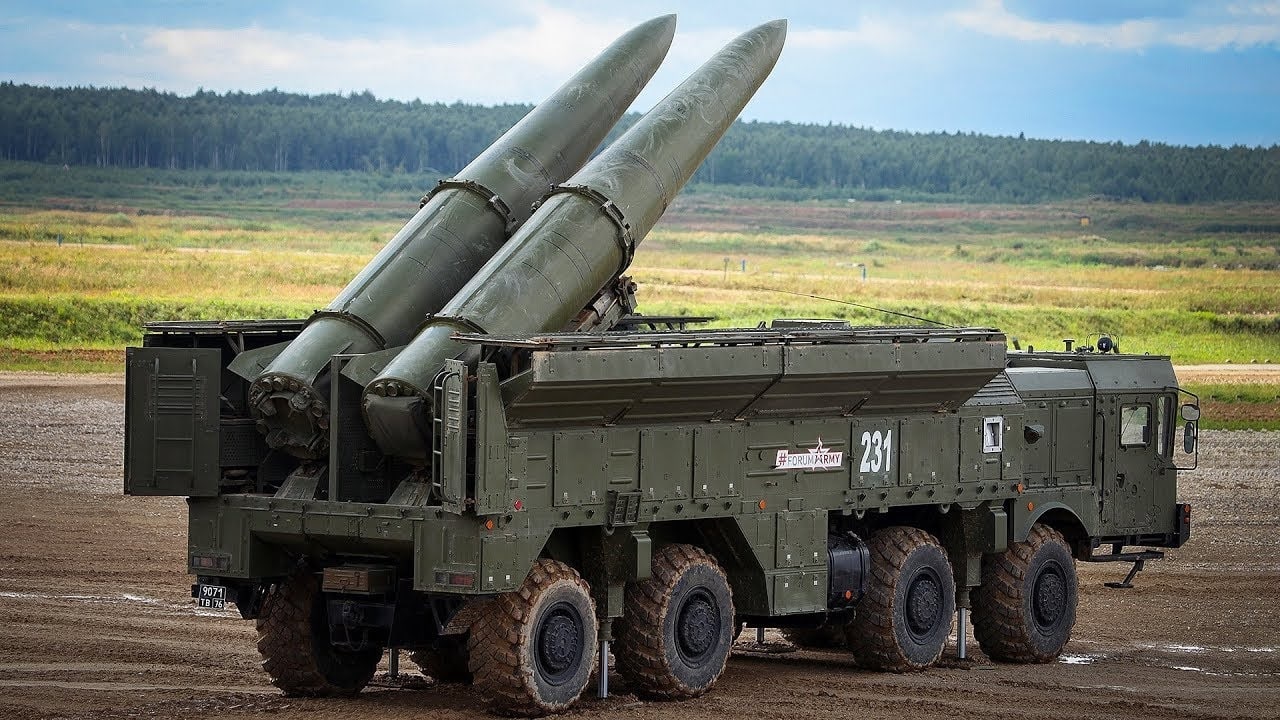
Russia’s Iskander-M is a road-mobile short-range ballistic missile (SRBM) that entered Russia’s military in 2006. It was designed to replace the Cold War-era OTR-23 Oka system.
It represents the advances made by Russia’s military under Vladimir Putin. The missile is carried on a highly mobile transporter-erector-launcher (TEL) that normally carries two ready-to-fire missiles. Here’s the thing, though. It can also fire nuclear missiles.
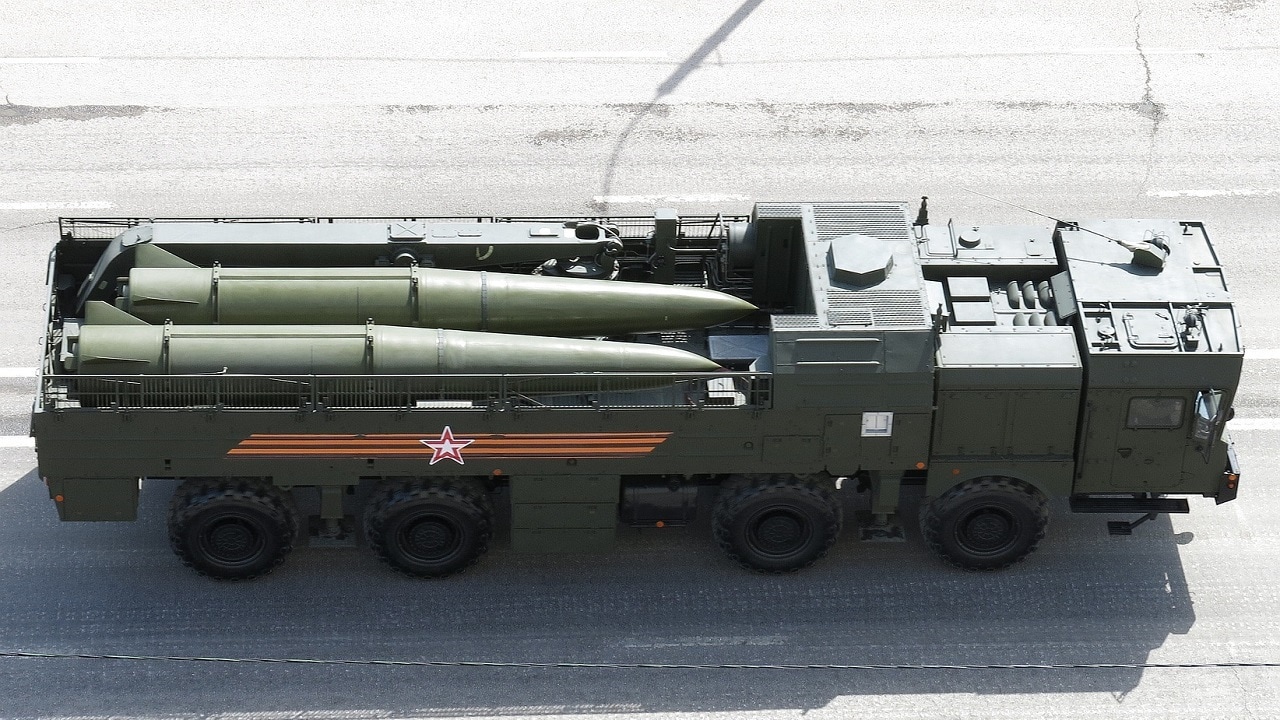
Iskander Transport Loader 9T250
Per the Center for Strategic and International Studies (CSIS), the missile possesses these key features:
- Range: up to 500 km
- Payload: 480-700 kg
- Engine: Solid-fuel rocket motor
- Launch Time: Just a few minutes
The system also employs “shoot-and-scoot” tactics to avoid enemy counterbattery attacks.
Iskander-M Beats Many Missile Defenses
Unlike older Soviet systems, and in line with Vladimir Putin’s modernization policies, Iskander’s complexity underscores its strategic importance, making it vital for Russia’s military posture.
Following that line of thought, the Iskander-M was specifically designed to survive interception by NATO (and Ukrainian) defenses. Once fired, the missile approaches its target on a depressed trajectory. On its way there, the Iskander-M missile engages in wild maneuvers. It radically alters its course to evade incoming defenses. The missile even releases decoys to further complicate any shootdown attempts.
On top of that, the missile possesses advanced electronic countermeasures designed to stymie any interceptors fired at it on its way to the target. Oh, and it presents a small radar signature, further complicating air and missile defenders, because they might either miss the missile entirely on radar or assume it was a flock of seagulls or something other than a screaming missile about to unleash fire and fury.
Russian designers specifically incorporated features on the Iskander-M to overcome advanced NATO air defenses, such as Patriot, Terminal High-Altitude Area Defense (THAAD), Aegis, and other similar Western defensive systems.
Ukraine Became the Testing Ground for the Iskander-M
Further, whatever else one may think about Russia’s performance in the Ukraine War, the fact is that the prolonged conflict has allowed the Russians to perfect many of their newer systems, such as the Iskander-M, at a rate far faster than if they were at peace. Instead of one revolutionary upgrade, analysts at the Royal United Services Institute (RUSI) argue that the protracted war has likely made continuous software and guidance improvements based upon battlefield experience.
Over the course of the war, Iskander-M has benefited from continuous software and guidance improvements, reflecting ongoing innovation driven by battlefield experience.
More shockingly, the Iskander-M can now apparently coordinate with drone swarms. A common tactic that both sides in the war have used against each other is to launch swarms of cheap drones to distract and drain limited enemy air-and-missile defenses, all while the bigger, more expensive–and lethal–missiles, like the Iskander-M, move to their targets with relative ease.
It’s the iterative development process of warfare as the greatest innovator of all for any weapon system.
Smother the Enemy
Russia has built an impressive ecosystem of weapons specifically meant to drain and strain the air-and-missile defenses of Ukraine. On the flip side, Ukraine has also created an impressive arsenal of drones and missiles for itself. But the Russian offensive ecosystem, matched against Ukraine’s declining air-and-missile defenses, is what matters here.
Thanks to its alliance with the Islamic Republic of Iran, Russia has a massive–and growing–arsenal of cheap Shahed-type drones at its disposal. Russian factories in the Far East are churning out cruise missiles like sausages.
In fact, last year, the head of NATO, Mark Rutte, publicly complained that it took the entire NATO defense industrial base a year to produce what the Russian defense industrial base produced in just three months, despite years of conflict in Europe with Russia.
Systems such as the Kalibr, Kh-101, Kinzhal, and Iskander-M all exist as part of a comprehensive, networked offensive ecosystem. The objective of this combined system is to overwhelm command-and-control systems while forcing defenders to choose which targets deserve scarce Patriot interceptors.
So, even if each missile isn’t exceptionally sophisticated, the combined attack overcomes whatever defenses are available (again, Russian intelligence understands that NATO defenses are being drained faster than they can be replenished).
Why NATO Fears Iskander-M
Not only can Iskander-Ms be loaded with nukes, but their range means these weapons can hit targets deep within European NATO states. Everywhere from Poland and Lithuania to Latvia and Estonia, as well as much of Finland–even Germany, thanks to the presence of Iskander-Ms in Kaliningrad–can be hit.
In terms of escalation with NATO, the Iskander-M will play a central role if Moscow ever decides to attack beyond Ukraine (which some Russian leaders have threatened in recent weeks, as the Ukraine War intensifies).
The Key Takeaway
At the end of the Cold War, Western planners believed their increasingly capable missile defenses would steadily reduce the effectiveness of short-range ballistic missiles.
The war in Ukraine has invalidated that assumption.
Russia has consistently demonstrated that, thanks to software upgrades, improved terminal maneuvering, decoys, and coordinated strike tactics, it can rapidly erode the effectiveness of even advanced systems like Patriot defensive software; sensors and tactics adapt in turn.
Evoking the work of RUSI again, this is an iterative competition over the long run rather than a permanent advantage for either side. But, right now, the Iskander-M proves that Russia is adapting better and faster than the NATO side of the ledger.
Iskander-M combines precision, mobility, survivability, and dual-capable payloads, reinforcing its reputation as a formidable and adaptable weapon system.
About the Author: Brandon J. Weichert
Brandon J. Weichert is the Senior National Security Editor at 19FortyFive.com. He also manages The Weichert Brief on Substack. Weichert also hosts “National Security Talk” on Rumble. He is the author of four bestselling national security books, the most recent of which is A Disaster of Our Own Making: How the West Lost Ukraine (Encounter Books). Follow him via Twitter/X @WeTheBrandon.