

Whither the Iran war? The best Middle East-watchers can do is peer through a glass darkly in an attempt to glimpse the future. The U.S.-Iran ceasefire—such as it was—is dead. President Donald Trump confirmed as much. Iran’s Islamic Revolutionary Guard Corps (IRGC) has resumed missile and drone attacks on mercantile shipping in the Strait of Hormuz in hopes of compelling shipmasters to transit a northerly corridor along Iranian shorelines, and perhaps provide a payoff for the privilege, instead of taking the U.S.-approved southerly route skirting close to Oman. Meanwhile, U.S. aircraft have resumed bombarding targets along the Iranian coast in an effort to degrade the IRGC’s wherewithal to menace ships passing through the Strait.
Abate the IRGC missile, drone, and speedboat threats sufficiently, and you abate the havoc Tehran has wrought on the global economy. Easier said than done.
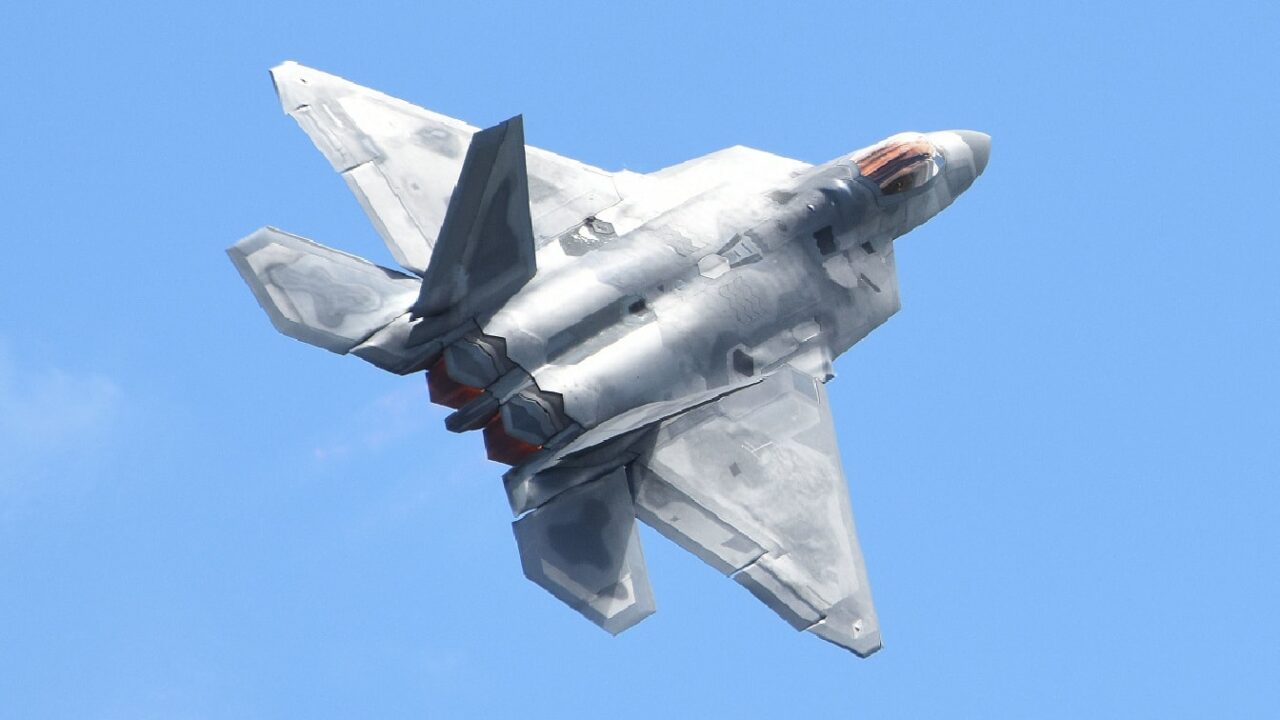
U.S. Air Force Maj. Paul Lopez, F-22 Demo Team commander, performers aerial maneuvers July 14, 2019, at the “Mission Over Malmstrom” open house event on Malmstrom Air Force Base, Mont. The team flies at airshows around the globe, performing maneuvers that demonstrate the capabilities of the fifth-generation fighter aircraft. The two-day event, featured performances by aerial demonstration teams, flyovers, and static displays. (U.S. Air Force photo by Airman 1st Class Jacob M. Thompson)
A couple of predictions do seem safe. One, it is doubtful in the extreme that Tehran will agree to relinquish control of the Strait of Hormuz—especially if the White House keeps demanding it do so in a public and humiliating fashion. As the Institute for the Study of War affirms, Iranian officialdom would view such a proclamation as “surrender.” And surrender is anathema to a regime fervently dedicated to “resistance” to the West.
Tehran has certainly resisted. It has succeeded as it defines success.
None of this would be obscure to the greats of strategy. Prussian martial sage Carl von Clausewitz observes, in oblique language, that war is “controlled by its political object,” and thus “the value of this object must determine the sacrifices to be made for it in magnitude and also in duration. Once the expenditure of effort exceeds the value of the political object, the object must be renounced, and peace must follow” (Carl’s emphasis). What he means in plainspoken English is that how much a combatant desires its political goals determines how much it is prepared to pay for those goals—and for how long. The political object is the goal, the magnitude is the rate at which the leadership is willing to expend militarily relevant resources on the cause, and the duration is how long the leadership is prepared to keep up the expenditure. The Clausewitzian formula resembles basic physics: multiplying the rate by the time yields the total quantity of something, in this case the price of permanent Iranian control of Hormuz.
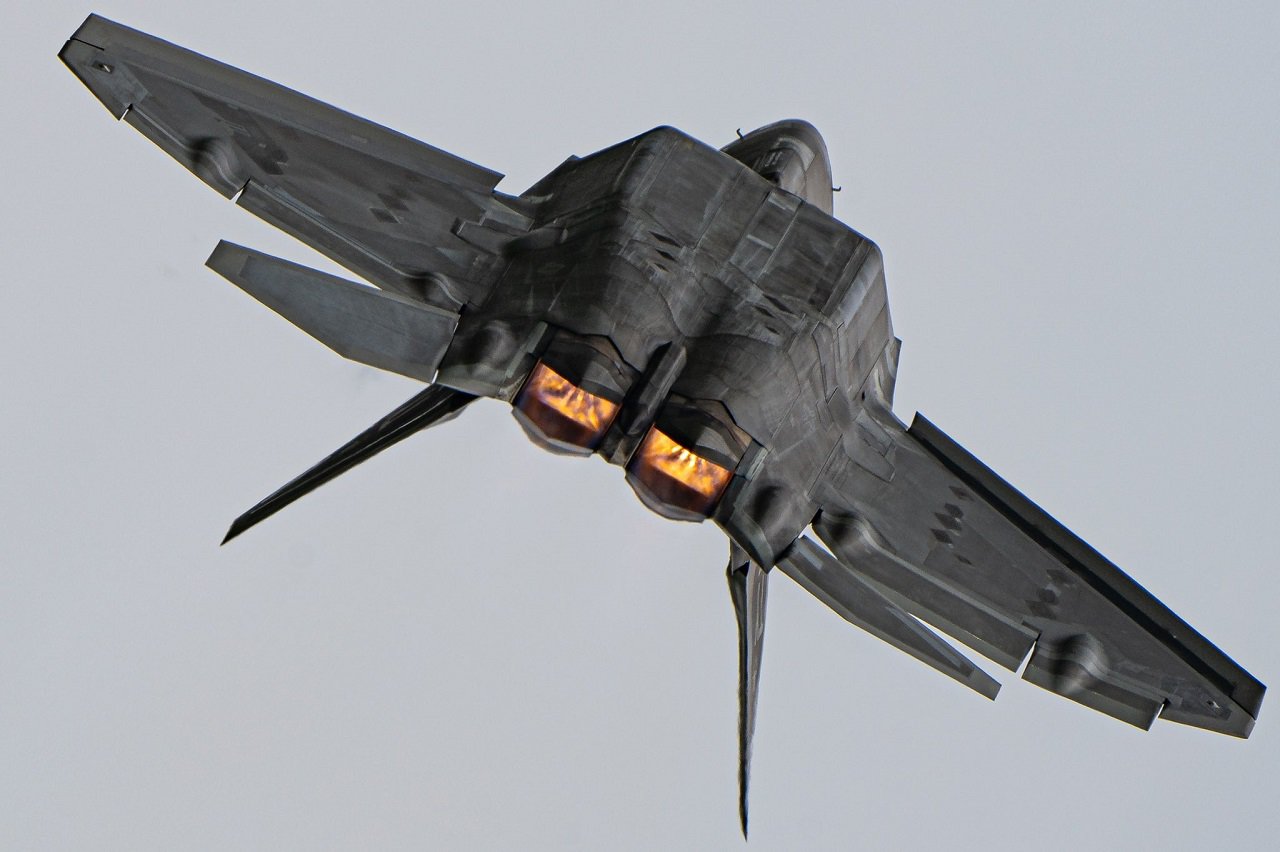
F-22 Raptor. Image Credit: Creative Commons.
The Clausewitzian calculus of war is something like making a major purchase. Want a fancy house or car? If so, you’re prepared to make hefty payments for a long time. If the house or car costs too much for your liking, Clausewitz would say to decline to close the deal, or, if you already closed it, get out of the deal on the best terms you can.
The Strait of Hormuz is Tehran’s precious, its McMansion or BMW. There is little reason to believe control of Hormuz is negotiable for the Islamic Republic regime so long as it remains in power. In Clausewitzian parlance, Tehran attaches such value to the Strait that the cause warrants spending the utmost magnitude of resources, relative to Iran’s means, for an unlimited time. Nor is there much sign the IRGC—by most accounts the wielder of political power in Iran these days—will flinch from this goal. Outsiders will have to keep the Revolutionary Guard from achieving it—in all likelihood by force of arms over a protracted time.
Two, it’s doubtful any U.S. air or naval campaign can achieve 100 percent effectiveness, completely eliminating the IRGC’s capacity to threaten maritime traffic. Perfection is an unforgiving standard in martial affairs, short of regime change. It verges on impossible to eliminate 100 percent of a foe’s arsenal, especially from the air or sea. Aerial and maritime forces do not seize control of key terrain and thus cannot reliably find all weapons caches an enemy has secreted. In all probability, then, Iran will retain some ability to assault vessels transiting the Strait of Hormuz—and shipping firms and insurers will balk at risking the journey through that narrow sea absent U.S. or allied naval protection.
That being the case, the United States and like-minded allies, partners, and friends will need to display staying power for traffic to resume normal patterns in the Strait. It’s doubtful the prewar status quo of unobstructed passage will return after all that has happened this year. Free passage will have to be defended indefinitely.
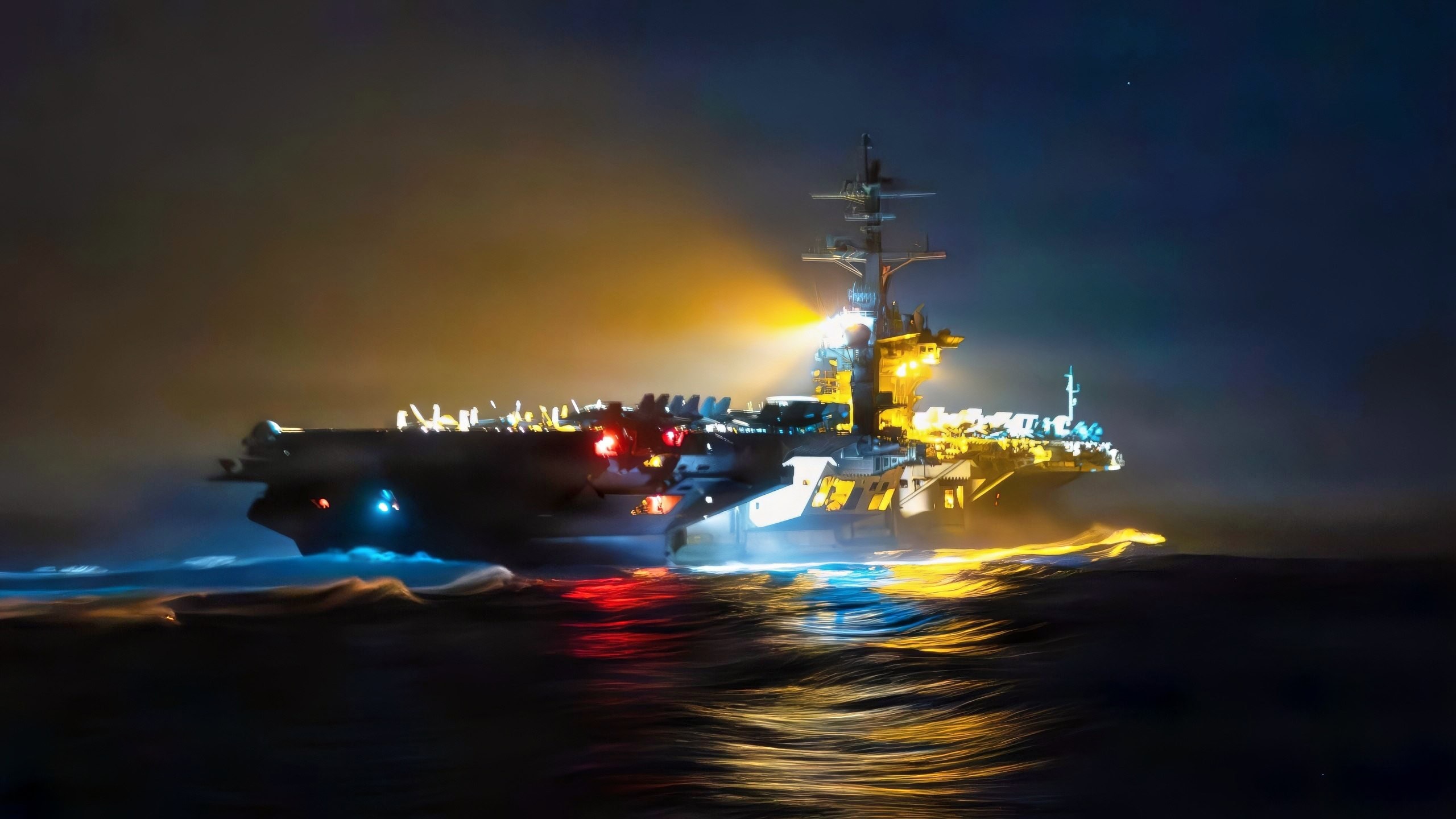
Nimitz-class aircraft carrier USS Abraham Lincoln (CVN 72) departs following a replenishment-at-sea with fleet replenishment oiler USNS Henry J. Kaiser (T-AO-187) during Operation Epic Fury, March 18, 2026. (U.S. Navy photo)
So much for the backgrounder. What are the likely courses of action available to guardians of free transit through Hormuz? Four stand out, in broad terms. They are not necessarily mutually exclusive. First, the United States could wash its hands of the conflict and leave, trusting to local antagonists to sort out their own affairs. Doing nothing is always an option. President Trump teased this option himself at one stage, suggesting that the United States might withdraw from the conflict without seeing the Strait reopened rather than stay the course. And retiring from the Middle East does find support in top-level U.S. security directives. Both the 2025 National Security Strategy and the 2026 National Defense Strategy demote the region to afterthought status among Washington’s priority theaters, behind the Western Hemisphere, the Western Pacific, and Europe (and just above “everywhere else”).
In other words, walking away from its fourth-ranked theater, by definition a theater of lesser interest, would conform to U.S. strategic priorities as the Trump administration has framed them. Clausewitz might well concur. He cautioned against expending resources urgently needed in a priority theater on a contingency in a theater commanding lesser importance. Prudent strategists spend on what matters most. They spend on what matters less only on a not-to-interfere basis with the uppermost priorities.
But like all courses of action, doing nothing comes with its own benefits, costs, opportunity costs, and hazards. Think about what walking away from the Persian Gulf region would entail. The United States has long-standing relationships in the region. Quitting the Iran war now would surrender its Gulf Arab allies to Iran’s tender mercies. That’s bad enough. Now think about how allies, partners, and friends elsewhere around the world—including in high-priority theaters such as the Americas, East Asia, and Europe—would interpret such an exodus. They might conclude they are next to be abandoned. If sufficiently powerful, they might make common cause to replace the American contribution to their security and offset whatever collective dangers they face.
Or they might strike the best deals they can with aggressors such as Iran, Russia, or China. In all likelihood such bargains would leave them subservient to hostile regional powers. Quitting the Middle East could irreparably damage the United States’ reputation for honoring its commitments—to its detriment worldwide. After all, the United States has no strategic position in the world without allies.
Abandonment could also forfeit freedom of the seas, an enduring American precept since the days of Thomas Jefferson and the Barbary Wars. International lawyers spare no opportunity to remind you that the United States is not formally a party to the UN Convention on the Law of the Sea, dubbed the world’s constitution for the oceans. And that is true, in part. But U.S. leaders pushed for the convention back when it was being negotiated, and administrations right and left have accepted it as customary international law for forty-plus years. Customary international law regards the practice of states—what a critical mass of states do, rather than what they put on parchment when they agree to a treaty—as an indicator of what they consider lawful.
It is a valid source of international law. What you do matters as much as what you say.
Moreover, the United States is the chief steward of the law of the sea. If the U.S. Navy and affiliated joint forces abandon the Strait of Hormuz, an international strait, to Iranian control—including toll-taking—Washington will have relinquished a fundamental principle of U.S. foreign policy and strategy. And it will have tacitly encouraged others to challenge that principle wherever it appears. International law—and the United States’ geopolitical standing—will have taken a heavy hit.
Chances are, the White House will blanch at this course of action. I hope so.
Second, at the other extreme, the White House and Pentagon could resume wholesale bombardment of Iran from the air and sea, reprising the full-blown combat that raged from late February until the April ceasefire. There is merit to such a course of action as well. Clausewitz defines warlike strength as a compound of material capability and capacity—weapons, manpower, logistics, and so forth—and the resolve to use that capability and capacity as the political leadership and society deem fit. A return to a full-scale airborne and maritime campaign might not diminish the Islamic Republic’s willpower to resist. Indeed, I believe it wouldn’t. But it might diminish the matériel dimension so much that Tehran, deprived of armaments, would have little wherewithal to resist—no matter how unbreakable its resolve.
Such an outcome is unlikely, though. If striking 15,000 targets, the Pentagon’s figure for the active phase of fighting through March 13, is not enough, chances are plinking more targets will not be enough either.
Third, the United States and Israel could add a ground component to the campaign. There is merit here as well. Land operations are the decisive component in warfare. As Admiral J. C. Wylie points out, the “man on the scene with a gun” is the arbiter of victory in warfare. By that Wylie means the soldier or marine brandishing superior firepower at the scene of action at the critical time. The soldier controls turf with help from air, sea, and space forces. In the Iranian case, the soldier toting a gun could hunt down and eradicate weapons meant for assailing for shipping in crucial seaways. But it remains doubtful the Trump administration, Congress, or the American electorate have much stomach for another prolonged ground war in the Middle East.
Iran is a large and distant land inhabited by some 90 million souls, a considerable number of whom approve of their current rulers. Invading it is a prospect few relish.
Which means, distressingly, that the fourth option is the least awful course of action available. Washington can (and evidently has) reinstate the U.S. Navy blockade to pinch Iran’s export-centric hydrocarbon economy, while escorting shipping through the Strait to ensure exports flow freely from U.S. allies, partners, and friends to buyers overseas and much-needed imports return to Gulf allies. There are unknowns. It is unclear how much support from the allies a convoy-like system would elicit remains unclear judging from Project Freedom, a short-lived effort last May to facilitate passage through the Strait. Saudi Arabia declined to allow U.S. forces to use bases in the kingdom to help “guide” ships through Hormuz, and the effort stalled out within days. A similar effort could meet a similar dismal fate.
Such an enterprise would be strategically defensive in intent—meant to restore free passage through the Strait of Hormuz—but with a tactically offensive bent. It would be designed to ensure the liberty to cross through Hormuz, an international strait. That’s the defensive element. But the campaign would incorporate the option to unleash tactical offensive blows against anti-ship sites in Iran. In effect, U.S. Navy surface combatants would hoist a shield over merchant shipping while Navy, Air Force, and Army aircraft and missiles acted as the counterbattery sword against the IRGC.
If it passed muster with the allies this time, such a marine effort would be resource-intensive, measured by the fraction of the Navy fleet committed to the endeavor—roughly 20% of deployable assets—needed to cover the entire globe, but less resource-intensive than full-scale joint bombardment, Epic Fury-style. The joint force desperately needs to conserve ordnance for higher-priority theaters like the Western Pacific.
So that’s my bleak prophecy. If the United States wants to uphold its alliances, its good name, and freedom of the sea, it will remain committed to maritime operations in the Gulf region indefinitely. This endeavor will not be over quickly. We will not enjoy this. Somewhere, Clausewitz is nodding knowingly.
About the Author: Dr. James Holmes, US Naval War College
James Holmes is J. C. Wylie Chair of Maritime Strategy at the Naval War College and a Faculty Fellow at the University of Georgia School of Public and International Affairs. The views voiced here are his alone.