
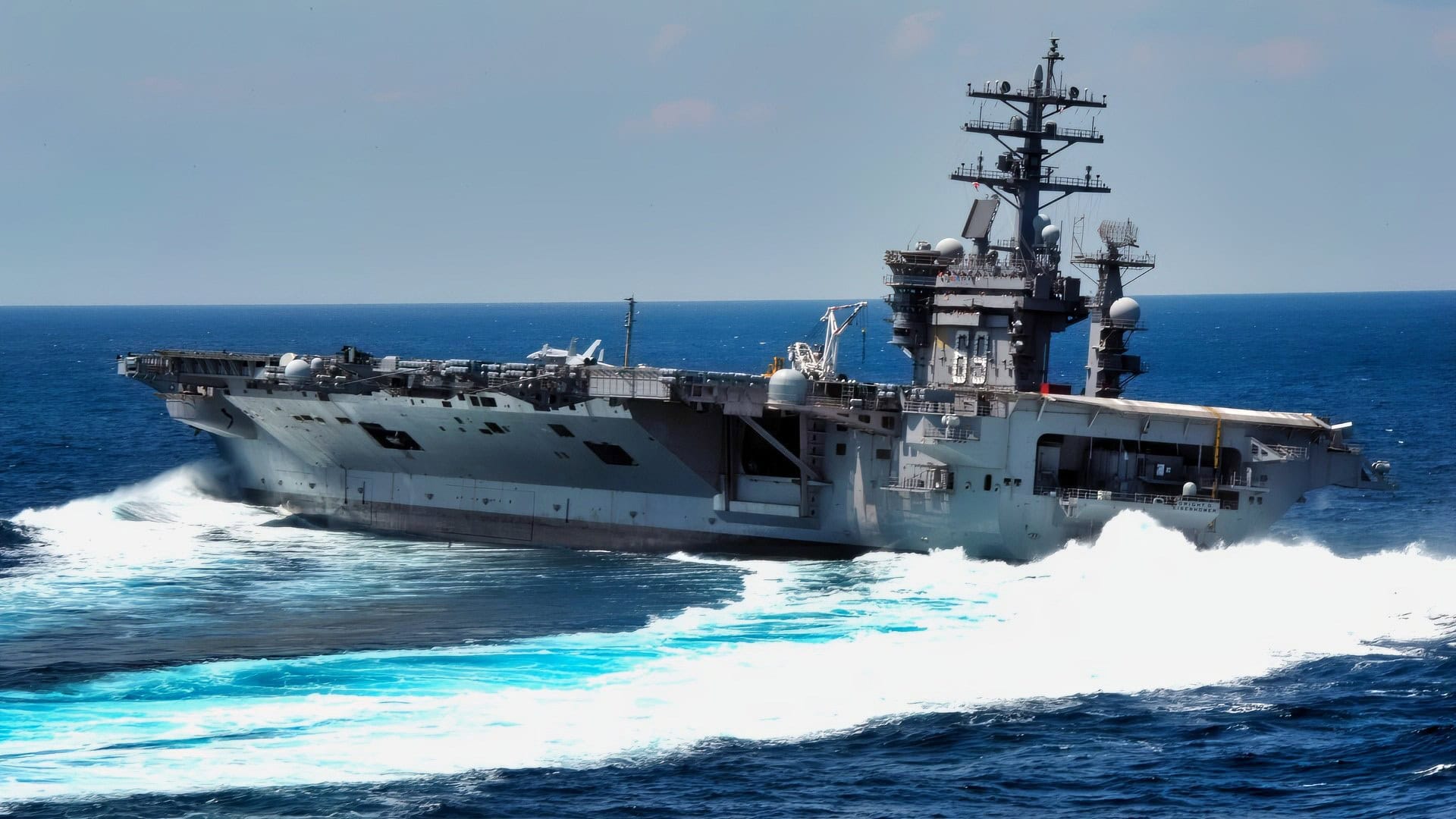
The Navy Plans to Retire USS Dwight D. Eisenhower in 2030. The Ford Class Is Not Ready: The Navy plans to inactivate aircraft carrier USS Dwight D. Eisenhower in fiscal 2030, when the second-oldest Nimitz-class carrier will be 53 years old. The same fiscal 2027 shipbuilding plan places delivery of the future USS Enterprise in fiscal 2031 and projects the carrier force falling from 11 ships to 10 during fiscal 2030.
That gap matters because federal law requires the Navy to maintain at least 11 operational aircraft carriers. The Navy plan acknowledges the problem in a footnote, promising continued reviews of service-life extensions, post-refueling life extensions and faster construction.
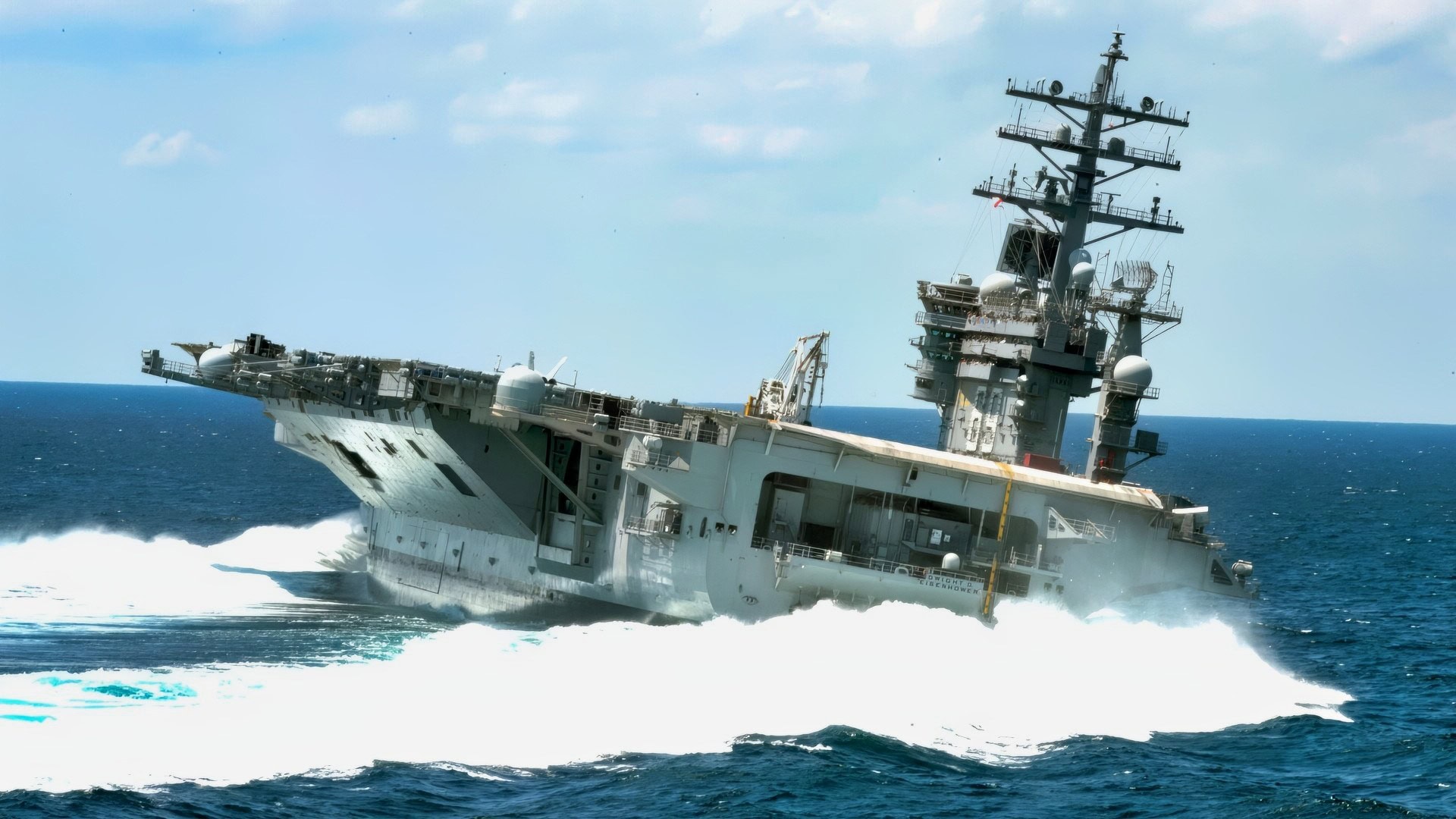
ATLANTIC OCEAN (June 14, 2011) The Nimitz-class aircraft carrier USS Dwight
D. Eisenhower (CVN 69) conducts rudder turns during sea trials. Dwight
D. Eisenhower completed a nine-month planned incremental availability at Norfolk Naval Ship Yard on June 10 and is scheduled to resume underway operations this summer. (U.S. Navy photo by Mass Communication Specialist 1st Class Christopher Stoltz/Released)
Eisenhower is not limping toward retirement from a pier. The carrier completed a major Planned Incremental Availability ahead of schedule in April 2026. Norfolk Naval Shipyard performed turbine inspections, underwater shafting work, catapult trough inspections and structural repairs before returning the ship to the fleet as fully mission capable.
Retiring Ike on a fixed calendar date therefore looks premature. The better decision is to keep the carrier available until Enterprise is delivered, accepted and ready to operate with an air wing. That extension still has to pass strict tests involving reactor fuel, hull condition, flight-deck systems, cost and shipyard capacity.
Ford-Class Delays Changed the USS Eisenhower Retirement Math
The Ford replacement schedule has moved repeatedly. John F. Kennedy is now due in March 2027. Enterprise slipped from July 2030 to March 2031. Doris Miller moved from February 2032 to February 2034 because construction space and delays on the ship ahead of it restricted module work. The latest Navy schedule leaves little reserve for another setback.
The problem is larger than one carrier. The Congressional Budget Office says Nimitz-class carriers took seven to eight years to build, while Ford-class carriers now require 10 to 11 years under current schedules. Kennedy’s path from first steel to delivery stretches to roughly 16 years, while the production timeline has become a warning in its own right.
The delays also cascade. Enterprise’s late equipment deliveries forced construction out of sequence. That congestion then affected Doris Miller. The result is a replacement system with almost no schedule margin.

Former General Dwight D. Eisenhower. Image Credit: Creative Commons.
USS Dwight D. Eisenhower Still Has Operational Value
Ike proved her value during a nine-month deployment that ended in July 2024. The strike group conducted combat operations against Houthi missiles and drones and supported maritime security across the Red Sea and Gulf of Aden. The Navy described the deployment as an unprecedented period of sustained carrier operations.
The ship then entered maintenance and returned early, giving the Navy a recently repaired carrier rather than an exhausted reserve hull. The 2026 work does not guarantee five more years of reliable service. It does show that the Navy has already invested substantial labor in keeping Ike operational near the end of her planned life.
Demand has not eased. East Coast carriers have repeatedly remained deployed beyond planned schedules as crises moved from Europe to the Middle East. Keeping Eisenhower through Enterprise’s transition would give commanders another flight deck for training, surge operations or a final deployment. It would also reduce the pressure that turns other carriers into ships trapped in maintenance after punishing operating cycles.
Extending USS Eisenhower Is Not Free Capacity
Ike will exceed the class’s certified 50-year service life by the planned 2030 retirement date. Another extension requires more than repainting the hull and keeping the crew aboard. Naval Reactors must verify fuel margin and propulsion-plant condition. Engineers must assess catapults, arresting gear, shafts, turbines, electrical systems and thousands of aging components.
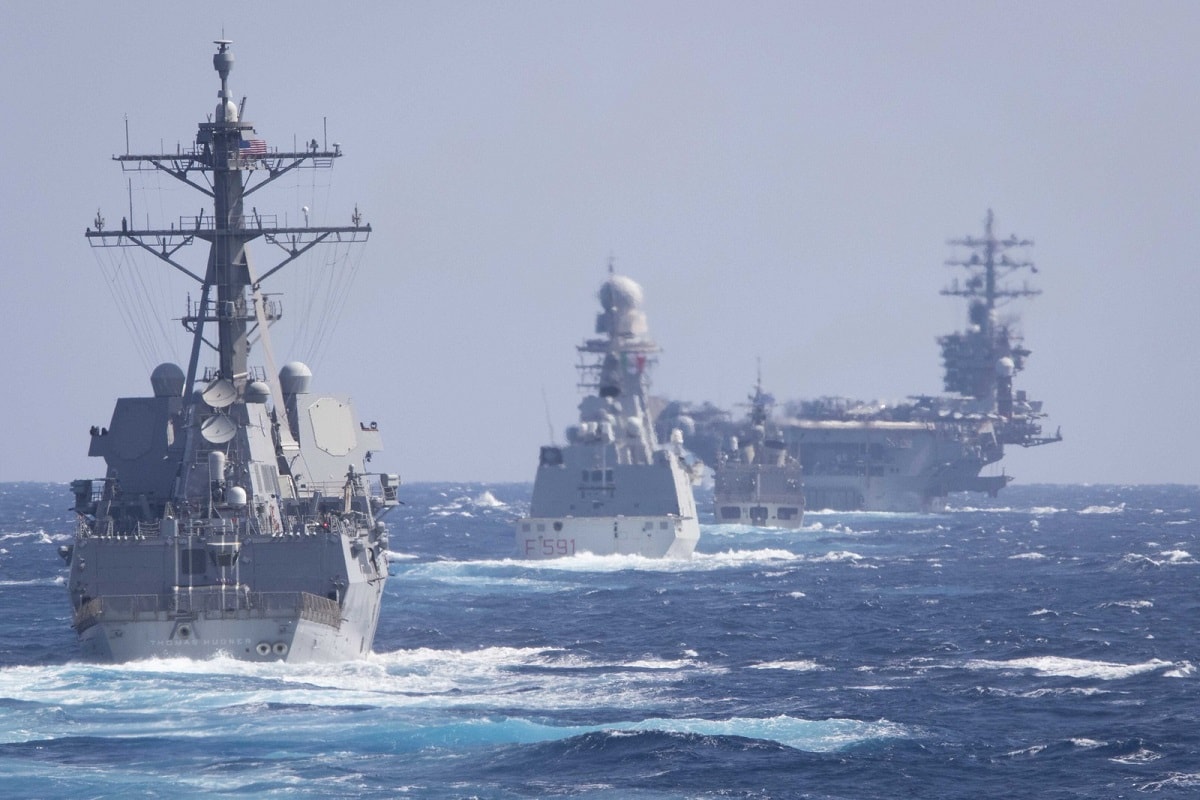
MEDITERRANEAN SEA (March 11, 2021) The Arleigh-Burke class guided-missile destroyer USS Thomas Hudner (DDG 116), left, the Italian navy Carlo Bergamini-class frigate ITS Virginio Fasan (F 591), the Hellenic Navy Hydra-class frigate HS Psara (F 494) and the Nimitz-class aircraft carrier USS Dwight D. Eisenhower (CVN 69), right, are underway in formation, March 11, 2021. The Dwight D. Eisenhower Carrier Strike Group on a routine deployment in the U.S. 6th Fleet area of operations in support of U.S. national interests and security in Europe and Africa. (U.S. Navy photo by Mass Communication Specialist 2nd Class Kaleb J. Sarten) 210311-N-QD512-3060.
The Navy also needs sailors. A Nimitz-class carrier and its air wing require thousands of personnel, while the service already faces manpower shortages. Maintenance money and shipyard labor assigned to Eisenhower cannot support another carrier, submarine, or delayed overhaul at the same time.
A carrier that spends the extension in repair does not solve the presence problem.
The legal definition counts a carrier temporarily unavailable for scheduled maintenance, but combatant commanders need deployable ships.
The extension works only if Ike delivers credible sea days at a cost lower than the strategic loss created by a 10-carrier fleet.
USS Enterprise Should Decide When Ike Leaves
Delivery is not the same as combat readiness. A new carrier still needs acceptance work, certifications, crew training, air-wing integration and fleet exercises. Gerald R. Ford did not begin its first deployment until more than five years after commissioning.
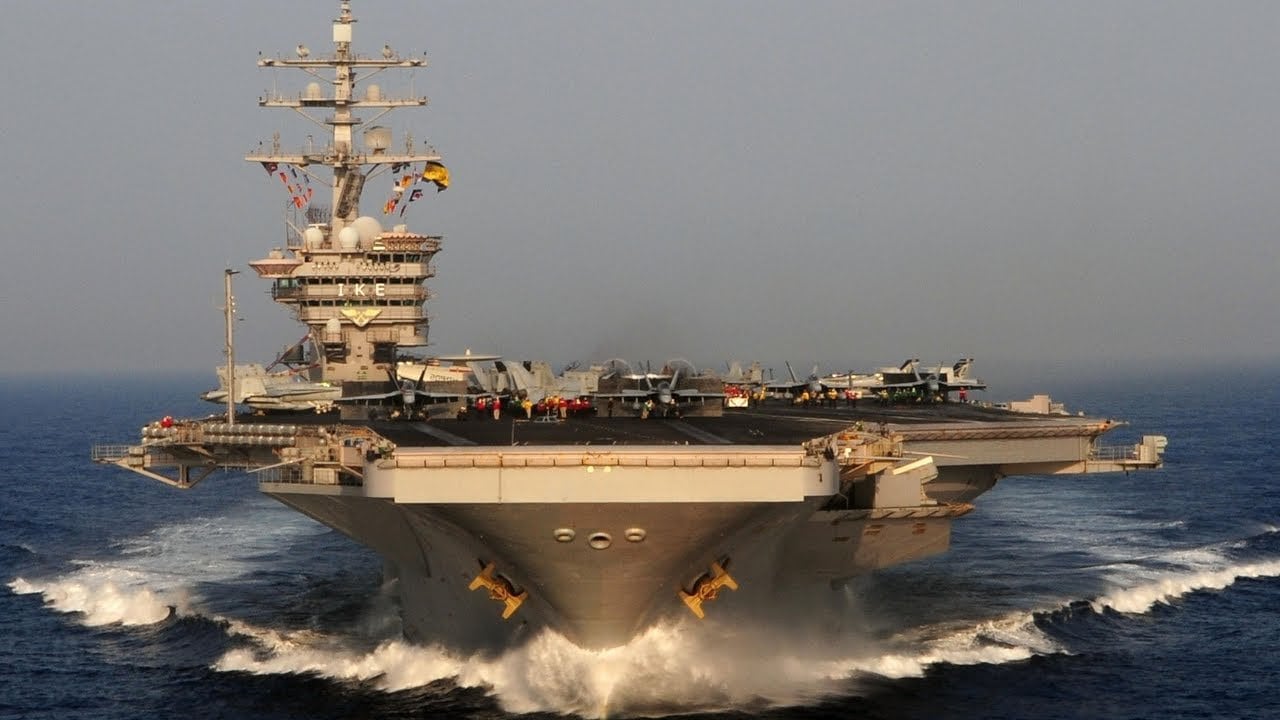
USS Dwight D. Eisenhower. Image Credit: U.S. Navy.
Enterprise should perform better after lessons from the first two ships, but the Navy should not assume a perfect transition.
The current plan already says Eisenhower’s material condition and combat contribution will be reviewed before a final inactivation decision. That review should be funded now, alongside a limited extension package lasting into 2031 or 2032.
The Navy is already using older carriers to cover industrial delays, while China is building naval aviation capacity at a faster industrial pace.
If Enterprise reaches the fleet on schedule and proves ready, Ike can begin inactivation without creating a gap.
If Enterprise slips again, the Navy should already have the money, maintenance plan, and reactor assessment needed to keep Eisenhower at sea.
MORE – China’s J-20 Fighter Is Being Built in Big Numbers
About the Author: Harry J. Kazianis
Harry J. Kazianis (@Grecianformula) was the former Senior Director of National Security Affairs at the Center for the National Interest (CFTNI), a foreign policy think tank founded by Richard Nixon based in Washington, DC. Harry has over a decade of experience in think tanks and national security publishing. His ideas have been published in the New York Times, The Washington Post, The Wall Street Journal, CNN, and many other outlets worldwide. He has held positions at CSIS, the Heritage Foundation, the University of Nottingham, and several other institutions related to national security research and studies. He is the former Executive Editor of the National Interest and The Diplomat. He holds a master’s degree focusing on international affairs from Harvard University.