The world is on a knife’s edge right now as the ceasefire with Israeli characteristics is apparently holding (somewhat) between the United States and the Islamic Republic of Iran.
Even though the ceasefire seems to be in effect, the Iranians are upset with the way in which the Israelis have completely ignored the tenets of that ceasefire in Lebanon, and Tehran is especially cross with President Donald Trump over how the Americans won’t simply recognize Iranian control over the vital Strait of Hormuz.
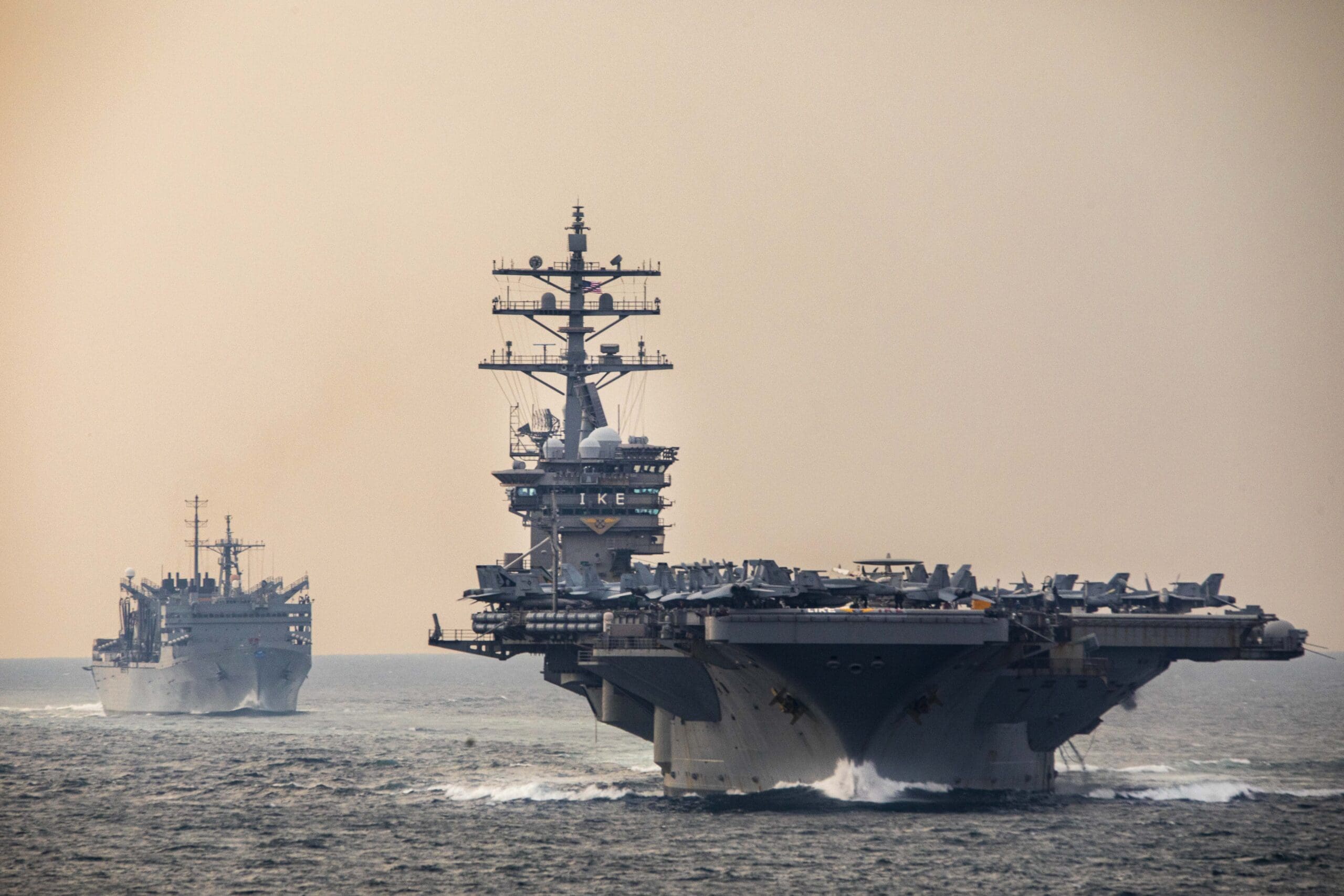
Components of the Dwight D. Eisenhower Strike Group (IKECSG) and the fast combat support ship USNS Supply (T-AOE 6) transit the Strait of Hormuz, Dec 14, 2023. As part of the Dwight D. Eisenhower Carrier Strike Group (IKECSG), the Philippine Sea is deployed to the U.S. 5th Fleet area of operations to help ensure maritime security and stability in the Middle East region. (U.S. Navy photo by Mass Communication Specialist 2nd Class Keith Nowak)
Washington Quietly Reconsiders War–For Now
What’s more, in the last week, there have been meetings between President Trump and his military advisers and between the American president and his Israeli counterpart, Prime Minister Benjamin Netanyahu.
The meetings with his military advisers were extensive discussions on how and when the United States might resume military action against the Islamic Republic, especially considering Tehran is clearly wedded to maintaining a hold on the Strait of Hormuz and the Iranian regime refuses to talk about its nuclear weapons program with the Americans (I thought that program was totally “obliterated” last year).
According to Trump himself, he might resume the conflict after the August 18 deadline governing the Memorandum of Understanding (MoU) between the US and Iran expires.
Indeed, the follow-on discussion with Netanyahu, according to the prime minister himself, led him to tell a crowd of supporters that the president intimated he might resume hostilities with Iran if Tehran refused to comply.
The August 18 Deadline Begins to Fade
Yet the Wall Street Journal correctly pointed out that Trump’s rhetoric regarding the Iran War and the August 18 deadline has shifted since he met with the US military’s top leadership. Earlier statements from the White House and the press highlighted that the August 18 deadline–the day the MoU expired–was firm.
If the Iranians did not, at that point, fully restore the Strait of Hormuz and meet to discuss their nuclear weapons program, then the fighting would resume.
Now, however, WSJ reports that the administration is no longer treating August 18 as a hard deadline.
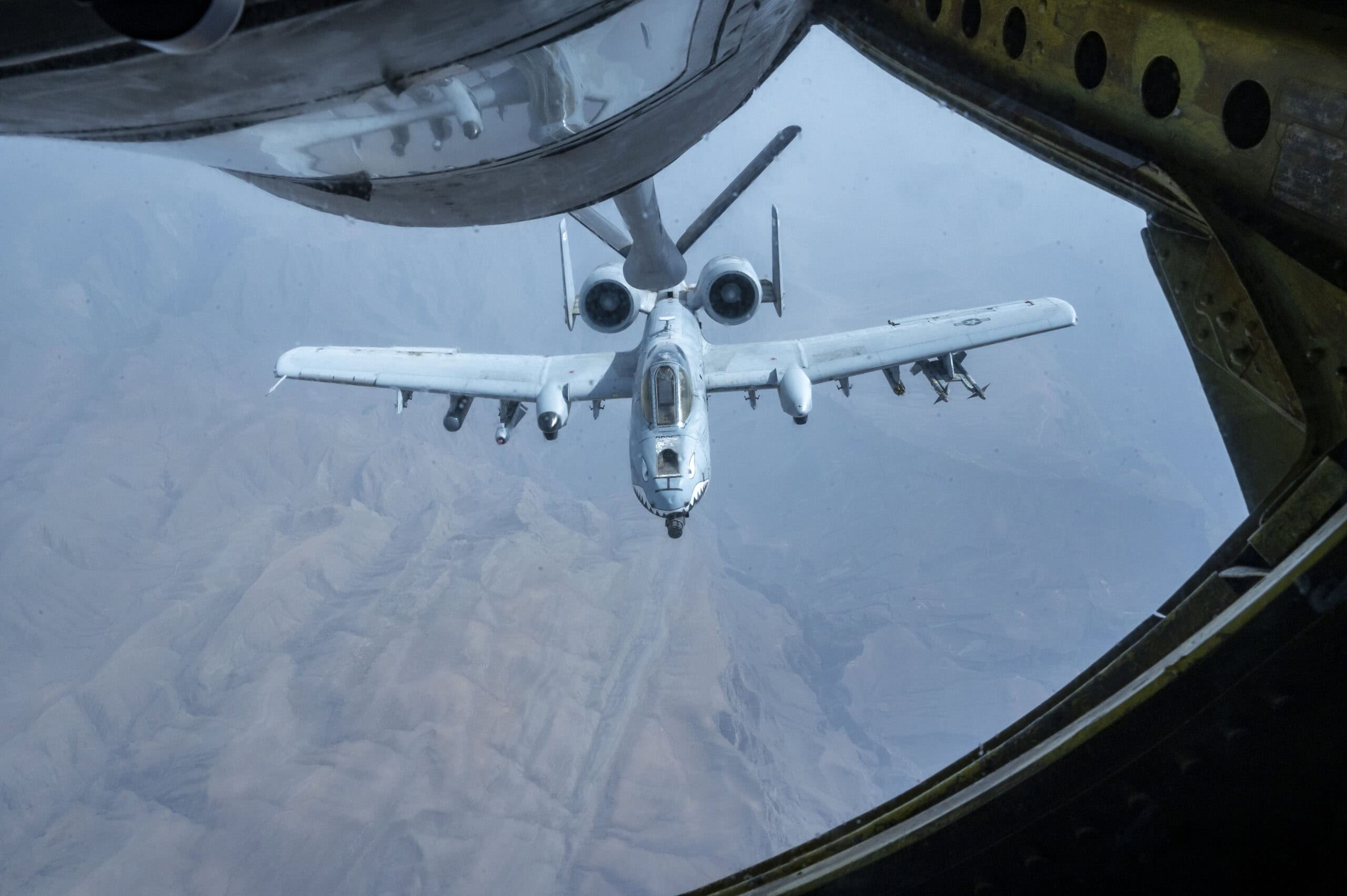
A U.S. Air Force A-10 Thunderbolt II from the 75th Expeditionary Fighter Squadron receives fuel from a KC-135 Stratotanker during air refueling operations above the Strait of Hormuz, July 21, 2023. In an ongoing effort to ensure the security and freedom of navigation in the region, U.S. Air Forces Central (AFCENT) reaffirms its unwavering commitment to maintaining stability and safeguarding global trade in this vital maritime route. (U.S. Air Force photo by Staff Sgt. Frank Rohrig)
Contrary to my belief that the negotiations are merely another ruse to buy the US military time before restarting hostilities in some capacity, Alexander Ward and Lara Seligman of the WSJ posit that Washington’s softening of the formerly hard August 18 deadline likely means negotiations are not collapsing.
They assess that the forty-seventh American president likely believes more can be gained through negotiations. What’s more, it showcases that the pressure to resume immediate offensives against Iran has likely reduced since the last outburst of violence.
A New Phase of “Armed Diplomacy”?
Ward and Seligman anticipate a scenario going forward that is less a ceasefire and certainly not a restoration of war, but rather a ceasefire punctuated by occasional violations by all sides, resulting in proportional strikes, followed by the resumption of negotiations.
This at least fits the larger pattern of how crisis management between the US, Israel, and Iran has occurred over the last several decades. Hence, former US ambassador to the Kingdom of Saudi Arabia calls this a “ceasefire with Israeli characteristics.”
What’s more, Ward and Seligman break down a significant event in the quest for peace: the establishment of a hotline between Tehran and Washington, specifically, between the Iranian regime’s ideological enforcers, the Iranian Revolutionary Guards Corps (IRGC).
This move by the Trump administration to establish a hotline with Tehran reflects the same form of Cold War crisis management. They signal a serious commitment to de-escalation.
Further, this WSJ piece reinforces a theory that I have been writing at this publication and on my Substack about how the Islamic Republic of Iran has become a true Middle East power in its own right–so much so that Washington is now, according to Ward and Seligman, creating a permanent deconfliction hotline with Tehran. That move signals normalization between Iran and the US.
By publicly reminding the world that he has been talking both to his military advisers and to Netanyahu about the resumption of hostilities with Iran, the forty-seventh president might be conducting what’s known as “coercive diplomacy.”

The crew of a U.S. Air Force B-1B Lancer display their mascot from the cockpit window during a presence patrol above the U.S. Central Command’s area of responsibility Oct. 30, 2021. Multiple partner nations’ fighter aircraft accompanied the B-1B Lancer at different points during the flight, which flew over the Gulf of Aden, Bab el-Mandeb Strait, Red Sea, Suez Canal, Arabian Gulf, Strait of Hormuz and the Gulf of Oman before departing the region. (U.S. Air Force photo by Senior Airman Jerreht Harris)
Another term for this concept derives from international relations scholar Henry R. Nau, who during the George W. Bush administration coined the term “Armed Diplomacy.” Essentially, this policy sees the use of limited force and extravagant threats during the diplomatic process to compel adversaries to negotiate.
The Military Reality Remains Unchanged
Many dissident American experts might disagree with this interpretation. I am certainly skeptical.
But, given that everyone now knows (because Trump himself admitted this painful reality in Versailles a few weeks ago), the US is about to run out of its energy buffers.
The US military has drastically depleted its key standoff munitions and defensive interceptor stockpiles–which won’t be resupplied anytime soon; Trump may realize he cannot reliably restart the war (if he expects to win in any semblance of that word).
Then again, these facts have been true from the start of the war. Yet, Trump continued fighting a war that most military experts told him could not be won under current conditions.
Nevertheless, the president persisted in fighting it.
Israel’s government is steadfastly committed to waging this war. In fact, whether Benjamin Netanyahu remains in power after this year’s elections in October, the reality is that Netanyahu’s likely successor–Naftali Bennett–is even more hawkish on Iran than is Netanyahu (if that’s even possible).
Hormuz Remains the Real Battlefield
Even though establishing a deconfliction line between the White House and the IRGC is a significant step, the fundamentals of the conflict have not yet changed.
And we’re not just talking about the military fundamentals (which are not in America’s favor at this point). The diplomatic strategy remains precarious.
That’s because it is not only the US and Iran that are negotiating.
The Iranians insist that the situation in Lebanon be part of any agreement. And the Americans, while paying lip service to that Iranian demand, have yet to fully enforce it.
Besides, Netanyahu has made clear he will continue prosecuting his (failing) war in Southern Lebanon as he sees fit, irrespective of the US-Iran MoU.
The Strait of Hormuz remains the most important factor in the war. Not for Israel, which ultimately could care less about that waterway.
The key for the US and Iran is the Strait because of the trade flows.
As you’ve likely become accustomed to reading, it bears repeating that 20 percent of the world’s oil, nearly 20 percent of the world’s natural gas, and one-third of the world’s agricultural inputs–to say nothing of the industrial inputs, like helium–flow through the Strait every year.
With the Strait of Hormuz blocked since the conflict began in February, these goods have not passed through in any significant volume.
And the Iranians are unlikely ever to relinquish their ability to impose fees on the Strait–while the Americans refuse to accept this new paradigm under any circumstance.
Until that situation is resolved, the prospects for peace–real peace–are next to zero. In the meantime, the Iranians have allowed some of the goods to leave through the Strait of Hormuz.
But those numbers are far fewer than before the war, thereby exacerbating the impending crash in global energy supplies, agricultural goods, and industrial inputs.
Indeed, the Iranians are likely going to slow-walk the restoration of trade flows through the Strait to ensure the Americans feel the pinch while forcing Washington to remain true to its agreement with Iran.
The Most Likely Outcome: Endless Extensions
The likeliest best-case scenario under these tense conditions would be for the Trump administration to continue what it has been doing with the tariffs since Trump implemented his poorly conceived trade war with the world: granting extensions every 45 days or so.
In fact, that’s what many experts have asserted will occur. And the WSJ piece implied that this was one such possibility, given that Trump neither entirely abandoned nor reaffirmed his previous commitment to meeting the August 18 deadline.
That’s better than total war.
It’s not as good as real peace, though. Because that means we will keep being brought to the brink each time a ceasefire extension is needed.
Since none of the warring parties can agree on what the end of the war will look like, this is the best scenario we can all hope for.
About the Author: Brandon J. Weichert
Brandon J. Weichert is the Senior National Security Editor at 19FortyFive.com. He also manages The Weichert Brief on Substack. Weichert also hosts “National Security Talk” on Rumble. He is the author of four bestselling national security books, the most recent of which is A Disaster of Our Own Making: How the West Lost Ukraine (Encounter Books). Follow him via Twitter/X @WeTheBrandon.