
When Major William “Pete” Knight brought the X-15A-2 down onto the dry lakebed at Edwards Air Force Base on October 3, 1967, he had just flown faster than any pilot in an airplane before or since, Mach 6.72, about 4,520 miles per hour. Then he climbed out, still in his pressure suit, and looked at what the flight had done. The white heat-shield coating was scoured and charred. There were burns along the wing leading edges and holes in the structure. And the dummy engine the aircraft had carried under its tail was simply gone.
The airplane that holds the record for the fastest flight in aviation history never flew again. NASA’s own account of the program says the aerodynamic heating damage from the record flight, sustained despite a special protective coating, helped ensure that the experiment the flight was built around never happened at all. The story of that day is the story of the X-15’s technology, which was so far ahead of its era that the machine ran into the laws of physics.
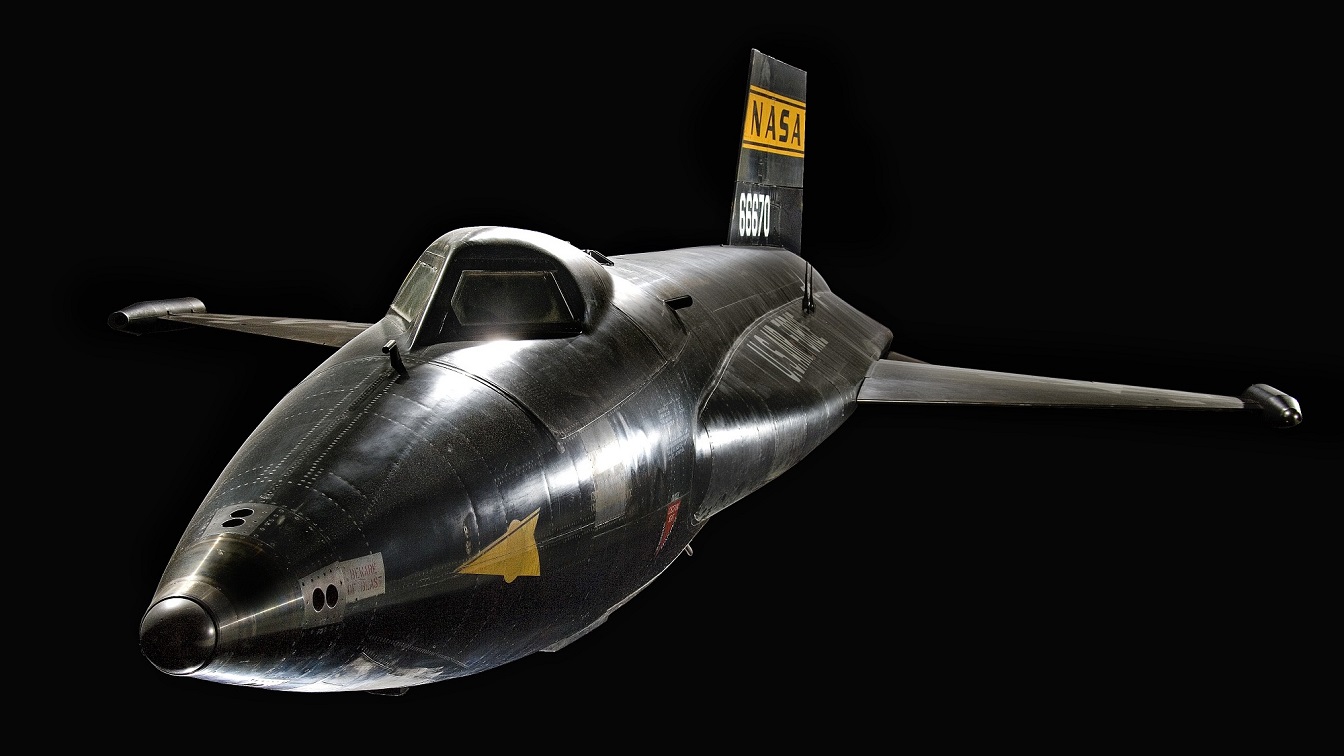
X-15 NASA Program. 19FortyFive.com Photo.
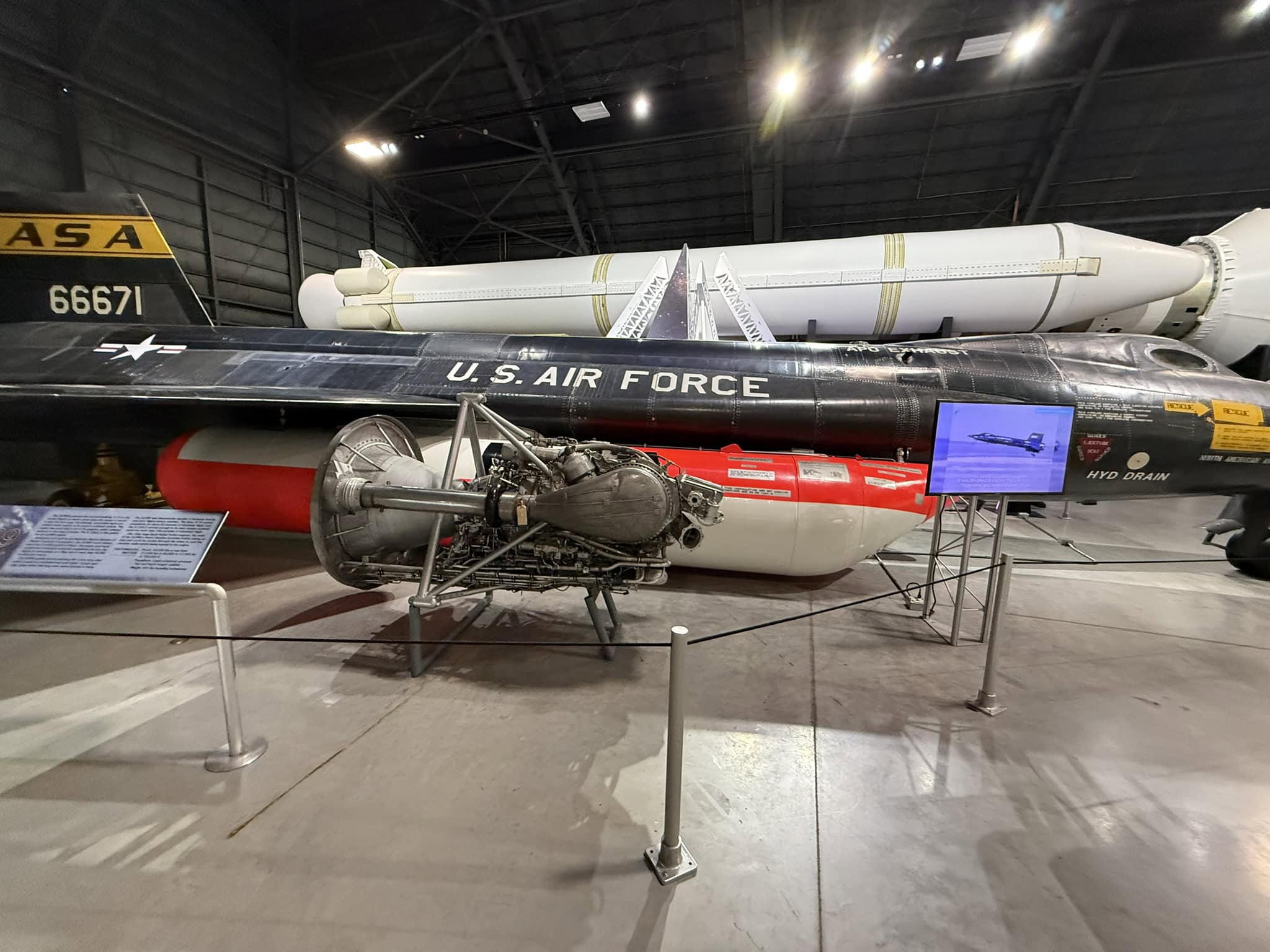
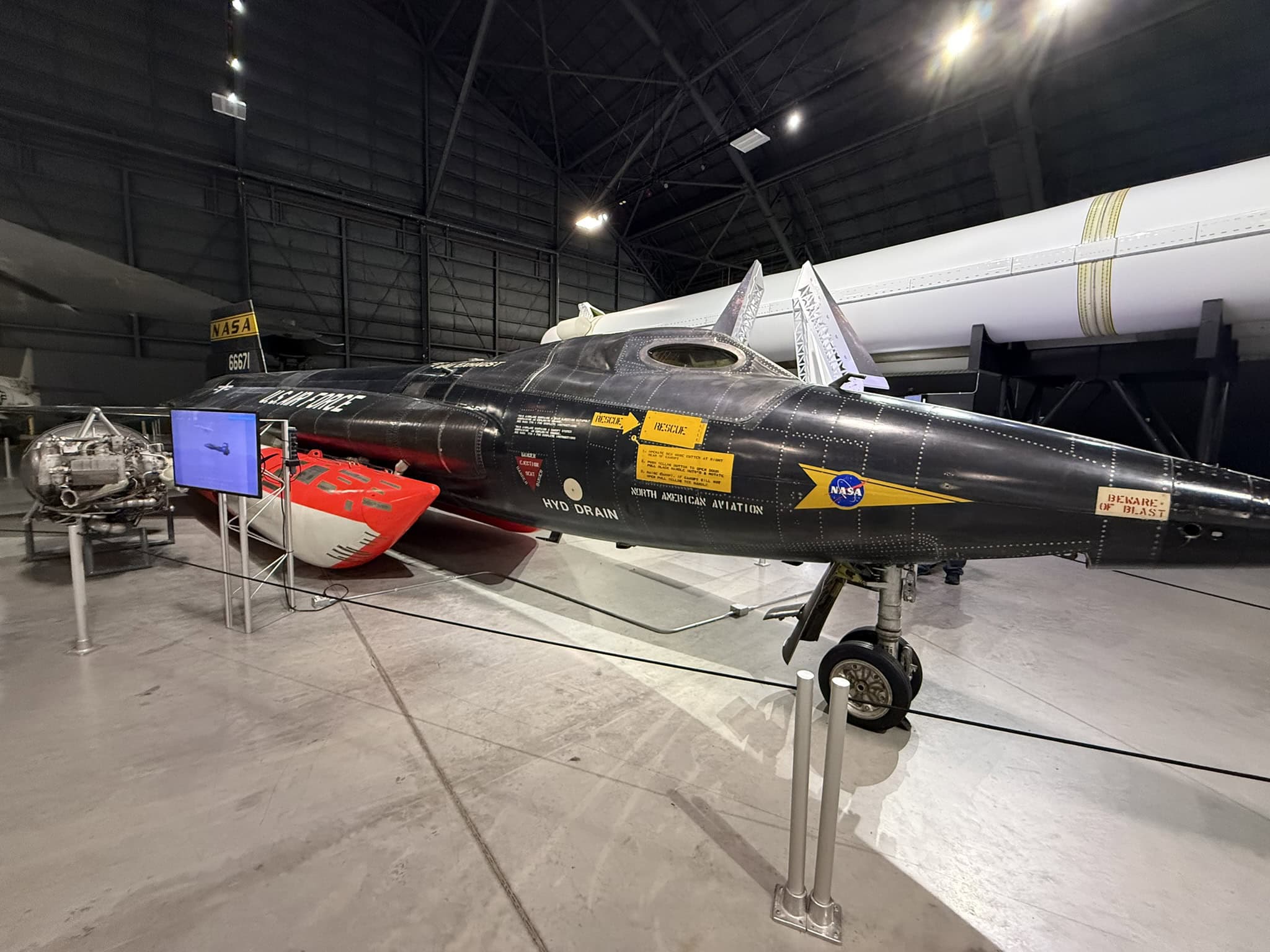
This is an image of the X-15 taken by Editor-In-Chief of 19FortyFive.com Harry J. Kazianis back in 2025 and the National Museum of the U.S. Air Force.
Inconel X, the XLR99 Rocket Engine, and a Design That Broke the Rules
When the requirement for the X-15 was written in the early 1950s, the world airspeed record stood at under 700 miles per hour. The new research airplane was ordered to fly Mach 5 and reach altitudes above 250,000 feet, numbers no aircraft had approached. North American Aviation, builder of the P-51 Mustang, won the contract, and the first flight came in June 1959.
Nothing about the machine was conventional. Ordinary aluminum softens at the temperatures generated by hypersonic friction, so the X-15 was skinned in Inconel X, a high-strength nickel alloy chosen to survive sustained heating around 1,200 degrees Fahrenheit. The metal expanded audibly in flight; Christian Gelzer, chief historian at NASA’s Armstrong Flight Research Center, put it plainly: “And the pilots could hear it expand behind them.” The shape broke the rules, too. Supersonic design demanded needle noses and razor-thin wings, and the X-15 deliberately rejected both, using a blunted nose and thick, blunt-edged wings because sharp edges concentrate heat at hypersonic speed. It was, in the Smithsonian’s description, a dramatic departure from good supersonic airplane design, and it was correct.
The propulsion matched the airframe’s ambition. The XLR99 rocket engine delivered 57,000 pounds of thrust, made the X-15 the first aircraft with a large throttleable, restartable rocket engine rated for a pilot, and drank its entire propellant load in well under two minutes of burn. The aircraft was carried to 45,000 feet under a B-52’s wing and dropped, because it could never have taken off on its own. Above the usable atmosphere, where wings and rudders grip nothing, the pilot steered with hydrogen-peroxide reaction thrusters in the nose and wings, wearing a full-pressure suit, flying what was in every meaningful sense a spacecraft with landing skids.
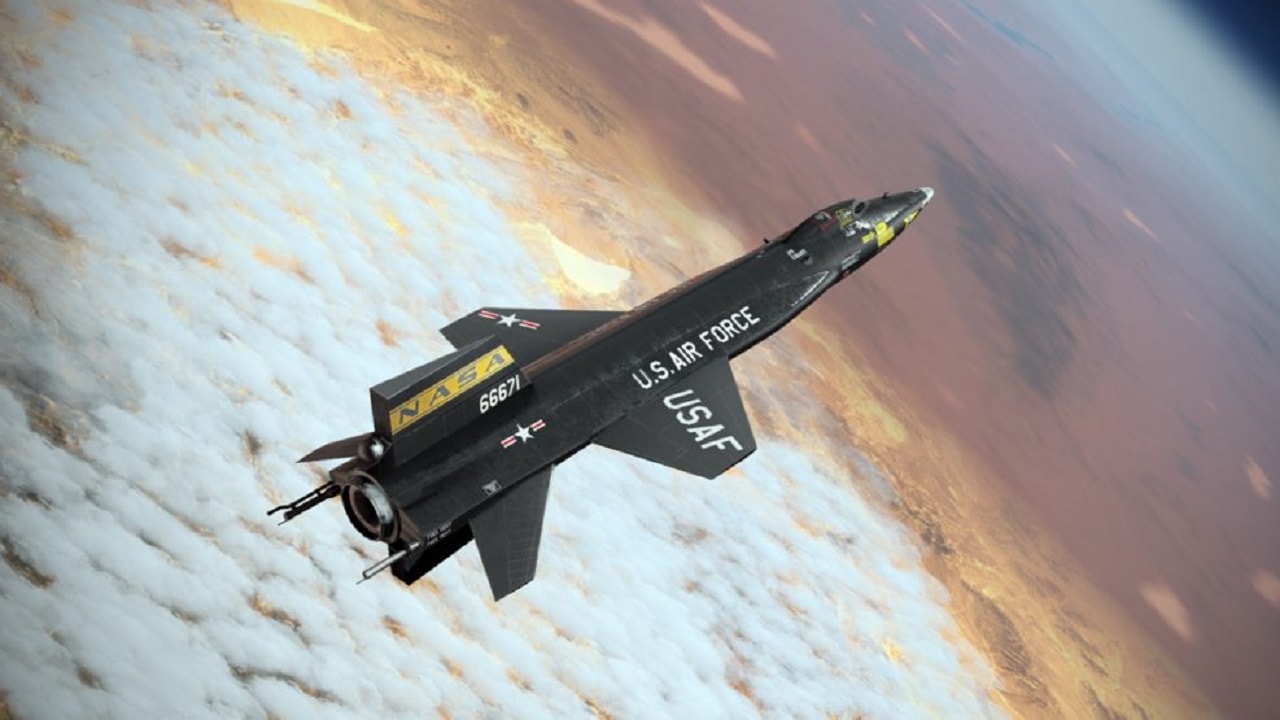
X-15. Image Credit. NASA.
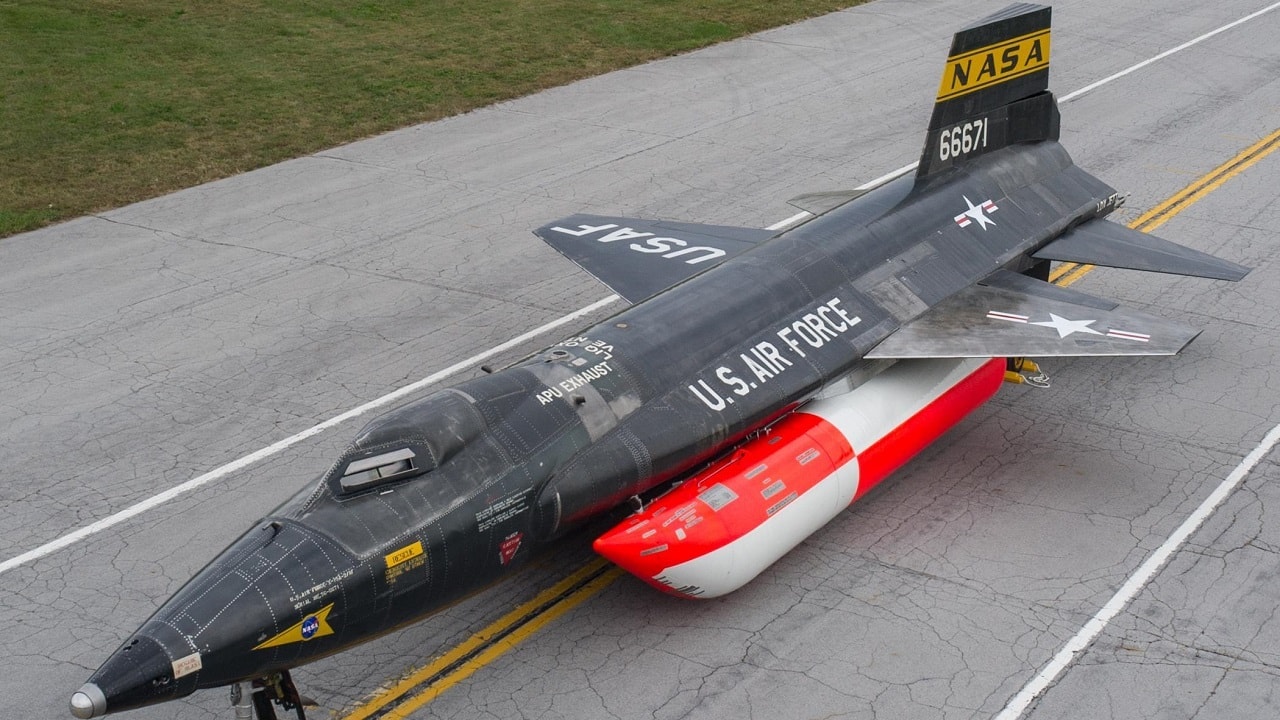
X-15. Image Credit: NASA.
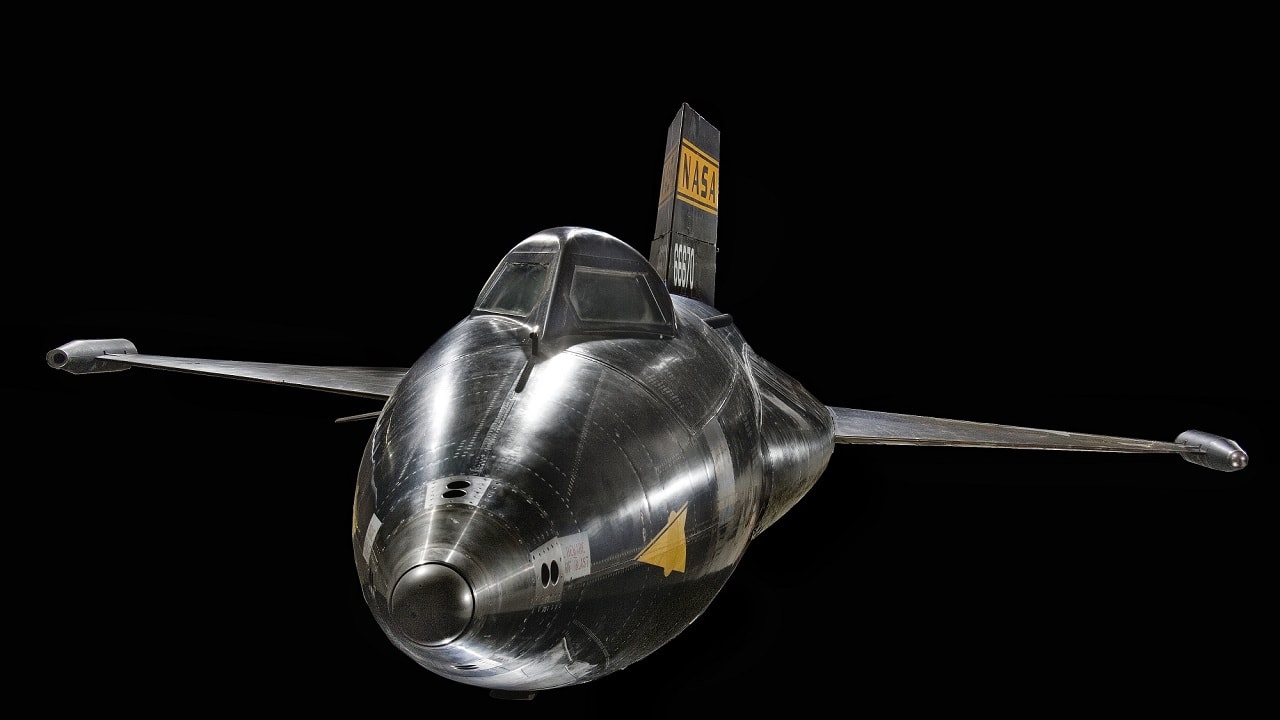
North American X-15, rocket powered experimental aircraft; black titanium skin with wedge shaped horizontal stablizer; yellow stripe NASA inisignia on tail with stars and red bars United States national insignia on wings; white letter text “U.S. AIR FORCE” on the sides of the fuselage.
The Mach 6.7 Flight That Burned Through the Airplane
By 1967, the second airframe had been rebuilt as the X-15A-2, stretched, fitted with jettisonable external propellant tanks for a longer burn, and coated in a sprayed-on ablative material meant to char and flake away, carrying heat with it.
Under the tail, it carried a dummy scramjet, a mockup of the revolutionary air-breathing engine the aircraft was eventually supposed to test at speeds above Mach 5. The October 3 profile was the program’s maximum-speed attempt: drop from the B-52, tanks away around Mach 2, then everything the engine had.
Knight got the record. The airplane paid for it. Analysis afterward found that shockwaves emanating from the dummy scramjet’s nose intersected the shockwave from its support pylon, focusing superheated vortices directly onto the structure.
The ablative coating in that zone was scoured away, the fuselage skin wrinkled, and the pylon itself burned through. Three of the four explosive bolts holding the scramjet detonated from the heat alone; the fourth fractured, and the dummy engine fell off the airplane at high speed, coming down in the desert more than 100 miles from Edwards. Post-flight photographs documented holes in the fuselage and burns along the wings; heating at the ventral fin had run roughly seven times as high as engineers expected. Jack Kolf, a Flight Research Center engineer, said later that if anyone had known the airplane would come back in that condition, “we never would have flown it.”
North American repaired the airframe, but the record flight had made the point. A declassified program report states the outcome without drama: the X-15A-2 effort was terminated during the repairs, and the still-higher speeds the aircraft had been modified to explore were never attempted. The fastest airplane flight in history was flown by an aircraft chasing performance it never got to demonstrate.
What the X-15 Program Cost and What It Bought
The record run came near the end of a program that had been rewriting the envelope for eight years. Three X-15s flew 199 missions between 1959 and 1968, flown by twelve pilots, among them a young Neil Armstrong, and eight of those pilots flew high enough, above 50 miles, to earn astronaut wings. The autumn of the record was also the program’s darkest. Six weeks after Knight’s flight, on November 15, 1967, Air Force Major Michael Adams was killed when the third X-15 broke up during reentry following pilot disorientation and a control-system failure, the program’s only fatal flight.
What the effort bought is hard to overstate. The Smithsonian credits the program with roughly 700 technical documents, a volume of research it equates to the output of a 4,000-person federal research center working for more than two years, spanning hypersonic aerodynamics, winged reentry, aerodynamic heating, and life-support systems for spacecraft. The data underwrote Mercury, Gemini, Apollo, and above all, the Space Shuttle, the only other winged vehicle ever to carry people faster. At one point, NASA and North American seriously studied sending a growth version of the X-15 itself into orbit before the capsule approach won out.
Fifty-Eight Years Later, America Is Trying to Get Back
The reason the X-15 is suddenly relevant again is that the United States is spending billions to rebuild a capability that retired with it.
The Pentagon’s hypersonic push against Chinese and Russian programs has revived exactly the problem the X-15 was designed to solve: how to test at Mach 5-plus without throwing away the vehicle each time.
The current answer is Stratolaunch’s Talon-A, an uncrewed, rocket-powered testbed that flew hypersonic in December 2024 and again in March 2025, topping Mach 5 and landing at Vandenberg, flights the Defense Department calls America’s first return to reusable hypersonic flight testing since the X-15 program ended in 1968. George Rumford, who directs the Pentagon’s Test Resource Management Center, framed the goal as cutting test turnaround “from months down to weeks.” A third hypersonic flight followed this March and was disclosed in May; it was the first flown from a converted 747 carrier under a Missile Defense Agency program.
The calibration is worth sitting with. Talon-A is a real achievement and a working answer to a real gap. It is also uncrewed, and it flies above Mach 5, which means that as of July 2026, the newest reusable hypersonic vehicle in American service is slower than the airplane Pete Knight flew with his own hands in 1967.
That airplane, the X-15A-2, sits today in bare nickel alloy at the National Museum of the US Air Force in Dayton, Ohio, its ablative coat long since stripped, the fastest airplane in history displayed a few galleries from machines it outran by miles per second, still wearing the airframe that came back from Mach 6.7 burned, holed, and finished. And, yes, some of the pictures in this article are of that very aerospace wonder.
About the Author: Harry J. Kazianis
Harry J. Kazianis (@Grecianformula) was the former Senior Director of National Security Affairs at the Center for the National Interest (CFTNI), a foreign policy think tank founded by Richard Nixon based in Washington, DC. Harry has over a decade of experience in think tanks and national security publishing. His ideas have been published in the NY Times, The Washington Post, The Wall Street Journal, CNN, and many other outlets worldwide. He has held positions at CSIS, the Heritage Foundation, the University of Nottingham, and several other institutions related to national security research and studies. He is the former Executive Editor of the National Interest and the Diplomat. He holds a Master’s degree focusing on international affairs from Harvard University.

