
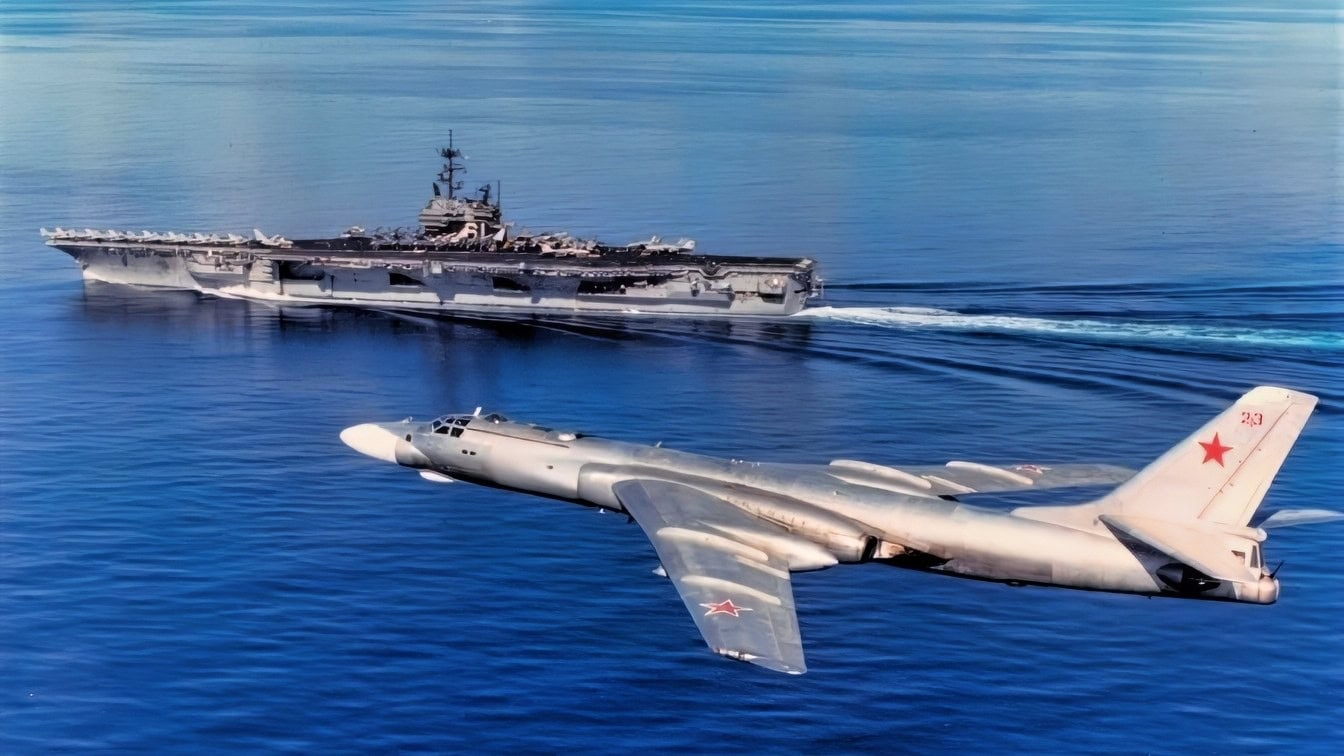
On July 18, 1979, one of America’s supercarriers suffered the sort of accident that seems quite unlikely given its size, crew, and the sophistication of its navigation systems.
The USS Ranger (CVA-61) collided with the Liberian-flagged tanker SS Fortune, roughly 30 miles east of Singapore near one of the busiest maritime corridors on earth.
Ranger was an enormous vessel, measuring roughly 1,050 feet long, with a flight deck covering several acres and a crew numbering in the thousands.
Yet the carrier’s size is part of why the collision happened; a boat so large carries incredible momentum and takes time and distance to maneuver.
And of course, the carrier doesn’t operate in a vacuum—it occasionally operates in crowded sea lanes alongside merchant vessels whose crews may be operating under different procedures and assumptions.
In the Ranger-Fortune collision, both vessels were damaged, spilling oil into the surrounding waters.
But weirdly, despite the collision’s relative significance, the event has mostly disappeared from public memory; no one talks about it.
Dangerous Waters
Geography contributed to the collision.
The waters surrounding Singapore connect the Strait of Malacca with the South China Sea, forming one of the principal maritime arteries between the Indian and Pacific Oceans—indeed, one of the world’s most significant chokepoints.
Tankers, freighters, naval vessels, and smaller commercial traffic are all compressed into a relatively constrained operating environment with narrow margins for error for a massive 1,000-foot-long American supercarrier.
This creates a radically different navigation problem from steaming across the open ocean.
Near Singapore, the Ranger couldn’t simply maneuver wherever it wanted; instead, it had to track commercial traffic, observe collision regulations, and anticipate changes in course and speed.
The Ranger’s crew needed to keep track of what the surrounding ships were doing, and doing so was harder than it is today.
Radar helped, of course, but navigation tech in 1979 was nowhere near what it is today on an integrated bridge. There was no GPS-based navigation picture like today, nor modern AIS broadcasting of the identity, position, course, and speed of surrounding commercial ships.
Radar contacts still had to be interpreted and plotted, and human lookouts remained an essential part of collision avoidance.
Ranger Meets Fortune
Fortune was a large commercial tanker, while Ranger was one of the Navy’s Forrestal-class supercarriers. The two vessels collided in the congested waters east of Singapore. Ranger’s bow struck Fortune, damaging the tanker and releasing oil.
The Ranger also sustained damage around its bow.
The amount of oil spilled into the ocean is unclear, and that uncertainty, in and of itself, is somewhat unusual. Crude released at sea can spread rapidly into a surface slick.
Light components of the oil evaporate, while heavier hydrocarbons can persist and disperse through the water, adhering to sediments and shorelines.
In tropical waters, where the incident occurred, high temperatures can accelerate some weathering processes, but that obviously doesn’t negate the environmental harms of the spill.
Weirdly Forgotten
Why does no one seem to remember the collision and the subsequent environmental harms? It’s hard to be precise about public memory, about what does and does not have staying power.
The Ranger-Fortune collision may have faded in part because nobody died and both ships survived.
The incident lacked the human catastrophe that tends to make stories stick in the mind.
Also, the Ranger wasn’t permanently lost or disabled. It went to receive repairs and then cycled back into regular service. Another factor might just be how crazy 1979 was.
The Iranian Revolution dominated headlines, especially the Iran hostage crisis, and later that year, the Soviet Union invaded Afghanistan.
It would have been easy for a boat collision to get lost in the headline shuffle. Also, the media ecosystem at the time wasn’t so robust.
There wasn’t any social media or 24-hour online news cycle complete with satellite imagery or cell phone footage of the event.
It was a headline or a 6 o’clock news blurb. It happened on the other side of the world. So while it’s odd in a respect that the Ranger-Fortune collision has been forgotten, it makes a certain degree of sense.
About the Author: Harrison Kass
Harrison Kass is a writer and attorney focused on national security, technology, and political culture. His work has appeared in Tablet, City Journal, The Hill, The Spectator, and The Cipher Brief. He holds a JD from the University of Oregon and a master’s in Global & Joint Program Studies from NYU. More at harrisonkass.com.