
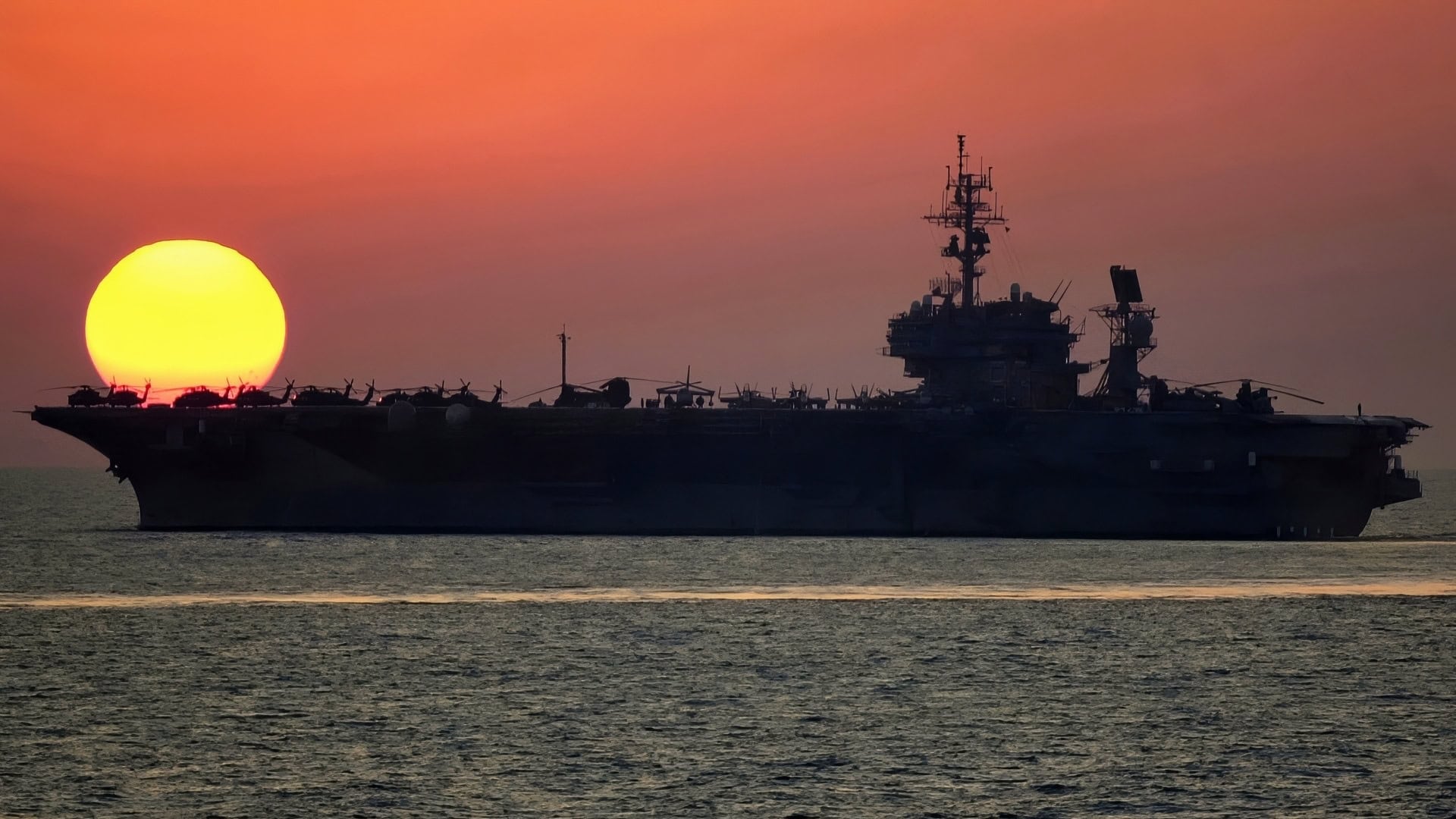
The United States has disposed of retired aircraft carriers at prices spanning four orders of magnitude. Five conventional carriers went to shipbreakers for one cent each. One was sunk on purpose after three years and $20 million of preparation. The first nuclear carrier will cost at least $1.28 billion and will not be finished until 2030. Nobody has ever put those numbers in one accounting, and the reason they diverge is not the size of the ship, the age of the ship, or the state of the scrap market. It is whether the ship has a nuclear reactor.
The Penny Fleet of Aircraft Carriers
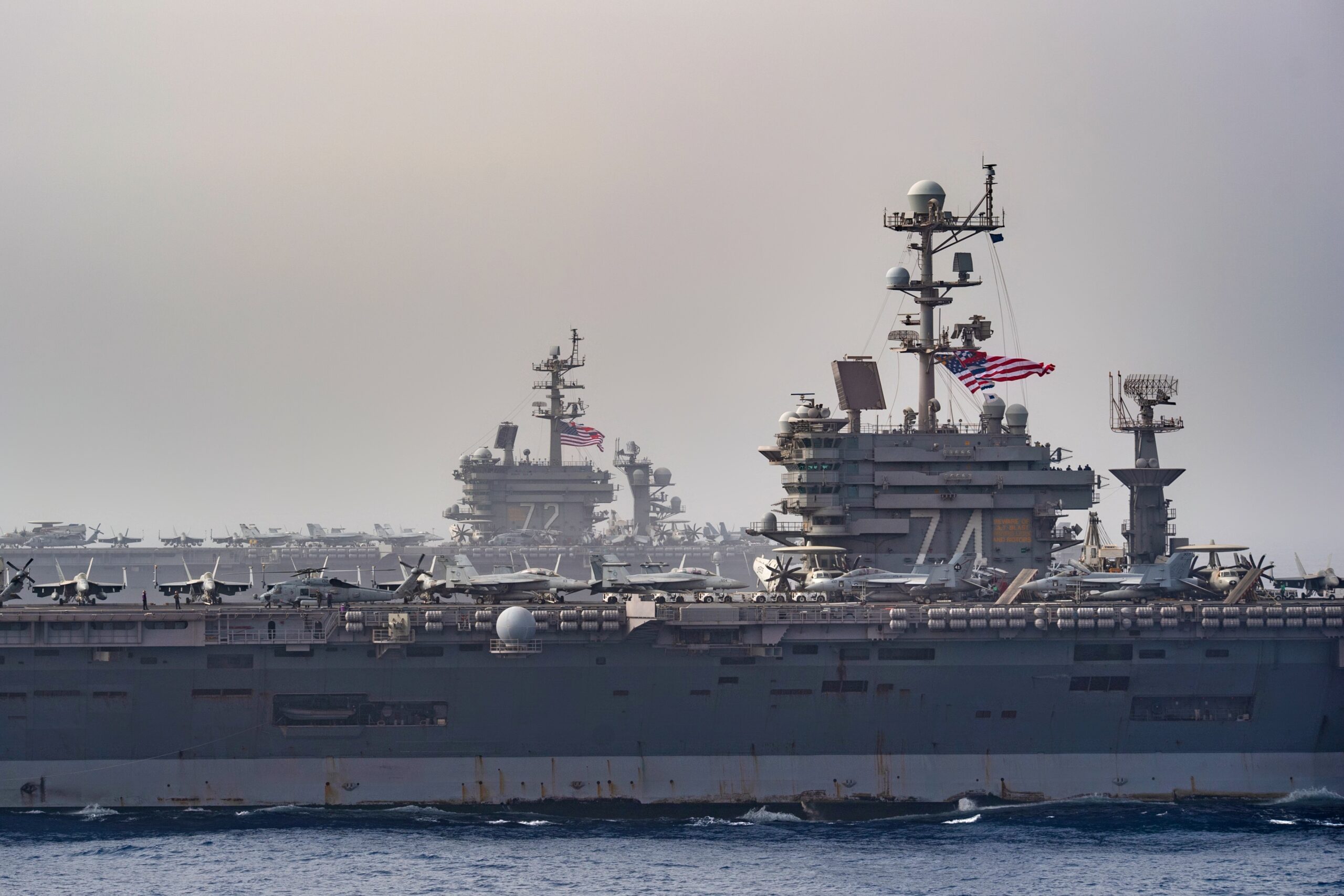
The aircraft carrier USS John C. Stennis (CVN 74) steams alongside the aircraft carrier USS Abraham Lincoln (CVN 72), background, in the Mediterranean Sea, April 24, 2019. The John C. Stennis Carrier Strike Group (CSG) 3 and Abraham Lincoln Carrier Strike Group (CSG) 12 are conducting dual carrier operations, providing opportunity for two strike groups to work together alongside key allies and partners in the U.S. 6th Fleet area of operations. John C. Stennis is underway in the Mediterranean Sea as part of the John C. Stennis Carrier Strike Group (JCSCSG) deployment in support of maritime security cooperation efforts in the U.S. 6th Fleet area of responsibility. (U.S. Navy photo by Mass Communication Specialist 3rd Class Grant G. Grady)
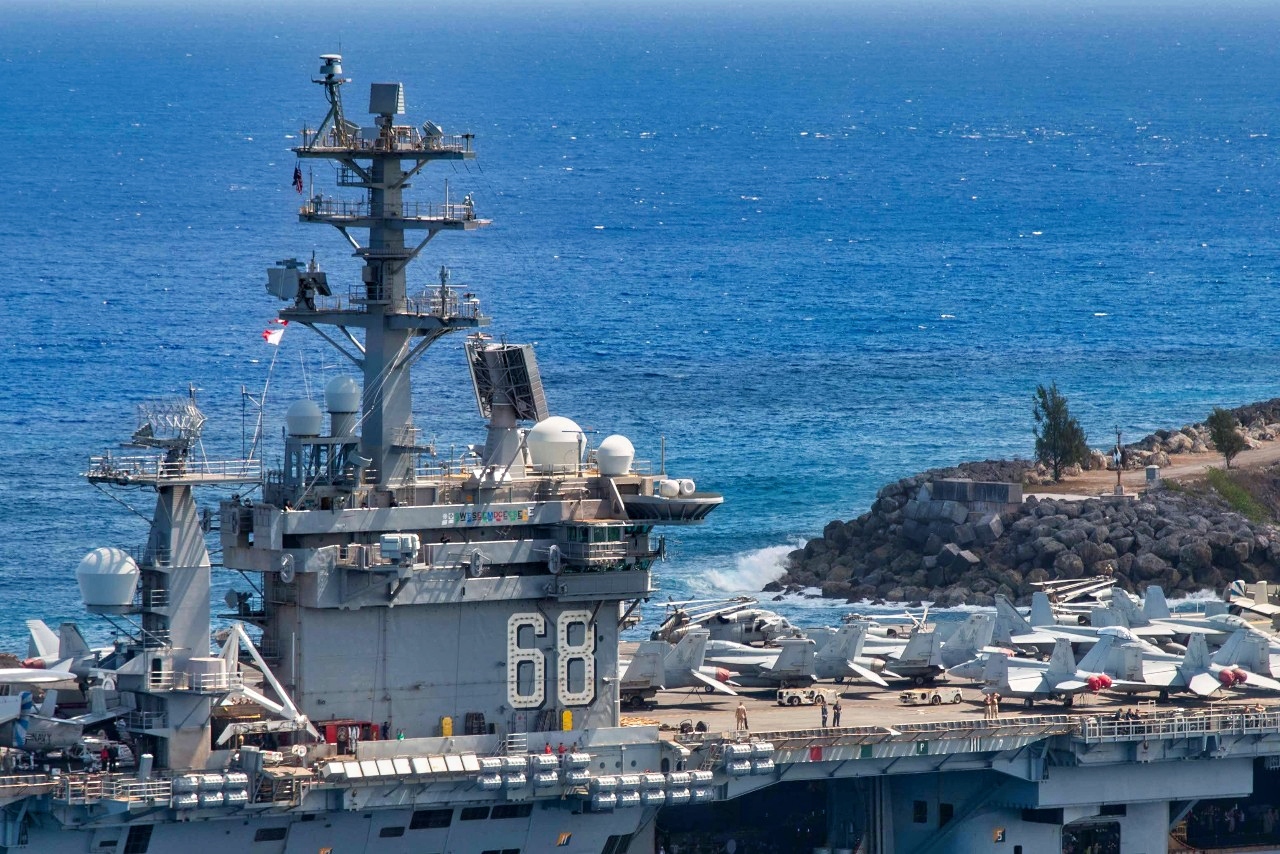
APRA HARBOR, Guam (April 18, 2025) Nimitz-class aircraft carrier USS Nimitz (CVN 68) arrived in Guam for a scheduled port visit, April 18. Nimitz is underway in the U.S. 7th Fleet area of operations on a scheduled deployment, demonstrating the U.S. Navy’s unwavering commitment to a free and open Indo-Pacific. (U.S. Navy Photos by Mass Communication Specialist 1st Class Samantha Jetzer)

Aircraft Carrier. Image Credit: U.S. Navy.
Forrestal went first, sold in 2013 to All Star Metals of Brownsville, Texas, for a single cent. Saratoga followed ESCO Marine for the same price. Then Ranger, then Kitty Hawk, and John F. Kennedy, each for one cent to International Shipbreaking Limited. Kitty Hawk cost about $264 million to build in 1961. She left Bremerton in January 2022 on a 16,000-mile tow around South America and reached the Texas breakers that May.
The penny is not a bargain-bin price; it is an accounting artifact that should be explained. Naval Sea Systems Command has described these as procurement contracts rather than sales: the government pays the contractor one cent, retains ownership of the hull until the last piece is cut, and lets the company keep the steel, aluminum, copper, and copper-nickel it recovers. The scrap covers the towing, the asbestos, the PCBs, the insurance, and the years of labor, so the fee falls to the smallest number the system can express.
When the scrap does not cover it, the number moves. The Navy paid International Shipbreaking roughly $3 million to dismantle Constellation, a sister ship of Kitty Hawk.
The Reef
Oriskany is the only American carrier deliberately sent to the bottom. The Essex-class ship was decommissioned in 1976, sat for decades, and was chosen for a pilot program that would turn retired warships into artificial reefs.

USS Intrepid USN Aircraft Carrier 19FortyFive Original Image.
Preparation ran three years and roughly $20 million: crews opened and cleaned more than 500 tanks and stripped out fuel, oil, asbestos, batteries, and the entire wooden flight deck, work that took years and $20 million before anyone lit a charge.
The Environmental Protection Agency approved the sinking in February 2006 after ruling that residual toxins in her cables, insulation, and paint would leach slowly over the century it will take for the hull to rust away.
On May 17, 2006, divers detonated the charges 22.5 nautical miles southeast of Pensacola Pass. Navy engineers had predicted the ship might take up to five hours to go under. She sank in 37 minutes, stern first, and settled upright in 212 feet of water, where Florida’s Wildlife Commission now lists her as the largest artificial reef ever intentionally created in American coastal waters.
The Nuclear End
Nuclear aircraft carrier USS Enterprise broke the pattern because she was built with eight A2W reactors, a choice no carrier before or since has repeated; every nuclear carrier that followed uses two.
That arrangement made her a one-off disposal problem, and it killed the museum campaign outright, since preserving her would have required partially dismantling the ship to extract the reactors first.
The bill arrived in pieces and was epic for sure. The Navy first awarded a $536.7 million dismantlement contract in 2025, then rebid the work after a legal challenge and awarded it again on July 15, 2026, to NorthStar Maritime Dismantlement Services of Vernon, Vermont, at $418.5 million, a rebid that cut roughly $118 million. That contract sits on top of what came before: $902 million for inactivation and $111 million for storage by USNI News’s accounting, or at least $1.28 billion all in, depending on which line items are counted. The work happens in Mobile, Alabama, and runs until September 2030. Roughly 35,000 tons of her steel may be recycled into the future USS Enterprise, CVN-80.
The Ship With No Total
Nimitz is the test of whether the Enterprise number was a one-off. She arrived at Naval Station Norfolk on July 9, 2026, and will be decommissioned in March 2027, ten months later than planned, after the Navy issued a $96 million advance-planning contract to Newport News Shipbuilding. The fiscal 2027 budget assigns $562 million to her inactivation — shutting down systems, draining fluids, demilitarizing spaces, preparing two A4W reactors for defueling. That is phase one. No total has been published, and no completion date exists in the public record. Forbes has reported estimates above $1 billion for the full job.
Why the Reactor Is the Whole Difference
A conventional carrier is a very large pile of recoverable metal wrapped around a manageable hazardous-material problem. Sell the metal, pay for the work, and the price converges on zero.
A nuclear carrier inverts every term. The government cannot transfer the reactors, spent fuel, or low-level waste to a commercial buyer, so it retains liability permanently. Defueling requires nuclear-qualified labor, M-290 shipping containers, and oversight by Naval Reactors. The compartments stay radiologically controlled. Scrap value never touches those costs, and the ship cannot be sunk as a target or given away as a museum. The steel is worth the same either way; the reactor is what moves the price by a factor of a hundred billion.
Enterprise finishes in September 2030 if the schedule holds. Nimitz decommissions in March 2027 with 600 uniformed positions still budgeted against her in fiscal 2030. Nine more Nimitz-class aircraft carriers follow her, and the Navy has published a price for none of them.
MORE – China Has 50 Frigates: The US Navy Is Building 2
About the Author: Harry J. Kazianis
Harry J. Kazianis (@Grecianformula) was the former Senior Director of National Security Affairs at the Center for the National Interest (CFTNI), a foreign policy think tank founded by Richard Nixon based in Washington, DC. Harry has over a decade of experience in think tanks and national security publishing. His ideas have been published in the NY Times, The Washington Post, The Wall Street Journal, CNN, and many other outlets worldwide. He has held positions at CSIS, the Heritage Foundation, the University of Nottingham, and several other institutions related to national security research and studies. He is the former Executive Editor of the National Interest and the Diplomat. He holds a Master’s degree focusing on international affairs from Harvard University.

