
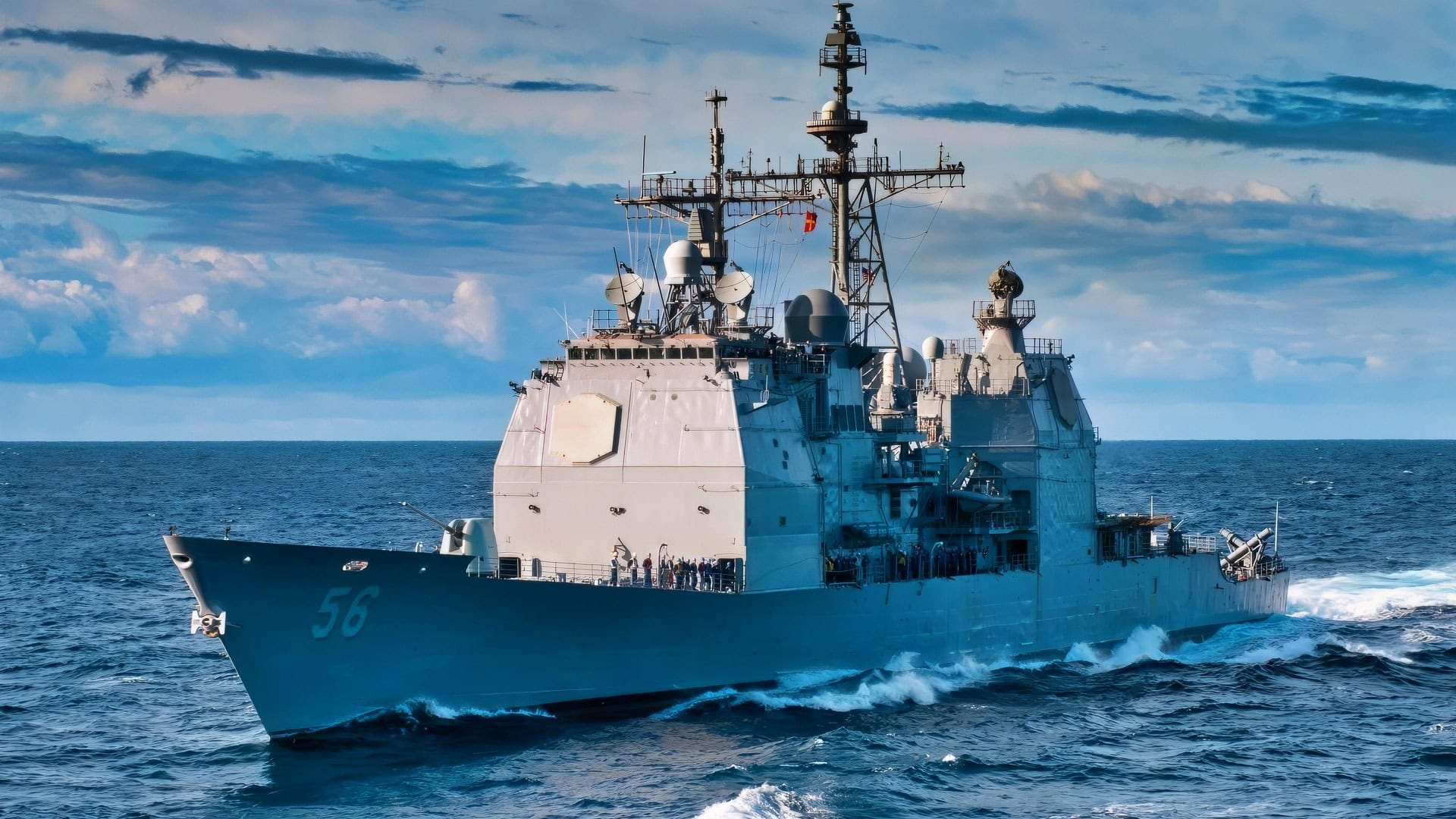
A $1.3 Billion Cruiser USS Princeton Was Nearly Sunk By A $1,500 Mine – On February 18, 1991, the Ticonderoga-class Aegis cruiser USS Princeton (CG-59) was severely damaged in the Persian Gulf during Operation Desert Storm when it struck two Italian-made MN103 Manta influence mines.
The first Manta mine detonated directly under the warship’s port rudder in about 16 meters of shallow water, and the second about 200 yards off the starboard bow, a sympathetic explosion that did no damage.
The first, however, injured three crewmembers, cracked the superstructure, buckled the hull at three frames, jammed the port rudder, damaged the starboard propeller shaft, and flooded the Number 3 switchboard room from chill-water pipe cracks that shut down combat systems for 90 minutes—a dead-in-the-water “mission kill” that rendered missiles and guns aft inoperable.
However, despite the heavy damage, the crew brought the AEGIS combat system and forward weapons back online within 15 minutes.
The ship stayed on station for 31 hours before being guided out of the minefield and returning to the United States for extensive repairs.
The $1.3 billion Aegis cruiser was severely damaged by a pair of Italian-made MN103 Manta sea mines that cost only about $1,500.
On the same day, a few hours earlier, the billion-dollar amphibious assault ship USS Tripoli (LPH-10) was also struck by an Iraqi LUGM contact mine. The explosion tore a 25×25-foot hole in the Tripoli’s hull, wounding four sailors. However, the Tripoli absorbed the blow and remained on station, fully functional.
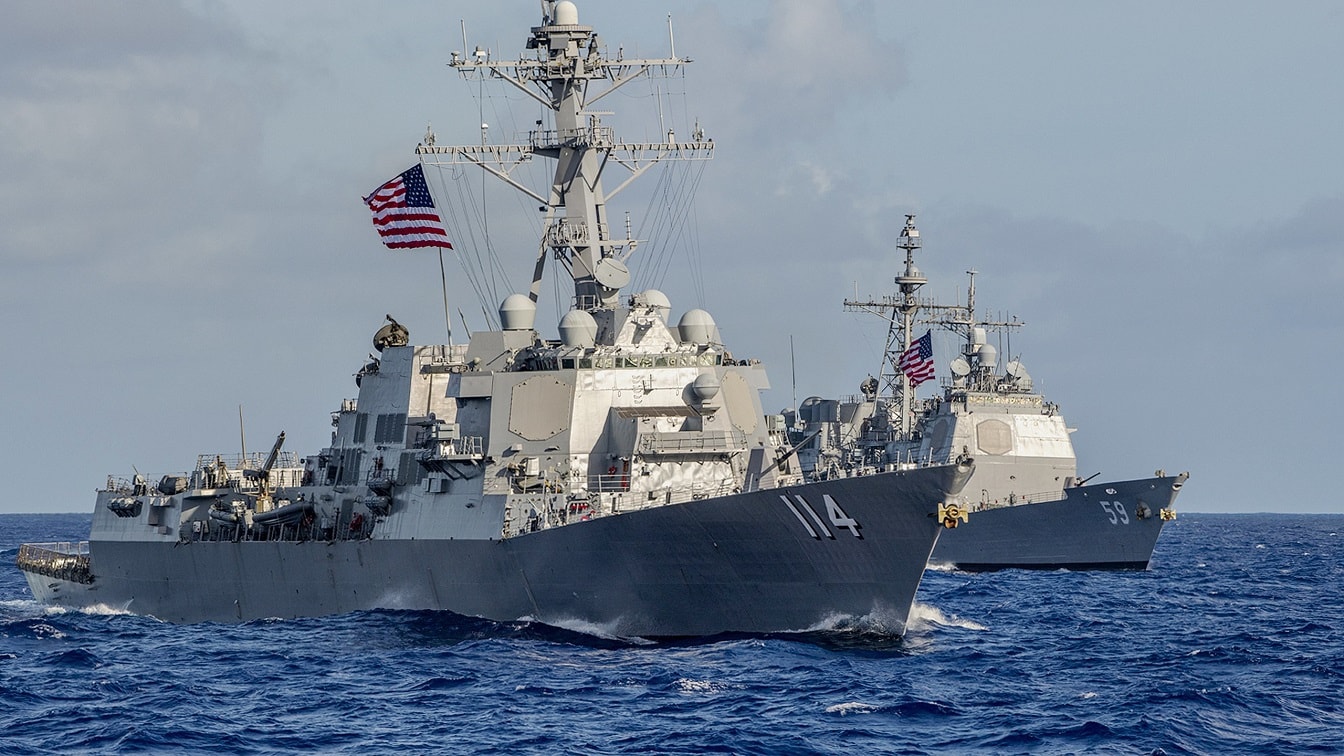
The Arleigh Burke-class guided-missile destroyer USS Ralph Johnson (DDG 114) and the Ticonderoga-class guided-missile cruiser USS Princeton (CG 59) steam in formation during dual carrier operations with the Nimitz and Theodore Roosevelt Carrier Strike Groups (CSG). Dual carrier operations unify the tactical power of two individual CSG, providing fleet commanders with an unmatched, unified credible combat force capable of operating indefinitely. The CSGs are on a scheduled deployments to the Indo-Pacific.
The Cost of Repairing the Two Ships Was $134 Million
Of the 18 warships lost or seriously damaged since World War II, 14 of them have struck sea mines.
The cheap Italian-made Manta sea mines punched far above their weight that day. The total cost of the three mines was about $5,000, but they did more than $134 million in damage to the two US warships, $67 million each to the Princeton and Tripoli.
In 1988, the USS Samuel B. Roberts (FFG-58) struck an undersea mine, causing $57 million in damage to the ship.
The Asymmetric Value Of Undersea Mine Warfare
Potential U.S. adversaries—from China and Russia to violent terrorist organizations—take advantage of the asymmetric value of mines, some quite sophisticated and lethal and others unsophisticated but still quite lethal.
Russia is believed to have more than 125,000 mines, China 80,000, and Iran is believed to have more than 6,000. They have also reportedly sold a number of mines to their Houthi proxies in Yemen, numbering in the hundreds.
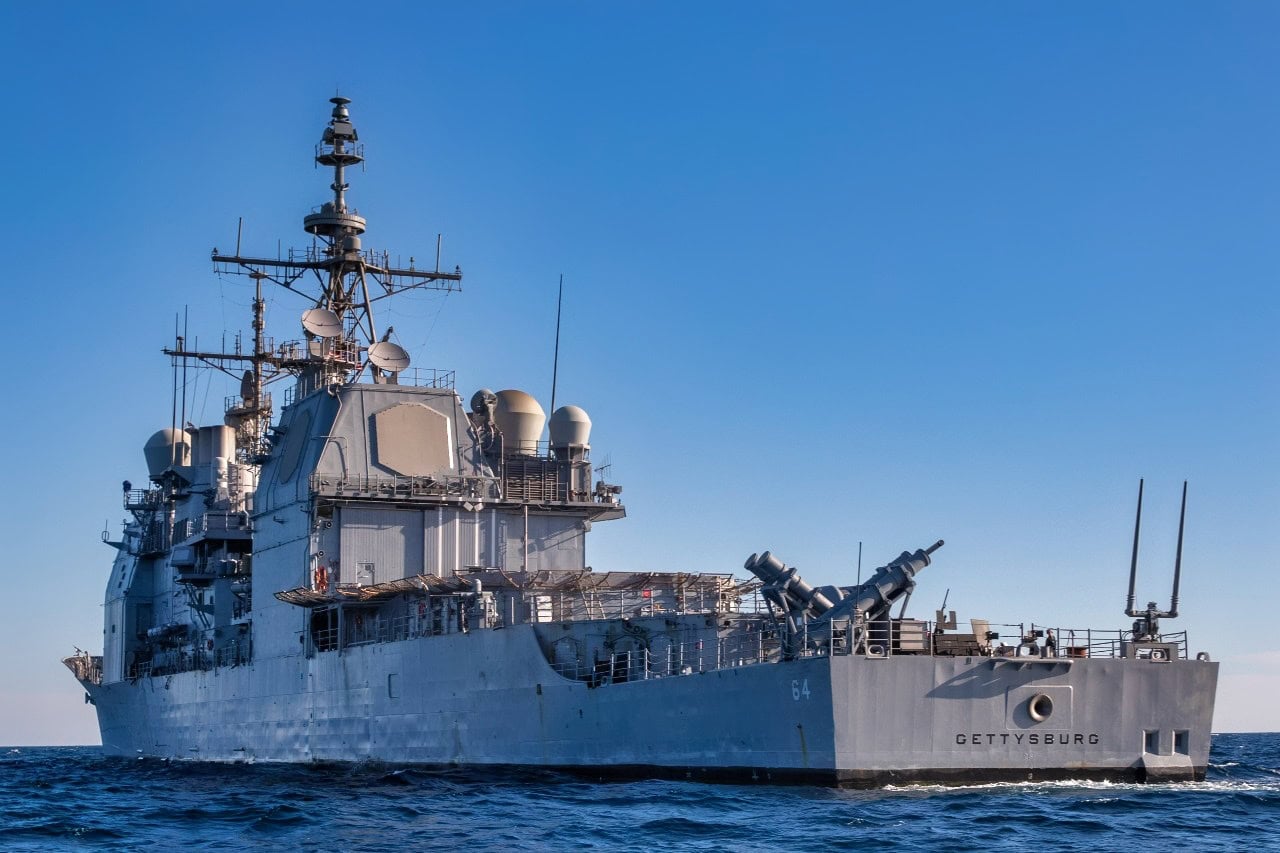
(Feb. 18, 2025) The Ticonderoga-class guided-missile cruiser USS Gettysburg (CG 64) sails in the U.S. Central Command area of responsibility. (Official U.S. Navy photo)
The US Navy has fewer than 10,000 sea mines, with the majority of those being the Quickstrike family of mines.
Our adversaries in these cases were able to leverage very cheap asymmetric weapons such as sea mines to wreak devastating damage to billion-dollar warships. With the Strait of Hormuz currently mined, it bears watching as clearing minefields is not an easy operation.
Background On The Ticonderoga-class Cruisers
The Ticonderoga-class cruisers were initially planned as a class of destroyers. However, the increased combat capability offered by the Aegis Combat System and the passive phased array AN/SPY-1 radar, together with the ability to operate as a flagship, was used to justify the change of the classification from DDG (guided-missile destroyer) to CG (guided-missile cruiser) shortly before the keels were laid down for Ticonderoga and Yorktown.
The Navy built 27 of the multi-role cruisers that can fire a multitude of Tomahawk cruise missiles, RUM-139 ASROCs, and anti-ballistic missile munitions. The Ticonderoga class was designed to function as a member of a carrier strike group or amphibious ready group, and can perform interdiction and escort missions.
The U.S. Navy states that guided missile cruisers primarily operate in a Battle Force role. These ships are multi-mission, capable of Air Warfare (AW), Undersea Warfare (USW), Naval Surface Fire Support (NSFS), and Surface Warfare (SUW) operations, serving as surface combatants that support carrier battle groups, amphibious forces, or operate independently as flagships of surface action groups.
Cruisers are equipped with Tomahawk cruise missiles, giving them additional long-range Strike Warfare (STRW) capability. Some Aegis Cruisers have been outfitted with a Ballistic Missile Defense (BMD) capability.
The lead ship of the class, USS Ticonderoga (CG-47), through CG-51, has been decommissioned. Over the next several years, several Ticonderoga-class guided-missile cruisers will undergo a structured modernization to ensure they reach their projected 35-year service life.
The Cruiser Modernization program aimed to enhance the CG-47 Ticonderoga class by modernizing the computing and display infrastructure, as well as the Hull, Mechanical, and Electrical (HM&E) systems.
Weapons and sensor sets will also be enhanced to improve their anti-submarine capabilities, including the addition of short-range electro-optical systems that can monitor the ship’s surroundings without emitting radar.
Additionally, routine machinery upgrades will be implemented to enhance all areas of the ship’s functionality. The modernized cruisers are expected to become more cost-efficient to operate, as their service life is extended to serve in the fleet through 2030.
Interestingly enough, the USS Princeton (CG-59) is still serving in the US Navy, is homeported in San Diego, and routinely deploys with Carrier Strike Groups (such as the Nimitz and Carl Vinson strike groups) to support security operations in the Pacific, Indian Ocean, and Middle East.
MORE – Russia’s K-222 Titanium Submarine Can Hit 44 Knots, and the US Navy Has Nothing Like It
About the Author:
Steve Balestrieri is a National Security Columnist. He served as a US Army Special Forces NCO and Warrant Officer. In addition to writing on defense, he covers the NFL for PatsFans.com and is a member of the Pro Football Writers of America (PFWA). His work was regularly featured in many military publications