
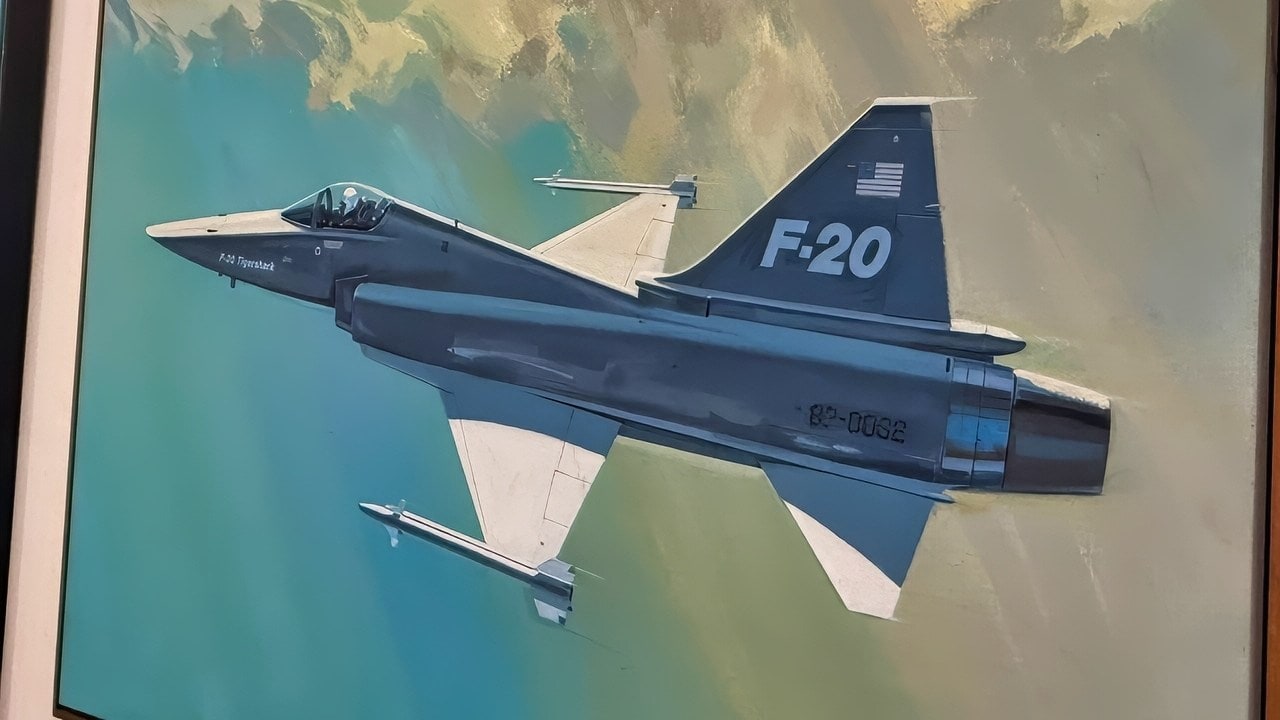
The F-20 Tigershark Had Mach 2 Speed and 9,000 Pounds of Weapons. It Never Won an Order: The Northrop F-20 Tigershark first flew at Edwards Air Force Base on Aug. 30, 1982. It began as the F-5G, a private effort to preserve the F-5E’s compact size and easy support while adding a more powerful engine, modern radar, and digital avionics. The Air Force’s historical account records three aircraft before cancellation.
Northrop and its subcontractors financed the program without a Pentagon development contract. A RAND case study placed the private investment above $1.2 billion and described the result bluntly: no F-20 was sold.

F-20 Tigershark Model at Western Museum of Flight. Image by Harry J. Kazianis/19FortyFive.com Image.
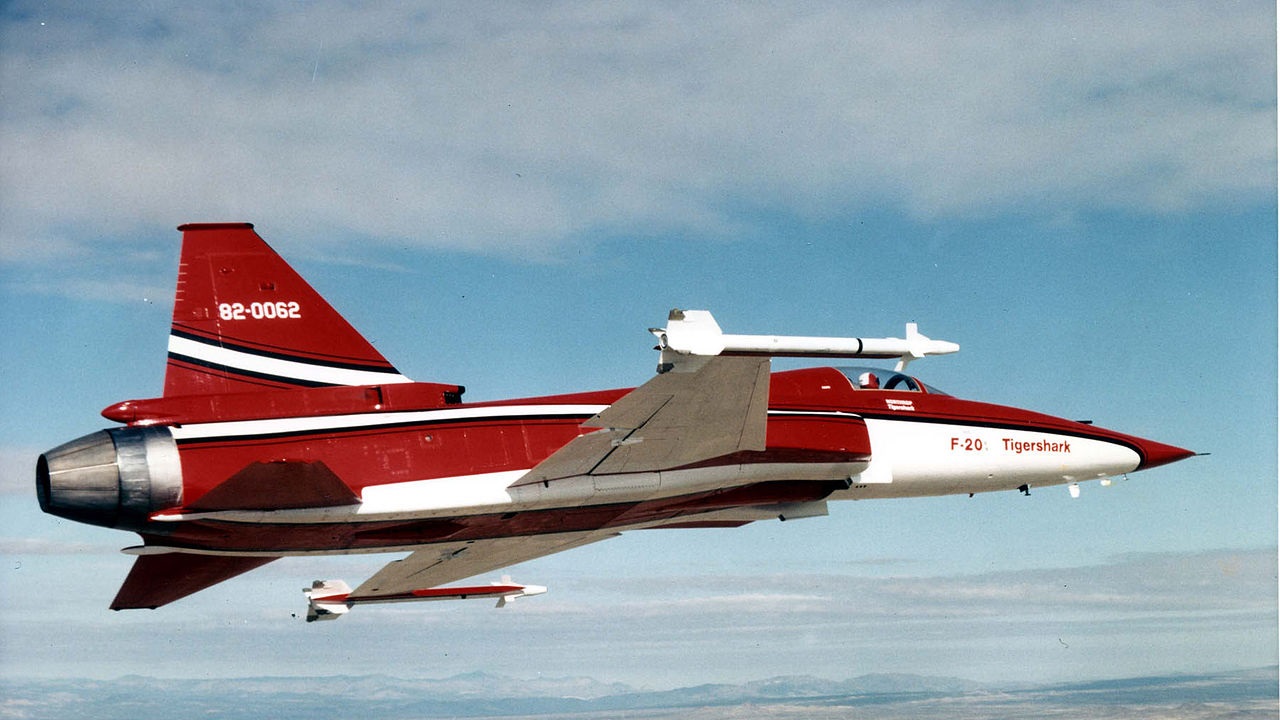
Northrop F-20 (S/N 82-0062) in flight. (U.S. Air Force photo)
The aircraft itself was impressive. Northrop’s 1985 technical brochure advertised Mach 2 performance, a 55,000-foot combat ceiling and a sea-level climb rate of 53,800 feet per minute. It also claimed a 59-second scramble from order to liftoff.
The program failed because its market disappeared. Washington first encouraged an affordable export fighter below the level of America’s frontline jets. The Reagan administration then loosened export rules and allowed many of the same allies to buy the F-16.
F-20 Tigershark Numbers: Speed, Hardpoints and Weapons
The F-20 replaced the F-5E’s two J85 engines with one General Electric F404-GE-100 producing 18,000 pounds of thrust. The change delivered far more power without abandoning the small airframe behind the successful F-5 export family.
Northrop listed seven external stations: two wingtip rails, four underwing hardpoints, and one centerline station. External carrying capacity exceeded 9,000 pounds. Internal armament consisted of two 20mm M39 cannons with 450 rounds in total.
The basic air-to-air fit included two AIM-9 Sidewinders. Northrop also offered four- and six-Sidewinder arrangements and radar-guided beyond-visual-range missiles, subject to U.S. approval and integration. The APG-67 radar supplied look-down search, target tracking, ground mapping, and maritime modes.
The stores chart listed Mk 82, Mk 83, and Mk 84 bombs, M117 bombs, 2.75-inch rocket pods, laser-guided bombs, air-to-surface missiles, anti-ship missiles, and a 30mm gun pod. Weapon count depended on bomb size and fuel tanks; six Sidewinders represented the largest published air-to-air fit. The broad menu explains why the Tigershark still attracts attention.
F-20 Tigershark Model at Western Museum of Flight. Image by Harry J. Kazianis/19FortyFive.com Image.
The F-20 Cost Less Until the F-16 Fought Back
Northrop offered 396 F-20s to the Air Force in April 1985 at $12.8 million each in 1985 dollars. The Government Accountability Office placed the F-16C entering Air Force service at $15.6 million.
Support packages narrowed the gap. RAND recorded an F-20 offer of nearly $15 million per aircraft with support, compared to about $18 million for the F-16C. General Dynamics answered with a stripped F-16SC at $10.9 million, or roughly $13.5 million with support. The larger F-16 production base erased Northrop’s clean price advantage.
Northrop projected readiness above 80 percent and 9.4 direct maintenance man-hours per flight hour. Those were manufacturer estimates from a tightly managed test program, not years of squadron service. RAND found Air Force officials skeptical of reliability claims drawn from three prototypes.
The F404 used modular construction; the avionics included built-in testing; and the onboard starter reduced ground-support requirements. Air forces already operating the F-5E Tiger II faced a simpler transition. Compact size imposed limits, though. The F-16 carried more fuel, offered greater combat range and accepted heavier payloads. Its larger airframe and fly-by-wire design offered more room for later growth.
Washington Removed the F-20’s Export Market
The Carter administration’s export policy created an opening for a capable fighter with fewer sensitive systems than frontline American aircraft. Northrop shaped the F-5G around this requirement. Reagan’s case-by-case approval of first-line fighter sales let Pakistan, Venezuela, and South Korea obtain F-16s instead.
Foreign governments preferred the jet flown by the U.S. Air Force. An American service order meant established training, spare parts, weapons integration, and political backing. The F-16’s expanding international user base strengthened every future sale.
Northrop’s F-20 Tigershark reached Mach 2, carried more than 9,000 pounds of weapons, and promised low costs. The F-16 killed its market.
Taiwan looked like Northrop’s strongest early customer, but Washington blocked an advanced-fighter sale while managing relations with Beijing. Other buyers waited for an American commitment. The Air Force had no frontline requirement for the F-20, and the Navy chose an F-16 variant for its aggressor purchase. The absence of a U.S. launch customer became fatal.
Congress later directed an Air Defense Fighter competition. GAO found the F-20 met minimum requirements but suffered radar, range, and weapon limitations for long-range interception. The Air Force selected modified F-16As already in its inventory rather than establish another fighter fleet.
Two Fatal Crashes Damaged the Sales Campaign
Two of the three Tigersharks crashed during overseas demonstration work. Northrop pilot Darrell Cornell died in South Korea in 1984. Dave Barnes died in Canada in 1985 after an apparentG-induced loss of consciousness.
Investigations found no aircraft-system fault that would require a design change. The findings protected the engineering record, not the marketing campaign. Losing two prototypes in public demonstrations made an unproven fleet appear riskier to governments already leaning toward the F-16.
Northrop ended the program in December 1986. The privately funded fighter died without a production order, joining the list of promising American aircraft left outside operational service.
The surviving third prototype now hangs at the California Science Center in Los Angeles. Its specifications were not the main reason it failed. The market Northrop built it to serve disappeared before the company sold one.
About the Author: Harry J. Kazianis
Harry J. Kazianis (@Grecianformula) was the former Senior Director of National Security Affairs at the Center for the National Interest, a foreign policy think tank founded by Richard Nixon in Washington, D.C. Harry has more than a decade of experience in think tanks and national security publishing. His ideas have been published in The New York Times, The Washington Post, The Wall Street Journal, CNN and many other outlets worldwide. He has held positions at CSIS, the Heritage Foundation, the University of Nottingham and several other institutions related to national security research and studies. He is the former Executive Editor of The National Interest and The Diplomat. He holds a master’s degree focusing on international affairs from Harvard University.

