
Iran is escalating its rhetoric and threats against the United States and its allies, warning that countries participating in Washington’s latest round of sanctions will now be treated as parties to the war and threatening to stop all oil exports across the Persian Gulf.
The threats come after the Trump administration announced a new plan to economically isolate Tehran, building on existing sanctions and implementing secondary sanctions against countries and institutions still doing business with the regime.
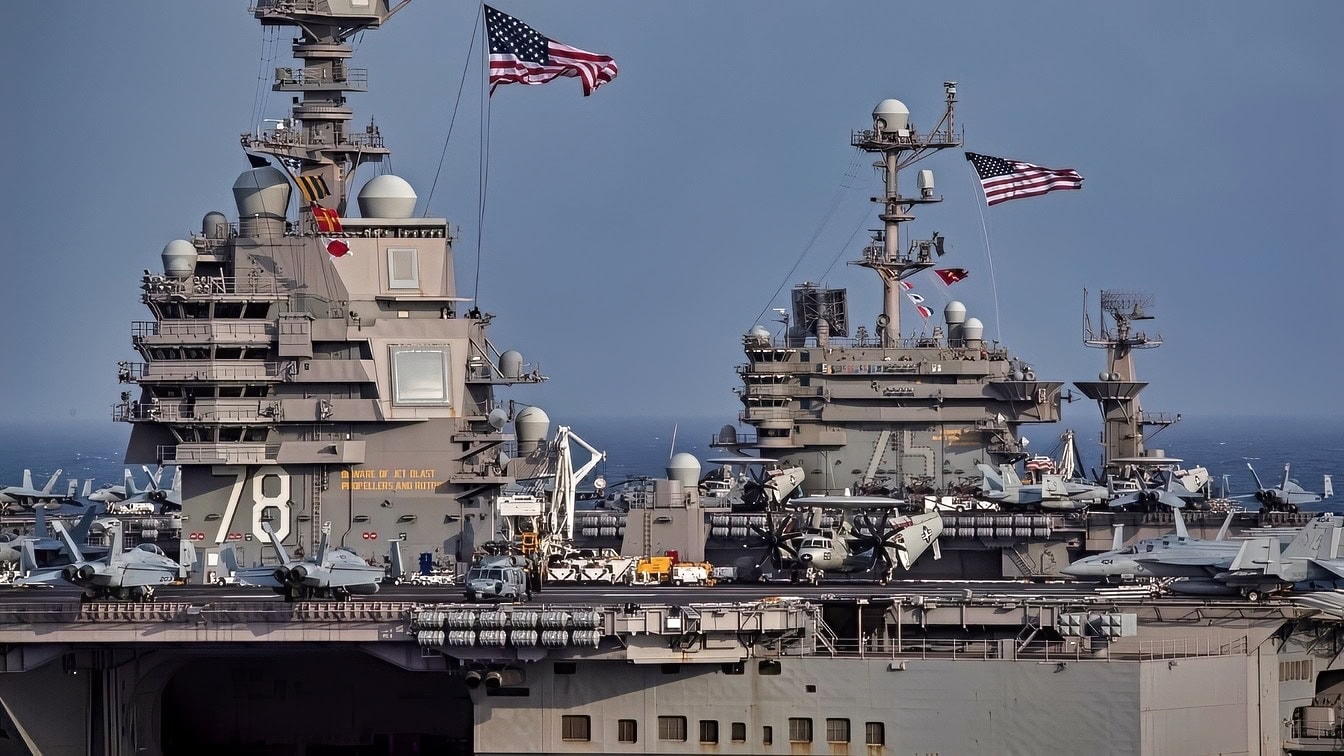
The Ford-class aircraft carrier USS Gerald R. Ford (CVN 78) and the Nimitz-class aircraft carrier USS Harry S. Truman (CVN 75) transit the Atlantic Ocean June 4, 2020, marking the first time a Ford-class and a Nimitz-class aircraft carrier have operated together underway. Ford is underway conducting integrated air wing operations, and the Harry S. Truman Carrier Strike Group remains at sea in the Atlantic as a certified carrier strike group force ready for tasking in order to protect the crew from the risks posed by COVID-19, following their successful Day 295. The Ford’s crew has been at sea since June. The Vietnam-era record is next. A laundry fire forced repairs in Crete and Croatia. Reports say 12-14 months to fix. In 1942, the Yorktown was repaired in 3 days after a 551-pound bomb plunged 50 feet into the ship. Admiral Nimitz demanded it. They delivered.
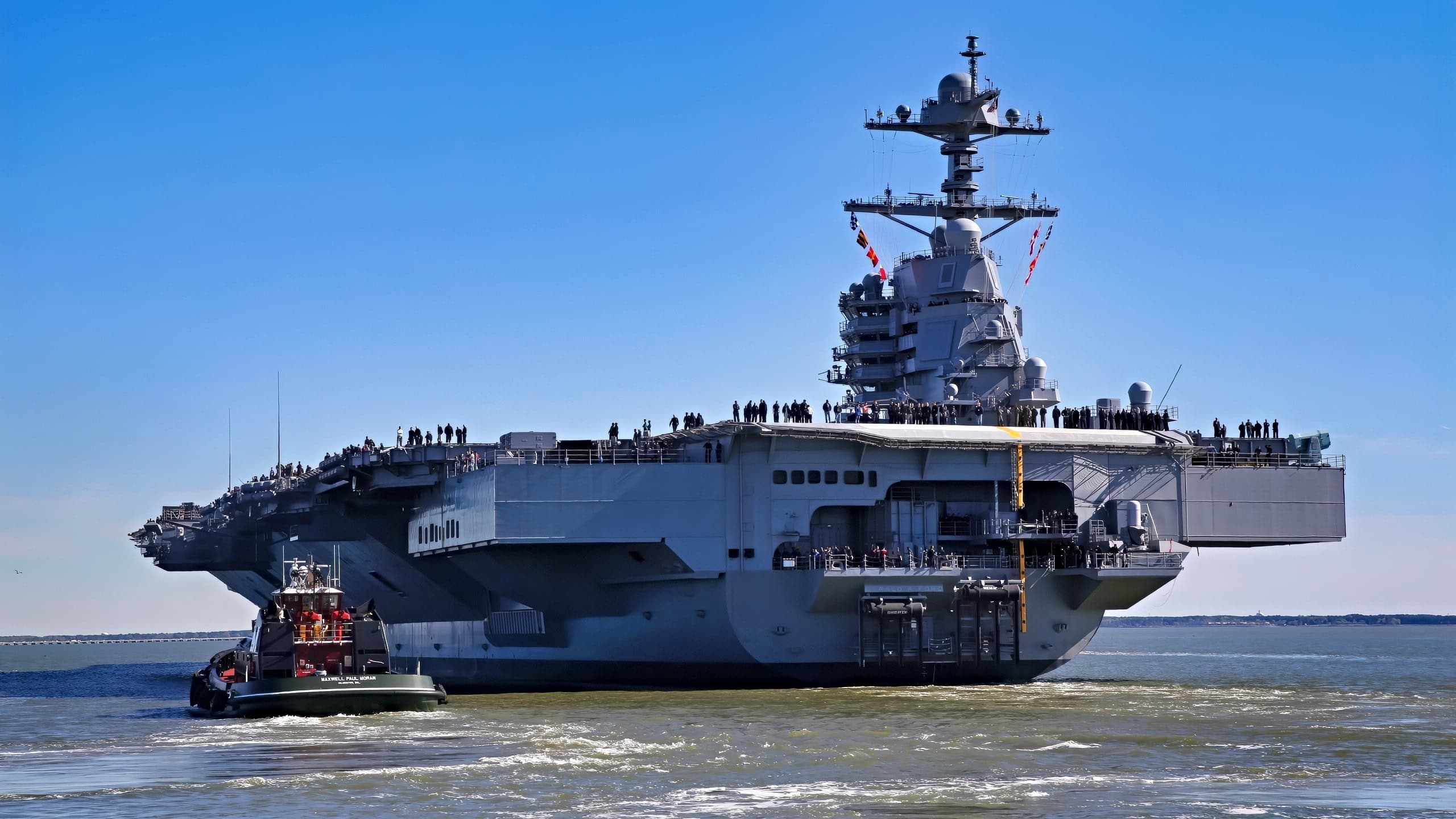
(April 8, 2017) – Pre-Commissioning Unit Gerald R. Ford (CVN 78) departs Huntington Ingalls Industries Newport News Shipbuilding for builder’s sea trials off the coast. The first- of-class ship—the first new U.S. aircraft carrier design in 40 years—will spend several days conducting builder’s sea trials, a comprehensive test of many of the ship’s key systems and technologies. (U.S. Navy photo by Mass Communication Specialist 2nd Class Ryan Litzenberger)
Speaking in Tehran, Iranian Foreign Ministry spokesman Esmail Baghaei told reporters that the government was preparing to respond if Washington continues to escalate economic pressure.
“Any escalation of this situation will undoubtedly bring about consequences,” Baghaei said. “Our hands are not tied.”
Even more explicit threats were issued over the weekend, ahead of Washington’s Monday announcement, by Mohsen Rezaei, the recently appointed secretary of Iran’s Supreme National Security Council. Rezaei said that Tehran would respond by shutting down all oil exports throughout the Persian Gulf and effectively bringing the global economy to its knees.
Iran’s Hands “Not Tied”
Baghaei’s comments on Monday came only hours before U.S. Treasury Secretary Scott Bessent outlined plans for what Washington calls “Operation Economic Outcast,” a campaign designed to cut off Iran’s remaining international financial and commercial relationships.
The plans were already announced ahead of time, with Bessent saying last week that an official announcement would be made on Monday, August 24.
The Iranian Foreign Ministry had already condemned the planned measures before the announcement was made and claimed that Washington was trying to intimidate sovereign countries into ending legitimate trade with Iran.
“Washington’s persistence in failed methods has no result other than proving America’s hatred for the Iranian people, because they know very well that the direct consequences of these sanctions are on ordinary citizens,” Baghaei told reporters during his weekly press conference.
“This illegal practice is a wake-up call for the international community, as America’s excesses and violations of the law in international relations have even provoked protests from its close allies,” he continued.
Iran’s Exact Threat
So, what is Iran threatening to do?
So far, Tehran is promising to do considerably more than just close off the Strait of Hormuz – something the regime has been threatening to do, or claiming to have already achieved, since February.
Now, Rezaei is threatening to prevent oil from leaving the Persian Gulf, even via alternative routes, if neighboring countries participate in the new U.S. operation.
“If the economic war continues, not a single drop of oil will be exported٫ neither through the Strait of Hormuz nor from anywhere in the Persian Gulf. Iran will regard any country’s participation in or support for America’s economic war against the Iranian people as an act of war,” Rezaei said in a statement issued online.
The threat would likely mean that Iran will pursue additional missile and drone attacks against regional infrastructure supporting the movement of crude oil, as well as drone and speedboat attacks on tankers in the region.
Iran would likely attempt to attack oil and gas infrastructure in neighboring Gulf states, potentially including facilities that allow Saudi Arabia and the United Arab Emirates to bypass Hormuz and continue sending crude to the international market.
Attacks on power stations and desalination plants may also be a means of escalation.
So far, Iran has proven that it can severely restrict shipping even with its conventional military power heavily degraded, but shutting off and stopping all Gulf exports would be a considerably harder task.
That being said, Iran has the missile stockpile required to cause chaos across the region, forcing Gulf states to expend their own interceptors and missile stockpiles to defend critical assets.
Iran’s Houthi proxy group is also already causing trouble in the Bab el-Mandeb Strait, squeezing exports from Saudi Arabia as the global economy suffers from a months-long supply shortage.
Will Trading Partners Comply?
For the U.S. campaign to work, financial institutions and countries already doing business with Tehran will need to comply – and so far, the regime’s biggest economic ally, China, is refusing to do so.
Shortly before Bessent’s Monday announcement, Iranian Parliament Speaker Mohammad Bagher Ghalibaf claimed Tehran had already received assurances from the country’s largest economic partners that they would not comply.
“Americans know that no one buys their bombast; the United States is not in an economic position to further restrict its relations with other countries.
Iran’s trading partners, both in the media and through messages sent to us, have made it clear that they don’t take these statements into account anywhere,” Ghalibaf wrote on X.
And when asked on Monday about Washington’s threatened secondary sanctions, Chinese Foreign Ministry spokesman Lin Jian suggested that what Ghalibaf said is true.
The spokesman said Beijing will watch developments closely and do what is necessary to protect China’s legitimate rights and interests.
About the Author: Jack Buckby
Jack Buckby is a British researcher and analyst specializing in defense and national security, based in New York. His work focuses on military capability, procurement, and strategic competition, producing and editing analysis for policy and defense audiences. He brings extensive editorial experience, with a career output spanning over 1,000 articles at 19FortyFive and National Security Journal, and has previously authored books and papers on extremism and deradicalization.