

Alexander the Great Won an Empire Before He Turned 33 – “I am not afraid of an army of lions led by a sheep; I am afraid of an army of sheep led by a lion.” The line is widely attributed to Alexander the Great, but no surviving ancient source securely connects the modern wording to him. The oldest documented form is attributed by Plutarch to the Athenian commander Chabrias.
The attribution is doubtful. The idea still fits Alexander’s career. He inherited an army from his father, Philip II of Macedon, then used speed, personal courage and tactical flexibility to destroy the Persian Empire and march as far as northwestern India.

Alexander the Great Statue. Image Credit: Christian D. Orr.
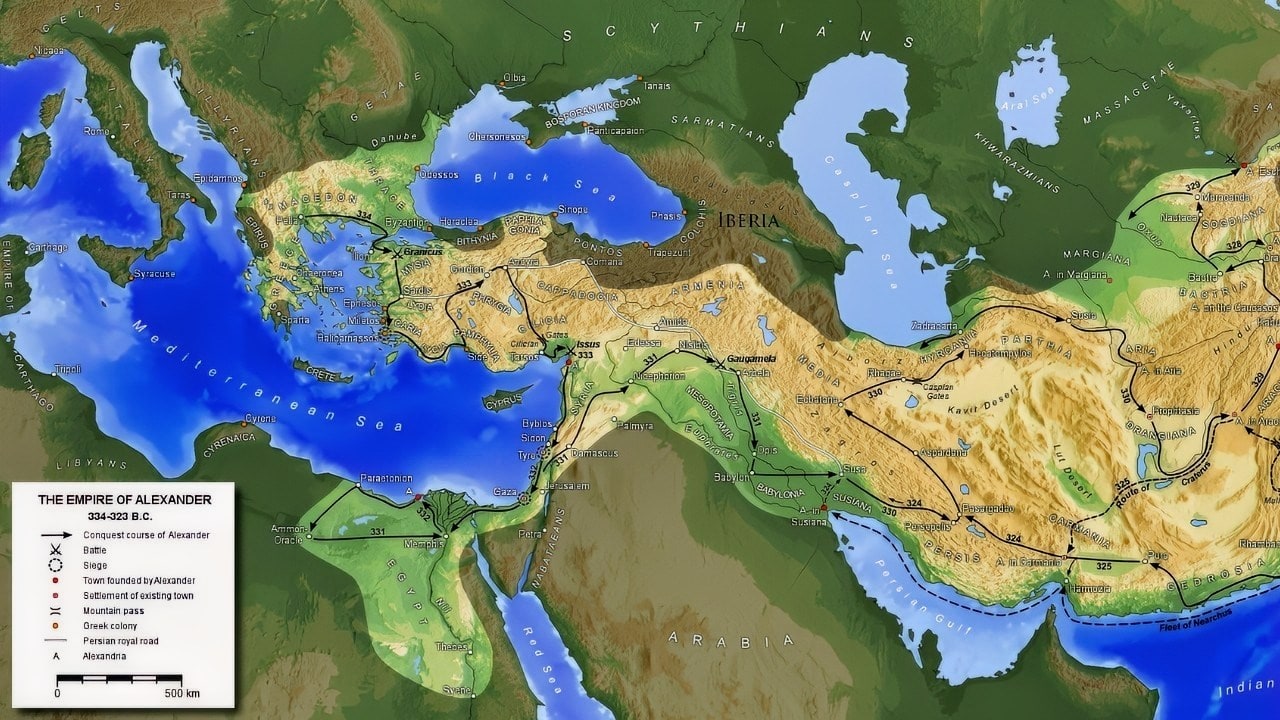
Alexander the Great Empire. Image Credit: Creative Commons.
Alexander was born at Pella in 356 BCE, the son of Philip and Olympias. Aristotle served as his tutor. The World History Encyclopedia notes that he became king at only 20 in 336 BCE after Philip’s assassination. He ruled for fewer than 13 years.
Philip II Built the Army Alexander Inherited
Alexander’s victories began with Philip’s reforms. Macedonian infantry fought in a deep phalanx with long sarissa pikes. Companion cavalry supplied the striking arm. Hypaspists, archers, javelin troops and engineers gave the army options beyond a frontal advance.
Alexander coordinated those units at high speed and often led the cavalry attack himself. Repeated wounds reinforced his reputation for sharing the dangers he demanded of his soldiers. His army integrated siege engineers, naval forces and local troops, giving him enough flexibility to keep campaigning after the great open-field victories over Persia were complete.
Before invading Persia, Alexander secured his throne. He campaigned in the Balkans and returned south when Thebes revolted in 335 BCE. The city was destroyed, warning other Greek states how quickly he would punish rebellion.
Granicus and Issus Put Alexander Against Persia
In 334 BCE, Alexander crossed the Hellespont with about 43,000 infantry and 5,500 cavalry. At the Granicus River, he defeated Persian forces defending the crossing and won his first major victory in Asia.
At Issus in 333 BCE, he met Darius III for the first time. The narrow battlefield restricted Persia’s numerical advantage. Alexander drove his right wing forward, broke toward Darius’s position and forced the king to flee. Darius’s family and baggage fell into Macedonian hands.
The victory showed how Alexander used Philip’s military system. The phalanx held and pressured the center while the king concentrated cavalry at the decisive point. Driving Darius from the field damaged the authority holding the Persian army and empire together.
Tyre Proved Alexander Could Win a Siege
The siege of Tyre in 332 BCE displayed engineering and persistence rather than open-field maneuver. The island city refused him entry. His forces built a causeway from the mainland, assembled a fleet and broke the defenses after about seven months.
Tyre’s fall denied the Persian fleet a major base. Alexander then entered Egypt, founded Alexandria near the Nile delta and was recognized as pharaoh. The British Museum says he founded more than 70 cities during his reign, although some were existing settlements renamed or reorganized.
Those cities served as garrisons and administrative centers, extending Greek language and institutions across conquered territory.
Gaugamela Destroyed Darius III’s Last Great Army
The decisive battle came at Gaugamela in 331 BCE. Darius selected open ground for cavalry and scythed chariots. Alexander advanced toward the right, drawing Persian forces outward and opening space nearer the center. He then drove the Companion cavalry toward Darius.
Darius fled again. Babylon and Susa surrendered, giving Alexander major administrative centers and immense treasuries. He later occupied Persepolis and burned its palace complex. Encyclopaedia Iranica records that Darius was murdered in 330 BCE by men around Bessus, the satrap of Bactria.
Alexander presented himself as Darius’s avenger and successor. He adopted parts of Persian court practice and recruited Iranian nobles and soldiers. The policy helped him rule, but angered Macedonians who believed their king was abandoning familiar customs.
His leadership also had a violent, authoritarian side. Alexander executed or killed senior associates, including Parmenion, Philotas and Cleitus. Loyalty grew from shared danger and victory, but royal power and fear were also part of his command.
India Exposed the Limit of Alexander’s Authority
After difficult campaigns in Bactria and Sogdiana, Alexander entered India. At the Hydaspes River in 326 BCE, he faced King Porus and war elephants. Alexander concealed part of his force, crossed away from the main camp and attacked before Porus could concentrate against him.
Porus lost but impressed Alexander, who restored him as a subordinate ruler. The victory showed the army adapting to unfamiliar terrain, tactics and weapons.
The advance stopped at the Hyphasis, or Beas River. The army refused to continue east after years of marching, fighting and monsoon conditions. Alexander accepted the demand to turn back. His authority had reached its practical limit.
The return was costly. Part of the force sailed down the Indus, while Alexander led troops through the Gedrosian desert. Shortages of water and food killed many. The army reached the imperial center exhausted and reduced.
Military History Remembers Alexander’s Combined-Arms Command
Alexander did not invent every formation he used. Philip created the military foundation. Alexander’s distinction came from combining its parts during more than a decade of war and adapting them to rivers, mountains, fortified cities, cavalry armies and elephants.
No major battle he personally commanded is known to have ended in defeat. His campaigns became reference points for later commanders studying operational speed, concentration of force and leadership from the front. The continuing fascination has generated modern treatments of the lion-and-sheep saying, debates over his treatment of conquered peoples and a larger archive examining his legacy.
His record also includes mass killing, enslavement and destroyed cities. His empire depended on conquest and personal authority.
Alexander Died in Babylon Before His Next Campaign
Alexander returned to Babylon in 323 BCE and prepared an expedition against Arabia. He fell ill after banquets and developed a worsening fever. Ancient accounts describe several days during which he continued to meet with officers and perform religious duties before losing the ability to speak.
He died on June 10 or 11, 323 BCE, at 32. The surviving accounts do not establish a cause. Poisoning rumors appeared soon afterward, while proposals include malaria, typhoid fever and complications from earlier wounds. Alexander left no adult heir and no settled succession plan when his officers began dividing command of the empire.
MORE – Russia’s K-122 Submarine Was a Titanium Hot Rod the US Navy Couldn’t Match
About the Author: Harry J. Kazianis
Harry J. Kazianis (@Grecianformula) was the former Senior Director of National Security Affairs at the Center for the National Interest (CFTNI), a foreign policy think tank founded by Richard Nixon based in Washington, DC. Harry has over a decade of experience in think tanks and national security publishing. His ideas have been published in the NY Times, The Washington Post, The Wall Street Journal, CNN, and many other outlets worldwide. He has held positions at CSIS, the Heritage Foundation, the University of Nottingham, and several other institutions related to national security research and studies. He is the former Executive Editor of the National Interest and the Diplomat. He holds a Master’s degree focusing on international affairs from Harvard University.