
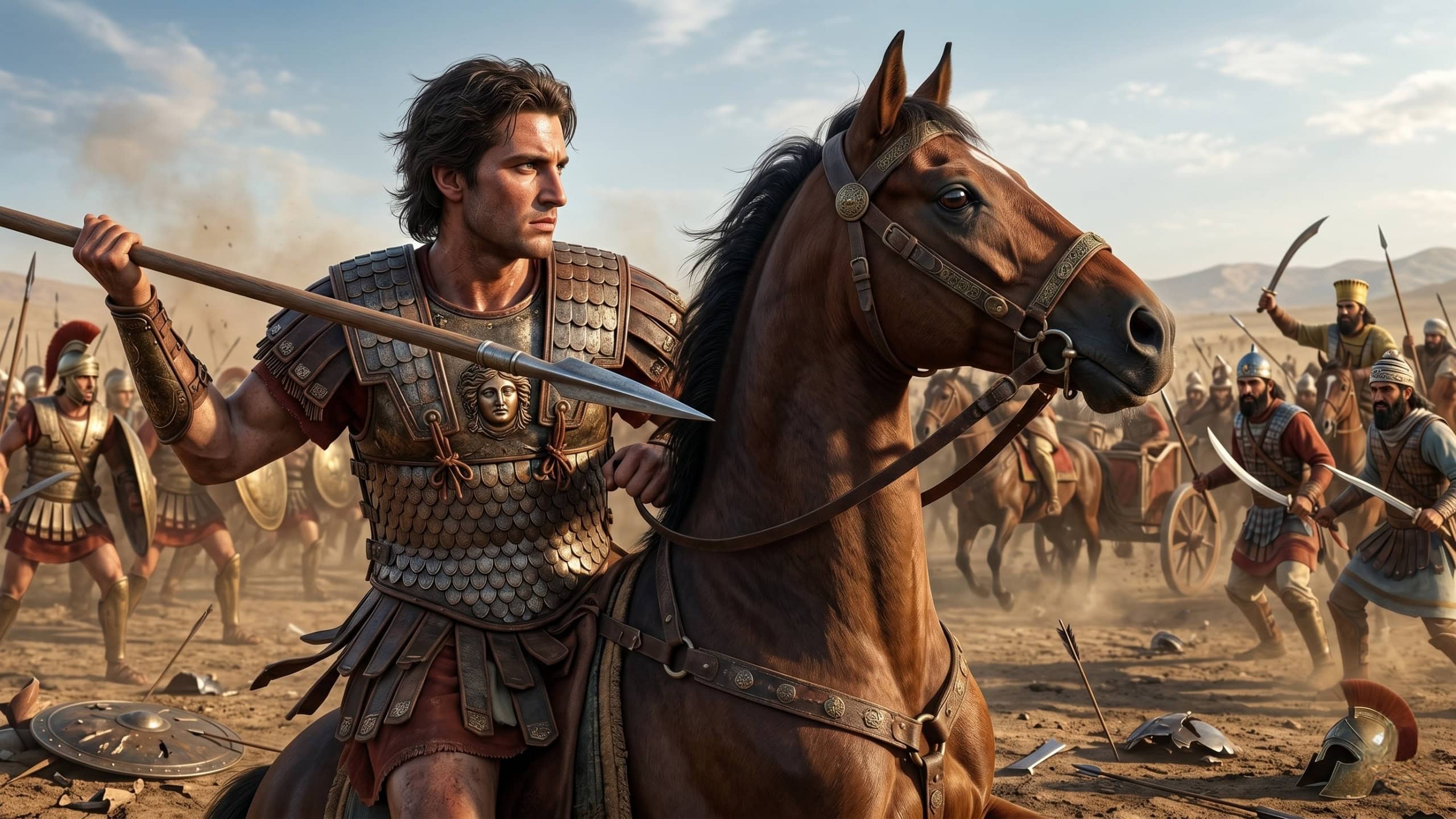
“Whatever possession we gain by our sword cannot be sure or lasting, but the love gained by kindness and moderation is certain and durable.” – Alexander the Great
Before Napoleon, before Caesar, before any of the great leaders of history, there was Alexander the Great.

Alexander the Great Map of Conquest Quote of the Day. Image Credit: Creative Commons.
Born in the Kingdom of Macedon in ancient Greece, Alexander is one of the most influential figures in history.
He conquered kingdom after kingdom, spread Greek culture across three kingdoms, and established a great empire by the age of 30. Since his death, great rulers have tried to achieve a fraction of what Alexander accomplished, and few have succeeded or even come close.
Alexander the Great: Early Life and Upbringing
Alexander III of Macedon was born in July 356 BCE in the city of Pella, the capital of the Macedonian kingdom. His father, King Philip II, was a shrewd ruler who transformed Macedon into a dominant military power in Greece.
At the same time, his mother, Olympias of Epirus, was intensely ambitious and deeply convinced that her son was destined for greatness.
As a young child, Alexander was tutored by Leonides, his mother’s relative, and by Lysimachus of Acarnania. He showed an aptitude for horseback riding and tamed a horse he named Bucephalas.
Alexander received instruction from the philosopher Aristotle, whom Philip appointed as his tutor when Alexander was a teenager.

Alexander the Great Statue. Image Credit: Christian D. Orr.
Under Aristotle’s guidance, Alexander studied a wide range of subjects, including philosophy, ethics, politics, science, medicine, and literature. Greek culture and thought became deeply ingrained in him, especially Homer’s works.
The Iliad held a particularly soft spot for Alexander, and he modeled his own heroic ideals on Achilles.
For the rest of his life, he carried an annotated copy of the epic with him in his campaigns.
The young boy made many acquaintances during his school days, many of whom would later become his most trusted generals.
Rise to Power
In 336 BCE, Philip II was assassinated under circumstances that remain unclear; his attacker was swiftly killed while trying to flee.
At just twenty years old, Alexander ascended the throne. His first move as king was to consolidate his power.
As news of his father’s death spread throughout the kingdom, many city-states immediately tried to rebel and regain their independence. He crushed the rebelling armies and sacked the city of Thebes as a show of force. Athens and the other states sued for peace soon after, and Alexander was appointed the title of Hegemon, or “leader,” over all of Greece.
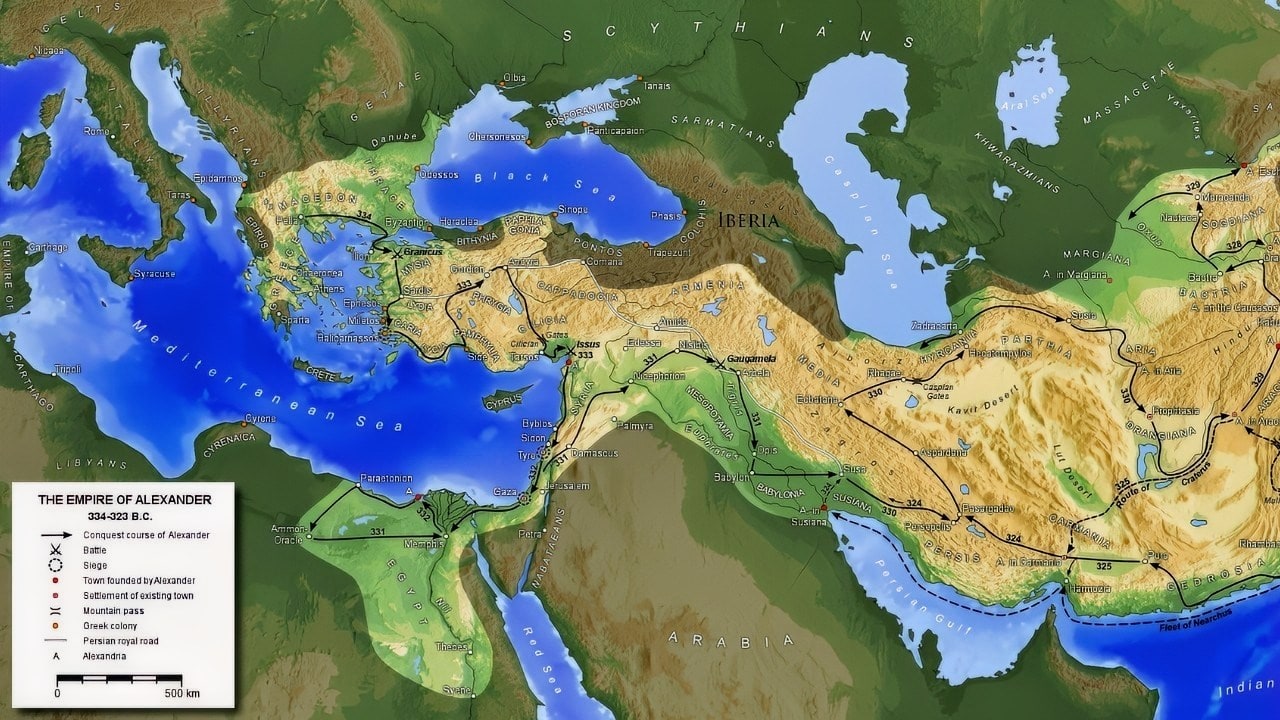
Alexander the Great Empire. Image Credit: Creative Commons.
With Greece subdued, Alexander turned his attention eastward toward the Persian Empire. This campaign had been planned by Philip and provided Alexander with an opportunity to achieve glory on a grand scale. In 334 BCE, he crossed into Asia Minor with an army of Macedonians and Greeks consisting of around 10,000 men.
The Persians and the Greeks (we shall refer to Alexander’s forces as “Greeks” for simplicity’s sake) first crossed swords at the Battle of Granicus, which resulted in a victory for the Greeks and the surrender of the Persian provincial capital of Sardis.
Persian Conquest
Spurred on by this initial victory, Alexander pressed forward along the Ionian Coast, conquering the cities of Miletus and Halicarnassus.
He continued forward, laying siege to heavily fortified Persian cities and crushing all resistance in his way. In 333 BCE, he faced the Persian king Darius III for the first time at the Battle of Issus. Despite being outnumbered, Alexander’s tactical skill led to a decisive victory. Darius fled, leaving behind his family, whom Alexander treated with respect.
In 331 BCE, Alexander confronted Darius once more at the Battle of Gaugamela. This engagement proved decisive.
Through superior strategy, discipline, and leadership, Alexander’s forces overwhelmed the Persian army. Darius fled again, and Alexander claimed dominion over Asia. Within a year, Darius was betrayed and killed by his own men, leaving Alexander as the undisputed master of the former Persian Empire. At this point, Alexander controlled territory stretching from Greece to Mesopotamia at the astonishing age of 22.
Conquest of India
Still unsatisfied, Alexander pushed eastward into Central Asia and the Indian subcontinent. He pushed through modern-day Afghanistan and Pakistan before arriving in the Peshawar Valley, beating back the mountain tribesmen that opposed him. In 326 BCE, Alexander defeated King Porus at the Battle of the Hydaspes River.
Despite knowing practically nothing about his enemy, their tactics, or the terrain, the Greeks still managed to defeat the Paravians through superior tactics. Alexander treated Porus with respect and allowed him to continue ruling, reinforcing his approach of winning loyalty through both generosity and strength.
Eventually, however, Alexander’s army reached its limits. After years of campaigning, his soldiers refused to march farther east at the Hyphasis River. Facing exhaustion, homesickness, and fear of the unknown, they demanded to be allowed to return.
Alexander resisted but ultimately agreed, marking the furthest extent of his conquests. The return journey proved disastrous, particularly the crossing of the Gedrosian Desert, where many soldiers perished from starvation and heat. This ordeal weakened Alexander physically and mentally.
Death and Fracturing of the Empire
In 323 BCE, Alexander returned to Babylon, where he began planning new campaigns to the West and the South. However, his plans were cut short when he fell ill after a banquet. After several days of fever, he died at the age of thirty-two. The exact cause of his death remains uncertain, with theories ranging from disease to poisoning. When asked who would inherit his empire, Alexander is said to have replied that it should go to the strongest. These vague instructions would fracture the empire he fought so hard to create.
Alexander’s death left a power vacuum. His vast empire was divided among his generals, known as the Diadochi, who fought bitterly for supremacy. While the empire’s political unity did not survive, its cultural impact endured.
As Alexander conquered territory, he introduced Greek culture and education to his subjects, thereby ushering in the Hellenistic Period.
The spread of Hellenism would influence Rome, Persia, Greece, the Middle East, and even far-off kingdoms in China would be influenced by Greek culture in some ways. The tales of Alexander the Great and the culture he introduced would continue to shape the world for centuries after his death.
About the Author: Isaac Seitz
Isaac Seitz, a Defense Columnist, graduated from Patrick Henry College’s Strategic Intelligence and National Security program. He has also studied Russian at Middlebury Language Schools and has worked as an intelligence Analyst in the private sector.