
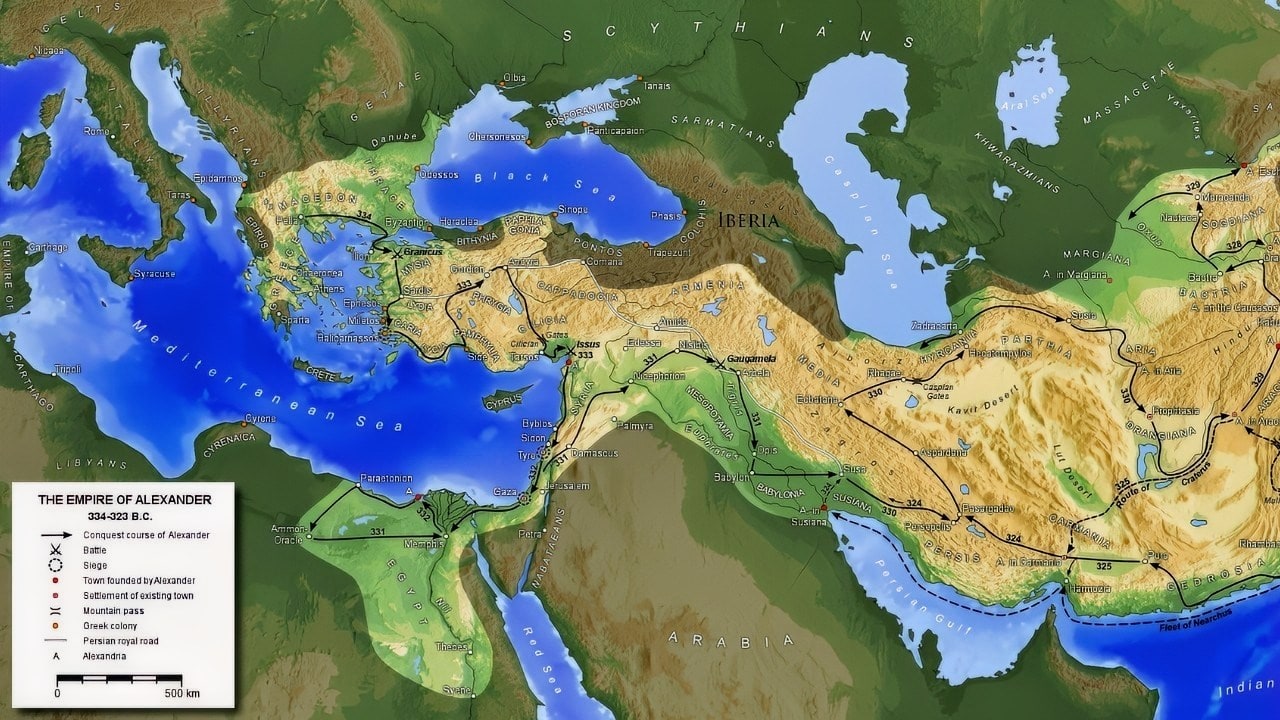
Key Points and Synopsis: Alexander the Great, tutored by Aristotle and driven by a vision of a unified empire, became King of Macedon at age 20.
-By his death at 32, he had conquered the Persian Empire and pushed as far east as India, creating a domain of 5.2 million square kilometers without ever losing a battle.
-His legacy, however, transcends conquest; his policy of cultural fusion spread Hellenism across three continents, influencing history for centuries and inspiring future leaders like Caesar and Napoleon.
Undefeated at 32: How Alexander the Great Conquered the World & Built the ‘Largest’ Empire
“There is nothing impossible to him who will try.” These words were spoken by Alexander the Great, arguably one of the most important men in all of history, and they perfectly summarize his mindset.
Alexander the Great sought to be the leader of a great Kingdom, and whatever he put his mind to, he accomplished.
His conquests created one of the largest empires in the world, spanning from the Balkans to modern-day India, and he was in his late 20s during most of the fighting.
Despite his early death, the Greek culture he brought to his subjugated lands transformed them, leading to the Hellenistic period in the region.
Early Life and Rise to Power
Alexander was the son of King Philip II of Macedon and Queen Olympias.
His father was a brilliant strategist and statesman who transformed Macedon into a dominant power in Greece, while his mother was known for her strong will and religious devotion.
From an early age, Alexander was groomed for greatness. At thirteen, he became a pupil of Aristotle, one of the greatest philosophers of all time.
Under Aristotle’s guidance, Alexander studied philosophy, science, medicine, and politics, developing a deep appreciation for Greek culture and intellectual pursuits. This education would later influence his vision of a culturally unified empire.
When Philip II was assassinated in 336 BCE, Alexander ascended to the throne at the age of twenty. Upon his ascension to the throne, he immediately sought to consolidate his power by eliminating his greatest rivals.
At the same time, several Greek city-states rebelled, and rivals within Macedon sought to undermine him. Displaying decisiveness and ruthlessness, Alexander crushed these uprisings, most notably destroying Thebes after its revolt in 335 BCE. This act sent a clear message to Greece: Macedonian authority was absolute.
Conquest of Persia and Egypt
Alexander’s greatest ambition was to conquer the Persian Empire, the most powerful state of the time. In 334 BCE, he crossed the Hellespont into Asia Minor with an army of about 40,000 men, marking the beginning of his legendary campaign.
His first major victory came at the Battle of Granicus, where he defeated Persian satraps and secured Asia Minor. In 333 BCE, he faced King Darius III at the Battle of Issus. Despite being heavily outnumbered, Alexander’s tactical brilliance secured a decisive victory, forcing Darius to flee and leaving his family in Alexander’s hands.
Continuing south, Alexander conquered Phoenicia and Egypt. Most towns surrendered without heavy resistance; however, the fortress city of Gaza refused to capitulate. After three unsuccessful assaults and a major shoulder wound, Gaza too was subdued.
In Egypt, he founded the city of Alexandria, which would become a center of learning and culture for centuries. The Egyptians welcomed him as a liberator, and he was declared the son of the god Amun, reinforcing his divine status and authority.
Push Towards India
In 331 BCE, Alexander met Darius again at the Battle of Gaugamela, near modern-day Iraq. This battle was one of his greatest achievements. Using superior tactics and discipline, Alexander shattered the Persian army, effectively ending Darius’s reign.
Soon after, he captured Babylon, Susa, and Persepolis, the ceremonial capital of Persia. The burning of Persepolis, whether intentional or accidental, marked the fall of the Persian Empire. Alexander pursued Darius, who his own men eventually killed. With Persia under his control, Alexander became the ruler of the largest empire the world had ever seen.
Not content with his victories, Alexander pushed eastward into India. In 326 BCE, he fought the Battle of the Hydaspes River against King Porus. This battle was among the most challenging of his career, as he faced rough terrain and Porus’ elephant-riding forces.
Despite the difficulties, Alexander emerged victorious and, impressed by Porus’s bravery, reinstated him as a local ruler. However, Alexander’s troops, exhausted and longing for home after years of campaigning, refused to march further into India. Reluctantly, Alexander turned back, beginning the long journey west.
The Legacy and Example of Alexander the Great
Alexander was not only a conqueror but also a visionary leader who sought to integrate cultures. He encouraged marriages between his soldiers and local women, adopted Persian dress and customs, and promoted the spread of the Greek language and ideas.
This policy of cultural fusion, known as Hellenization, left a lasting impact on the regions he conquered. He founded over twenty cities, many named Alexandria, which became hubs of trade and learning.
His empire facilitated the exchange of ideas, art, and science between East and West, shaping the course of history.
In 323 BCE, Alexander fell ill in Babylon and died at the age of thirty-two. The exact cause of his death remains a mystery. Historians suggest that his death was either due to fever, poisoning, wounds sustained during his campaigns, or perhaps a combination of all of these.
His untimely death left his empire without a clear successor. His generals, known as the Diadochi, divided the empire into several kingdoms, leading to decades of conflict.
At the time of his death, Alexander commanded the largest empire ever seen at the time. It spanned from Macedonia to India, covering some 5.2 million square kilometers.
Alexander the Great’s legacy is immense. He is remembered as one of history’s greatest military strategists, undefeated in battle. His conquests spread Greek culture across three continents, laying the foundation for the Hellenistic Age.
Philosophers, artists, and scientists thrived in this era, influencing civilizations for centuries. Ironically, Alexander’s reputation lasted much longer than his empire ever did. His example would inspire other historical leaders such as Julius Caesar, Napoleon Bonaparte, and many other ambitious despots.
About the Author: Isaac Seitz
Isaac Seitz, a Defense Columnist, graduated from Patrick Henry College’s Strategic Intelligence and National Security program. He has also studied Russian at Middlebury Language Schools and has worked as an intelligence Analyst in the private sector.