
Summary and Key Points: Pioneer 11 threaded the ring plane in 1979 and nearly hit a moon nobody knew existed; the Voyagers dissolved the rings into ringlets and found spokes that physics says shouldn’t survive; Cassini weighed the whole system and died protecting a moon. What the probes learned is stranger than the postcard: rings possibly younger than the dinosaurs, raining an Olympic pool of ice into Saturn every half hour, thinner in proportion than paper, haunted by unexplained features, and doubling as the only seismograph that will ever read Saturn’s slushy heart.
Saturn’s Famous Rings Explained
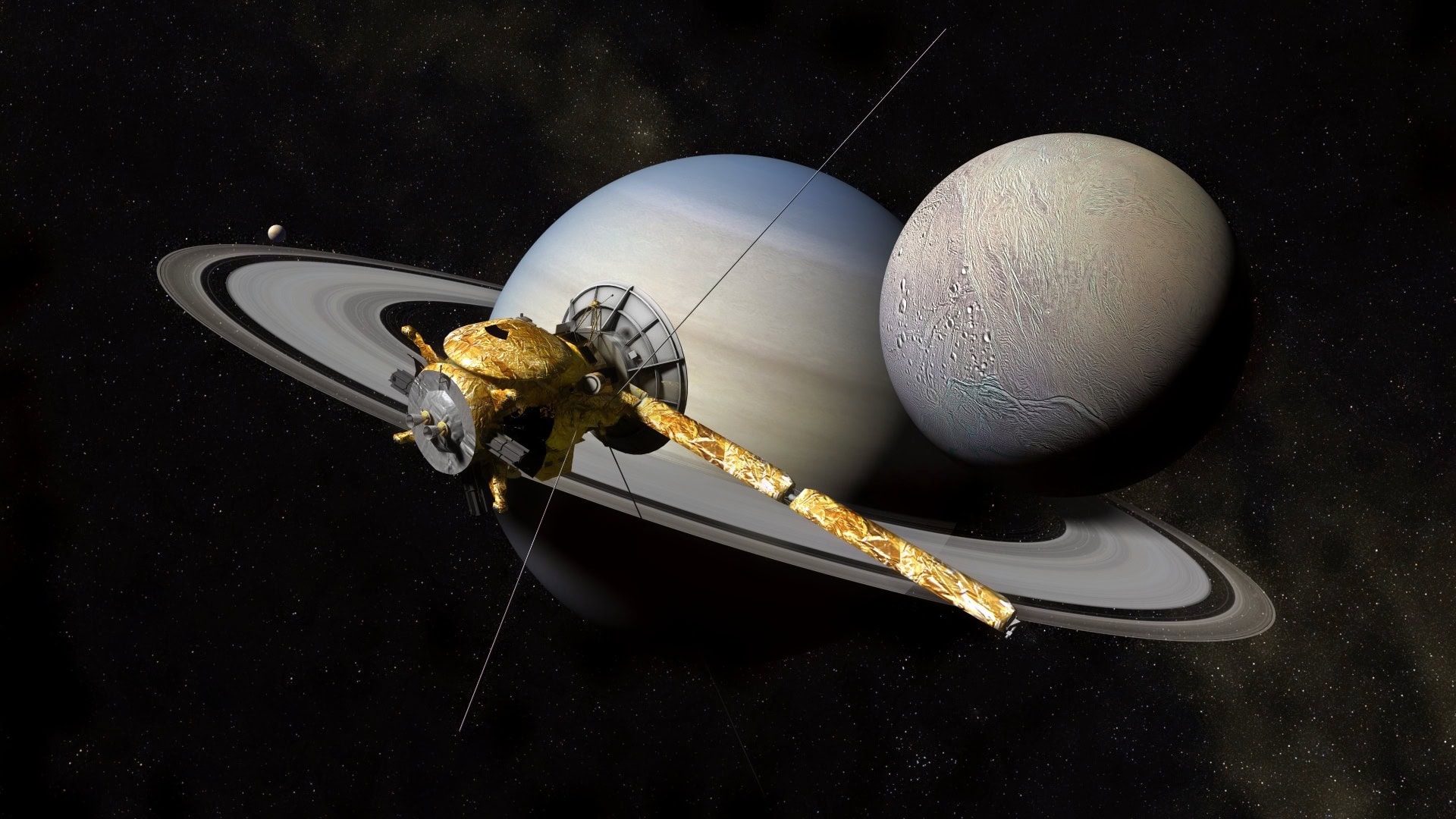
Four robotic emissaries have seen Saturn’s rings up close, and each one rewrote them. Galileo glimpsed the rings as baffling “cup handles” in 1610, and it took until 1655 for Christiaan Huygens to recognize a disk; the probes needed only decades to take the story further than three centuries of telescopes. Pioneer 11 arrived first, on September 1, 1979, deliberately flown through the ring plane as a pathfinder to prove the crossing was survivable, discovering the thin F ring on the way and nearly colliding with a moon, Epimetheus, that nobody knew existed, missing it by about 4,000 kilometers.
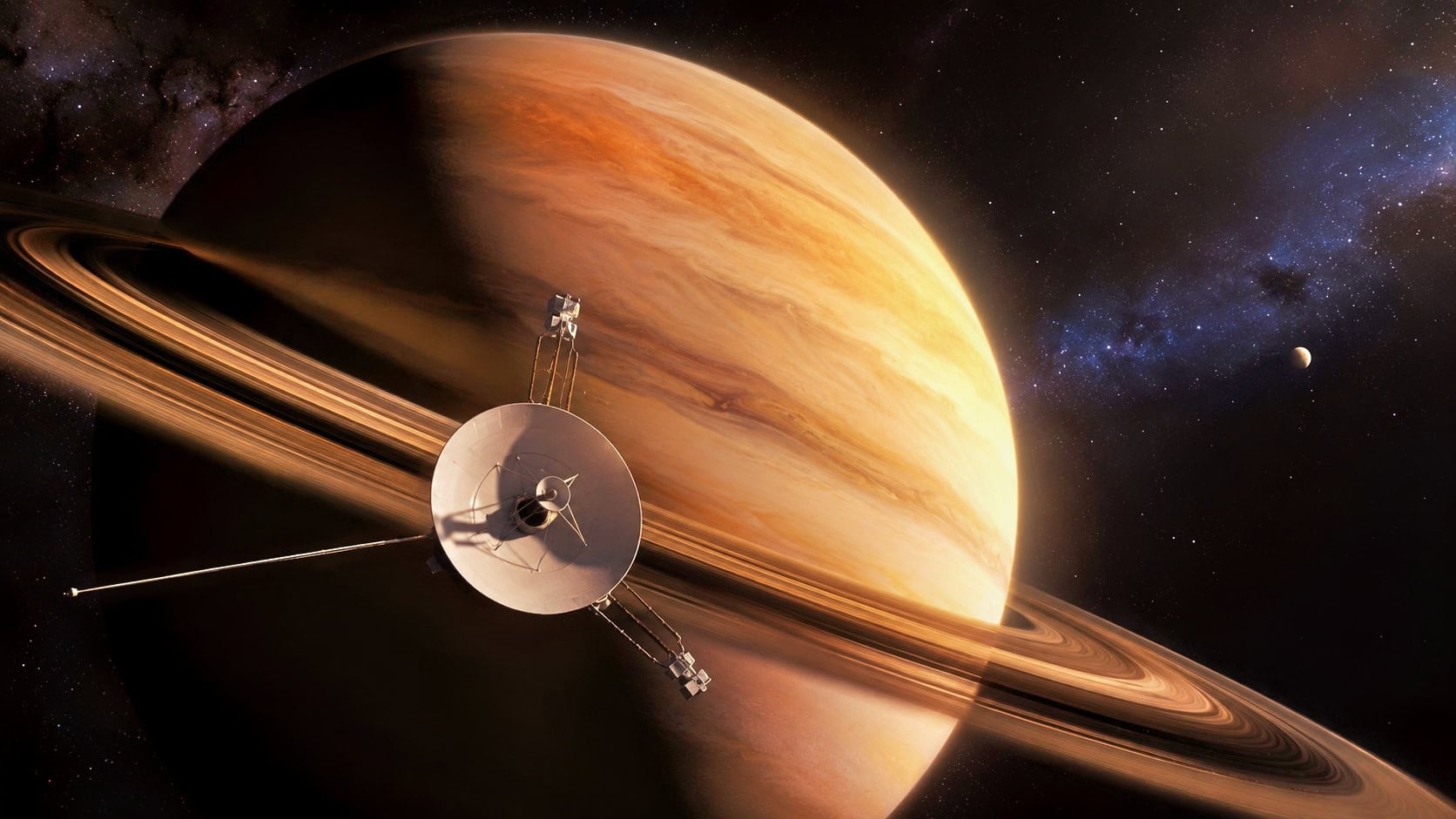
Pioneer 11 Probe NASA and Saturn Artist Rendering. Image Credit: Banana Nano.
Voyager 1 and Voyager 2 followed in 1980 and 1981, dissolving the smooth rings of every textbook into tens of thousands of ringlets. Then Cassini spent 13 years in orbit, from 2004 to 2017, and finished by flying through the gap between the rings and the planet 22 times before its deliberate final plunge. Out of all that data came a picture almost nobody outside planetary science carries around. Here are the five strangest things the probes taught us, the ones most people have never heard.
The Rings May Be Younger Than the Dinosaurs
For centuries, the safe assumption was that the rings are as old as Saturn, leftovers of the solar system’s birth 4.5 billion years ago. Cassini’s death orbits broke that assumption.
Flying between the planet and the rings, the spacecraft felt the rings’ gravity directly, and a team led by Luciano Iess published the resulting weight in the journal Science in 2019: the whole vast system holds only about 40 percent of the mass of Saturn’s small moon Mimas. That matters because the rings are more than 95 percent clean water ice, and space is dirty; infalling dust should darken them steadily.
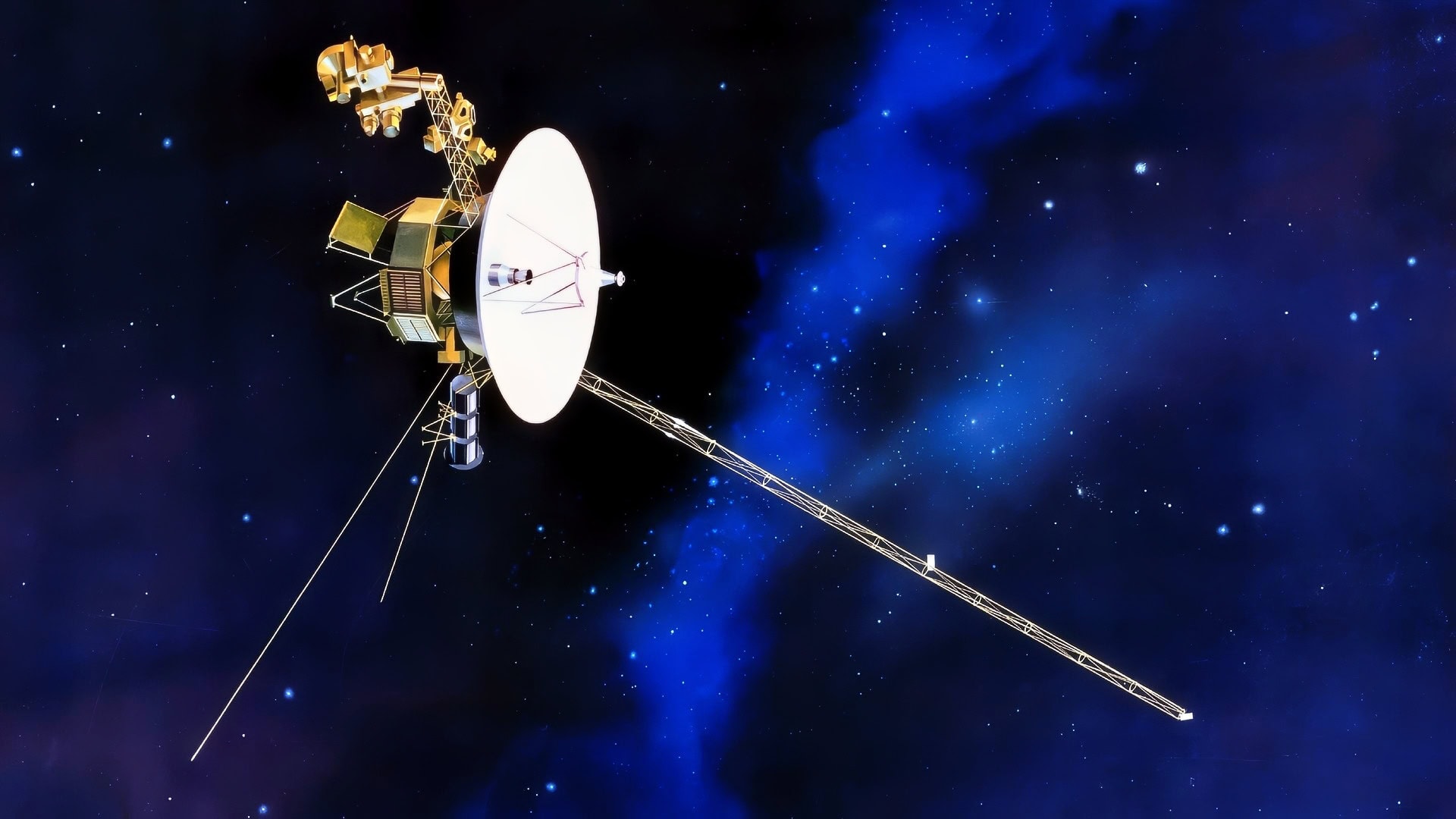
Artist’s Concept of Voyager. NASA Photo.
So little ice, still so bright, points to youth, and NASA’s own announcement put the likely formation window at 10 million to 100 million years ago, meaning dinosaurs may have looked up at a ringless Saturn.
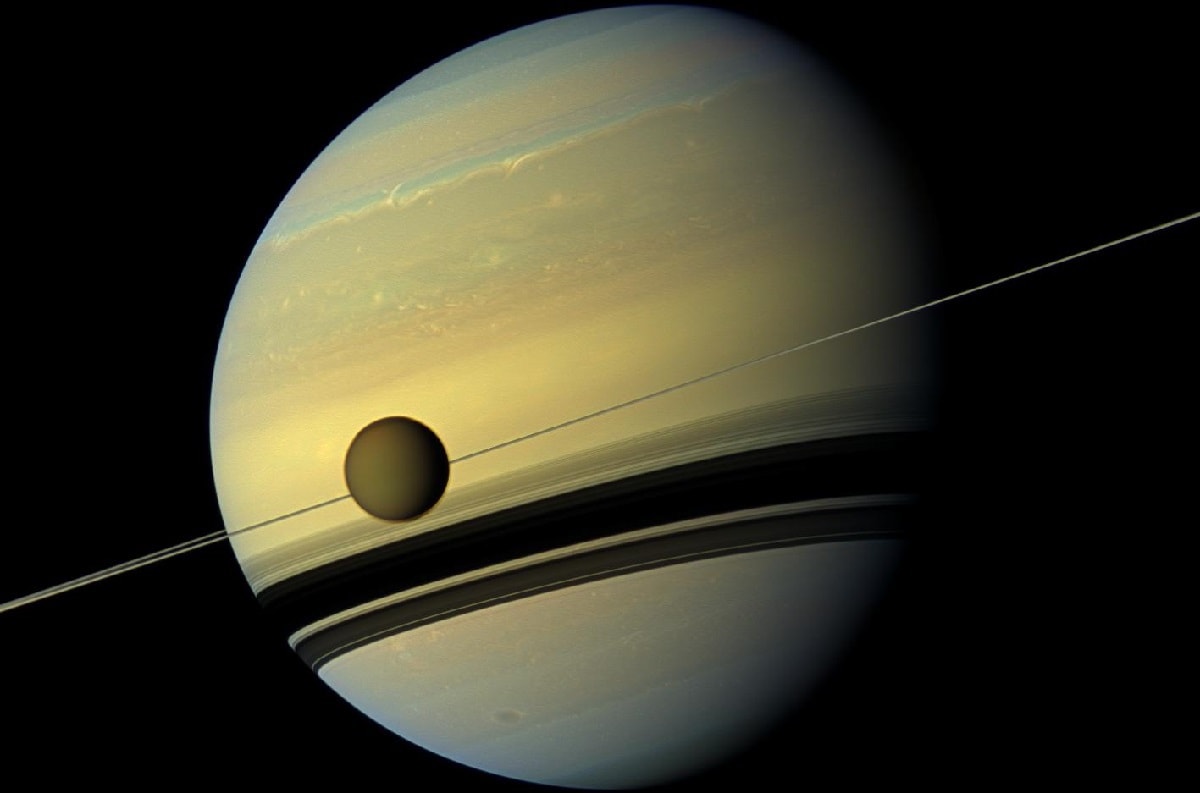
Saturn and Titan. Creative Commons Image.
The leading origin story is an icy moon that wandered too close and was torn apart by tides. Honesty requires the asterisk: some researchers now argue the rings might be ancient but scrub themselves clean, looking forever young, and the debate is live. The mass measurement, though, is not in dispute, and it leads directly to the next surprise.
They Are Disappearing, and 2025 Gave Earth a Preview
The rings are falling into Saturn. Cassini and ground-based observations captured the process, called ring rain: ice grains, charged by sunlight and micrometeoroid impacts, are captured by Saturn’s magnetic field and funneled into the atmosphere.
One widely cited estimate found the rain draining enough water to fill an Olympic swimming pool roughly every half hour, and when Cassini’s final orbits measured additional material pouring straight down at the equator, the projected lifespan of the rings dropped to a few hundred million years at most, possibly under one hundred million.
“We have shown that massive rings like Saturn’s do not last long,” is how a NASA scientist summarized three studies on the subject. In other words, humanity evolved inside the narrow window when Saturn has rings at all. There was even a preview: through 2025, Earth crossed Saturn’s ring plane, turning the rings edge-on and making them nearly vanish from backyard telescopes. That vanishing was geometry, not erosion, and the two are constantly confused. The real disappearance is slower and permanent.
The Entire System Is Nearly Nothing
The numbers that make the rings majestic also make them a kind of illusion. The main rings span roughly 280,000 kilometers, wide enough to lay more than twenty Earths side by side, yet where sharp-edged gaps let scientists measure them, the sheet is less than 200 meters thick and in places perhaps only 10 meters, the height of a three-story house. Scaled down, no sheet of paper is proportionally thinner.
Even the famous dark gaps deceive: Pioneer 11 found they brighten when lit from behind, meaning they are not empty at all, only thinner, and the crisp outer edges of the great A and B rings are held in place by the gravitational metronome of moons like Mimas.
Add the Cassini mass result, 40 percent of one modest moon spread across that immensity, and the grandest structure in the solar system turns out to be a film of ice, gravitationally choreographed dust and boulders, ranging from grains to chunks the size of buildings, each on its own orbit. The purity is the final oddity: better than 95 percent water ice, cleaner than almost anything in the outer solar system, which is exactly the evidence that started the age fight in item one.
The Spokes: Features That Should Not Exist
When the Voyagers closed in, their cameras caught something no telescope had ever seen, and no theory predicted: dark, radial smudges the size of continents, sweeping around the B ring like spokes on a wheel. They form and dissolve within hours, which orbital mechanics flatly forbids, since ring material closer to Saturn moves faster and should shear any radial feature apart almost instantly.
The probes supplied the clue: the spokes turned bright when lit from behind, the signature of fine dust, and the working theory is electrostatics, dust grains charged and levitated above the ring plane by processes tied to Saturn’s magnetic field. They are seasonal, waxing toward the planet’s equinoxes on a roughly seven-year rhythm, and Cassini watched a full cycle. Forty-five years after Voyager found them, their exact cause remains unexplained, and the Hubble Space Telescope now monitors each returning spoke season from a billion miles away, most recently around the equinox of May 2025.
The Rings Are a Seismograph, and They See Inside Saturn
The strangest discovery is the one the rings made about the planet. The rings are laced with spiral density waves, most raised by the gravity of Saturn’s moons. But when scientists traced certain waves in the C ring using star-occultation data that the Voyagers and Cassini gathered over more than two decades, the moons could not account for them. The source was Saturn itself: the planet’s rings like a struck bell, and its internal oscillations shake the nearby ring material into patterns, turning trillions of ice particles into the readout of an instrument.
The field even has a name, kronoseismology. Its landmark came in 2021, when Caltech researchers matched one stubborn, unpredicted wave to Saturn’s interior and showed the planet has no compact core at all but a fuzzy, diluted one, a slushy mix of rock, ice, and gas grading outward through most of the planet’s radius. No probe will ever descend into Saturn and survive; the rings are the only window anyone has into its heart. That window is now the whole observatory, because when Cassini flew into the planet on September 15, 2017, protecting the ocean moon Enceladus from contamination, it left Saturn with no spacecraft and none funded to follow.
The archive Cassini transmitted is still yielding discoveries nine years later, Hubble checks in on the spokes every year, and the rings keep raining quietly into the planet, an Olympic pool every half hour, on a countdown only the probes ever let us see.
MORE – The NASA Space Shuttle Could Hit Mach 25
About the Author: Harry J. Kazianis
Harry J. Kazianis (@Grecianformula) was the former Senior Director of National Security Affairs at the Center for the National Interest (CFTNI), a foreign policy think tank founded by Richard Nixon based in Washington, DC. Harry has over a decade of experience in think tanks and national security publishing. His ideas have been published in the NY Times, The Washington Post, The Wall Street Journal, CNN, and many other outlets. He has held positions at CSIS, the Heritage Foundation, the University of Nottingham, and several other institutions related to national security research and studies. He is the former Executive Editor of the National Interest and the Diplomat. He holds a Master’s degree focusing on international affairs from Harvard University.

