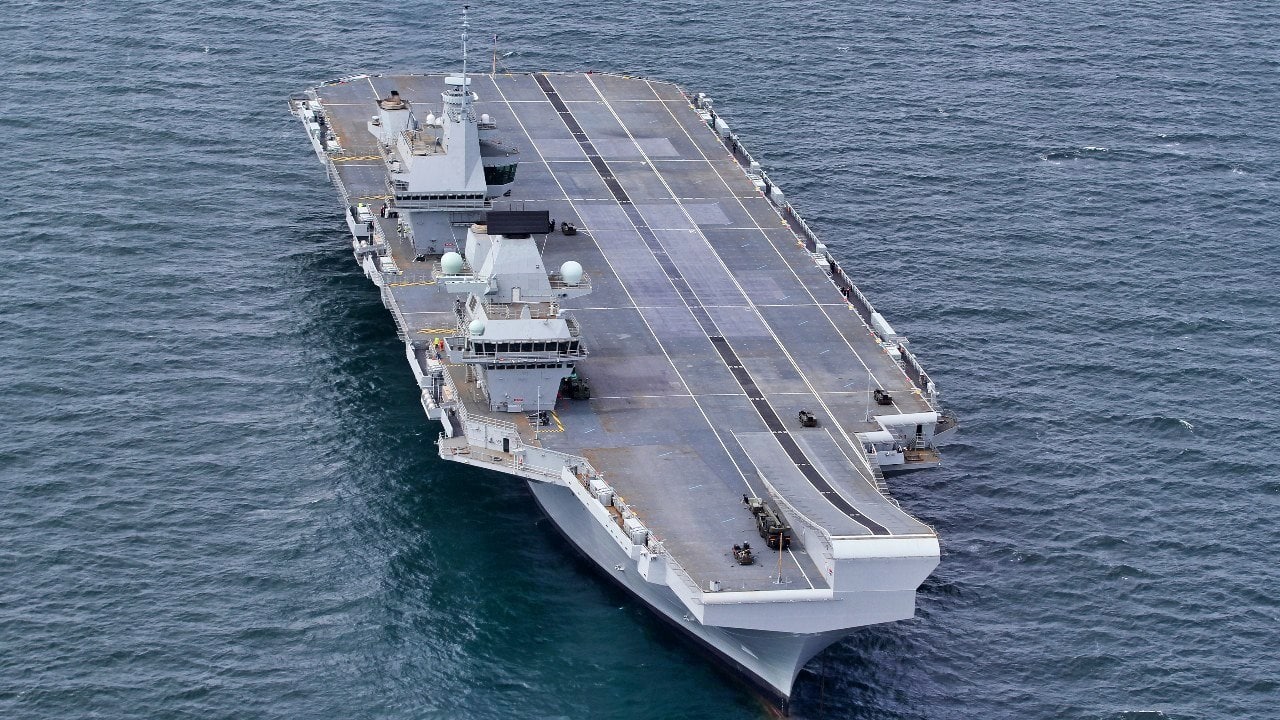
“Rule Britannia! Rule the waves, Britons will never be slaves!” That’s one of the most memorable lines in the magisterial 1740 patriotic song, “Rule, Britannia!” by James Thomson and Thomas Arne.
It was less a whimsical lyric and more a statement of fact at the time of that song’s making.
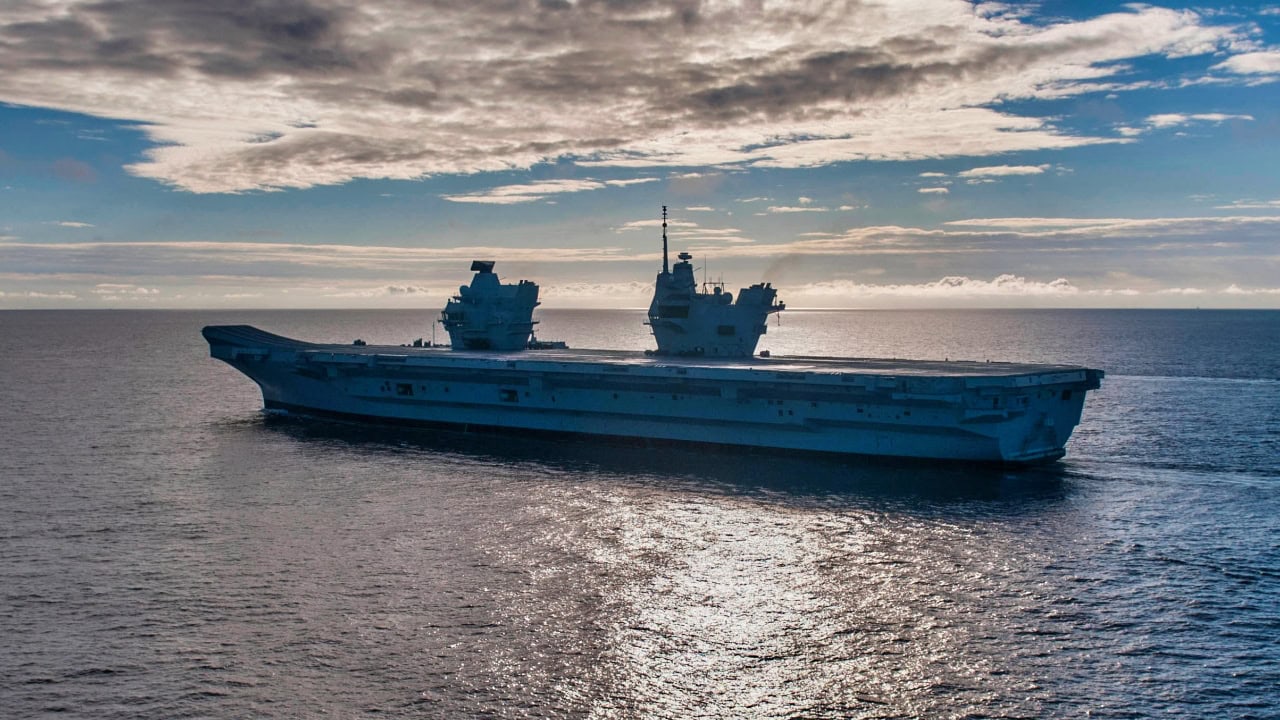
(Aug. 8, 2017) The Royal Navy aircraft carrier HMS Queen Elizabeth II sails in formation alongside the Nimitz-class aircraft carrier USS George H.W. Bush (CVN 77) during exercise Saxon Warrior 2017, Aug. 8. Saxon Warrior is a United States and United Kingdom co-hosted carrier strike group exercise that demonstrates interoperability and capability to respond to crises and deter potential threats. (U.S. Navy photo by Mass Communication Specialist 3rd Class Tristan B. Lotz/Released)
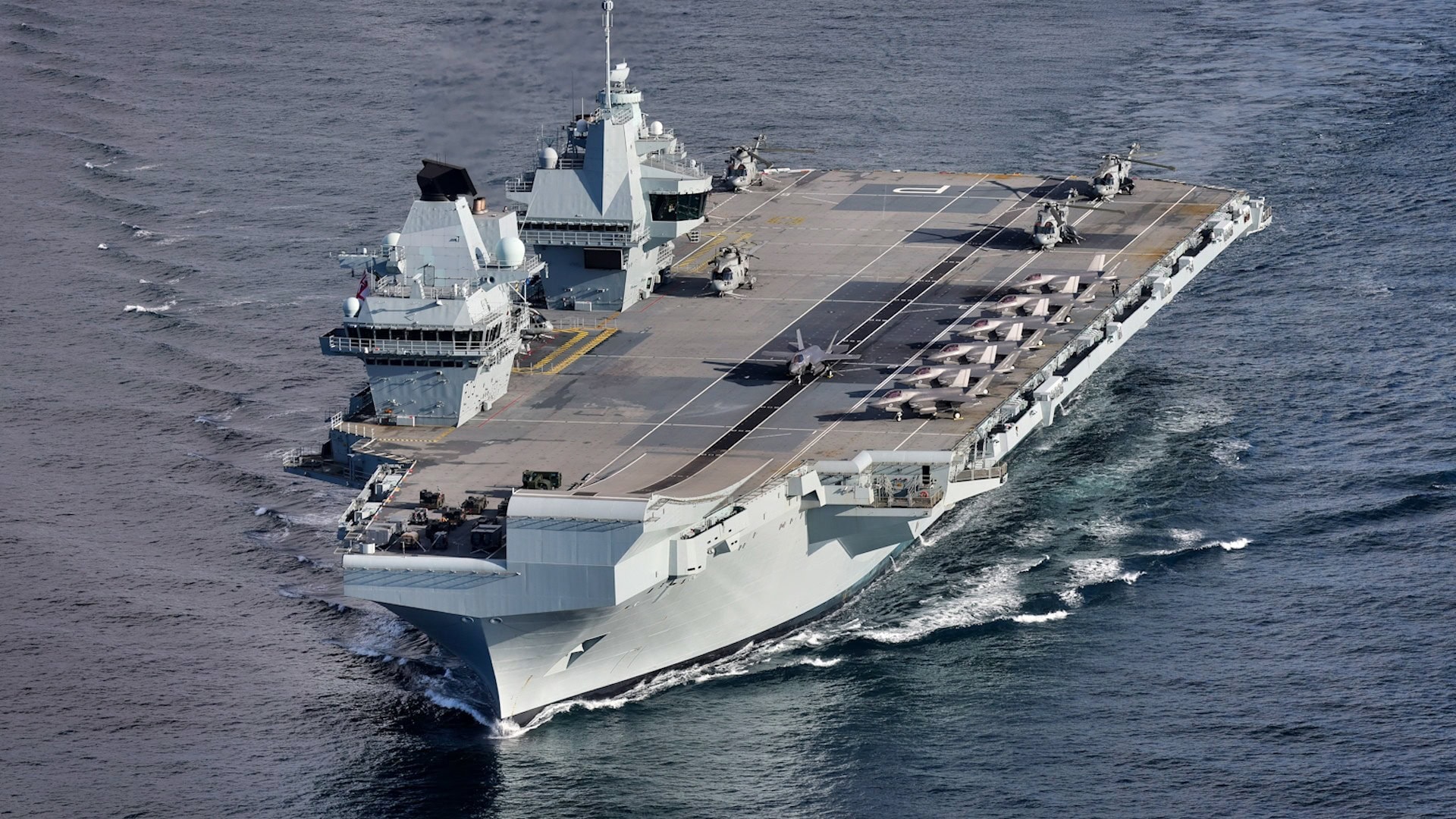
Royal Navy Aircraft Carrier. Image Credit: Royal Navy.
After all, by 1740, the year the song was first crafted, Britain had displaced the Spanish as the primary naval power for 152 years (when the Spanish Armada was lost at the Battle of Gravelines, beginning the rise of Britain’s Royal Navy).
Losing Dominance
That dominant reality persisted several hundred years thereafter. And so long as the Royal Navy ruled the waves, Britons never worried about their own security.
By the Second World War, though, that golden age was coming to an end. Sure, the British had been on the winning side in World War II.
But it limped out of that war, having been drained by its war with the Nazis, having most of its empire usurped by its American ally as the price of US assistance against the Axis Powers, and then losing its remaining colonial possession during the wave of decolonization that followed Britain’s “victory.”
By 1959, the decline of even the once-mighty Royal Navy was impossible to ignore.
One of the most infamous examples of that collapse of British naval power came in the form of the CVA-01, the proposed HMS Queen Elizabeth, intended to replace Britain’s aging postwar aircraft carriers (while preserving the Royal Navy’s ability to operate conventional fixed-wing aircraft at sea into the 1990s).
Instead, the British government canceled the project in 1966 amid mounting economic problems, pressure on the sterling, and a fundamental reassessment of Britain’s global military commitments.
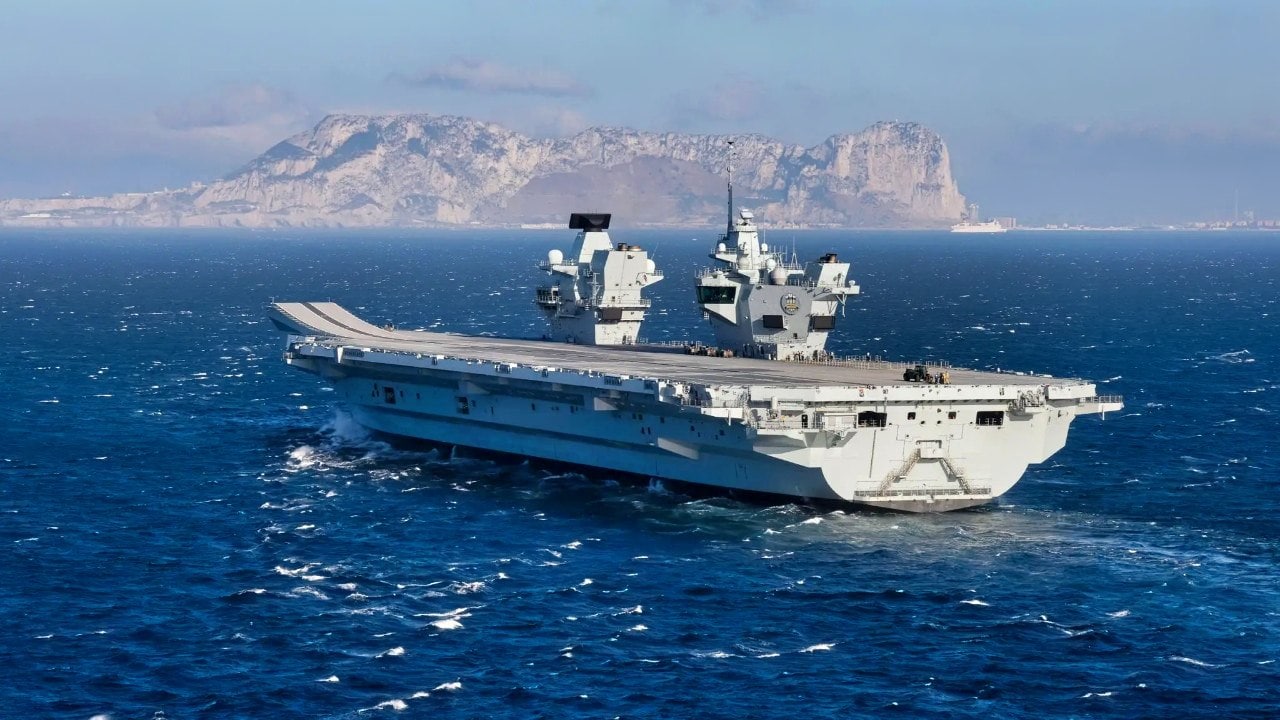
HMS Prince of Wales Royal Navy. Image Credit: Royal Navy.
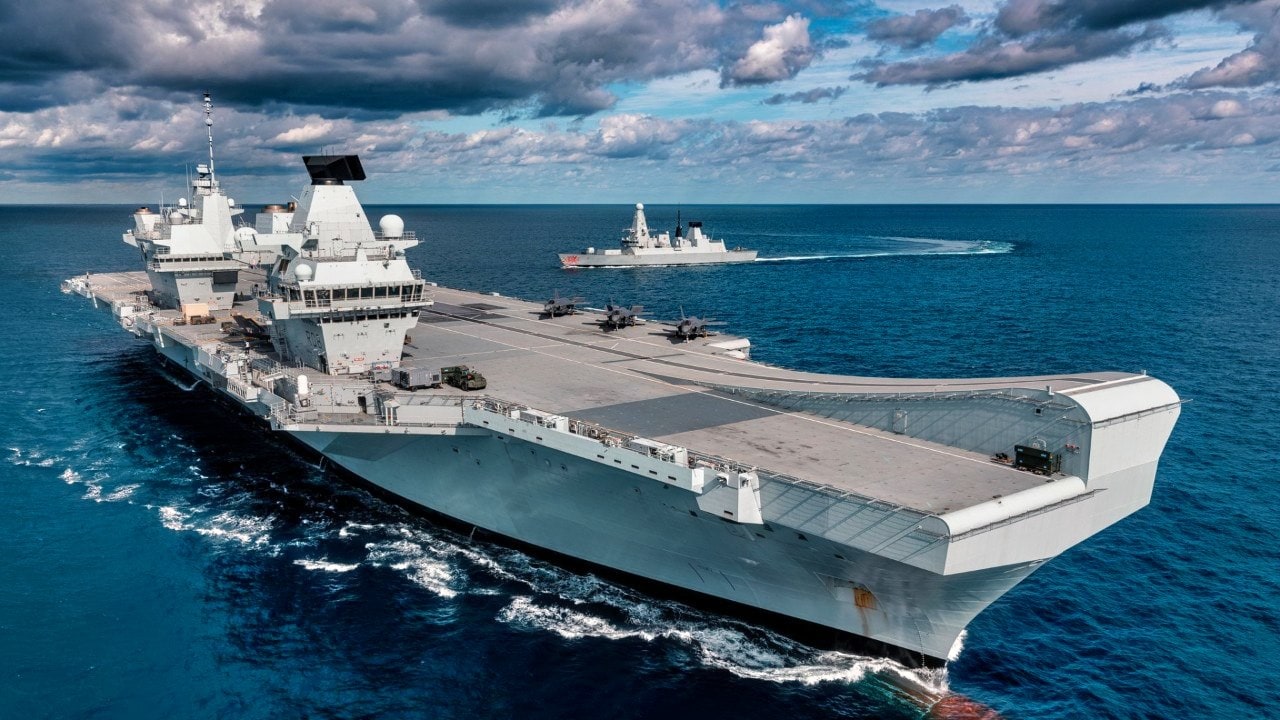
Queen Elizabeth-Class Royal Navy Aircraft Carrier. Image Credit: Creative Commons.
The cancellation became one of the defining moments in the Royal Navy’s post-WWII contraction (a process the British are still coming to terms with today).
Around 1959, London recognized that its existing carrier force, which included the HMS Ark Royal, Eagle, Victorious, Hermes, and Centaur, was based on wartime designs and struggled to accommodate larger jet aircraft.
In 1962, the Royal Navy’s engineers began designing a replacement capable of supporting modern naval aviation.
The CVA-01 Rises?
Enter the CVA-01, which was one of the most ambitious postwar designs for an aircraft carrier.
That final design was projected to displace around 54,500 to 55,000 tons and measure about 936 feet long. It would have been conventionally powered by oil-fired steam turbines driving three propellers.
She’d carry a crew of more than 3,000 sailors and possess an air wing of 18 F-4 Phantom warplanes, 18 Blackburn Buccaneer strike aircraft, four Gannet airborne-early-warning aircraft, and five Sea King helicopters.
Two steam catapults and arresting gear would support conventional aircraft operations onboard.
Designers intended to install a Sea Dart surface-to-air missile launcher at the stern of the CVA-01.
The flight deck itself incorporated an unusual “three-lane” arrangement designed to allow aircraft to land, taxi, and launch with less interference between operations.
The CVA-01 would also have received advanced three-dimensional radar and automated aircraft-control systems. Those capabilities, however, came with an exploding price that British leaders were increasingly allergic to.
The CVA-01 Dies
By the time that Prime Minister Harold Wilson took power in 1964, ushering in a Labor Party government, it was clear that the CVA-01’s days were numbered. At the time, Britain was struggling with persistent balance-of-payments problems and pressure on the pound.
Cuts had to be imposed upon the Ministry of Defense.
The Royal Air Force (RAF) argued that its land-based aircraft could perform missions otherwise assigned to carriers. The Royal Navy, of course, pushed back.
The Wilson government sided with the RAF. The carrier was effectively dead. That triggered a massive protest among Royal Navy leaders.
The First Sea Lord, Adm. Sir David Luce, resigned. Shortly after, Navy Minister Christopher Mayhew resigned in protest, too. It was clear what the cancellation of the CVA-01 meant at the all-important strategic level: an end to the Royal Navy going “East of Suez.”
Thus, the decision was a negative feedback loop. No new carriers meant no capabilities to go “East of Suez” in any meaningful way, thereby killing whatever remained of Britain’s global naval power.
Britain Returns to the Carrier…Kind Of
By the 1990s, though, London reversed its decision. The 1998 Strategic Defense Review authorized development of two new large carriers.
HMS Queen Elizabeth and HMS Prince of Wales, each approximately 65,000 tons.
This decision was made decades after Britain ended the CVA-01 project.
The current carriers Britain possesses are problematic for the much smaller Royal Navy than the new carriers in the 1960s and 70s would have been.
CVA-01 remains the most prominent example of Britain abandoning the engine of its empire, the Royal Navy, in response to post-World War II realities.
And once they abandoned that concept, the British spent decades trying to reconstitute it.
While England today has two new conventionally powered aircraft carriers, the HMS Queen Elizabeth and the HMS Prince of Wales, these vessels are struggling to maintain relevance. They are soaking up considerable resources in a limited Royal Navy.
About the Author: Brandon J. Weichert
Brandon J. Weichert is the Senior National Security Editor at 19FortyFive.com. He also manages The Weichert Brief on Substack. Weichert also hosts “National Security Talk” on Rumble. He is the author of four bestselling national security books, the most recent of which is A Disaster of Our Own Making: How the West Lost Ukraine (Encounter Books). Follow him via Twitter/X @WeTheBrandon.