
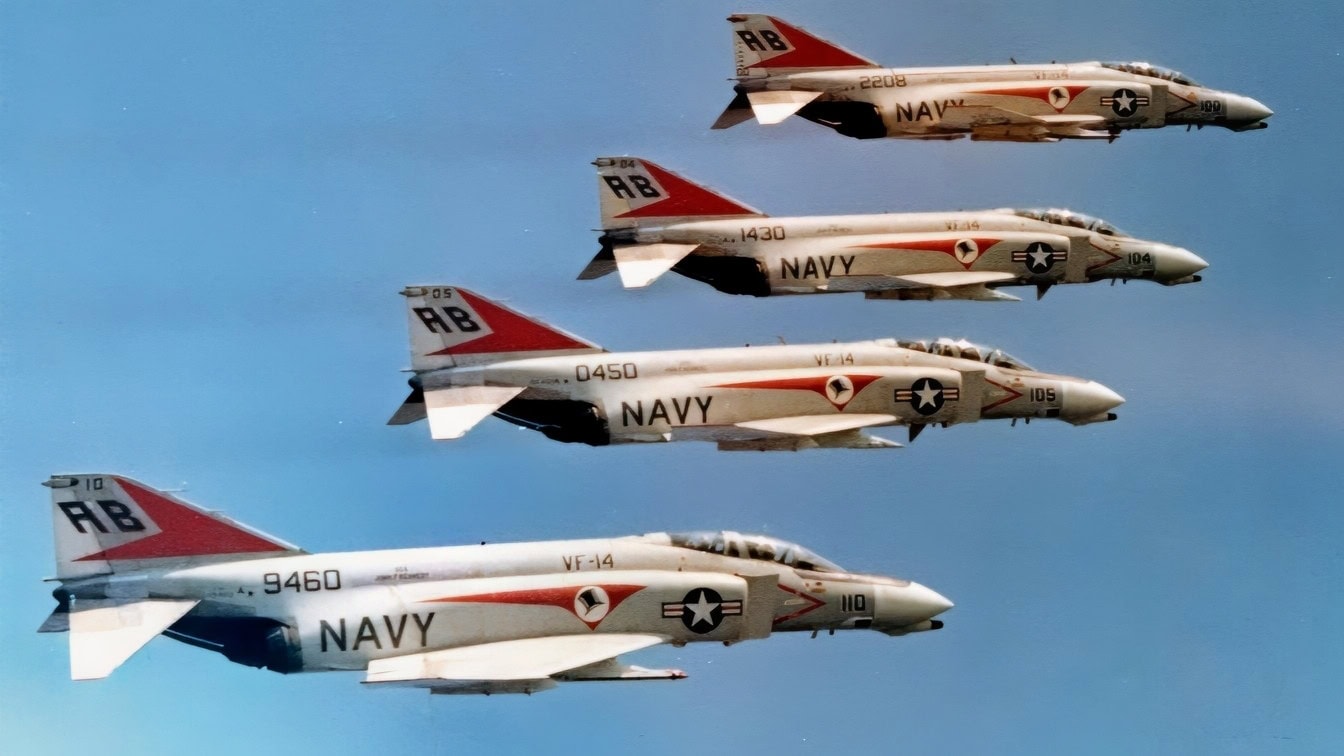
The McDonnell Douglas F-4 Phantom II was undoubtedly the predominant American-made 3rd-Generation fighter jet. It was purchased by 11 of America’s foreign military sales (FMS) customers and thus made a big impact—both literally and figuratively—during multiple “hot wars” of the Cold War, from the Vietnam War to the 1973 Yom Kippur War to the 1991 Persian Gulf War, aka Operation Desert Storm.
The Phantom’s universal appeal was highly understandable; among other things, it set a whopping 16 world speed and altitude records between 1959 and 1962 despite its massive size, prompting Vietnam veteran pilot Dick Anderegg to joke that the whopper of a warbird provided “proof that if you put enough thrust behind a brick you can make it fly.”
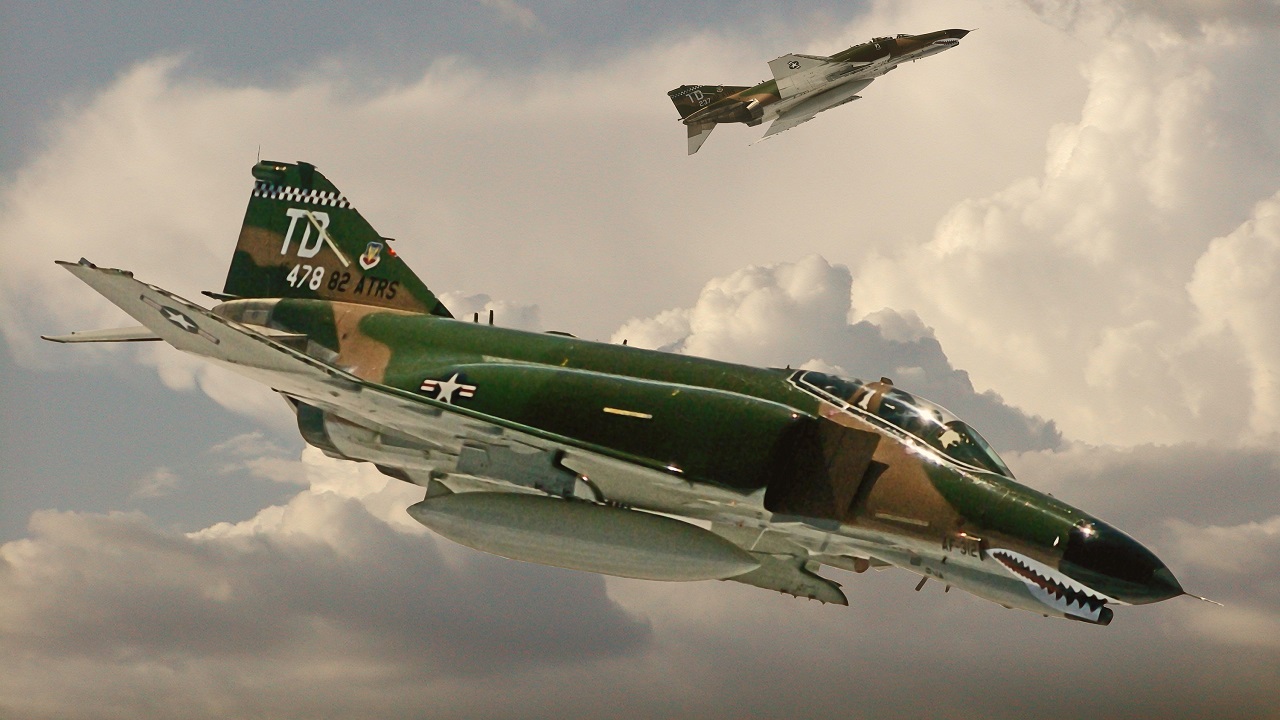
F-4 Phantom. Image Credit: U.S. Air Force.
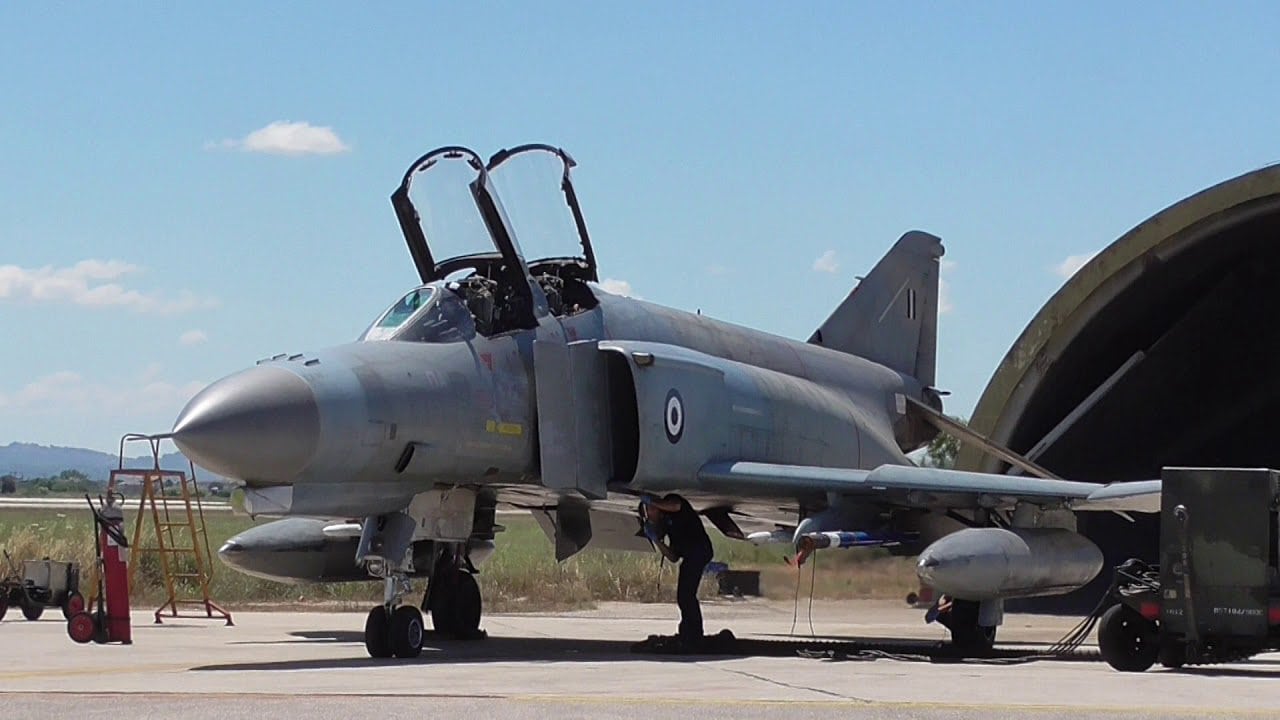
F-4E. Image Credit: Creative Commons.
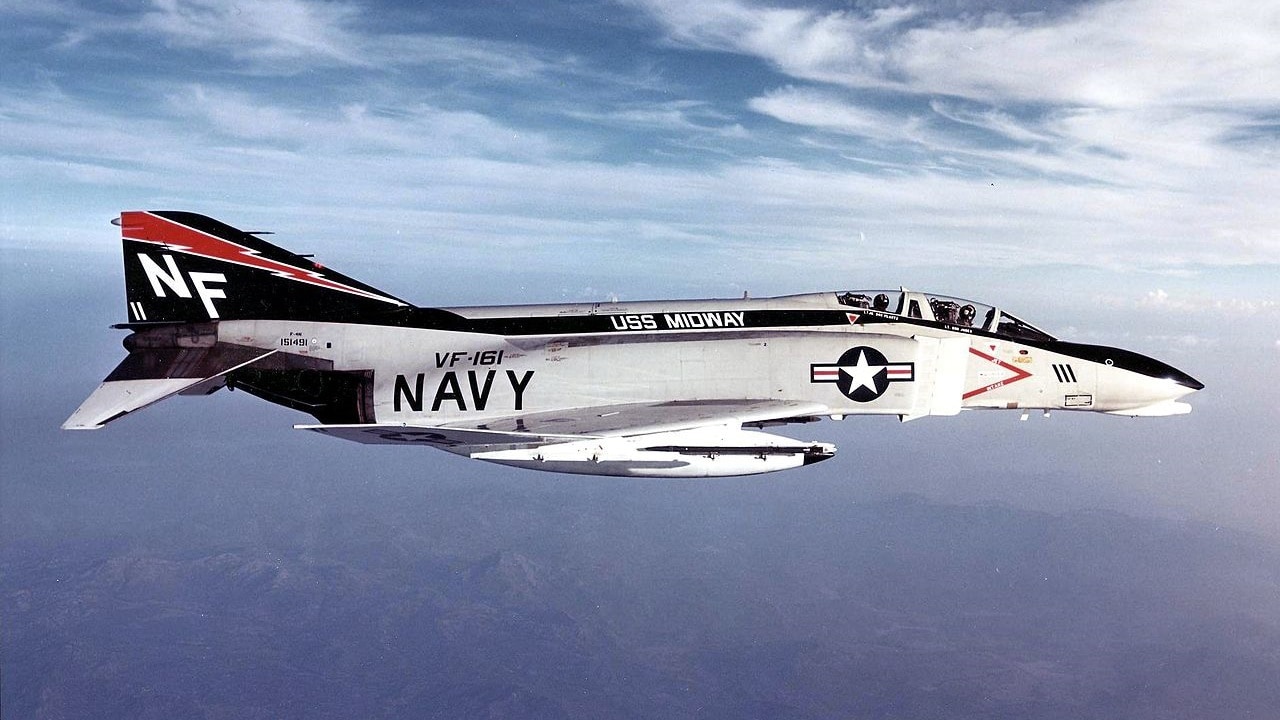
F-4 Phantom. Creative Commons Image.
35 years after the end of the Cold War, only three nations still fly the Phantom II: (1) Greece, a NATO ally of the United States; (2) Turkey, also ostensibly a NATO ally despite both its longstanding enmity with Greece and its current head of state’s cozy relationship with Russia, and (3) an outright enemy of the U.S., that being Iran.
We shall now focus on the F-4’s Iranian history, and we’ll start with a logical question: How the heck did an enemy entity like the Islamic Republic of Iran end up with this all-American fighter plane in the first place?
Initial History: How Iran Got Its Phantoms
An excellent question. Well, you see, back when Iran acquired the F-4, it wasn’t yet our adversary.
The FMS transaction took place during happier times for U.S.-Iran relations, during the reign of the predecessor to the Ayatollah Ruhollah Khomeini, namely the Shah Mohammad Reza Pahlavi. The Shah was unabashedly pro-U.S. and pro-Israel.
Accordingly, the U.S. delivered 225 F-4D, F-4E, and RF-4E (reconnaissance) variants to then-friendly Iran in the 1960s and 1970s, making the Persian nation the ssecond-largestexport customer of the fearsome Phantom.
Operational Performance of the Iranian Phantoms
Notwithstanding the Phantom’s nexus with both the so-called “Great Satan” and “Little Satan,” i.e., the United States and Israel, the Ayatollah’s fighter pilots of the Islamic Republic of Iran Air Force (IRIAF) were still pragmatic enough to put religious fundamentalist fervor aside for the sake of getting good use out of their grandfathered-in fighter jets.
Accordingly, IRIAF F-4s saw heavy action in the Iran–Iraq War in the 1980s and, despite the Western arms embargo on spare parts, were kept operational by overhaul and servicing from Iran’s aerospace industry.
Though not as prestigious in the IRIAF social pecking order as the F-14 Tomcat—another U.S.-made fighter plane conveniently inherited from the Shah’s days—Iranian Phantom drivers still pulled off some daring missions:
– Operation Scorch Sword, an attack by a pair of Iranian Phantoms against the Iraqi Osirak nuclear reactor site near Baghdad on 30 September 1980; granted, Scorch Sword was nowhere near as famous or effective as the Israeli Air Force’s Operational Opera/Operation Babylon strike against that same reactor the following year
-A 4 April 1981 strike by eight Iranian F-4s against the Al Weredo (H-3) complex of air bases in the far west of Iraq, which resulted in many Iraqi Air Force (IqAF) aircraft being destroyed or damaged in exchange for zero Iranian losses.
In turn, the Iranian Phantom fighter jockeys took their fair share of losses. Case in point: on 5 June 1984, two Royal Saudi Air Force (RSAF; l-Quwwat Al-Jawiyah Al-Malakiyah as-Su’udiyah) F-15 Eagle pilots downed two Iranian F-4s.
The IRIAF reportedly used the aging Phantoms in combat as recently as 2014, in strikes against the Islamic State/ISIS/ISIL/Da’esh terrorist group.
And one can’t forget how F-4 Phantoms came up against American F-22 Raptors who flew under them, undetected.
Moreover, despite the age of the airframes and the lack of spare parts, the old warbirds haven’t remained completely frozen in time; in November 2020, the regime showcased its Qased 900-kg (1,984-lb.) electro-optic-guided smart bombs during its annual “Defenders of the Sky” drills.
Current Status
Before the onset of Operation Epic Fury/Roaring Lion, reliable sources indicated that the IRIAF had a total of 63 F-4D/E/RF airframes, constituting 27.27 percent of their total 231-strong fighter fleet, which in turn comprised 58 percent of the IRIAF’s total active inventory of 400 aircraft.
So then, in the wake of the intensive joint U.S.-Israeli air campaign, one has to wonder: Are any Iranian Phantoms still left?
Thus far, there’s no indication that the IRIAF Phantom fleet has been completely wiped out—or *almost* completely wiped out anyway—as Iran’s Tomcat fleet has. Indeed, Iranian Phantom losses appear to have been comparatively modest thus far:
-On March 1, 2026, the Israeli Air Force (IAF) destroyed one F-4 along with two F-5 fighter jets as the trio was preparing to take off from the Artesh Air Force 2nd Tactical Airbase in Tabriz, East Azerbaijan Province
-On that same date, U.S. Air Force strikes destroyed multiple F-4D/Es—as verified via video footage by U.S. Central Command (CENTCOM)—though the exact number isn’t specified
So, that gives us at least 2–3 F‑4s confirmed destroyed thus far; though additional losses remain unconfirmed, many IRIAF assets are kept well hidden.
The Iranians’ current reluctance to send their Phantoms skyward is quite understandable, given the stark differential in capabilities between those 3rd-Generation and America’s and Israel’s 4.5 Generation F-15s and F-16s and 5th-Generation F-22s and F-35s.
About the Author: Christian D. Orr
Christian D. Orr is a Senior Defense Editor. He is a former Air Force Security Forces officer, Federal law enforcement officer, and private military contractor (with assignments worked in Iraq, the United Arab Emirates, Kosovo, Japan, Germany, and the Pentagon). Chris holds a B.A. in International Relations from the University of Southern California (USC) and an M.A. in Intelligence Studies (with a concentration in Terrorism Studies) from American Military University (AMU). He is also the author of the book “Five Decades of a Fabulous Firearm: Celebrating the 50th Anniversary of the Beretta 92 Pistol Series,” the second edition of which was recently published.