
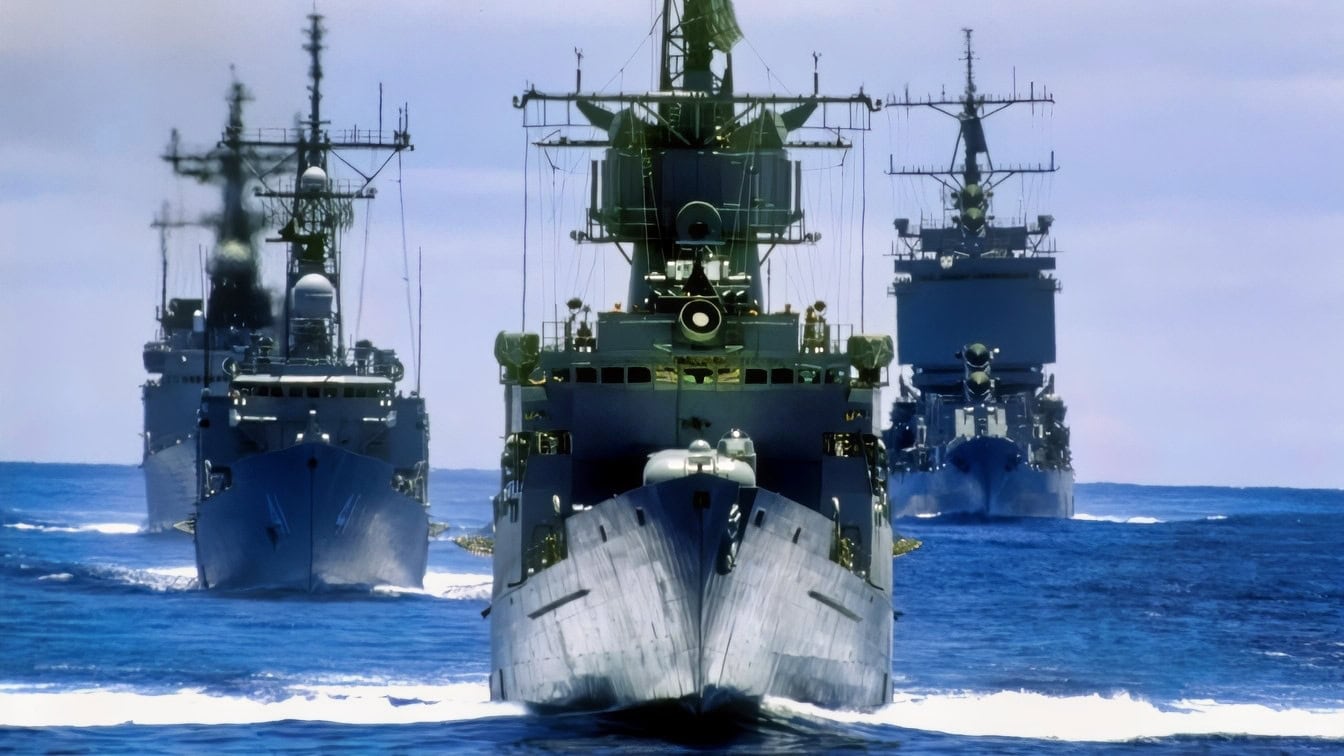
I want battleships. Late last year, President Donald Trump announced that he wanted to construct the first class of dreadnoughts since the 1940s, the nuclear-powered “Trump-class.” Battlewagons—heavyweight surface combatants—used to dominate the sea. The battleship Missouri, on whose decks imperial Japan surrendered in 1945, is emblematic of this iconic ship type. Or, I get to admire the battleship Massachusetts, now also a museum ship, every day on my way to work. And I say “hello, ship” every time.
Alas, I doubt we will ever see the Trump-class.
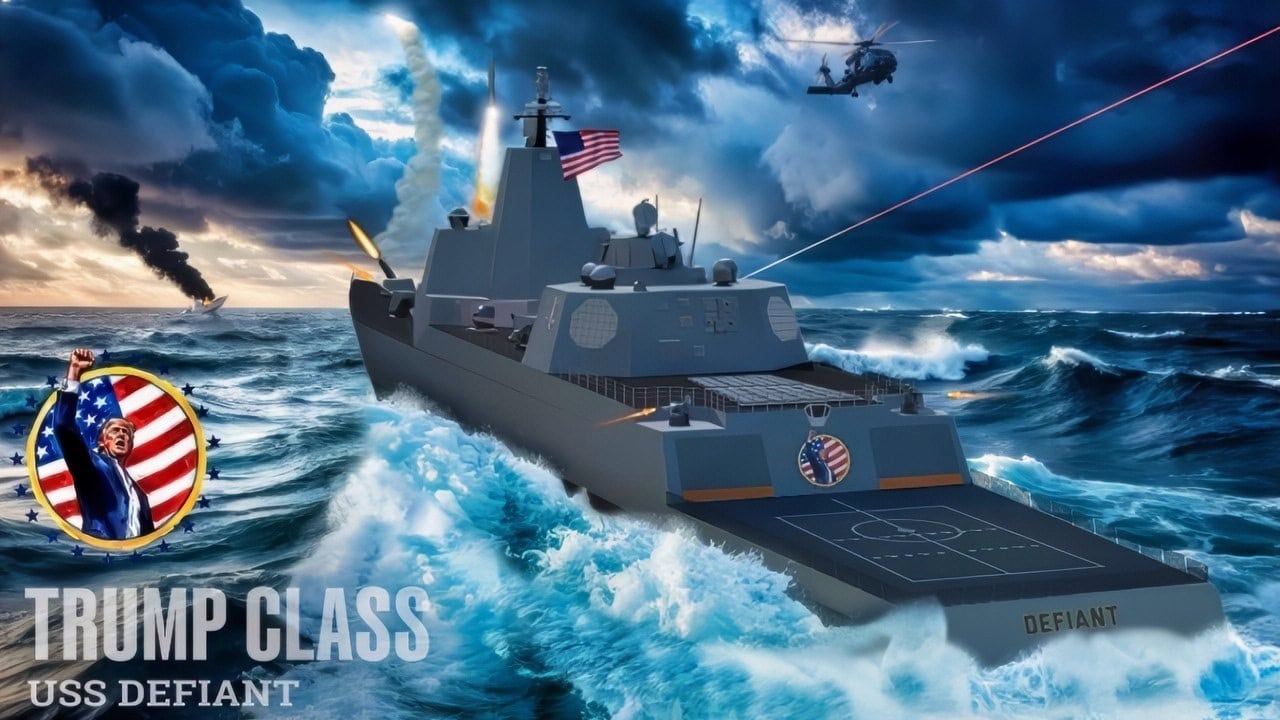
Trump-Class Battleship. Image Credit: Creative Commons/White House Photo.
The logic underlying supersized surface combatants is impeccable. Sea-power sage Alfred Thayer Mahan defined “capital ships” as ships of war that constituted a great navy’s battle line. For Mahan, a capital ship was able to stand in a fight with the best a peer navy could hurl at the battle line. It could duke it out with reasonable chances of victory. Capital ships boasted the offensive and defensive power to dish out heavy firepower in action while withstanding punishment from the foe.
Back then—Mahan lived during the age of steam—naval battle meant fleets of battleships and battlecruisers exchanging gunfire at close range. Naval commanders sought to concentrate superior force at the time and place of battle, skewing the outcome in their favor. Now as then, the goal is to concentrate stronger firepower at the scene of action at the right time. But since then, of course, the implements of high-seas warfare have morphed beyond anything Mahan could have imagined, with the advent of guided missiles, naval nuclear propulsion, and, today, artificial intelligence, autonomous weapon systems, and directed-energy weapons harnessing lasers or microwaves.
Capital ships remain desirable, but several factors should give us pause. First, Mahan’s English contemporary and rival, Julian S. Corbett, provides ample cause to doubt that nouveau battleships will ever be built. When analyzing fleet design, Corbett explains that a navy can field only so many capital ships. Capital ships are too large, complex, and resource- and manpower-intensive for even a great navy to afford many. Navies need other types of craft in abundance.
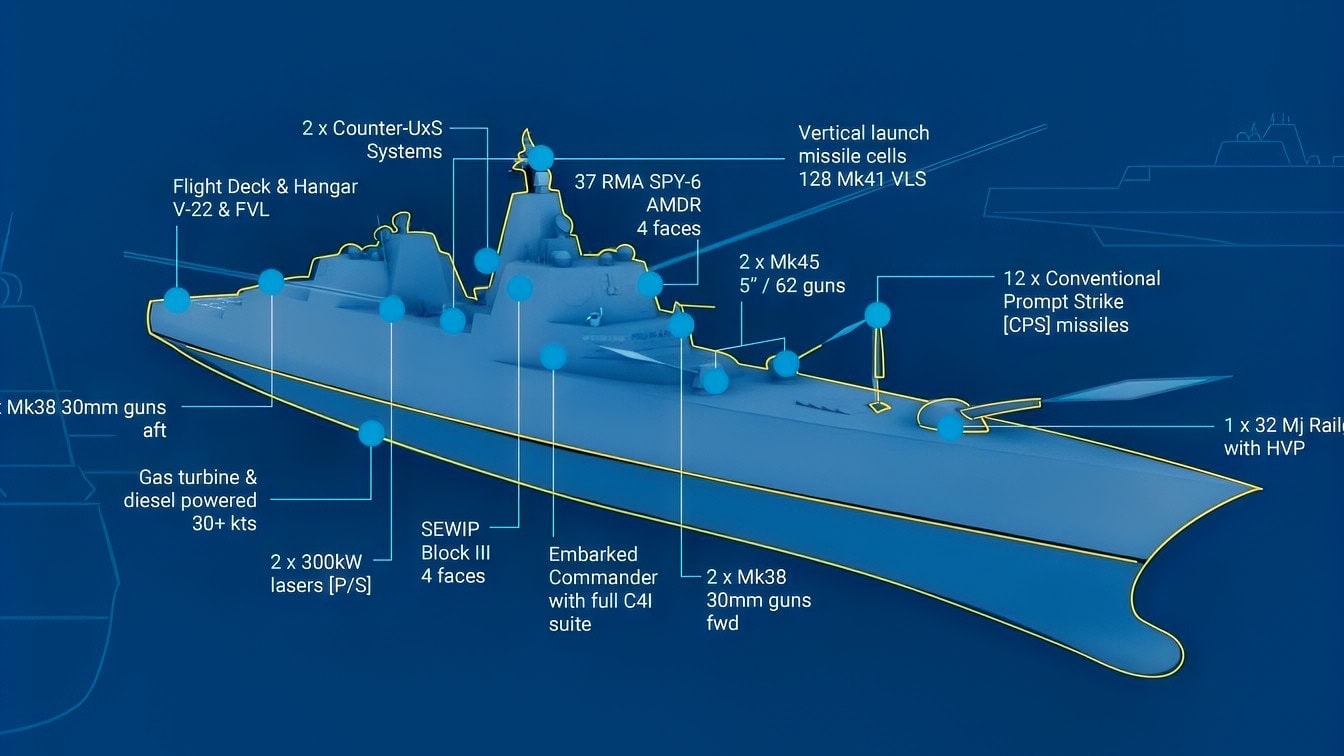
Trump-Class Battleship Creative Commons Image
Cost is key.
Aircraft carriers have been the U.S. Navy’s capital ships—the core of its battle fleet—since World War II. A fundamental question is whether the Defiant class would replace the carriers as the U.S. Navy’s capital ships if purchased.
The price tag for the first-in-class USS Defiant comes in at a cool $23 billion according to the Congressional Budget Office (CBO). Now, that figure is a mite misleading; U.S. Navy practice includes R&D costs in the price of the first ship in the class, which inflates the lead ship’s cost by far. Still, the CBO estimates the average cost of each Defiant-class hull at $18 billion over the program’s lifespan.
Contrast that with the price of the U.S. Navy’s next nuclear-powered aircraft carrier, USS John F. Kennedy, which will set taxpayers back a trifle over $13 billion according to the Congressional Research Service. This hints at trade-offs within a finite shipbuilding budget. Forced to choose, is the Trump administration saying that it intends battleships to replace carriers within the Navy battle fleet—repealing decades of history?
The relative cost figures suggest so.
Flattops emerged as the Navy’s chief striking arm following the Japanese attack on the U.S. battleship contingent at Pearl Harbor. They have remained so ever since. But the White House seems to want to turn back time to the age of heavy-hitting surface combatants, when aircraft carriers were an auxiliary platform.
Second, and intimately related, combat capability. Would the Trump class offer sufficient return on investment to justify its cost? If Congress and the Pentagon were prepared to spend an extra $5 billion per hull on each Defiant-class battleship as opposed to a Ford-class aircraft carrier, the U.S. Navy’s latest flattop, that would amount to an earthshattering statement about priorities for fleet design.
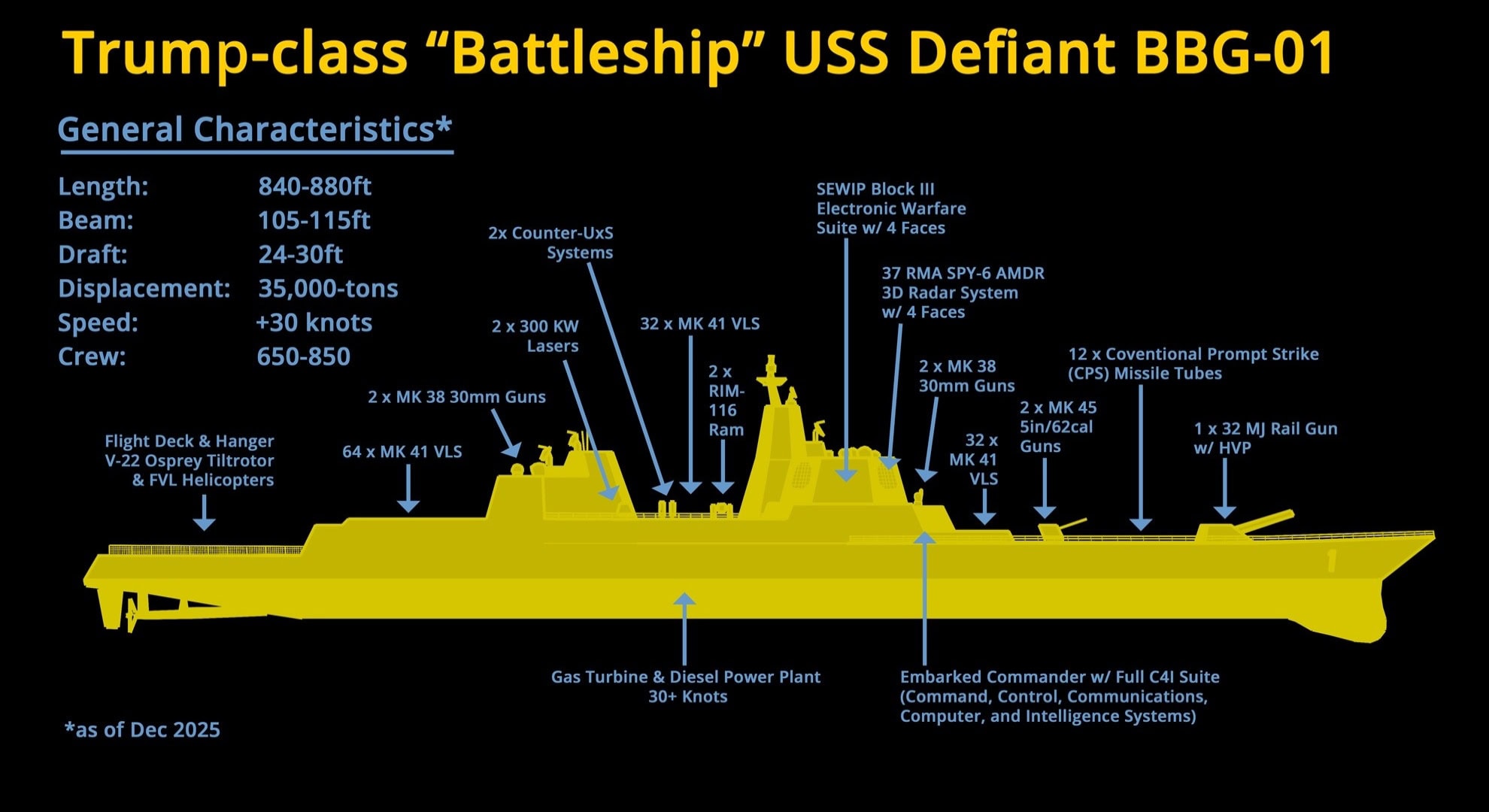
Carriers manifest proven capabilities in terms of air power, whereas the proven capabilities set to be installed in the battleships equate more or less to those mounted in a Ticonderoga-class cruiser—a vessel one-third the Defiant’s tonnage. The cruisers carry, and the proposed battleships will carry, about the same number of vertical-launch missile silos.
Ticonderogas boast 122 vertical-launch cells, the battleships will brandish 128.
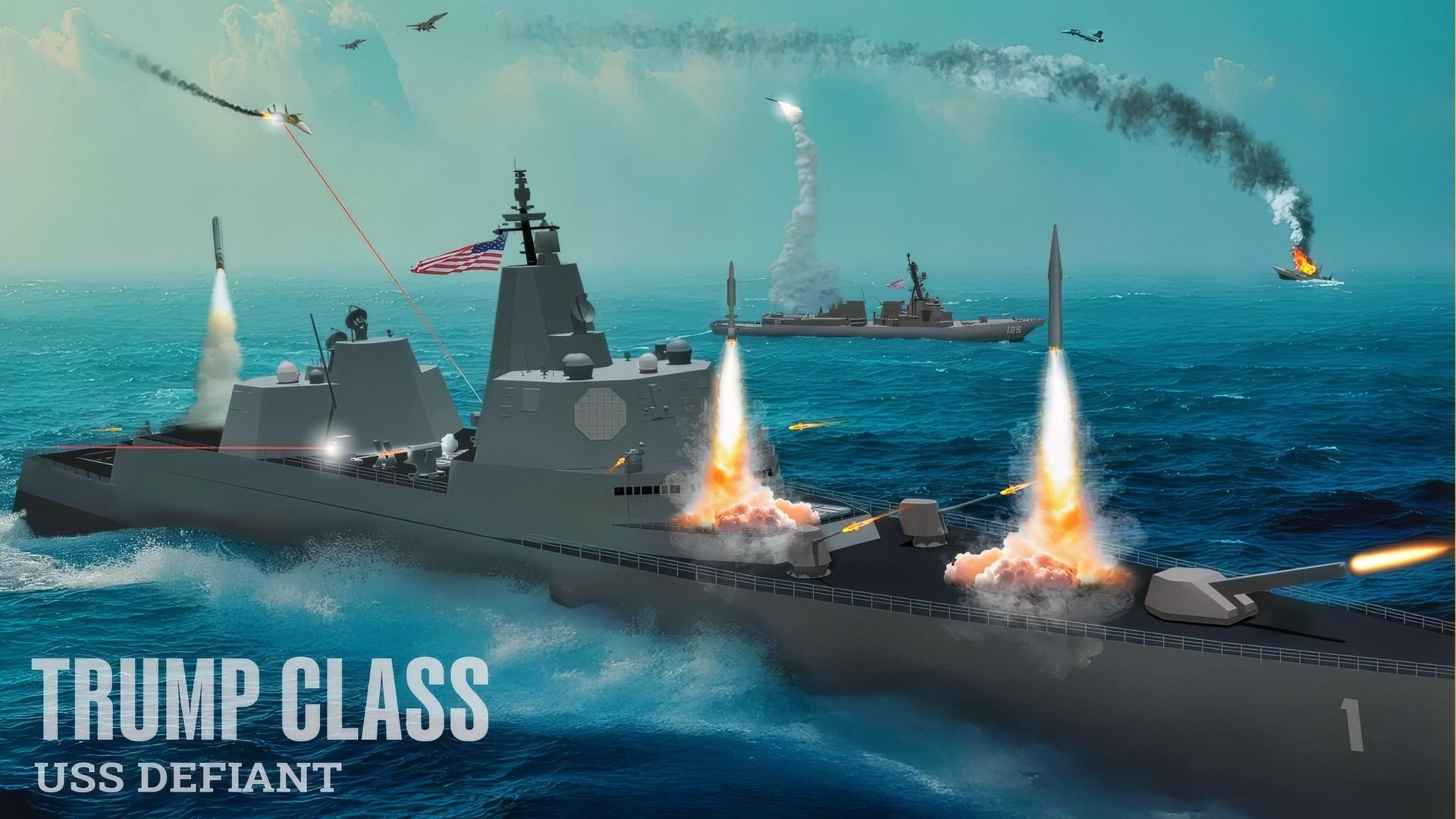
Trump-Class Battleship USS Defiant. Image Credit: Creative Commons.
The other armaments planned to be installed aboard the Defiants—an electromagnetic railgun, hypersonic missiles, lasers, sea-launched nuclear-tipped cruise missiles—are promising technologies that have not yet proved their mettle. And they may not, engineering challenges being what they are. This century has not been kind to efforts to pile lots of fledgling technologies onto new platforms—witness the littoral combat ship, the Zumwalt-class destroyer, or the Ford-class itself.
That’s the peril of attempts at “transformation.”
Past experience underscores the need for an experimental mindset in ship design and construction. A ship, or any weapon system for that matter, is a hypothesis until it’s reduced to engineering and endures rigorous field trials. And by the scientific method, those who advance a hypothesis do their darnedest to falsify their hypothesis. It stands only if efforts to disprove it fail. In other words, naval magnates and shipwrights must resist the eureka! impulse. Not all great ideas work out under realistic circumstances, and combat is the sternest of taskmasters.
Should the White House and Congress make the fateful choice to forge ahead with the battleship project, the U.S. Navy should experiment with the new class rather than rush it into mass production. Build a little, test a little, learn a lot. Better to get the technology right first than have it disappoint later.
Third, industrial capacity. If the Defiant class does proceed, who’s going to do the construction work? At present only two U.S. shipyards build nuclear-powered warships, and only one—Newport News—constructs nuclear-powered surface combatants, i.e., aircraft carriers. The maritime industrial base is already struggling to build and maintain the 11-carrier fleet mandated by law. Indeed, the Government Accountability Office reports that every U.S. Navy shipbuilding program is behind schedule and over budget.
Trump-Class Battleship Creative Commons Photo
How the industrial complex could accommodate a new class of nuclear-powered behemoths is unclear if existing demand is going unmet.
And fourth, opportunity costs. The sheer expense of capital ships threatens to consume the U.S. Navy’s shipbuilding budgets, holding down the ship count at a time when the Navy desperately needs to expand. A decade ago Congress mandated a 355-ship fleet, yet the inventory remains mired at under 300 hulls, about where it stood back then.
The Navy’s latest shipbuilding plan espouses a fleet of 381 traditional crewed ships plus enough unmanned vessels to bring the total figure to around 500. Sinking so many taxpayer resources into a few battleship hulls threatens prospects for expanding and remaking the Navy’s fleet design.
Again, I want Defiant-class battleships at sea. But the impediments are daunting.
About the Author: Dr. James Holmes, US Naval War College
Dr. James Holmes is the J. C. Wyle Chair of Maritime Strategy at the US Naval War College and a Faculty Fellow at the University of Georgia School of Public and International Affairs. The views voiced here are his alone.