
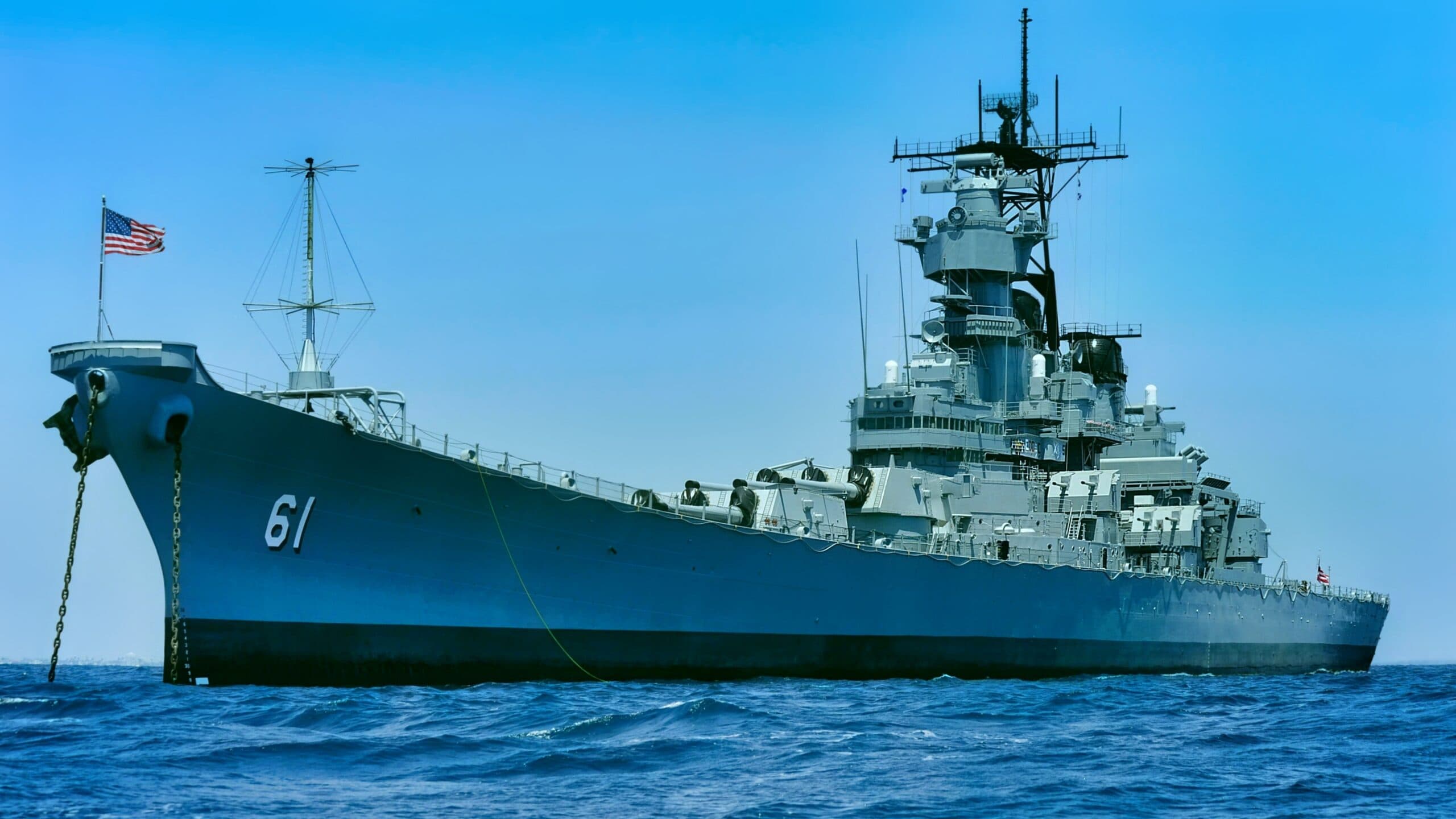
The Navy Now Wants 15 Trump-Class Battleships. The First One Costs More Than an Aircraft Carrier — and the Math Only Gets Worse From There: On December 22, 2025, President Trump stood at Mar-a-Lago and announced a new class of battleships bearing his name, the centerpiece of a “Golden Fleet.” In May, the Navy’s 30-year shipbuilding plan quietly turned that announcement into a program of record: fifteen ships through 2055. The Navy’s own budget documents price the first one at $17.47 billion — more than a Ford-class aircraft carrier — and the first three at $43.5 billion, a sixth of the entire five-year shipbuilding account. This piece makes the argument that the numbers make on their own: in an age of drones, hypersonic missiles, and anti-access warfare built specifically to kill large surface ships, the Trump-class is a magnificent answer to the wrong decade, and the costs are the case.
The Sticker Price for the Trump-Class
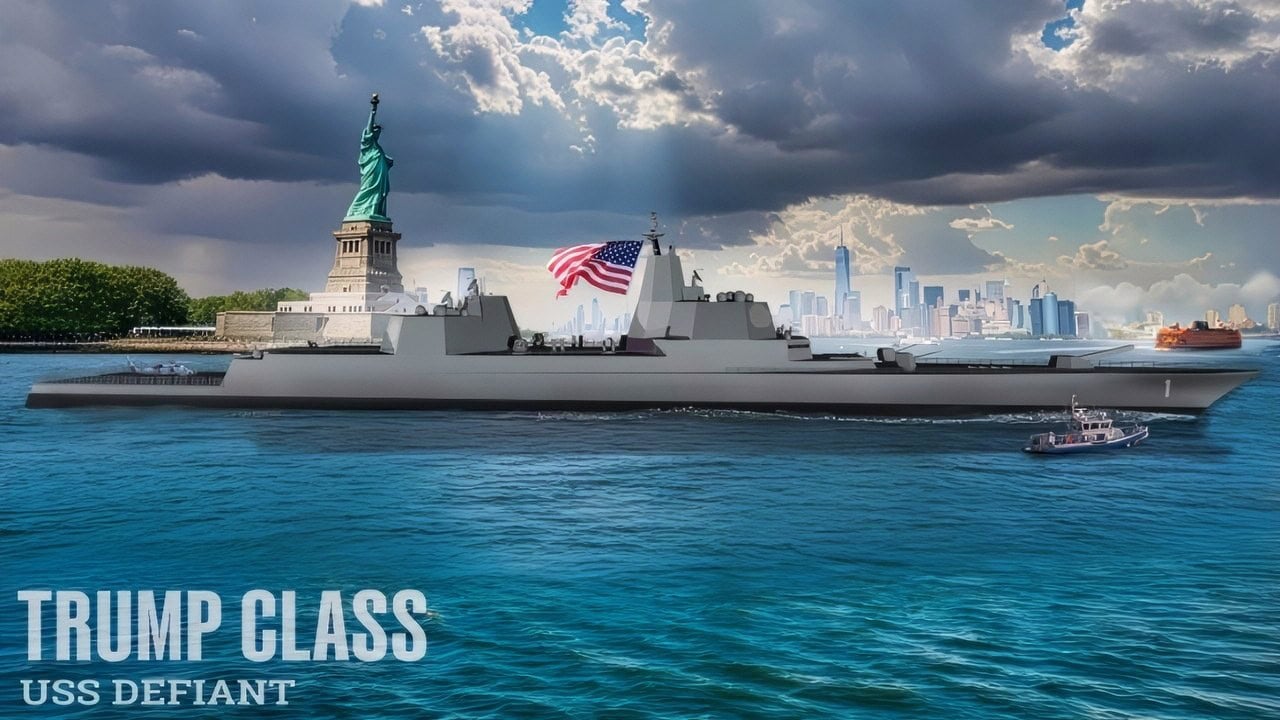
Trump-Class Battleship. Image Credit: Creative Commons/White House.
Start with the Navy’s own figures, because no critic’s estimate is required. The budget documents released in April put the gross weapon system cost of the lead ship, USS Defiant, at $17.47 billion, with $1 billion in advance procurement requested for fiscal 2027 and $16.47 billion the following year. Ships two and three are projected at roughly $13.5 billion and $12 billion, for a three-ship bill of $43.5 billion through fiscal 2031 — more than 16 percent of the Navy’s entire five-year shipbuilding account, spent on three hulls that deliver in 2036, 2038, and 2039. For scale, the next three Ford-class aircraft carriers are estimated at $13 to $15 billion apiece; the Defiant, an 840- to 888-foot, 35,000- to 41,000-ton surface combatant, costs more than a carrier. Then-Navy Secretary John Phelan called the figure an early estimate that could still settle downward with scale. The Congressional Budget Office’s naval analyst, Eric Labs, ran the numbers the other direction: a lead ship in the $15-to-22-billion range, and follow-on ships at $10 to $15 billion each, assuming ideal labor conditions, an assumption he immediately undercut by noting the shipbuilding workforce has not grown since 1990 and is too small for even the Navy’s current plans.
Now extend the Navy’s own per-hull figures across the fifteen ships the May plan commits to, and procurement alone lands in the neighborhood of $200 billion. That is before the crews of more than 650 sailors per ship, the missile inventories to fill them, the escorts to protect them, the reactors if the nuclear designation holds, and forty years of sustainment, which on capital ships has historically run to multiples of the construction cost. Whatever the final total, the direction is not in doubt: this would be the most expensive surface combatant program in American history outside the carrier force.
What $200 Billion Buys Into
The deeper problem is not the price. It is what the price purchases, and the world it purchases it for. China has spent two decades building an arsenal designed for exactly one purpose: killing large ships and the bases that support them, including some 1,700 missiles aimed at U.S. facilities across the Pacific, anti-ship ballistic missiles built to strike moving vessels at range, and hypersonic weapons that compress defensive reaction time toward zero. The same era has produced the cheap-drone revolution, in which uncrewed systems costing a few hundred thousand dollars have sunk warships worth tens of millions and forced a great-power fleet into harbor. Into this environment, the Navy proposes to sail a 35,000- to 41,000-ton hull carrying 650-plus sailors and more than a tenth of a year’s shipbuilding budget — the most valuable non-carrier target afloat — in an ocean where being the biggest target is the problem.
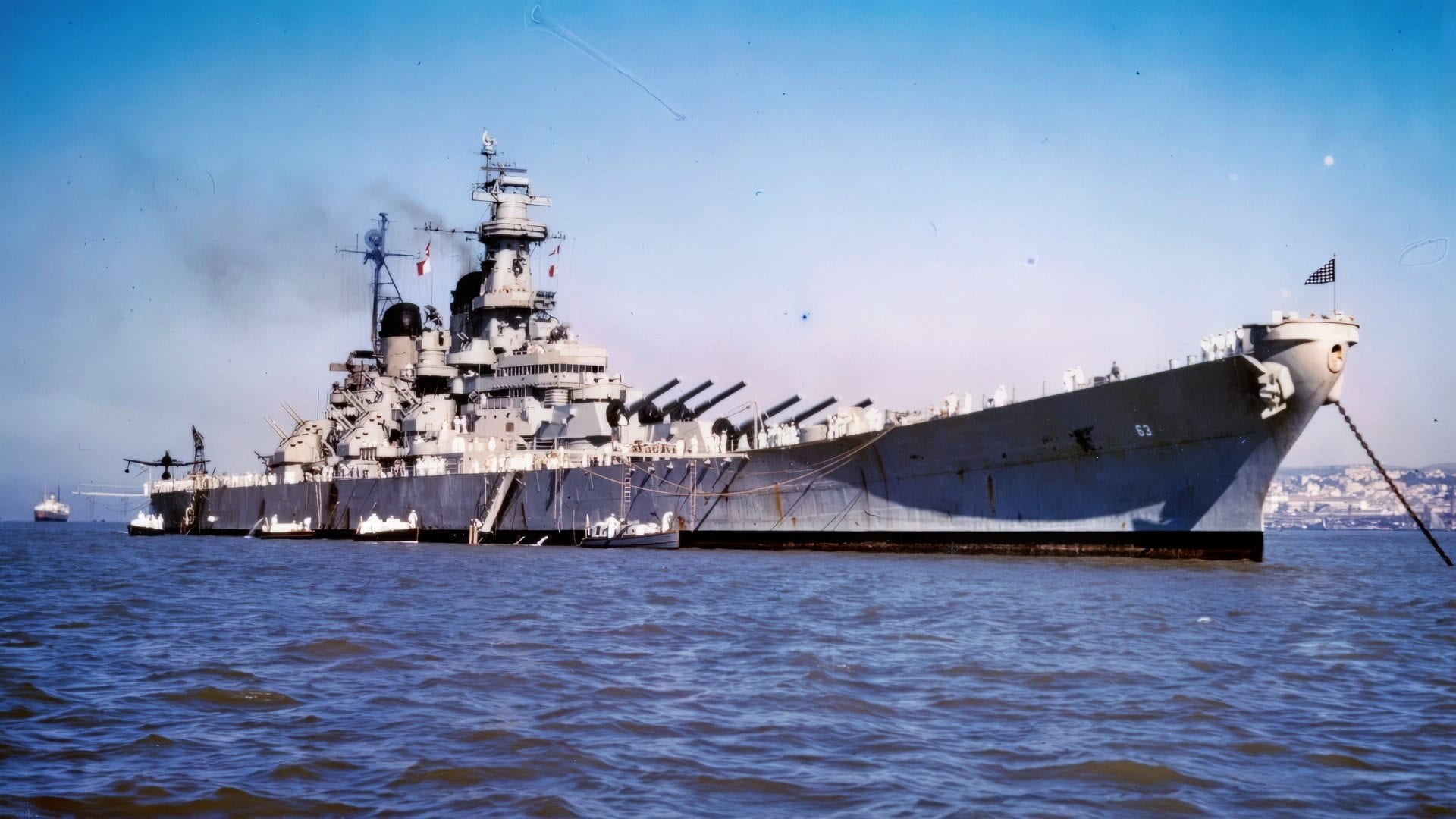
Anchored off Piraeus, Greece, April 1946. Official U.S. Navy Photograph, now in the collections of the U.S. National Archives.
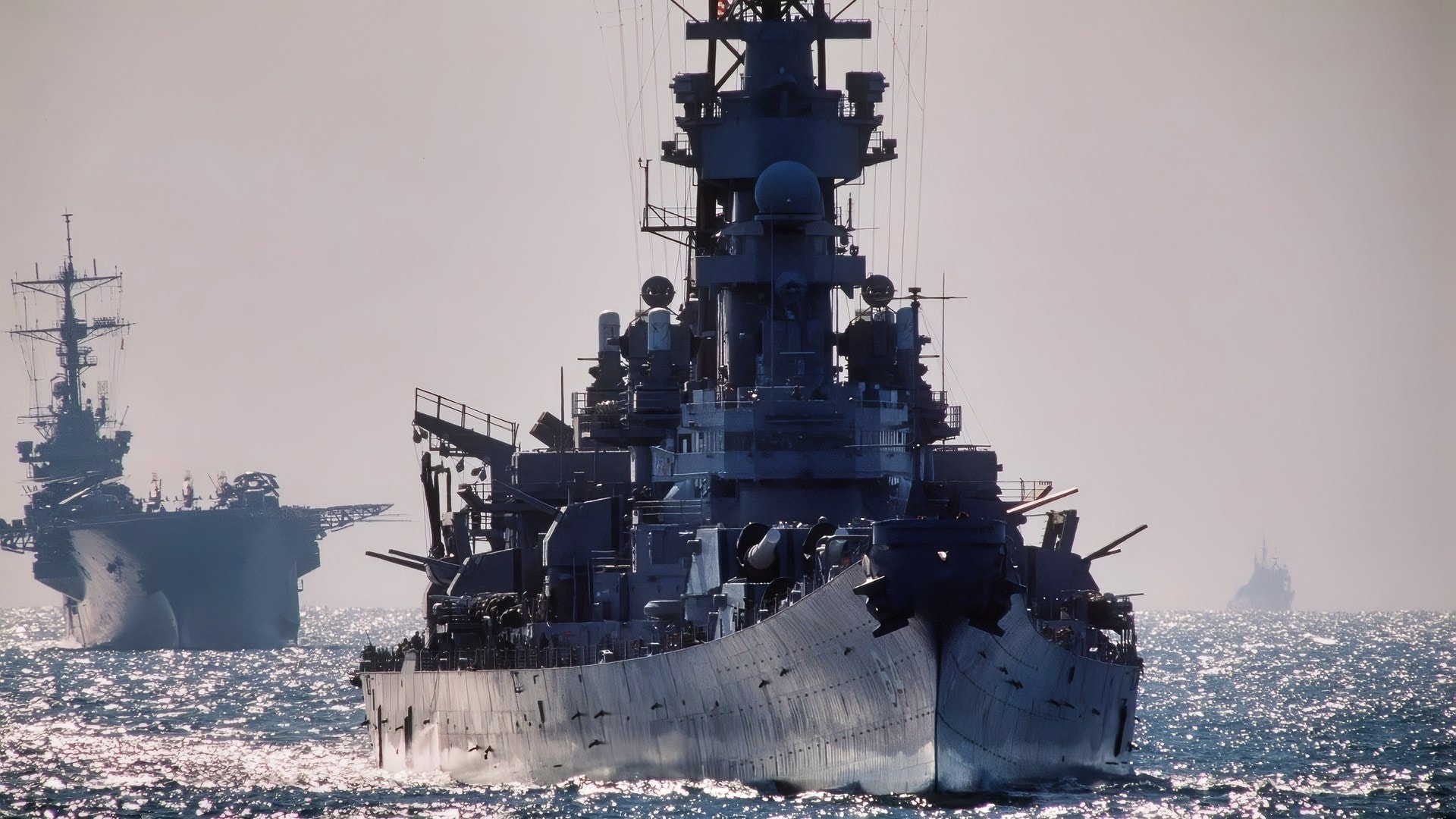
Iowa-Class Battleship Sailing with the Fleet. Image Credit: U.S. Navy.
That is not an outsider’s critique; it is the Navy’s own doctrine. The service’s answer to anti-access warfare is distributed maritime operations: spreading firepower across many smaller platforms so no single enemy salvo can sink the fleet. The battleship inverts the concept, and the Center for Strategic and International Studies’ Mark Cancian made precisely that point in an analysis bluntly titled “The Golden Fleet’s Battleship Will Never Sail”: the ship contravenes the Navy’s own operating concept, will take years to design, and will almost certainly be canceled once its full cost and schedule are known, after several years and several billion dollars are gone. The wargames of a Pacific fight keep reaching the same conclusion from the other direction: survival comes from dispersal, numbers, and magazines, not from concentrating value into hulls an adversary has spent twenty years learning to find.
The Diseases It Already Shows
If the strategic logic is questionable, the acquisition pattern is familiar because the program is already exhibiting the specific pathologies that wrecked its predecessors. The preliminary specifications describe a ship armed with laser turrets, a railgun, and room for hypersonic and nuclear weapons, which is to say a hull designed around technologies that do not exist in deployable form, including a railgun the Navy itself canceled in 2021 after a decade and roughly half a billion dollars. That is the Ford-class disease: the carrier packed 23 immature technologies into one first-of-class hull and ran billions over.
The requirements are already unstable: the April budget documents describe a conventionally powered ship, Phelan called nuclear propulsion unlikely that same month, and the May shipbuilding plan describes a nuclear-powered vessel: a foundational design question reversed inside a single spring, on a program whose keel is supposed to be laid in 2028. A design that is not final, marching to a political schedule, is exactly what killed the Constellation-class frigate in November.

USS Iowa Battleship Seal on the Bridge. 19FortyFive Photo by Harry J. Kazianis
And beneath all of it sits the industrial base: a Navy that builds a fraction of what China’s yards produce, that left the attack submarine Boise pier-side for a decade awaiting overhaul, and that projects a fleet of 299 ships in 2031 against its own stated requirement of 355, now adding the largest American surface combatant in eighty years to the queue.
The Political Half-Life
There is also an actuarial problem no engineering can fix: the program is unlikely to outlive its patron. Fortune’s analysis of the shipbuilding plan noted that 30-year plans are aspirational documents, that everything beyond 2031 sits under an explicit “under review” footnote, and that a program this costly and this personally attached to the current president is a leading candidate for cancellation if the House changes hands, with the 44 percent defense-budget increase that funds it already facing congressional resistance. The previous Navy secretary departed in April after reportedly clashing with Pentagon leadership, including over the shipbuilding push. A lead ship delivered in 2036 must survive three presidential administrations before it ever floats; fourteen more must survive seven. The Congressional Research Service’s Ronald O’Rourke put the polite version of the concern on the record, saying it is worth asking “whether the program came first and the analysis came later or not.” The impolite version is the Zumwalt, a 32-ship program that delivered three — and the Zumwalt was never named after anyone with a term limit.
The Case for the Battleship, Stated Fairly
The honest ledger requires the strongest version of the other side because it exists. The Navy genuinely is short of missile capacity for a Pacific war; magazine depth is a real deficiency, and the arsenal-ship idea, a big hull stuffed with cells, has had serious advocates for thirty years. The surface fleet genuinely is out of growth room: the commander of the Navy’s surface forces has said the Flight III Arleigh Burkes can no longer accommodate new systems, and has called the battleships “exactly” what the fleet needs. Nuclear power for directed-energy weapons has engineering logic, the Hanwha investment in the Philly Shipyard ties the program to a genuine shipbuilding-revival strategy with allied capital, and the plan’s stated missions, high-volume long-range fires and survivable fleet command, describe real gaps.
But every one of those goals has a cheaper path, and that is the whole argument. Cancian’s alternative is the boring, correct one: upgrade proven designs and ramp up production, which builds presence now rather than capability in 2036.
The opportunity cost of one Defiant is six or more Arleigh Burke destroyers, or four-plus Virginia-class attack submarines, or thousands of missiles distributed across hulls, unmanned vessels, and aircraft that no single Chinese salvo can service. And the one recent program that actually escaped the cost spiral, the B-21 bomber, did it with a fixed-price contract, mature technology, and requirements that never moved. The battleship inverts all three on its first page.
The Age Already Answered This
America has run this experiment before. The Iowa-class battleships were hauled out of mothballs in the 1980s, modernized at great expense, and retired again within a decade, because the age of the battleship had ended and no refit could argue with it. The age has moved further since: toward the missile, the drone, the distributed swarm, and away from the majestic concentration of national wealth in a single steel hull.
The Navy’s own budget documents, the CBO’s warnings, the doctrine’s contradiction, and the political calendar all point the same way.
Fifteen ships, a fifth of a trillion dollars in procurement alone, are arriving in the most lethal anti-ship environment ever constructed. The numbers are the argument, and they argue for the fleet America needs in quantity now, not the monument it might manage to launch in ten years. The battleship is the most expensive way ever devised to relearn a lesson the ocean has already taught twice.
About the Author: Harry J. Kazianis
Harry J. Kazianis (@Grecianformula) was the former Senior Director of National Security Affairs at the Center for the National Interest (CFTNI), a foreign policy think tank founded by Richard Nixon based in Washington, DC. Harry has over a decade of experience in think tanks and national security publishing. His ideas have been published in the NY Times, The Washington Post, The Wall Street Journal, CNN, and many other outlets worldwide. He has held positions at CSIS, the Heritage Foundation, the University of Nottingham, and several other institutions related to national security research and studies. He is the former Executive Editor of the National Interest and the Diplomat. He holds a Master’s degree focusing on international affairs from Harvard University.

