
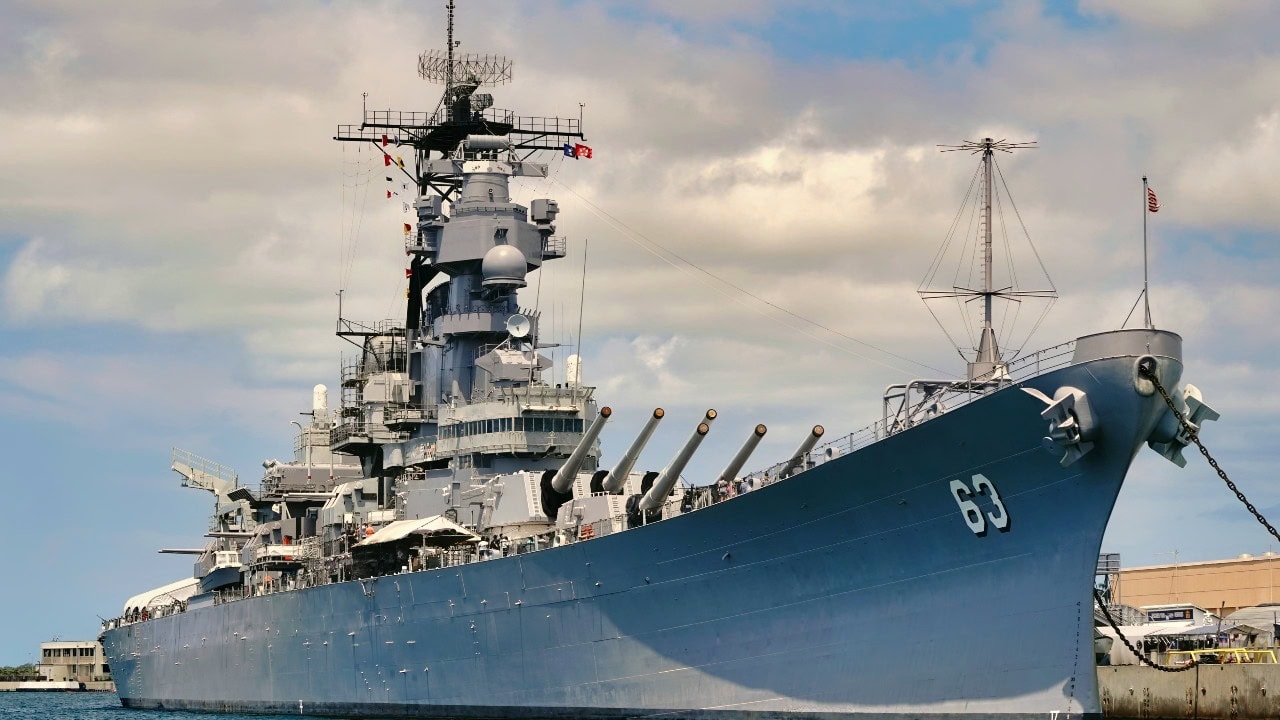
The U.S. Navy seriously considered converting Iowa-class battleships into a sort of aircraft carrier or hybrid “battlecarrier” during World War II and later during the Cold War, but the plans were never built.
Between 1942 and 1943, naval planners looked at partially built or active battleship hulls to quickly boost flight decks for more aircraft carriers.
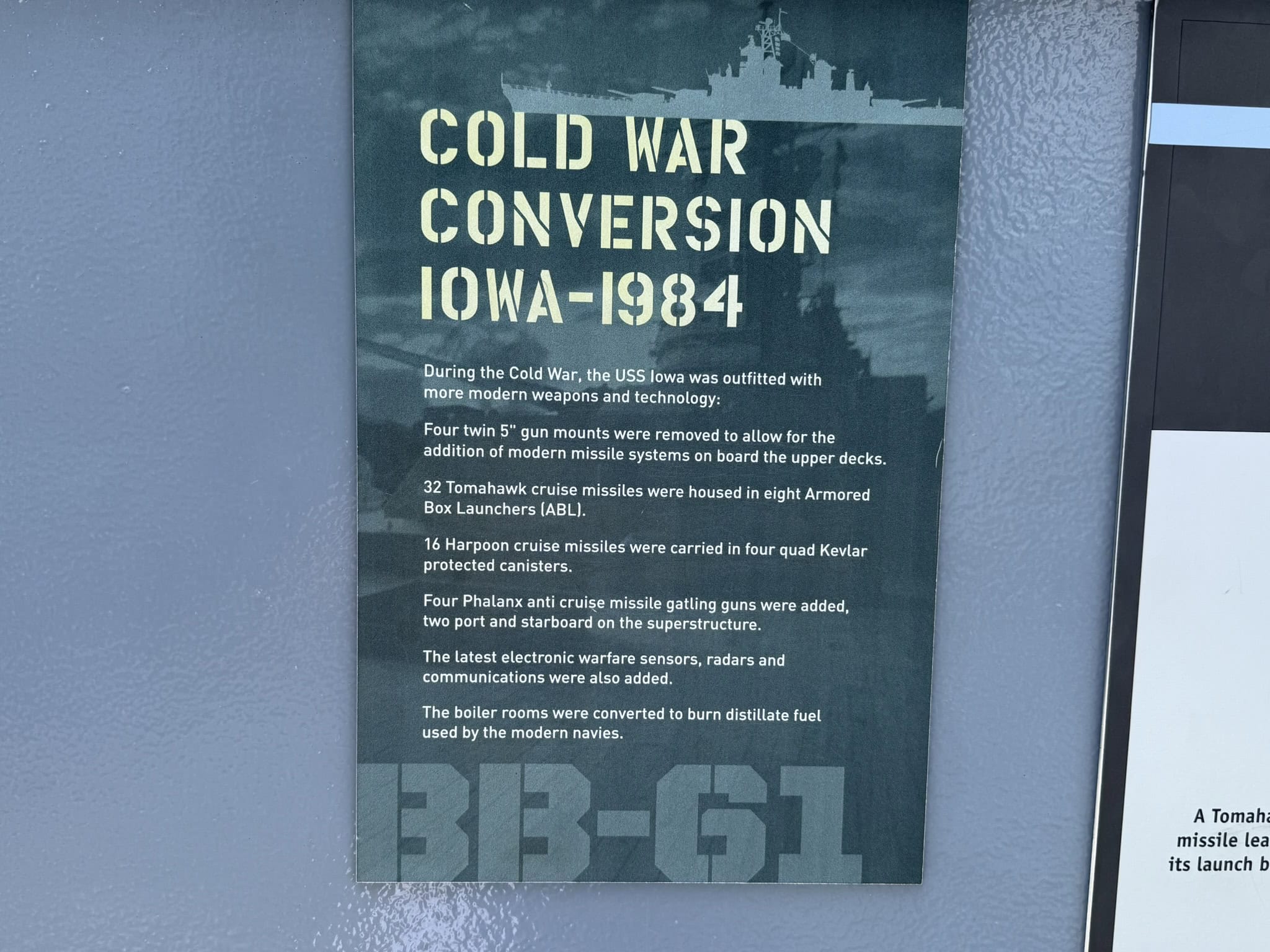
USS Iowa Battleship visit by Harry J. Kazianis for 19FortyFive.com. Taken back in August 15, 2025.
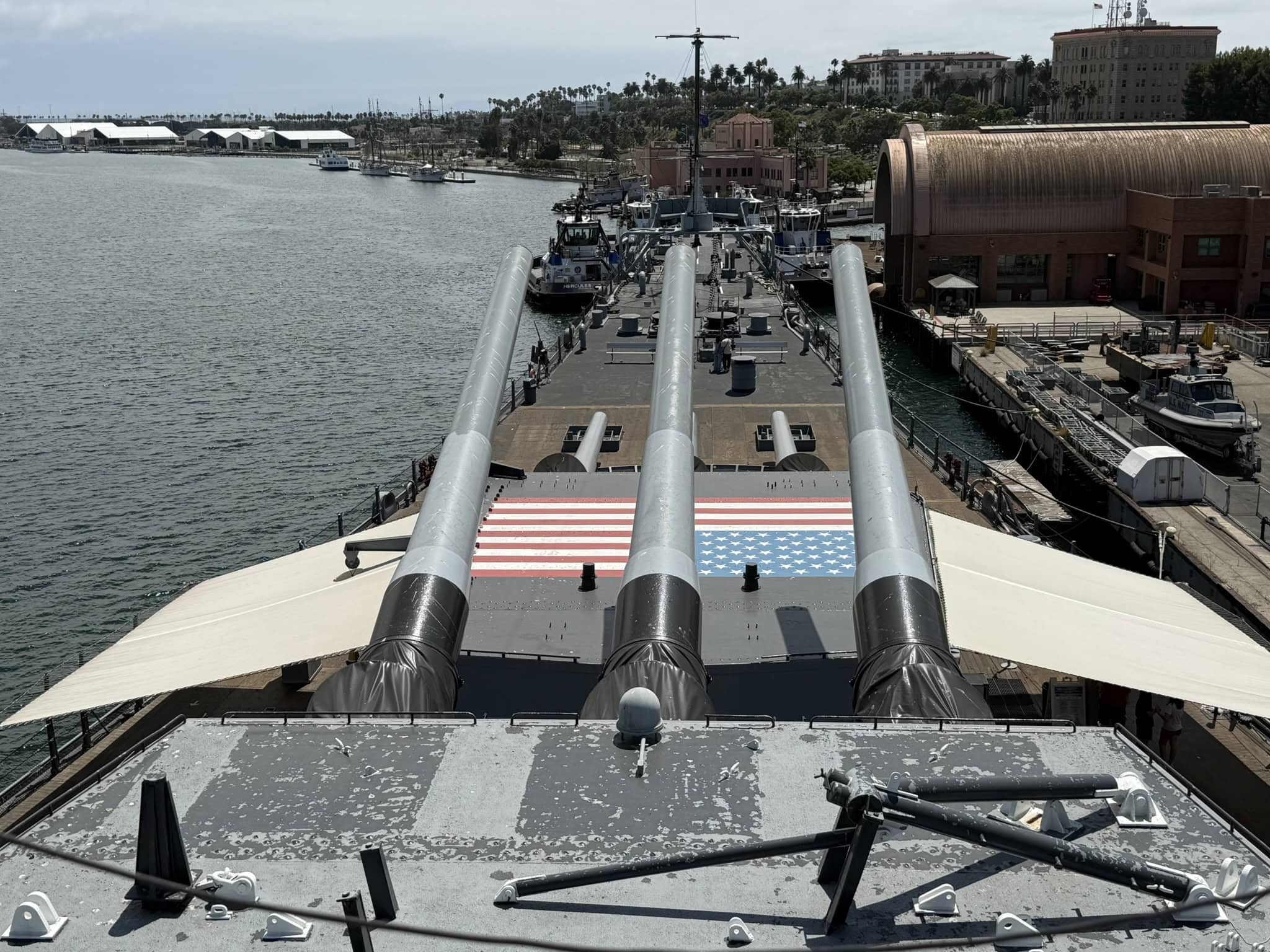
USS Iowa Battleship visit by Harry J. Kazianis for 19FortyFive.com. Taken back in August 15, 2025.
Pearl Harbor and a few months later, the Battle of Midway had convinced the Navy brass that the aircraft carrier, not the battleship, was the predominant power in the world’s oceans.
The design would have swapped heavy guns for a flight deck capable of holding roughly 70 to 75 aircraft.
Yes, the US Navy once tinkered with the idea of aircraft carriers with 16-inch guns. But what exactly was a battlecarrier?
The Soviets, with their Kiev-class cruisers, and the Japanese attempted this concept with varying degrees of success; however, the US Navy ultimately decided against it, correctly viewing it as impractical and too expensive.
The Navy Once Considered Turning Battleships Into Battlecarriers
America’s battleships served with distinction in World War II, and later in Korea, Vietnam, and Desert Storm. Many naval analysts believed those massively armored hulls could have extended their service lives by converting them into aircraft carriers.
A battle carrier is the concept of modifying a battleship to include a flight deck aft, where Gun Turret #3 would typically be located. The magazines would be removed, and a hangar deck built in.
While Iowa-class battleships were never initially built with flight decks, proposals were made in the early days of World War II, and even a late-1970s design was considered to convert them into “battlecarriers” with a flight deck for VSTOL aircraft, such as the Harrier jump jet.
However, these plans were never realized. The Iowa-class battleships carried floatplanes during World War II (Vought OS2U Kingfisher and Curtiss SC Seahawk) and later helicopters. Still, these were primarily used for spotting and rescue operations rather than for dedicated flight operations.
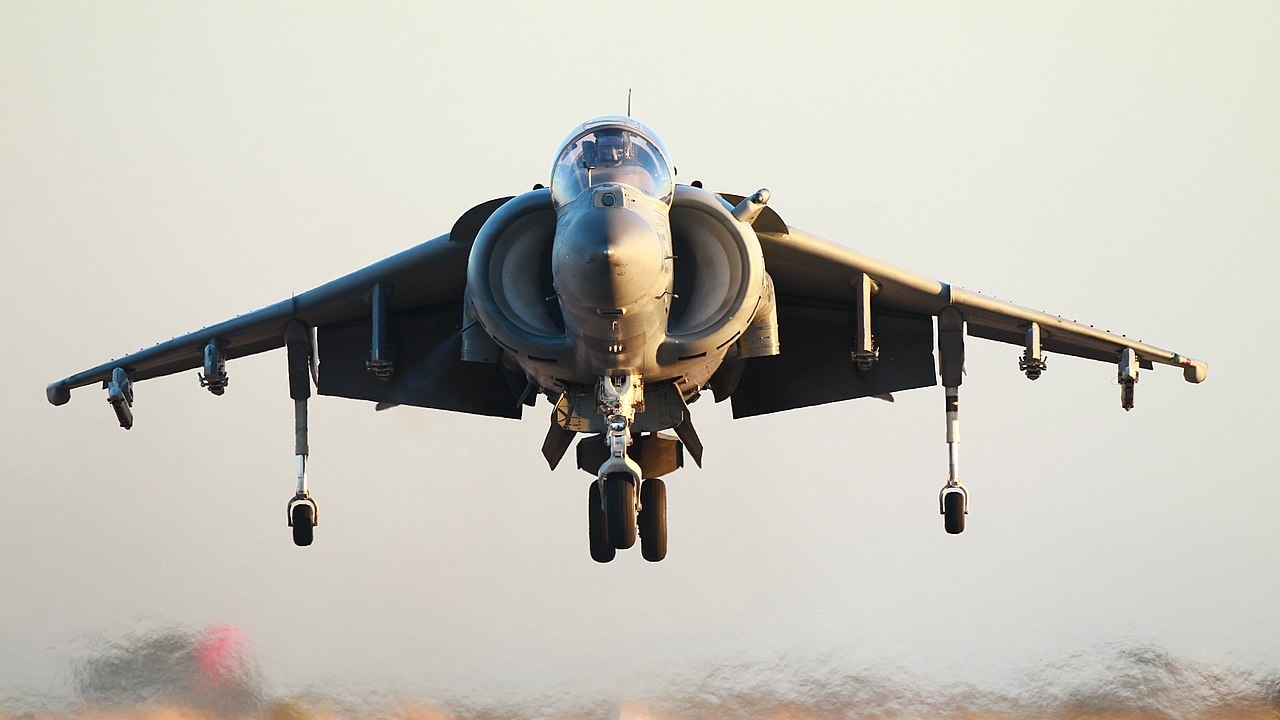
An AV-8B Harrier hovers over the flight line during the Marine Corps Community Services (MCCS) sponsored annual Air Show on Marine Corps Air Station (MCAS) Miramar, San Diego, Calif., Oct. 13, 2012. The MCAS Miramar Air Show showcases not only the aerial prowess of the Armed Forces but their appreciation of the community’s support and dedication to the troops. (U.S. Marine Corps photo by Cpl. Jamean Berry/Released)
The Iowa-Class’ Original Design Did Have Aircraft
The Iowa-class battleships were designed with two aircraft catapults to launch floatplanes for spotting and rescue missions. But after Pearl Harbor, the Navy decided to repurpose some unfinished battleship hulls.
In June 1942, plans were prepared for the General Board as part of an exploration of carrier conversions for warship hulls then under construction.
This plan, dated June 1942, represents the conversion of Iowa-class battleship hulls. It would have produced a ship with an external appearance similar to the Essex-class (CV-9).
It should be noted what was happening during this historic time frame. Despite stopping the Japanese during the Battle of the Coral Sea and sinking all four frontline carriers ( Akagi, Kaga, Sōryū, and Hiryū) during the Battle of Midway, the Japanese still held a numerical advantage in carriers. The US had lost the Lexington in the Coral Sea and the Yorktown during the Battle of Midway.
That left the US with just two carriers, the Enterprise and the USS Hornet. Japan had two fleet carriers and four light carriers. The Hornet would be sunk during the Battle of Santa Cruz in October 1942.
The US sank one light carrier (the Shōhō) during the Coral Sea action. She was hit by at least 13 bombs and seven torpedoes. She sank in four minutes.
Thus, the US was desperately short of carriers in the Pacific, with only two usable flattops to cover a vast ocean, which may be why they considered converting some battleship hulls into carriers.
In the 1970s, The Navy Wanted “Interdiction Assault Ships”
In the late 1970s, proposals were made to convert the Iowa-class battleships into “battlecarriers” with a flight deck capable of supporting STOVL (Short Take-Off and Vertical Landing) aircraft operations.
One specific proposal, known as the “Interdiction Assault Ship,” envisioned a V-shaped flight deck replacing the number three turret, along with missile silos and upgraded gunnery.
“As Admiral Zumwalt wrote to one petty officer in 1973, conversion of the Iowa-class battleships had been considered and studied, but all had reached the same conclusion: the ships were too old, too manpower intensive, too expensive to operate, and too costly, especially in comparison to the new sea control ship design.”
Both the British and the Japanese tried this during World War II, but neither brought it to fruition.
Number Three Turret Would Be Replaced With A Flight Deck
Instead of the number three turret, the modifications would require a significant increase in armament. The V-shaped, ramped flight deck would be installed, with the base of the V on the ship’s stern.
Two elevators would bring Boeing AV-8B Harrier II jump-jets up from a new hangar to the flight deck. It was envisioned that the battleships could support up to 12 Harriers.
Existing five-inch gun turrets would be removed and replaced with 155-millimeter howitzers for naval gunfire support.
In the space between the V would be a field of tactical missile silos, such as the MK 41 made by Lockheed. Up to 320 silos could fit in this space, supporting a mixture of Tomahawk land-attack missiles, ASROC anti-submarine rockets, and Standard surface-to-air missiles.
This massive loadout would dwarf even the 154 Tomahawks found on today’s Ohio-class guided missile submarines.
The hangar deck could accommodate 500 Marines and be ferried to shore via helicopters, supported by Harriers, 155mm howitzers, and the forward 16-inch guns. Unfortunately, this concept never materialized. And the Iowa-class battleships were retired and repurposed as museum ships.
There is something nostalgic about the old big battlewagons. We all remain enamored with those big 16-inch guns that were so awesome to watch when they unleashed a broadside. But it was not to be.
And today, the carrier faces a murky future given the state of A2/AD systems. The carrier may pass the torch to submarines in the very near future.
MORE – The US Army Spent $400 million on Just 7 Tanks
About the Author: Steve Balestrieri
Steve Balestrieri is a National Security Columnist. He served as a US Army Special Forces NCO and Warrant Officer. In addition to writing on defense, he covers the NFL for PatsFans.com and is a member of the Pro Football Writers of America (PFWA). His work was regularly featured in many military publications