
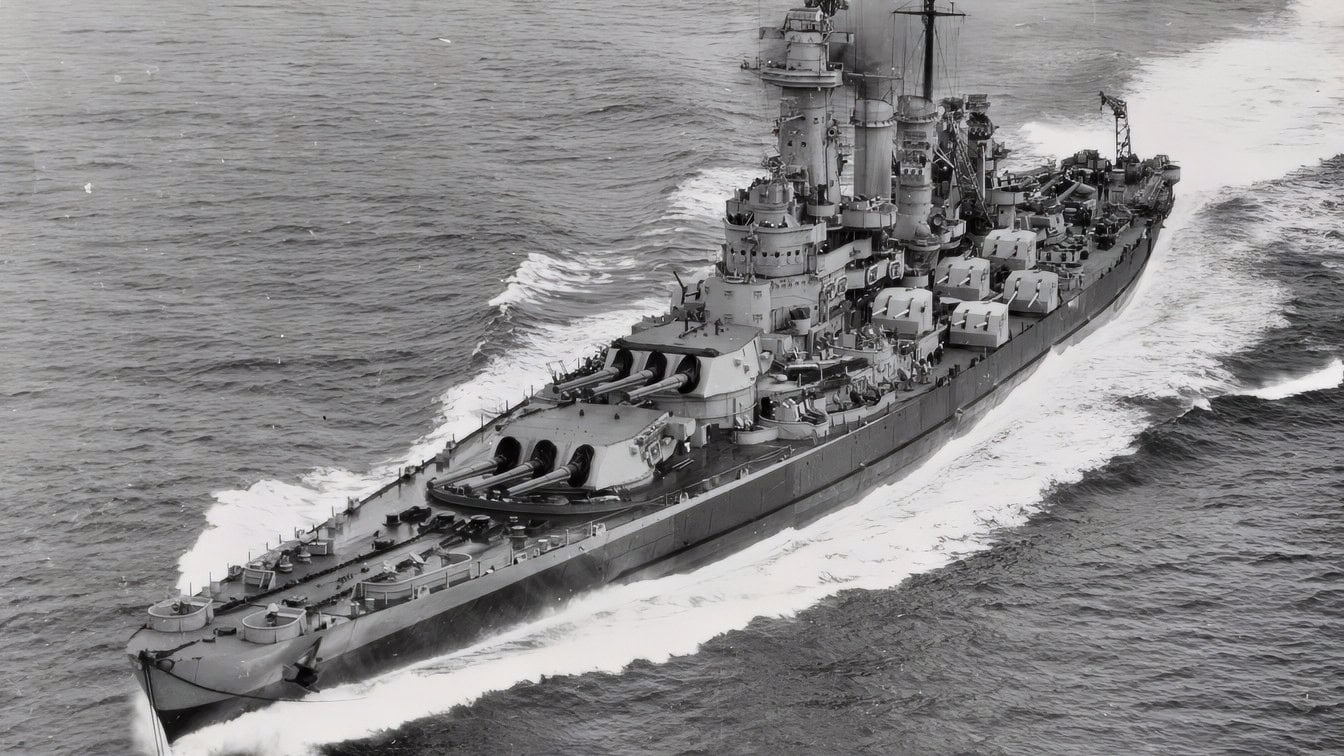
One Unreported Turn Sent USS Washington Into USS Indiana at 4:28 A.M: At 4:28 a.m. on February 1, 1944, USS Washington drove its bow into the starboard quarter of USS Indiana in the darkness near Kwajalein. The collision killed 10 sailors, destroyed roughly 60 feet of Washington’s forward hull and opened Indiana’s side beneath its after 16-inch turret.
Two modern American battleships left combat because of a maneuvering failure, not Japanese gunfire.
Washington displaced about 44,800 long tons at full load and measured 728 feet. Indiana displaced 44,519 long tons and measured 680 feet. Nearly 90,000 tons of battleship had met inside a fast carrier formation.
Both ships belonged to Task Group 58.1, which included the carriers Enterprise, Yorktown, and Belleau Wood, the battleship Massachusetts, the light cruiser Oakland, and nine destroyers. The force was supporting Operation Flintlock, the invasion of Kwajalein Atoll, and was steaming at 19 knots before dawn.
Indiana had orders to leave formation and refuel four destroyers at night so they would be ready for anti-submarine screening the next day. At 4:20 a.m., Indiana reported a left turn and a reduction to 15 knots. Captain James M. Steele changed the maneuver toward the formation’s right without transmitting the new course. Eight minutes later, Washington struck.
Indiana’s Refueling Turn Crossed a High-Speed Formation
Night refueling preserved daylight for combat operations, but it placed large ships close together while courses and speeds changed. Indiana was leaving a formation containing three carriers, three battleships, and a destroyer screen during an active invasion.
The irony was severe. Washington had already crippled Japan’s Kirishima off Guadalcanal in one of the Pacific War’s rare battleship duels. The ship emerged without a direct hit to its hull, an achievement that placed it among the most successful American battleships of World War II. Fifteen months later, another American battleship appeared across its bow.
Washington’s officer of the deck saw Indiana close ahead on the port bow and ordered “back, emergency full” with the rudder hard left. Indiana also maneuvered. The distance was too short for ships of this size to clear each other. About a minute later, Washington’s bow struck Indiana and scraped along its aft starboard side.
Washington Lost 60 Feet of Bow While Indiana Was Torn Open
Washington received the most visible damage. About 60 feet of the forward hull was crushed and ground away. The main deck folded toward the sea, with anchor chains helping hold the ruined structure in place. Navy photographs show the collapsed bow and the open forward hull.
The armored citadel protected Washington’s magazines, machinery, and gun positions farther aft. The bow lay outside that core protection. The collision struck the part of a North Carolina-class fast battleship least prepared to absorb another capital ship at close range.
Indiana’s starboard quarter was dished inward and ripped open below the after 16-inch turret. The turret’s rangefinder was damaged, several anti-aircraft guns were destroyed, and the starboard aircraft catapult and a floatplane went overboard. The compact South Dakota-class hull survived, but Indiana needed major yard work.
Six sailors aboard Washington were killed or listed as missing, while four died aboard Indiana. The ships had spent the previous hours supporting an invasion under threat from Japanese aircraft, submarines, and shore batteries. Their death came from a collision inside their own formation.
The Court of Inquiry Put Responsibility on Indiana
The Navy’s court of inquiry found Indiana at fault because the ship failed to transmit every course change. Its record between 4:20 a.m. and the collision was also incomplete, preventing investigators from reconstructing a precise plot of the maneuver.
The court held Steele responsible for an admitted mistake and a failure to appreciate the danger of maneuvering heavy ships at high speed in darkness. He lost command and received no further sea assignment. Washington’s officer of the deck was praised for an action that reduced the damage.
The court recommended better training for battleship captains, officers of the deck, and combat information center watch officers. Radar and radio did not correct a maneuver kept on Indiana’s bridge, the same command-accountability principle found in later Navy collision investigations.
Wartime Shipyards Returned Both Battleships to Combat
Both ships reached Majuro for initial work, with the repair ship USS Vestal assisting Washington. Indiana continued to Pearl Harbor, where workers repaired its hull, weapons, and aviation equipment. It returned for carrier raids against Truk at the end of April.
Washington needed temporary bow work at Pearl Harbor before crossing to the Puget Sound Navy Yard. Workers fabricated and installed a replacement bow in less than three months. A Navy photograph dated April 26 shows the forward hull restored.
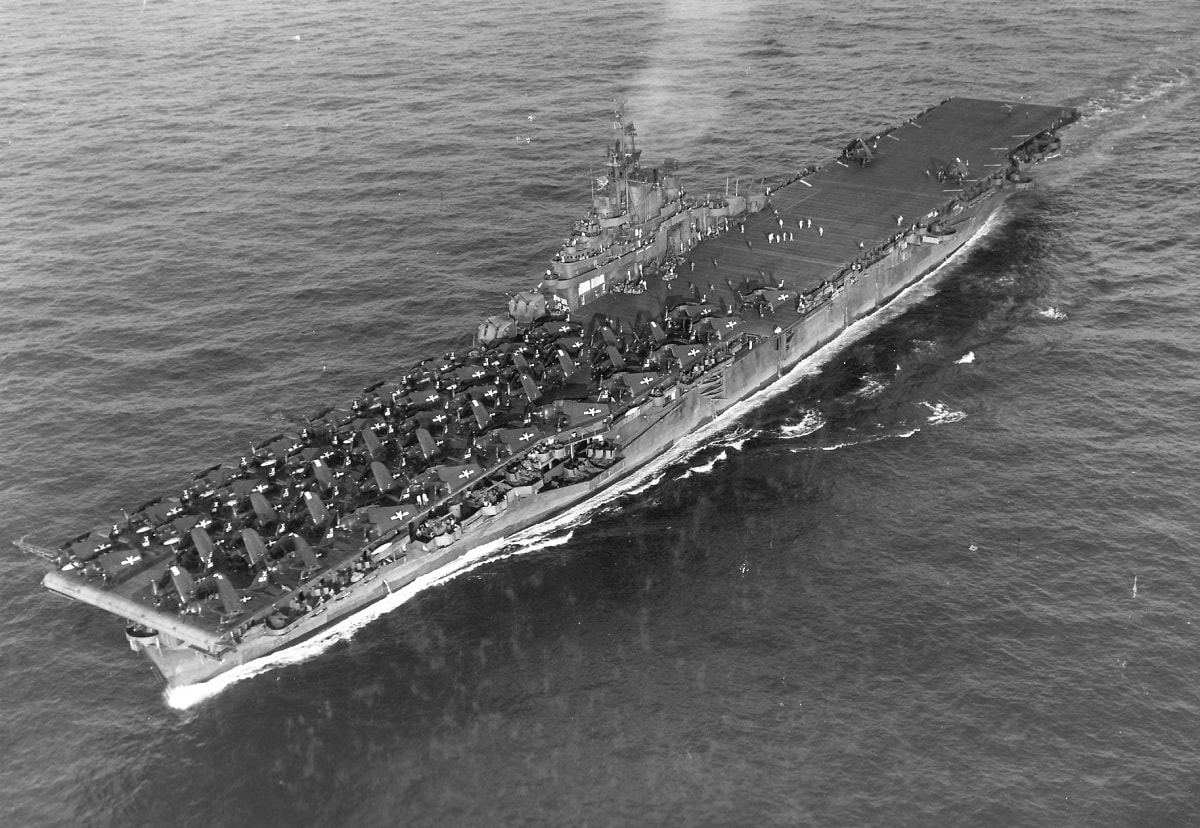
USS Wasp. Image: Creative Commons.
Washington returned to the combat zone by the end of May. On June 19, 1944, Washington and Indiana were both back with the carrier force during the Battle of the Philippine Sea.
About the Author: Harry J. Kazianis
Harry J. Kazianis (@Grecianformula) was the former Senior Director of National Security Affairs at the Center for the National Interest (CFTNI), a foreign policy think tank founded by Richard Nixon based in Washington, DC. Harry has over a decade of experience in think tanks and national security publishing. His ideas have been published in the NY Times, The Washington Post, The Wall Street Journal, CNN, and many other outlets worldwide. He has held positions at CSIS, the Heritage Foundation, the University of Nottingham, and several other institutions related to national security research and studies. He is the former Executive Editor of the National Interest and the Diplomat. He holds a Master’s degree focusing on international affairs from Harvard University.

