
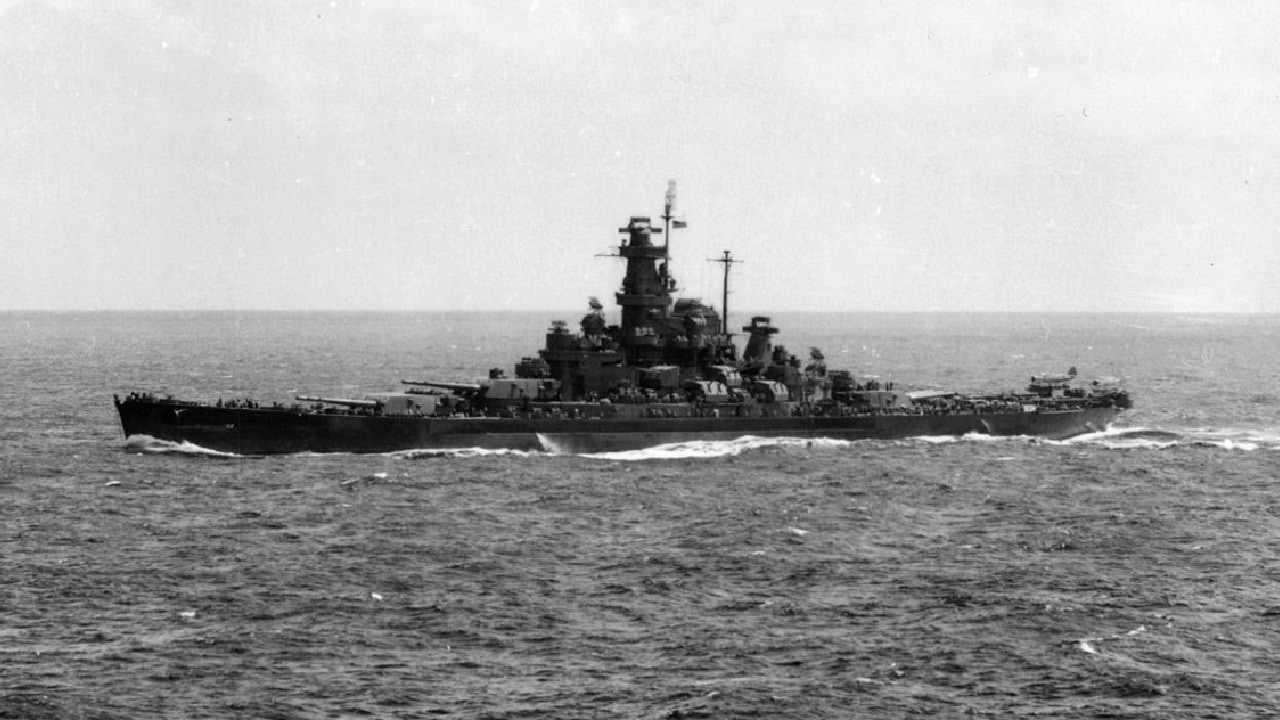
Forget the Iowa-Class: The South Dakota Battleships Did the Hard Fighting in WWII
Many military history buffs consider the United States Navy’s Iowa-class battleships to be the most successful battleship class of all time, and quite understandably so. One could reasonably argue that the North Carolina-class battlewagons were naval history’s second-most successful battleship class, especially when you consider that the only one-on-one battleship kill of WWII was scored by one of the North Carolinas, that being the USS Washington (BB-56) (more on this in a bit).
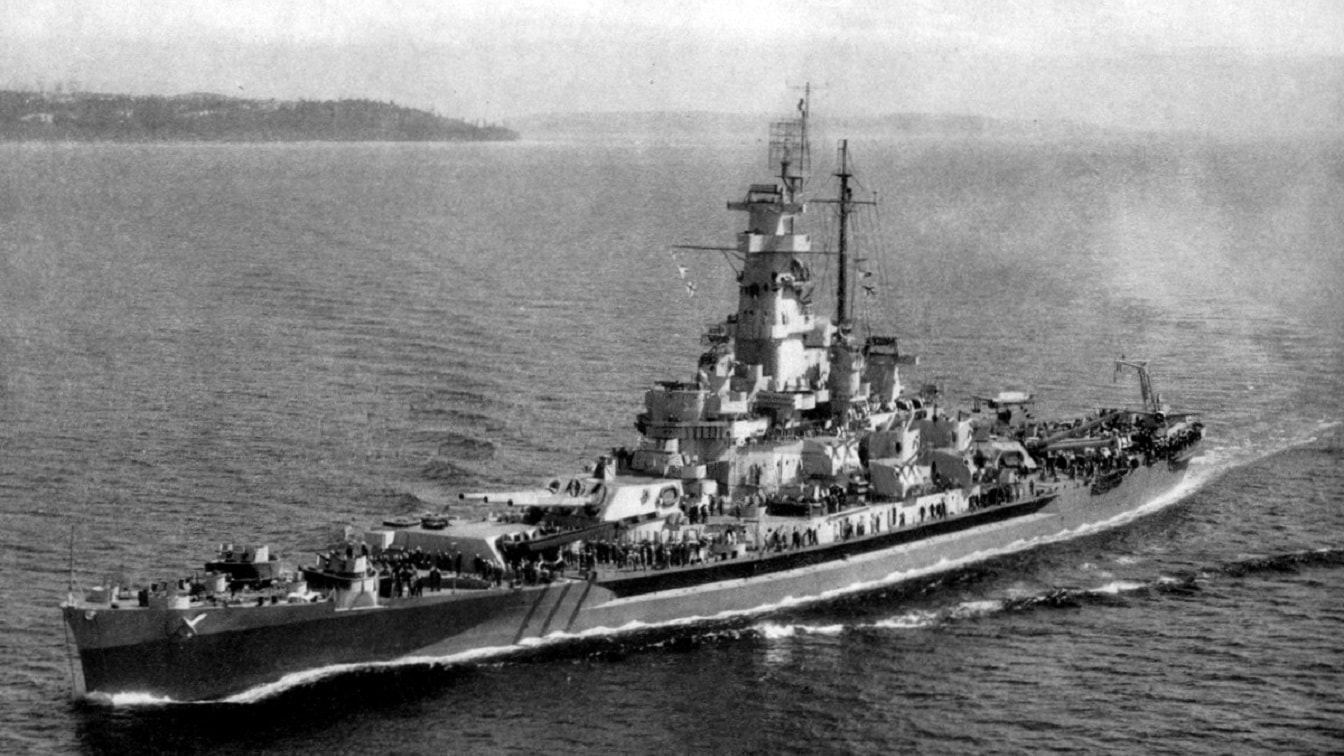
The U.S. Navy battleship USS Massachusetts (BB-59) underway, most probably after her refit at the Puget Sound Naval Shipyard, Washington (USA), circa in July 1944. She is painted in Camouflage Measure 22.
Perhaps not coincidentally, both the Iowas and the North Carolinas were classified as “fast battleships.” Meanwhile, there was a third class of USN fast battleships that unfortunately didn’t obtain the same degree of fame that their Iowa- and North Carolina-class counterparts did: the South Dakota class.
Time now to give the South Dakota-class battleships their well-deserved moment in the spotlight.
South Dakota-Class Battleship Initial History
This battleship class was named for “The Mount Rushmore State,” or as the “50 Rejected State Mottos” email joke put it a quarter-century ago, “Closer Than North Dakota” (or better yet, as one of my old U.S. Air Force Security Forces buddies jokingly called it, “The Dirty South”). Just like with “The Hawkeye State” of Iowa, South Dakota is a landlocked Midwestern state that inherently lacks a coastline, ergo it’s a tad ironic having seven seas-sailing warships named for both of them.
State semantical sidebars aside, a total of four South Dakotas were built and commissioned. The lead ship of the class was, appropriately enough, the USS South Dakota (BB-57), which was built by the New York Shipbuilding Corporation (which was actually located in the state of New Jersey, just like the so-called New York Jets and New York Giants of the National Football League); her keel was laid on July 5, 1939, she was launched on June 7, 1941, and she was commissioned on March 20, 1942.

South Dakota-Class. Image Credit: Creative Commons.
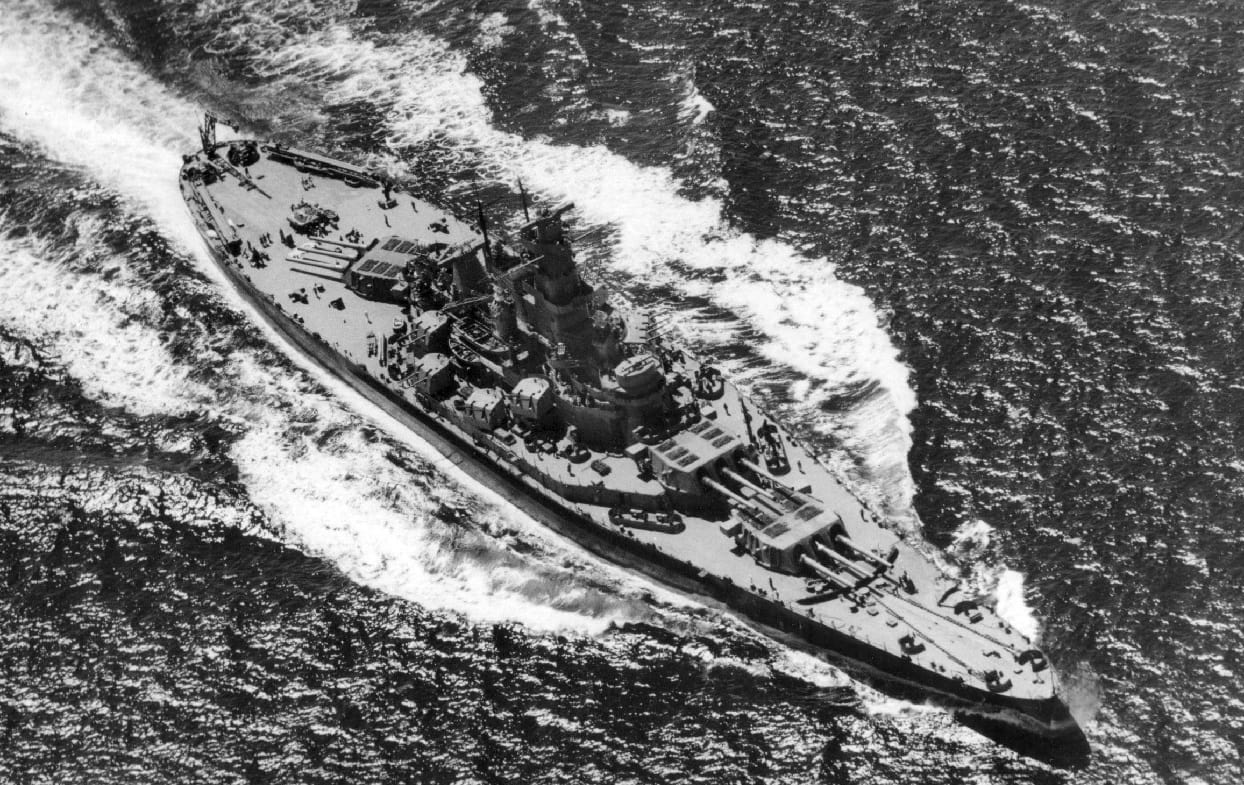
USS South Dakota. Image: Creative Commons.
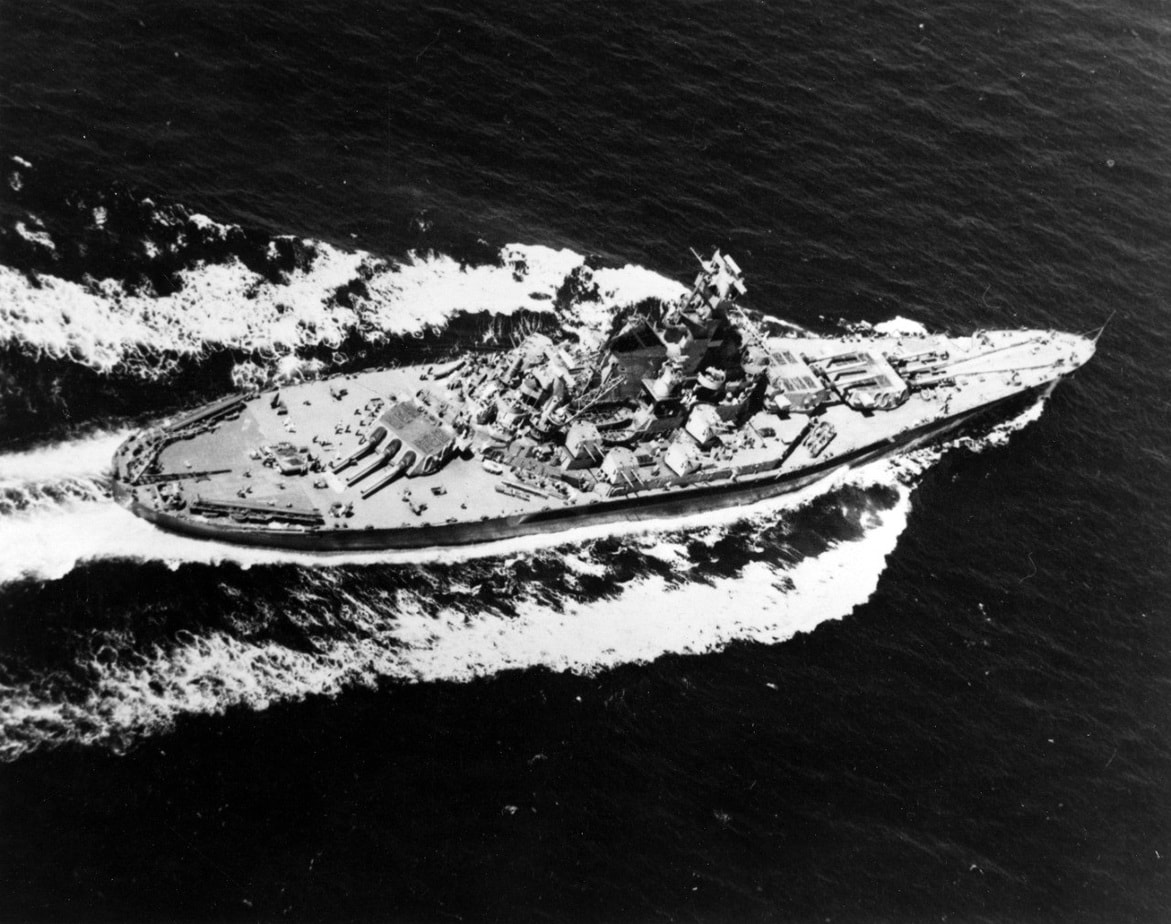
USS South Dakota-Class. Image: Creative Commons.
Next in line came (in chronological order):
–USS Indiana (BB-58); built by Newport News Shipbuilding, commissioned on March 20, 1942
-USS Massachusetts (BB-59), built by Bethlehem Steel Corporation, commissioned on May 12, 1942
-USS Alabama (BB-60), built at Norfolk Naval Shipyard; laid down on June 14, 1938, launched on June 1, 1940, and commissioned on August 16, 1942
South Dakota-Class Tech Specs and Vital Stats
-Displacement: 45,233 tons fully laden
-Hull Length: 680 feet
-Beam Width: 108 feet 2 inches
-Draft: 36 feet 2 inches
-Max Speed: 27.5 knots (50.9 km/h; 31.6 mph)
-Crew Complement: A combined 2,634 commissioned officers and 1,772 enlisted seamen
-Primary Armament: 9 x 16-inch (406 mm)/45 caliber Mark 6 guns (two triple-gun turrets fore, one such turret aft)
-Secondary Armament: 20 × 5-inch (127 mm)/38 caliber Mark 12 guns
-Tertiary Armament: 76 × Bofors 40 mm and 67 × Oerlikon 20 mm antiaircraft guns
Operational History
As we mentioned in the beginning segment of this article, the USS Washington scored the only one-one-one battleship kill of WWII.
To be more specific, ’twas the USS Washington that pulled off this monumental achievement during the Second Naval Battle of Guadalcanal on 14-15 November 1942, and her victim was the Imperial Japanese Navy (IJN) battleship Kirishima. (For good measure, the IJN destroyer Ayanami was also sent to Davy Jones’s locker by the mighty guns of the Washington.)
What sometimes gets lost in the shuffle is the fact that the USS South Dakota also participated in this battle. However, BB-57 didn’t land a single blow on the IJN adversaries therein; she was instead rendered hors de combat due to electrical failures that soon led to her sustaining multiple Japanese shellfire hits to her superstructure, which fortunately didn’t threaten her buoyancy but did cost 40 of her men killed in action and an additional 180 wounded.
However, South Dakota still got in plenty of licks against the enemy during her WWII career, including shore bombardments of Japanese positions in Guadalcanal, Santa Cruz, the Gilberts and Marshalls landings, and the Marianas campaign. As for her sister ships’ combat experiences:
-Indiana participated in the invasions of Tarawa (scoring her first aircraft kill), the Marshall Islands, Hollandia (in Dutch New Guinea), and Iwo Jima
-Massachusetts contributed heavily to the Operation Torch landings during the Mediterranean/North Africa campaign, most notably the five hits scored against the Vichy French battleship Jean Bart
-Alabama provided shore bombardment and/or antiaircraft support in multiple Pacific engagements, including Kwajalein in early 1944 and the shelling of the Japanese Home Islands in July 1945
Where Are They Now?
Two out of the four have been preserved for posterity as floating museums: (1) USS Alabama at Battleship Memorial Park in Mobile, Alabama; and (2) USS Massachusetts (” Big Mamie”) at Battleship Cove in Fall River, Massachusetts.
South Dakota and Indiana were both scrapped; luckily, a screw from the latter and the mast and anchor from the latter have been saved. For good measure, there’s the Battleship South Dakota Memorial in Sioux Falls.
Meanwhile, USS South Dakota’s participation in the Second Naval Battle of Guadalcanal has also been immortalized in pop culture to some extent thanks to a 1988 made-for-TV movie titled “Too Young the Hero,” starring Ricky Schroder in the true story of Seaman First Class Calvin Graham, who heroically served on that ship and in that battle at the tender age of twelve (back then, it was quite easy to lie about your age on your enlistment papers and get away with it).
Ironically enough, seven years later that movie was broadcast, Schroder would make the successful transition from child star to “grownup” movie roles as a naval officer in “Crimson Tide,” a fictionalized depiction of the USS Alabama…no, not the battleship, but rather the Ohio-class ballistic missile submarine (SSBN-731) of the same name.
About the Author: Christian D. Orr, Defense Expert
Christian D. Orr is a Senior Defense Editor. He is a former Air Force Security Forces officer, Federal law enforcement officer, and private military contractor (with assignments worked in Iraq, the United Arab Emirates, Kosovo, Japan, Germany, and the Pentagon). Chris holds a B.A. in International Relations from the University of Southern California (USC) and an M.A. in Intelligence Studies (concentration in Terrorism Studies) from American Military University (AMU). He is also the author of the newly published book “Five Decades of a Fabulous Firearm: Celebrating the 50th Anniversary of the Beretta 92 Pistol Series.”