
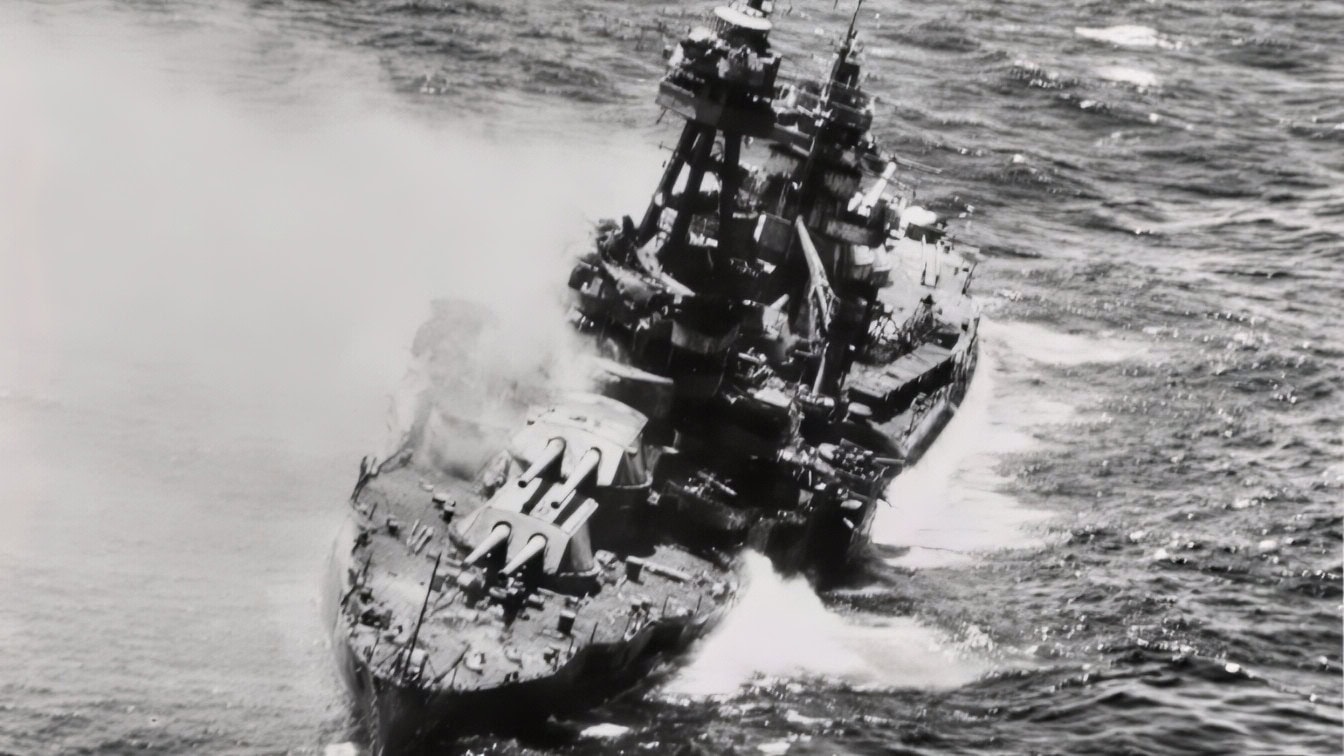
USS New York by the Numbers: The $14,000,000 Battleship With Ten 14-Inch Guns: A 1915 New-York Tribune account placed USS New York’s cost at $14 million. The New York Navy Yard in Brooklyn laid her keel on September 11, 1911, and commissioned the battleship on April 15, 1914. The interval was 947 days.
The ship entered service at 27,000 long tons standard displacement and more than 28,000 tons fully loaded. She measured 573 feet overall, had a beam of 95 feet 3 inches, and carried a crew of roughly 1,050. Modernization widened and weighed her down. By the end of World War II, full-load displacement had reached about 34,000 long tons.
New York’s defining weapons were ten 14-inch/45-caliber guns in five twin turrets. The original 1,400-pound armor-piercing projectile produced a 14,000-pound broadside. Later ammunition raised projectile weight to 1,500 pounds, giving the battleship a 15,000-pound, or 7.5-ton, salvo.
Her service spanned 32 years, two world wars, and the dawn of the atomic age. New York served with the British Grand Fleet, bombarded North Africa, Iwo Jima, and Okinawa, earned three World War II battle stars, and survived two nuclear tests. She never fought another battleship.
Brooklyn Built New York Around Coal and 28,100 Horsepower
New York was the lead ship of a two-vessel class completed by USS Texas. Fourteen Babcock & Wilcox coal-fired boilers supplied two vertical triple-expansion engines. The machinery drove two propeller shafts, producing about 28,100 indicated horsepower and giving the ship a designed speed of 21 knots.
The layout belonged to the final generation before the Navy standardized oil firing, turbine propulsion, and four-turret arrangements. New York carried five main turrets, including one amidships. A 12-inch armor belt protected much of the waterline, and the turret faces reached 14 inches.
Her original armament also included twenty-one 5-inch/51-caliber guns intended to stop destroyers and torpedo boats. Four submerged 21-inch torpedo tubes reflected a period when designers still expected battleships to launch torpedoes during a close fleet action. The tubes disappeared during the interwar reconstruction.
The $14 million figure came from contemporary newspaper coverage and appears to include more than the basic hull-and-machinery account used in Navy budget tables. Guns, armor, ammunition, and government-furnished equipment did not always appear under one construction line.
Ten 14-Inch Guns Produced a 15,000-Pound Broadside
Each original 14-inch gun weighed more than 142,000 pounds with its breech and measured 53.5 feet long. A 365-pound propellant charge launched the early 1,400-pound shell at 2,600 feet per second.
The Navy rebuilt the weapons during the 1930s. The modernized guns weighed about 62 tons, used a 425-pound full charge and fired the 1,500-pound armor-piercing shell at 2,600 feet per second. New York retained a maximum elevation of 15 degrees, limiting range to roughly 23,000 yards, or 13 miles.
The five twin turrets weighed about 532 tons apiece after modernization. Ammunition handling remained labor-intensive, and the class managed roughly 1.25 to 1.5 rounds per gun each minute. At the upper rate, all ten guns theoretically placed 22,500 pounds of armor-piercing shells downrange in 60 seconds.
World War II transformed the weapons around the main battery. New York eventually carried six remaining 5-inch guns, ten 3-inch anti-aircraft guns, forty 40 mm Bofors barrels,s and thirty-six 20 mm Oerlikons. The same hull built for a gun duel became a shore-bombardment and anti-aircraft platform.
World War I Put New York Inside the British Grand Fleet
New York became the flagship of Battleship Division Nine after the United States entered World War I. The American division reached Scapa Flow on December 7, 1917, and joined the British Grand Fleet as the Sixth Battle Squadron. Its duties included convoy protection, blockade support, and fleet exercises in the North Sea.
The main battery never opened fire on an enemy during the war. New York’s most unusual damage came on October 14, 1918, while entering the Pentland Firth. A violent underwater collision dented the starboard side and broke two blades from one propeller, reducing speed to about 12 knots.
Officers believed the battleship had struck a submerged German U-boat and that the propeller then hit it. No German submarine loss has been tied conclusively to the incident. While New York limped toward Rosyth the next morning, lookouts saw three torpedo wakes pass ahead of the ship.
New York witnessed the surrender of the German High Seas Fleet on November 21, 1918. She later helped escort the transport as President Woodrow Wilson traveled to France for the peace negotiations.
Oil Fuel and Early Radar Kept an Old Battleship Useful
A major 1926–1927 reconstruction replaced the fourteen coal-burning boilers with six oil-fired Bureau Express boilers. Anti-torpedo bulges increased the beam to more than 106 feet; two funnels became on; stronger fire-control positions replaced the cage mast; and an aircraft catapult went aboard. The reciprocating engines remained.

The “Baker” explosion, part of Operation Crossroads, a nuclear weapon test by the United States military at Bikini Atoll, Micronesia, on 25 July 1946. The wider, exterior cloud is actually just a condensation cloud caused by the Wilson chamber effect, and was very brief.
New York became one of the Navy’s earliest shipboard radar testbeds in 1938 when the experimental XAF set was installed. Tests aboard the battleship helped move radar toward fleet service.
The reconstruction did not give New York the speed of newer battleships. She remained a 21-knot ship while the later standard-type battleships and fast carrier escorts took over fleet maneuver missions. Her useful jobs became convoy protection, training, and heavy gunfire against fixed targets.
Operation Torch Was New York’s First Combat Gunfire
New York escorted convoys to Iceland and Scotland during the first year of American participation in World War II. Her first shooting war came off Safi, Morocco, during Operation Torch on November 8, 1942.
The battleship fired 60 rounds from the 14-inch battery at Vichy French defenses. One shell entered the observation opening of the Point de la Tour coastal battery, destroyed the range-finding position, and silenced the guns. New York then moved toward Casablanca in case the incomplete French battleship Jean Bart remained a threat.
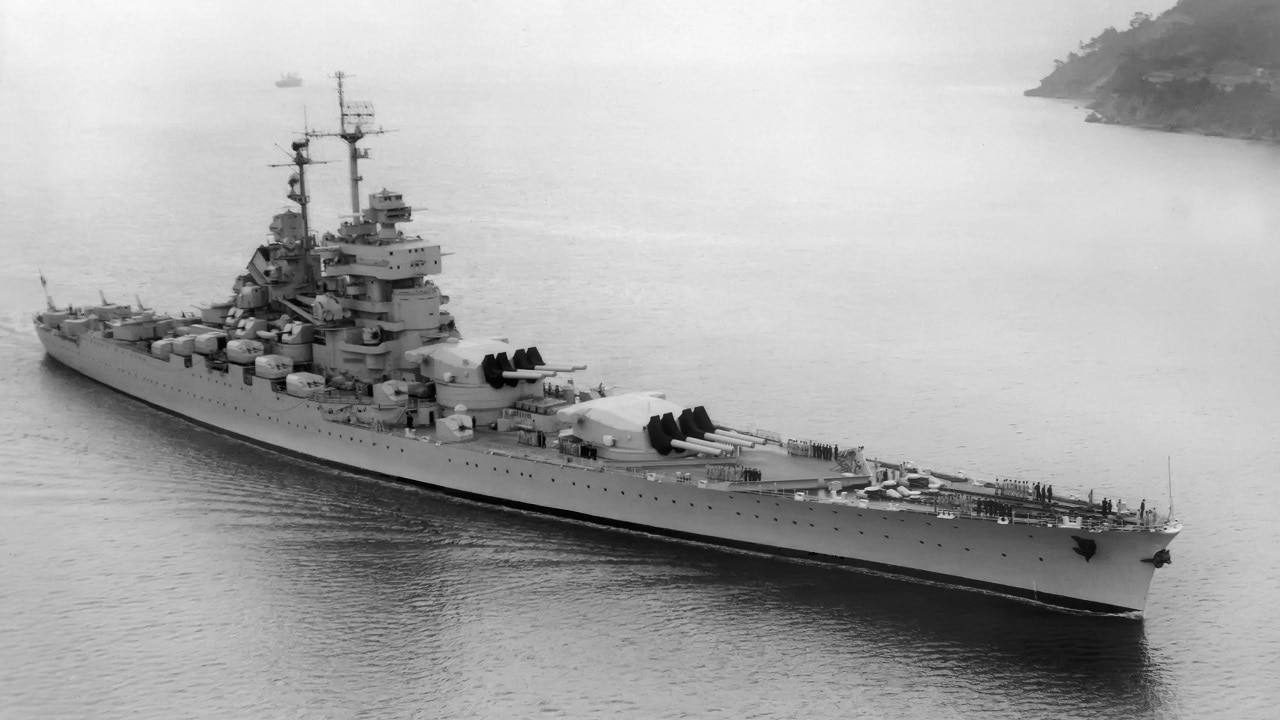
Jean Bart battleship of the French Navy. Image Credit: Creative Commons.
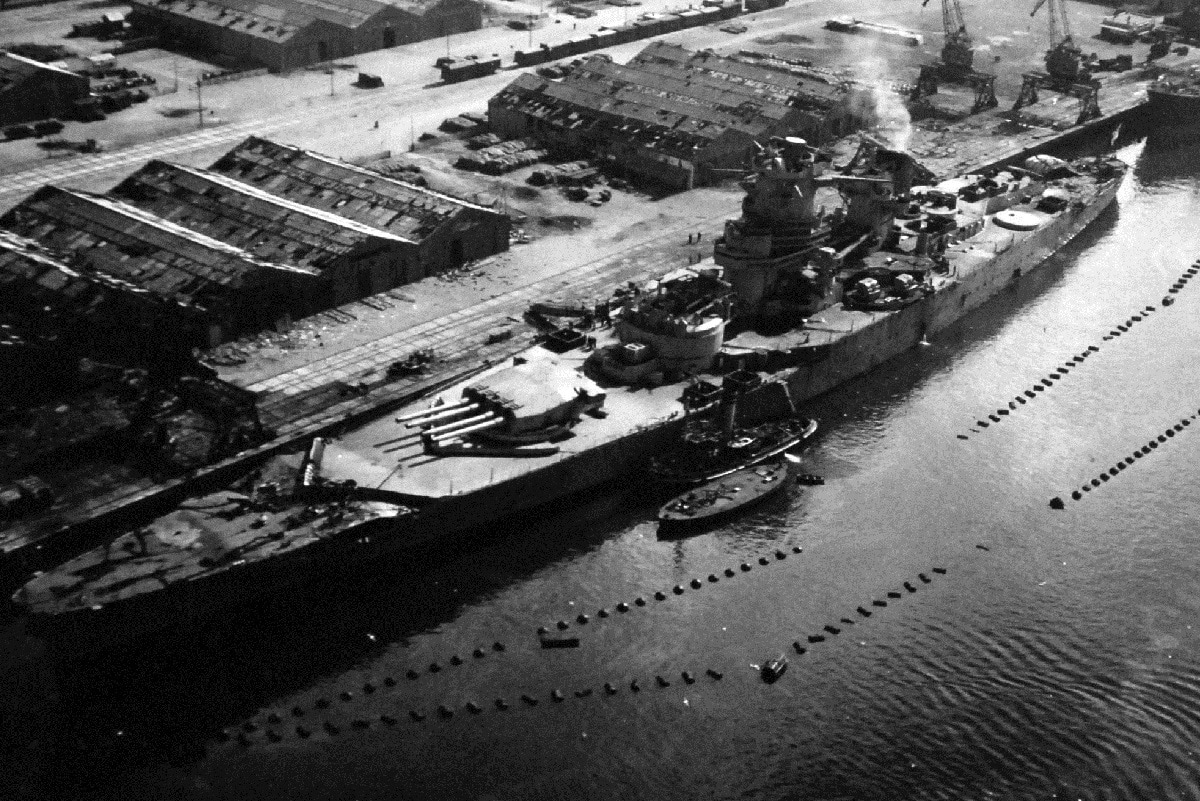
80-G-37325: Operation Torch, Battle of Casablanca, Invasion of North Africa, November 1942. View of French battleship Jean Bart, following attack by Allied gunfire and aerial bombardment. Aerial photograph taken by aircraft from USS Ranger (CV 4), 11 November 1942. Official U.S. Navy Photograph, now in the collections of the National Archives. (2014/4/3).
There was no battleship duel. USS Massachusetts had already struck Jean Bart and disabled its operational main turret. New York’s heavy guns spent the rest of the war against land targets rather than armored capital ships.
After North Africa, New York became a major gunnery school. Between July 1943 and June 1944, the ship trained about 11,000 enlisted personnel and 750 officers. Three Naval Academy cruises carried another 1,800 midshipmen before the Navy sent the battleship to the Pacific.
Iwo Jima and Okinawa Wore Out the 14-Inch Barrels
New York reached Iwo Jima on February 16, 1945, after losing a blade from the port propeller on the approach. Over three days, the ship fired 6,417 rounds of all calibers, including 1,037 rounds from the 14-inch guns. One salvo detonated a large Japanese ammunition store.
Permanent propeller repairs followed at Manus. New York then joined the bombardment force off Okinawa on March 27 and stayed for 76 straight days. Her expenditure reached 4,159 rounds of 14-inch ammunition and 7,001 rounds from the 5-inch battery.
A kamikaze grazed the ship on April 14 and destroyed a spotting aircraft sitting on its catapult. New York suffered superficial damage and two injuries. It was the closest she came to serious combat damage during World War II.
By June 11, the main-gun barrels were worn enough for the Navy to send New York to Pearl Harbor for relining. Across World War II, the ship fired more than 53,000 rounds of all types and spent 414 days underway. Gunfire support had become the old battleship’s strongest mission.
Two Atomic Tests Preceded New York’s Final Sinking
New York carried veterans home under Operation Magic Carpet and appeared at the October 1945 Navy Day celebration in New York City. The Navy then selected her for Operation Crossroads at Bikini Atoll in July 1946.
The battleship remained afloat after the Able airburst and the Baker underwater detonation. Radioactive contamination made inspection and decontamination difficult, the same problem that affected much of the Crossroads target fleet.
New York was decommissioned on August 29, 1946, and towed to Pearl Harbor for radiological study. The two nuclear tests left her afloat, but no return to service was planned.
Navy aircraft and surface ships sank the hull about 40 miles off Oahu on July 8, 1948.
About the Author: Harry J. Kazianis
Harry J. Kazianis (@Grecianformula) was the former Senior Director of National Security Affairs at the Center for the National Interest (CFTNI), a foreign policy think tank founded by Richard Nixon based in Washington, DC. Harry has over a decade of experience in think tanks and national security publishing. His ideas have been published in the NY Times, The Washington Post, The Wall Street Journal, CNN, and many other outlets worldwide. He has held positions at CSIS, the Heritage Foundation, the University of Nottingham, and several other institutions related to national security research and studies. He is the former Executive Editor of the National Interest and the Diplomat. He holds a Master’s degree focusing on international affairs from Harvard University.

