
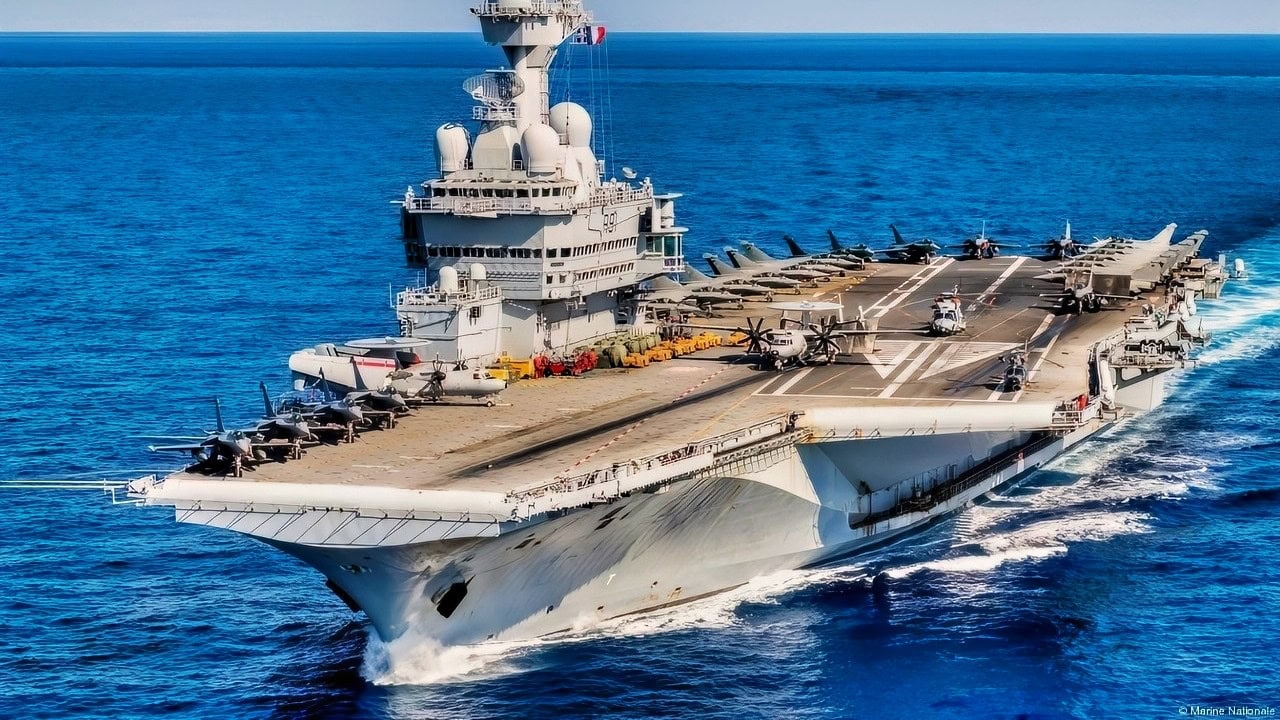
The French Navy’s Nuclear Charles de Gaulle Is the Only Aircraft Carrier Outside the U.S. Navy That Can Land a Super Hornet. That Is Because France Bought American – In February 2025, three aircraft carriers steamed together in the Philippine Sea: USS Carl Vinson, Japan’s JS Kaga, and France’s Charles de Gaulle. Somewhere in the middle of that exercise, American F/A-18 Super Hornets came down on the French deck and caught a wire, and French Rafale Ms did the same thing aboard the American one. Nothing else in the world’s navies can produce that photograph. Roughly a dozen aircraft carriers sail under flags other than the Stars and Stripes, and exactly one of them can recover a US Navy strike fighter and throw it back into the sky.
The reason has nothing to do with French engineering brilliance and everything to do with a procurement decision made decades ago in Paris: the machinery that launches and stops aircraft aboard Charles de Gaulle was designed and built in the United States.
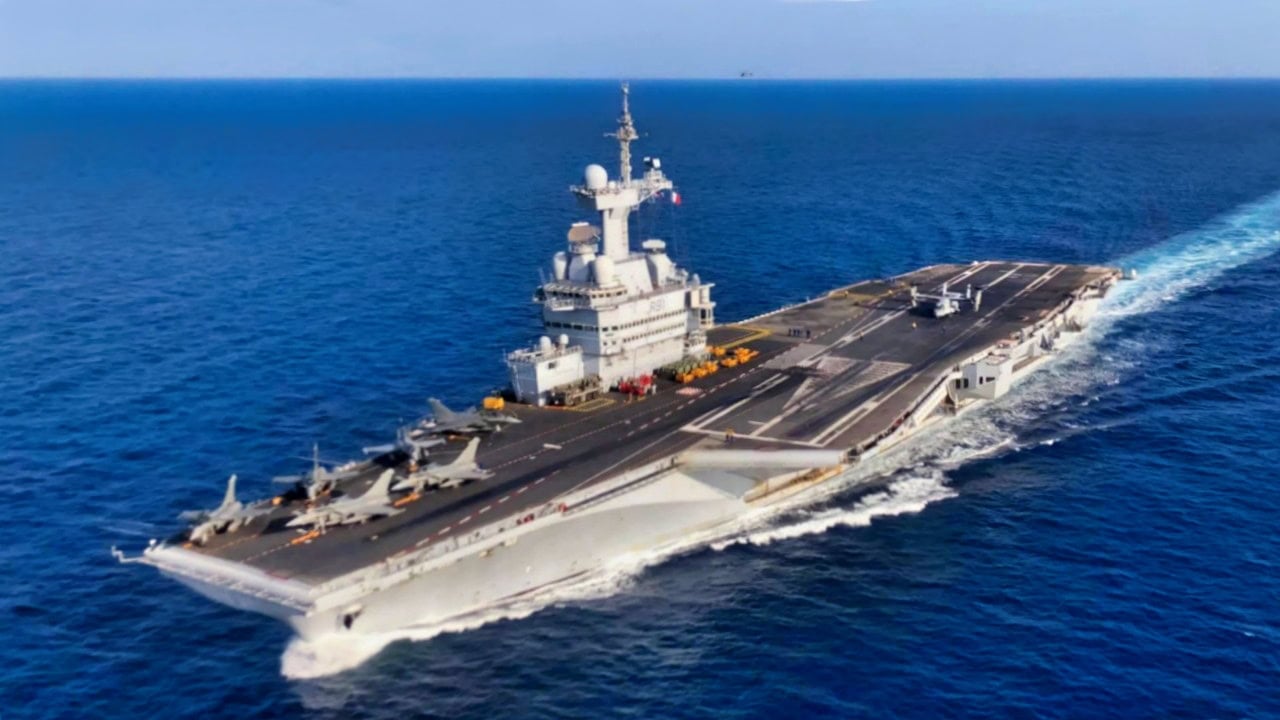
U.S. 5TH FLEET AREA OF OPERATIONS (April 24, 2019) A U.S. Marine MV-22 Osprey assigned to the 22nd Marine Expeditionary Unit sits on the flight deck of France’s Marine Nationale aircraft carrier FS Charles De Gaulle (R 91). This was the second time that Ospreys have landed aboard the French vessel. Marines and Sailors assigned to the 22nd MEU and Kearsarge Amphibious Ready Group are currently deployed to the U.S. 5th Fleet area of operations in support of naval operations to ensure maritime stability and security in the Central region, connecting the Mediterranean and the Pacific through the western Indian Ocean and three strategic choke points. (U.S. Marine Corps photo by Maj. Joshua Smith/Released)
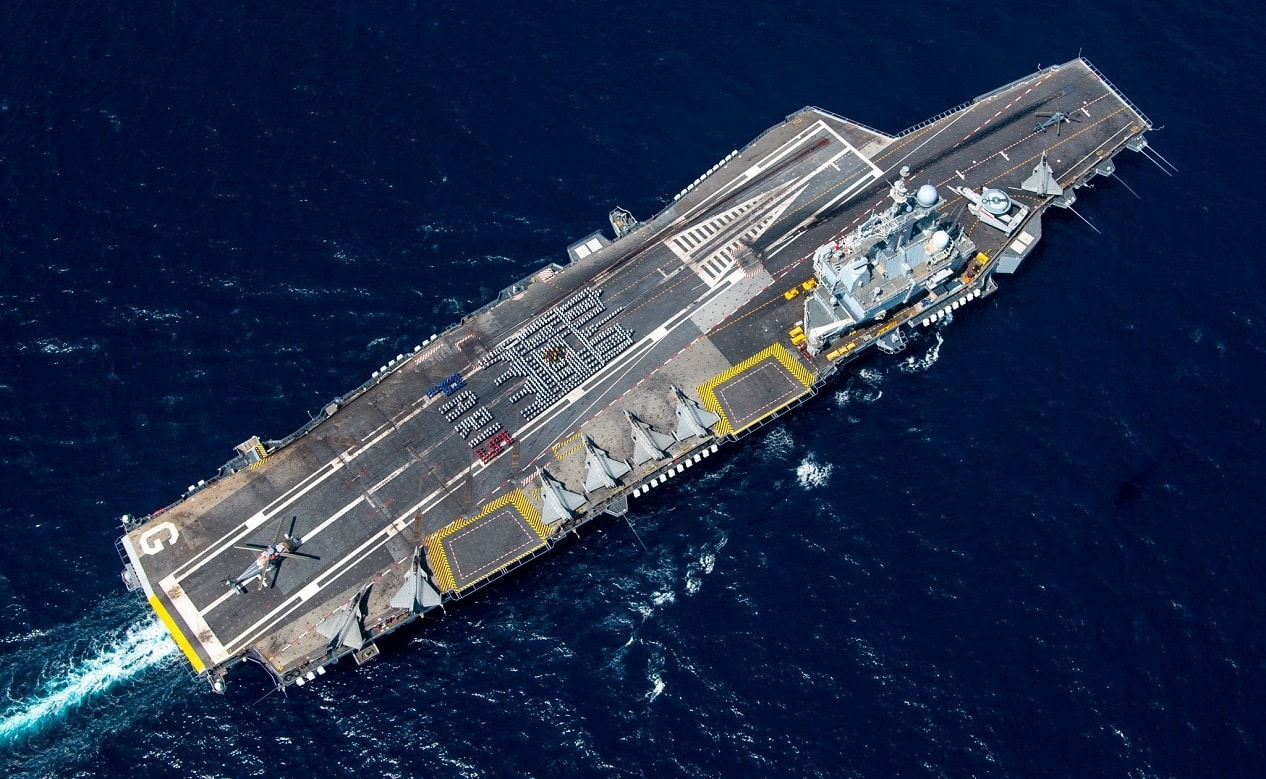
French Aircraft Carrier Charles de Gaulle.
The Hardware Came From America
Charles de Gaulle is a CATOBAR carrier, which means catapult-assisted takeoff with arrested recovery, the American method. Her flight deck runs about 260 by 64 meters with an angle of 8.5 degrees, and the two steam catapults set into it are 75-meter units derived from the C-13 designs used aboard American carriers, licensed to France and paired with American arresting gear.
They are shorter than the catapults on a Nimitz-class ship, which is the price of putting the system aboard a 42,000-ton hull rather than a 100,000-ton one, but they are the same family of machines, throwing aircraft off the bow with the same physics with the same interfaces.
The choice was not sentimental. France also bought the E-2C Hawkeye, the American radar aircraft that gives a carrier group its eyes, and the Hawkeye is heavy, propeller-driven, and utterly dependent on a proper catapult stroke and a long enough landing area.
Buying the airplane meant buying the deck equipment that could handle it. It also meant discovering the hard way, during 1999 sea trials, that the angled deck was too short for safe Hawkeye recoveries, which forced French engineers to extend it by 4.4 meters before the ship entered service in 2001. The dependency runs into daily operations: French naval officers have acknowledged that an American officer serves aboard the carrier to manage the maintenance interface for the catapults.
What Interoperability Looks Like in Practice
The first proof came on March 3, 2020, when Charles de Gaulle and USS Dwight D. Eisenhower ran a cross-deck exercise in the Mediterranean.
Two American aviators flying Super Hornets and four French aviators flying Rafales and an E-2C swapped decks, logging touch-and-goes plus one full arrested landing on each ship. It was the first time an F/A-18E had ever trapped aboard the French carrier, and the American pilot who did it described the systems and procedures of the two navies as effectively compatible.
Five years later, the trick had become a working routine rather than a demonstration. During Charles de Gaulle’s first Pacific deployment, the five-month Mission Clemenceau 25, the February 2025 exercise with Vinson and Kaga produced cross-deck landings in both directions, and then something more revealing: Rafale Ms refueled American Super Hornets in flight, and a Marine Corps MV-22 Osprey put down on the French deck.
When one of the French carrier’s E-2C Hawkeyes went down for want of a part, France used a standing cross-servicing agreement to obtain the component from Vinson and return the aircraft to service, which is the sort of thing that only works when two navies fly some of the same equipment. The human layer matches the hardware: Charles de Gaulle’s landing signal officers spend two years training in America, which is why they can wave aboard an American jet without improvising.
The Claim, Stated Precisely
One qualifier keeps this accurate. American fixed-wing aircraft land on allied decks all the time because the Marine Corps flies the F-35B, which needs no catapults or arresting wires.
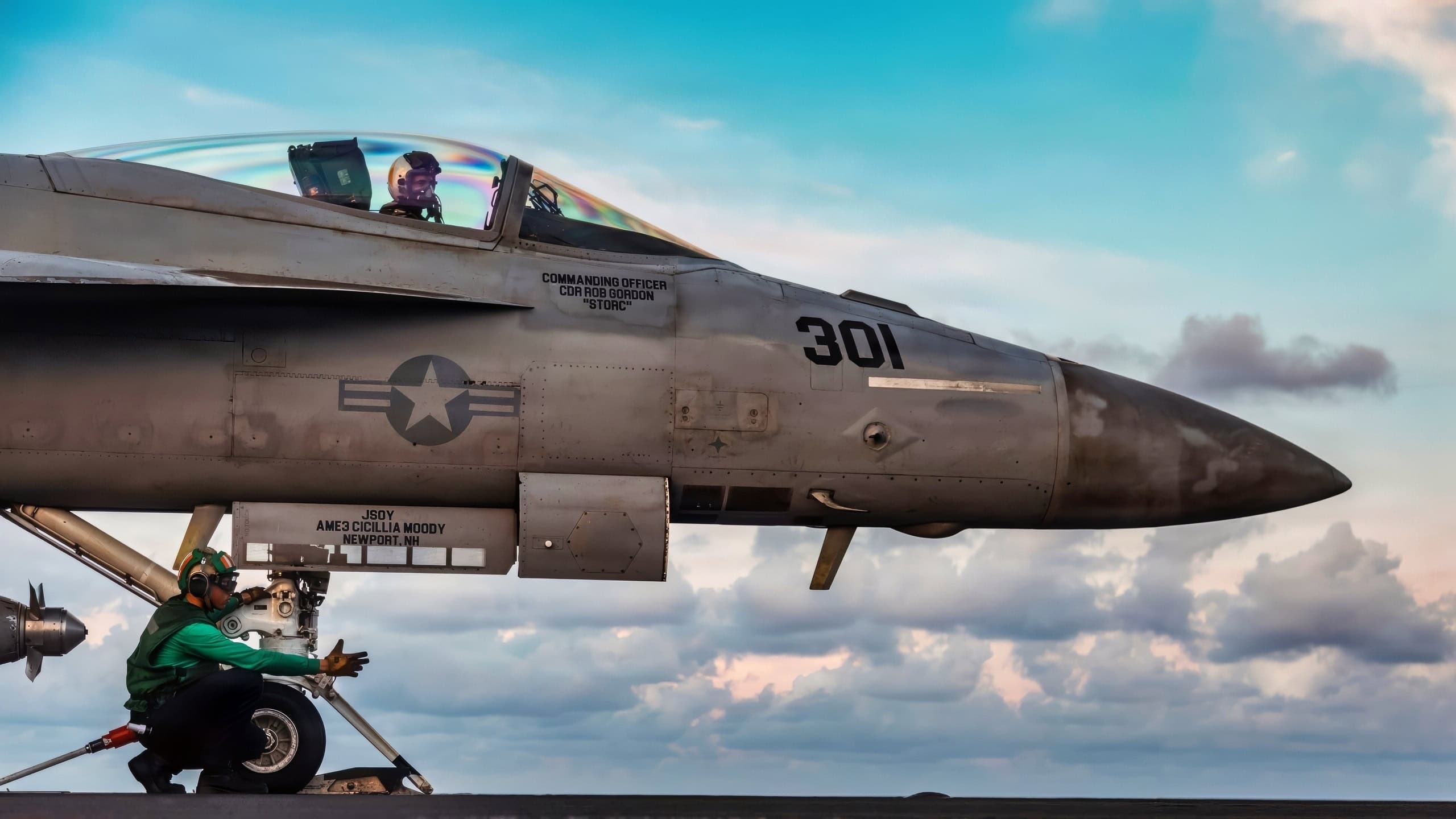
A U.S. Sailor performs a safety scan of the catapult track as an F/A-18E Super Hornet aircraft positions for launch from the flight deck while underway in the Caribbean Sea, Nov. 25, 2025. U.S. military forces are deployed to the Caribbean in support of Operation Southern Spear, the U.S. Southern Command mission, Department of War-directed operations, and the president’s priorities to disrupt illicit drug trafficking and protect the homeland. (U.S. Navy photo)
Marine F-35Bs deployed aboard HMS Queen Elizabeth for an entire cruise, flew from HMS Prince of Wales in 2025, operated off Italy’s Cavour, and landed on Japan’s Izumo in October 2021, the first fixed-wing landing on a Japanese carrier since the Second World War.
What those ships cannot do is the harder half. Japan’s converted flat-tops have no catapults or arresting gear and no way to launch a heavy radar aircraft; the British carriers are ski-jump ships by design.
China’s Fujian broke the catapult monopoly in a narrow technical sense, but her electromagnetic system is Chinese-built and Chinese-only, which is interoperability with nobody. The accurate sentence, then, is this: Charles de Gaulle is the only deck outside the US Navy where an American catapult aircraft — a Super Hornet, a Growler, a Hawkeye — can operate exactly as it would at home.
What a Second Catapult Deck Is Actually Worth
The French carrier is not a substitute for an American one, and the comparison is unkind on paper. She displaces about 42,000 tons against a Nimitz-class ship’s 100,000, runs roughly 200 feet shorter, and carries around 30 Rafale Ms and two or three Hawkeyes, whereas an American air wing runs to twice that number of aircraft. She is also a single ship in a one-carrier navy, which means France has periods with no carrier at all.
The value is not tonnage. It is that in a crisis stretching from the Mediterranean to the Red Sea to the Philippine Sea, there exists one allied deck where an American jet low on fuel, or diverted, or unable to reach its own ship, can trap, refuel, rearm, and launch again. Fleets are finite, distances are not, and a second usable deck in the right ocean is worth more than its displacement suggests.
The Successor Doubles Down
France is not walking back this dependency; it is deepening it deliberately. The next French carrier, named France Libre for the wartime Free French movement that Charles de Gaulle himself led, is designed at roughly 80,000 tons, close to double the current ship, powered by two new reactors and priced near $11 billion.
Her catapults and arresting gear will again be American: the electromagnetic systems built by General Atomics for the Ford class, which will keep the French flagship interoperable with the US Navy into the second half of the century.
A nation that treats strategic autonomy as doctrine has now chosen American launch equipment twice, sixty years apart, because the alternative is a deck no ally can use.
About the Author: Harry J. Kazianis
Harry J. Kazianis (@Grecianformula) was the former Senior Director of National Security Affairs at the Center for the National Interest (CFTNI), a foreign policy think tank founded by Richard Nixon based in Washington, DC. Harry has over a decade of experience in think tanks and national security publishing. His ideas have been published in the NY Times, The Washington Post, The Wall Street Journal, CNN, and many other outlets worldwide. He has held positions at CSIS, the Heritage Foundation, the University of Nottingham, and several other institutions related to national security research and studies. He is the former Executive Editor of the National Interest and the Diplomat. He holds a Master’s degree focusing on international affairs from Harvard University.