
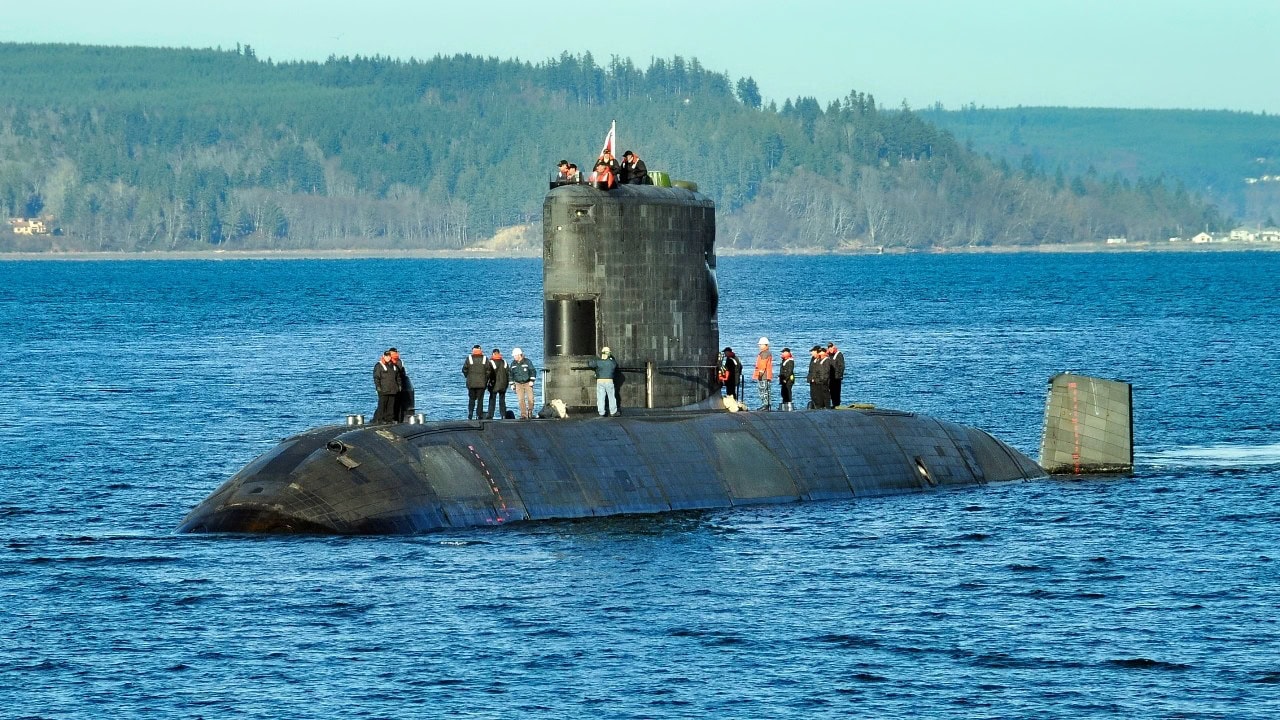
On 12 July 2026, in water nearly three miles deep, more than fifty nautical miles north of Kauai, a Canadian submarine fired a heavyweight torpedo into a decommissioned American guided-missile cruiser and sent her to the bottom. The cruiser was the former USS Mobile Bay, a 567-foot Aegis warship that cost the United States roughly a billion dollars to build and fired Tomahawks in two wars. The submarine was HMCS Corner Brook, which the Royal Canadian Navy acquired from the United Kingdom for one pound sterling. The cruiser carried the name of the battle at which an American admiral is remembered for damning the torpedoes and ordering full speed ahead.
This is the full account of how a boat Britain could not find a use for came to fire the shot that killed her.
The Ship Named for Ignoring Torpedoes
Mobile Bay was the seventh Ticonderoga-class cruiser, ordered in January 1982, laid down at Ingalls Shipbuilding in 1984, launched in 1985, and commissioned in February 1987.
She was built around the Aegis combat system and its SPY-1 phased-array radar, carried 122 vertical launch cells across two Mk 41 systems, and could fire Standard missiles, Tomahawks, and rocket-thrown anti-submarine torpedoes from the same magazine, which made a single hull capable of air defense, land attack, and submarine hunting at once.
Over 36 years, she launched cruise missiles in the Gulf War and again in the 2003 invasion of Iraq, evacuated Americans in 1989, and rode out the Mount Pinatubo eruption while homeported in Japan.
The Navy decommissioned her in August 2023. A year later she was ruled ineligible for the National Register of Historic Places, which closed the museum option and left one destination, and this publication’s accounting of what the disposal of warships costs explains why the alternatives to scrapping and sinking almost never survive contact with a budget.
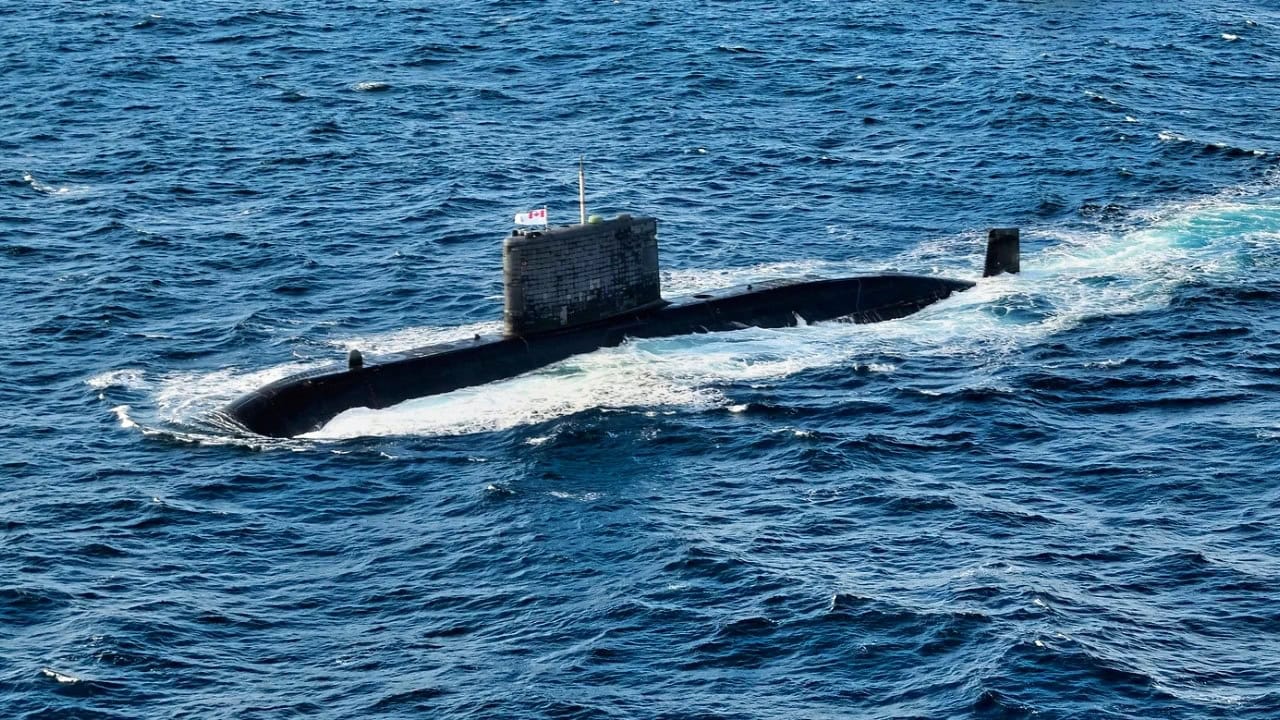
Victoria-Class Submarine at Sea. Image Credit: Creative Commons.
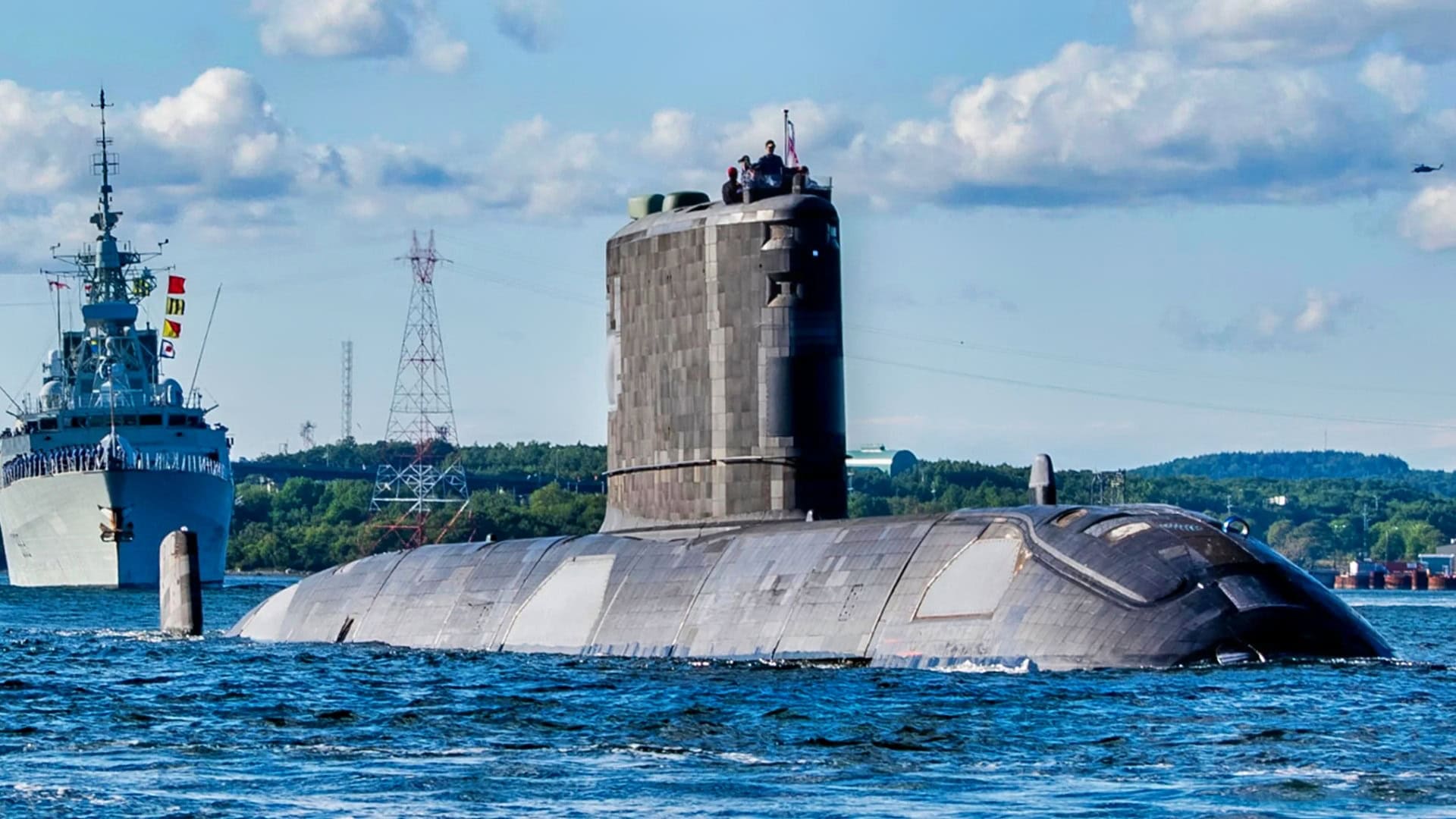
Victoria-Class Submarine Canada.
Her name came from the fight in Mobile Bay in August 1864, where David Farragut took his squadron through a minefield after his lead monitor blew up, and where the tradition has him shouting to damn the torpedoes and go. A torpedo in 1864 was a moored mine.
The ship’s motto, carried for 36 years, was Full Speed Ahead.
The Submarines Britain Could Not Use
The boat that finished her began as HMS Ursula. Britain ordered the first Upholder-class submarine in 1983 and three more in 1986, diesel-electric boats meant to handle the shallow, cluttered work that nuclear attack submarines do poorly.
All four entered Royal Navy service between 1990 and 1993. All four were laid up in 1994. The end of the Cold War and the budget cuts that followed pushed the Royal Navy toward an all-nuclear submarine force, leaving four nearly new conventional submarines suddenly without a mission, crews, or a place in the plan. Canada had the opposite problem.
Its Oberon-class boats were finished, an earlier plan to buy nuclear submarines had collapsed, and building new conventional boats was estimated at three to five billion Canadian dollars. Ottawa needed hulls, and Britain needed the hulls gone.
What a Pound Buys
The famous price is real and almost meaningless on its own.
Canada entered an eight-year, interest-free lease-to-buy arrangement in 1998, and the nominal pound per submarine was the payment that transferred title upon the lease’s expiration. The money moved elsewhere. The main contract ran to C$501 million, and the formal project budget was C$812 million, which a Defence Department audit broke out as the main contract plus C$160 million for initial support and C$151 million for infrastructure and Canadian modifications.
The same audit later put the real figure at no less than C$897 million, including costs outside the project’s original scope. What the pound bought was legal, not economic: a token payment large enough to make a transfer binding without pretending a market price existed, the identical device the US Navy has used to hand aircraft carriers to shipbreakers for one cent.
In both cases the coin is the receipt, and the real transaction is everything attached to it. Here that meant four submarines plus their technical records, training simulators, spare parts, specialized tools, and instruction for Canadian crews, with Britain responsible for fixing safety-critical defects found during reactivation and Canada responsible for installing its own weapons and communications afterward.
A financing scheme was announced under which submarine payments would be offset against British use of Canadian training ranges at Wainwright, Suffield, and Goose Bay. A later parliamentary review found the barter never happened. Canada paid Britain for the boats, and Britain paid Canada for the ranges.
The Bill Nobody Wrote Down
The bargain for the renamed Victoria-class went wrong immediately and stayed wrong for a decade.
Defence officials had underestimated what it takes to wake up submarines that had sat since 1994 and convert a small British class to Canadian standards; deliveries slipped, training pipelines broke, and the Canadianization work ran long.
The worst of it came in October 2004, when seawater entered HMCS Chicoutimi during her delivery voyage across the Atlantic and contributed to an electrical fire that killed Lieutenant Chris Saunders. Chicoutimi did not enter Canadian service until 2015, eleven years later.
The fleet spent years alongside rather than at sea, and the availability problems that followed have shaped every Canadian submarine debate since, including the replacement question this publication has covered as the boats aged past their intended lives.
Fifteen Years From the Seafloor to the Shot
Corner Brook’s own history sharpens the point. In June 2011, while training submerged off British Columbia, she struck the bottom, damaging her bow badly enough that the accident became one of the defining embarrassments of the Victoria class.
What followed was years of repair folded into an extended docking and modernization period, the kind of yard time that consumes budgets and produces nothing visible. She returned to the water and then to operations, and in July 2026, she was part of the Canadian contribution to the largest naval exercise on earth.
Fifteen years and one month separated the day Corner Brook hit the seafloor from the day she put a torpedo into an American cruiser in front of dozens of navies. Governments rarely get to point at a single moment and say the repair bill was worth it. Canada got one.
How You Sink a Cruiser
RIMPAC 2026 ran from 24 June to 31 July around Hawaii, and its sinking exercises are the capstone, the rare chance to fire live weapons at a real warship and watch what happens. Mobile Bay was hit by a multinational, multi-axis attack that read like a catalog of everything now aimed at ships: HIMARS rockets fired by a Kentucky Army National Guard artillery battalion, Japanese Type 12 anti-ship missiles, air-launched Long Range Anti-Ship Missiles, Spike NLOS, and heavyweight torpedoes.
Corner Brook fired last, a wire-guided Mk 48 that the Canadian account identifies as a Mod 7AT, and the sequence is not arbitrary. Missiles and rockets hitting a ship above the waterline start fires, wreck compartments, and kill crews, but they do not necessarily remove the ship’s ability to float.
A heavyweight torpedo does. Detonating under the keel rather than against the hull, it opens a gas bubble that lifts the ship amidships and then drops her into the void it created, breaking her back.
That is why the submarine gets the last shot in a sinking exercise, and why an aging diesel boat can end a cruiser that survived everything fired at her from the air.
The US Navy’s release on the exercise dated the cruiser’s sinking to 11 July, while the Royal Canadian Navy’s account of its own submarine’s shot places it on 12 July, a one-day divergence between two navies describing the same night.
Six days later, the amphibious assault ship ex-USS Peleliu went down in the same waters, hit by Harpoons from the American attack submarine USS Columbia. Both wrecks lie in about 15,000 feet of water.
What the Pound Bought
The submarines were always the smaller half of the purchase. What Canada preserved by buying used was an institution: submariners take years to qualify; the technicians who understand pressure hulls, batteries, sonar, and torpedo systems take even longer; and a country that lets that expertise lapse does not get it back by writing a check later.
The Victoria-class kept those people employed and at sea for three decades during which Canada could not afford to build anything comparable, and the boats did real work, including a 197-day Indo-Pacific deployment by Chicoutimi and the first visit by a Canadian submarine to Japan since 1968. That institution is now the basis of the replacement.
In July 2026, Ottawa named Germany’s TKMS its preferred supplier for up to 12 Type 212CD submarines, with the first four targeted for 2034, a decision this publication argued was the correct call while noting Ottawa still has to decide what the boats are for, and the Victoria-class is being modernized to bridge into the mid-to-late 2030s against a replacement gap that could run far longer than planned.
About the Author: Harry J. Kazianis
Harry J. Kazianis (@Grecianformula) was the former Senior Director of National Security Affairs at the Center for the National Interest (CFTNI), a foreign policy think tank founded by Richard Nixon based in Washington, DC. Harry has over a decade of experience in think tanks and national security publishing. His ideas have been published in the NY Times, The Washington Post, The Wall Street Journal, CNN, and many other outlets. He has held positions at CSIS, the Heritage Foundation, the University of Nottingham, and several other institutions related to national security research and studies. He is the former Executive Editor of the National Interest and the Diplomat. He holds a Master’s degree focusing on international affairs from Harvard University.

