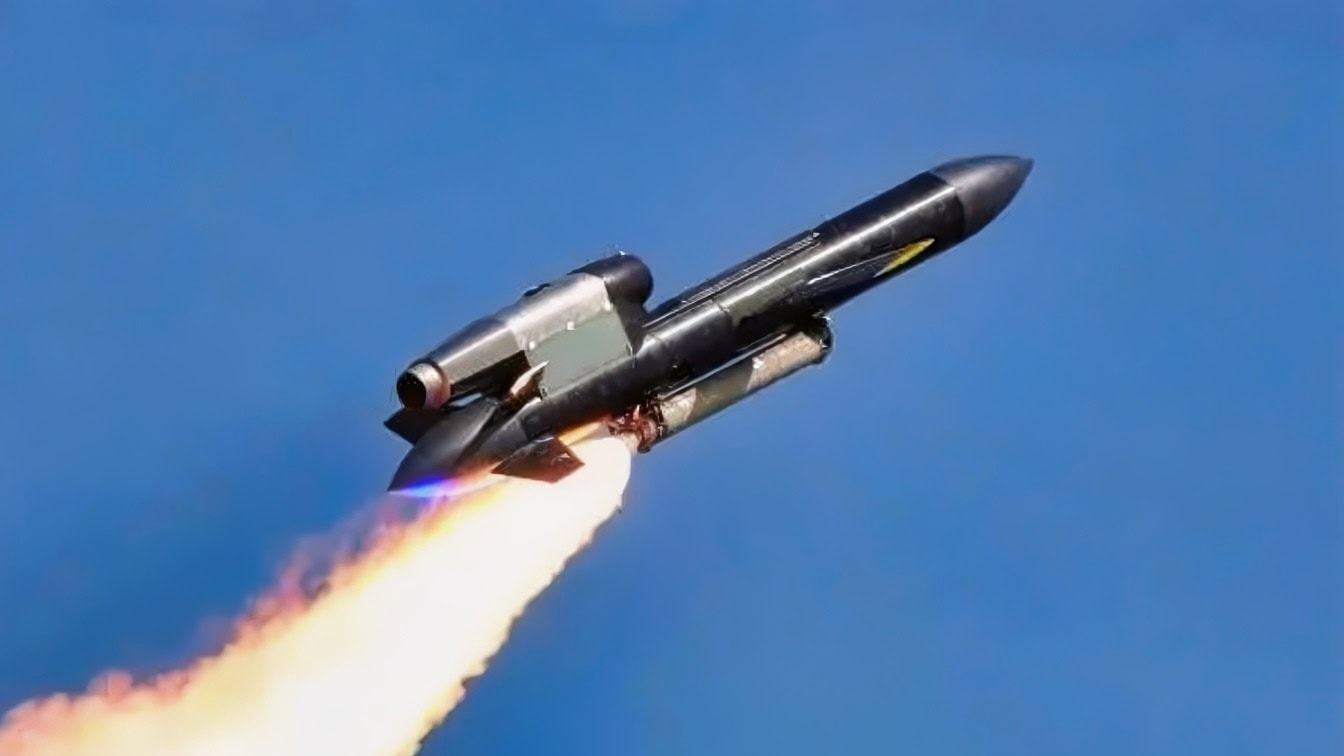
Summary and Key Points: Ukraine is hitting targets inside Russia with a cruise missile that costs about $600,000 and carries a heavier warhead than an American Tomahawk. The FP-5 Flamingo is nearly 40 feet long, weighs 6 tons, carries 1,150 kilograms of explosives, and has a range of 3,000 kilometers. It is built by Fire Point, a private Ukrainian company founded in 2022, and powered by the Ivchenko AI-25TL — a turbojet originally designed decades ago for the L-39 Albatros, a Soviet jet trainer. That engine is also the missile’s biggest problem because there are only so many left in the world.
The Flamingo Cruise Missile: Ukraine Has a New Weapon to Strike Russia With
Ukraine’s Flamingo cruise missile is a remarkable turn for the country, and a return to Kyiv’s role during the Soviet period as a missile manufacturing powerhouse — though now those Ukrainian missiles are pointed east, toward Russia.
Developed by Fire Point, a private Ukrainian company, and debuted last year, the FP-5 Flamingo is a ground-launched, turbojet-powered cruise missile designed for long-range strikes deep inside Russia.
Its payload and range — thought to be about 1,150 kilograms (about 2,500 pounds) and 3,000 kilometers (nearly 1,900 miles) — make it one of the longest-range weapons Ukraine has fielded in the ongoing war against Russia, a weapon that relies on foreign supply chains or operational approval.
Back in the USSR
During the Cold War, Ukraine was the epicenter of the Soviet Union’s missile production. Design bureaus like Yuzhnoye in Dnipro and production giants like Yuzmash churned out intercontinental ballistic missiles, cruise missiles, and rockets for Soviet space programs.
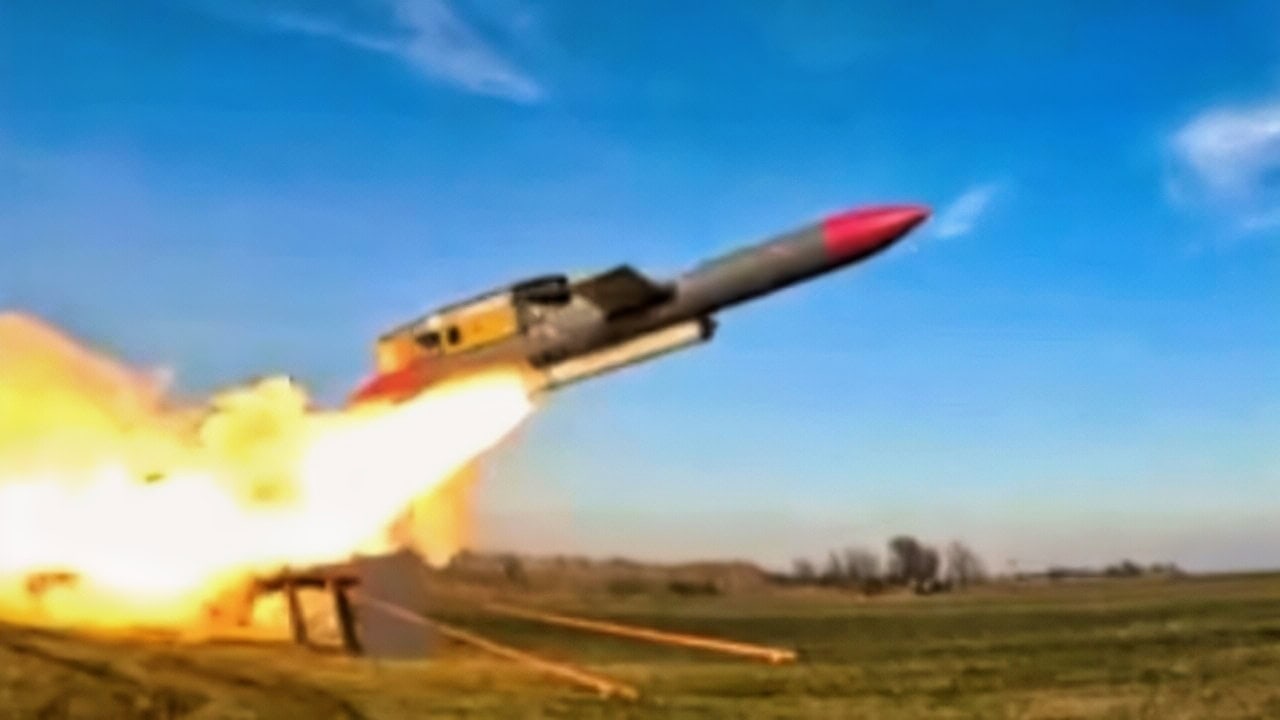
FP-5 Flamingo Cruise Missile. Creative Commons Image.
But after Ukrainian independence in 1991, much of the country’s missile production capacity atrophied, though some of the engineering know-how survived, albeit in scattered, piecemeal form.
Fire Point, founded in 2022 after Russia’s full-scale invasion, leveraged its earlier engineering legacy to design and build the Flamingo. Intriguingly, the missile’s power plant is the Ivchenko AI‑25TL turbojet, which originally powered the L-39 Albatross, a Soviet-era jet trainer.
Flamingo: Operational Use and Strategic Effects
Kyiv has used the Flamingo missile primarily against high-value targets within Russia, in particular of a military or industrial nature.
Confirmed or reliably attributed strikes from this year include a rocket and space center in Samara, about 900 kilometers from the Ukraine-Russia border, as well as an ammunition plant in Volgograd and several other machine shops in Russia, several of which are important nodes in Russia’s missile and munitions supply chains.
Previously, it was only reachable with Western-supplied weapons like the Anglo-French Storm Shadow/Scalp EG family of weapons, or via remotely controlled drone attacks like Operation Spider Web.
The Flamingo’s large warhead is what makes it different than the other systems Ukraine relies on. Its payload exceeds that of a Tomahawk cruise missile, an advantage when targeting large industrial sites.
The Ukrainian missile is also significantly cheaper — about six times less — than the American cruise missile.
The Flamingo’s subsonic cruising speeds, around 850 to 950 kilometers per hour, and relatively low flight altitude are designed to hinder Russian air defenses from picking up and shooting down the missile, though that has not prevented Moscow’s forces from shooting down a number of Flamingos before impact.
Still, enough have penetrated Russian air defense umbrellas to inflict significant damage and demonstrate that Ukraine can prosecute a deep-strike campaign independent of foreign missile supplies or political decisions.
A U.S. Air Force F-16 Fighting Falcon flies a presence patrol over the U.S. Central Command area of responsibility, Feb. 23, 2025. Fighting Falcons fly routine patrols over the AOR to deter aggression and bolster the regional defensive posture. (U.S. Air Force photo by Staff Sgt. Jackson Manske)
Strategic Autonomy as well as Constraints
For Kyiv, the Flamingo offers not just a long-range, heavy-hitting cruise missile, but also a significant degree of strategic autonomy.
Similar Western-supplied systems have been operationally constrained by significant caveats related to their use, and supply limits and targeting approvals have further crimped those munitions’ use.
But the domestically produced Flamingo allows Ukraine to decide when and where to fire, decisions limited only by production capacity — which appears to be increasing. Monthly Flamingo strikes have seemingly climbed as production has increased.
Flamingo’s Limitations
But the Flamingo missile is no silver bullet.
Perhaps one of its most significant constraints is its powerplant, the aforementioned Ivchenko AI‑25TL turbojet.
That engine exists in limited numbers, and although Ukraine has reportedly sought alternative powerplants, the bottleneck has seemingly limited the Flamingo’s scaling up.
The Flamingo’s size — nearly 40 feet long and weighing 6 tons — makes it difficult to hide and to transport. Its low-altitude flight profile helps it evade some air-defense radars but also exposes the missile to ground-based air defenses.
Russian strikes on Fire Point production nodes and Flamingo launch sites in Ukraine have put the missile’s deployment and production locations in Russia’s crosshairs too.
Flamingo’s accuracy is questionable. Manufacturer data specify a circular error probability of about 14 meters (about 46 feet). But that is best understood as under ideal conditions, and GPS jamming and other electronic warfare measures are likely to degrade real-world performance.
Though the missile does give Kyiv some independence from foreign donors, Ukraine still relies on some imported components to keep Flamingo production lines open.
Strategically, Flamingo gives Ukraine a degree of autonomy it did not previously enjoy — but it is far from perfect.
About the Author: Caleb Larson
Caleb Larson is an American multiformat journalist based in Berlin, Germany. His work covers the intersection of conflict and society, focusing on American foreign policy and European security. He has reported from Germany, Russia, and the United States. Most recently, he covered the war in Ukraine, reporting extensively on the war’s shifting battle lines from Donbas and writing on the war’s civilian and humanitarian toll. Previously, he worked as a Defense Reporter for POLITICO Europe. You can follow his latest work on X.