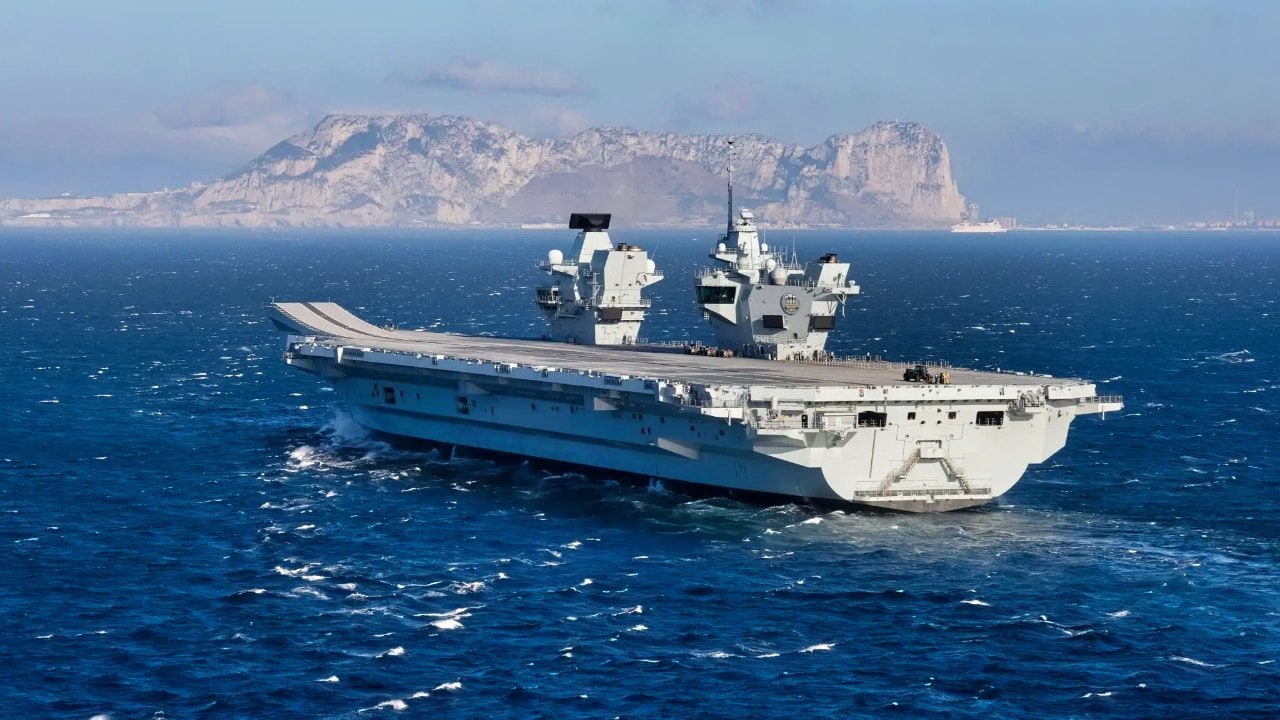
Summary and Key Points: Brandon J. Weichert argues the Royal Navy’s 65,000-ton aircraft carrier HMS Prince of Wales, 932 feet long with room for up to 36 F-35B Lightning II fighters, is a vulnerable target without escorts: it carries no medium- or long-range surface-to-air missiles, only three Phalanx 20mm systems, relies on Merlin Crowsnest helicopters instead of E-2D Hawkeyes, and depends on six rarely available Type 45 destroyers with Sea Viper, which kept it out of the Iran war.
The Royal Navy’s Aircraft Carriers Look Like Sitting Ducks in a War
When the British Royal Navy committed to building two 65,000-ton aircraft carriers, HMS Queen Elizabeth and HMS Prince of Wales, it met the decision with great fanfare.
There was, of course, similarly intense pushback. Many feared what the exorbitant cost of these two carriers would do to the budget.
Others fretted over the complexity of maintaining these two massive conventionally powered aircraft carriers.
Another source of controversy has been the mechanical issues that have arisen since the carriers were deployed.
Still, HMS Prince of Wales and its sister ship remain among the largest warships Britain has ever built. Yet, having an aircraft carrier alone is insufficient.
An aircraft carrier, like any platform, must provide tactical advantages for your side and improve your navy’s strategic position to be worth anything.
A Big Problem
The HMS Prince of Wales, whatever advantages it might bring to the Royal Navy (which remain in question), is still a vulnerable target if deployed without an appropriate naval escort.
The United States Navy has organic defensive weapons, escort availability, airborne surveillance, and supporting naval infrastructure that work together to ensure those leviathans operate safely in hostile territory.
Unlike those American supercarriers, though, the HMS Prince of Wales relies upon a much smaller British surface fleet to provide critical defense against incoming missiles, hostile aircraft, submarines, and the kinds of drone swarms that have defined the war in Ukraine and the Middle East.
Specifications
The second of two Queen Elizabeth-class aircraft carriers, the HMS Prince of Wales measures around 932 feet long and can carry up to 36 F-35B Lightning II stealth fighters. Despite this capacity, the HMS Prince of Wales’ air wing is usually much smaller than that full load.
Budgeting and staffing issues have strained the Royal Navy for years.
Even without the protective envelope of surface warships, the Prince of Wales lacks a medium- or long-range shipboard surface-to-air missile system.
Its primary organic missile-defense weapons are three Phalanx close-in weapon systems (CIWS), supported by smaller guns.
The Phalanx utilizes a radar-directed 20mm Gatling gun to defend against incoming threats at short distances. The Phalanx system is meant to be a carrier’s final defensive layer, not a substitute for the defensive layer escort ships are meant to provide.
Compare what the Americans employ with what the British can afford, and ask yourself whether the British investment was truly worth it.
US carriers carry Sea Sparrow-type surface-to-air missiles, Rolling Airframe Missiles, Phalanx CIWS, and electronic warfare (EW) gear.
The strike groups themselves typically include Arleigh Burke-class guided-missile destroyers equipped with the Aegis combat system, capable of tracking and engaging multiple aerial threats using Standard Missile interceptors (and other systems).
Undersea, US attack submarines provide additional protection, with the carrier-based E-2 Hawkeye airborne early-warning aircraft extending the carrier group’s ability to detect and track approaching threats.
Both the American Nimitz- and Ford-class carriers have massive air wings that can accommodate up to 60 (or more) aircraft (both fixed-wing and rotor-wing).
Meanwhile, the British already have a smaller F-35 B footprint on their carriers, and they operate no early-warning aircraft comparable to the E-2D Advanced Hawkeye.
Instead, the British use Merlin helicopters equipped with the Crowsnest surveillance system.
But these helicopters lack the endurance that the E-2D Hawkeyes enjoy.
Lack of Escorts
As for British carrier escorts, the Royal Navy has only six Type 45 air-defense destroyers. They are rarely available in those numbers, though.
If they were, Britain wouldn’t have the kind of force-protection problems it has endured with its two carriers.
But maintenance backlogs at Britain’s strained shipyards, the difficulty in keeping these ships properly staffed, and the cost of maintaining these ships at sea have all conspired to ensure that those Type 45s are not available in any meaningful way–especially as London desires to deploy its carriers into combat zones where drone and missile swarms will dominate the engagement.
If the Type 45s were available in useful numbers, they would bring a powerful Sea Viper system into combat, providing longer-range defensive capabilities than the HMS Prince of Wales.
Not Worth the Cost for These Aircraft Carriers
Indeed, the HMS Prince of Wales could not have deployed to the Middle East as the war there between Israel, the United States, and the Islamic Republic of Iran was heating up.
Britain’s limited number of available warships meant London could not risk the carrier.
As a vital NATO member, the British Royal Navy could call on allies to provide escort ships.
But that requires those countries to be willing to commit to the mission that London wanted to send their carriers on.
Britain’s carriers are essentially limited in their capabilities, not because they cannot handle the mission set that London wants to give them.
But because the supporting infrastructure that makes carrier operations possible while in combat is simply unavailable.
And that isn’t set to change anytime soon.
Therefore, the entire rationale for building those carriers makes less and less sense.
About the Author: Brandon J. Weichert
Brandon J. Weichert is the Senior National Security Editor at 19FortyFive.com. He also manages The Weichert Brief on Substack. Weichert is the co-host for The Mario Nawfal Show on Twitter/X. He is the author of four bestselling national security books, most recently A Disaster of Our Own Making: How the West Lost Ukraine (Encounter Books). His next book, Fortress Americas: A New Monroe Doctrine (Tucker Carlson Books), is due out December 8. Follow him via Twitter/X @WeTheBrandon.