Summary and Key Points: The US Navy had 14,500 treaty tons left and built the aircraft carrier USS Wasp: no magazine armor, no torpedo protection, 4 knots slow. 2 torpedoes sank her in 1942.
USS Wasp: Worst Carrier Ever?
WWI ended in late 1918 with the collapse of both Imperial Germany and Imperial Russia.
The war left the rest of Europe broke and in debt as it tried to rebuild and rearm.
By 1921, the remaining world powers found themselves engaged in another naval arms race, much like the one between Germany and the UK that partially fueled WWI.
Now, the worry came from the expansionist, militarist Empire of Japan.
Japan was rapidly building capital ships, and both the US and UK saw the Rising Sun flag as a growing threat to their colonial possessions and territories in the Pacific and Indian Oceans.
The US Tried To Head Off A Naval Arms Race, But Failed
To reduce these tensions, the United States, under President Harding, proposed a naval arms limitation treaty in which the US, the UK, Italy, France, and Japan would limit the total tonnage of their major capital ships, including battleships and aircraft carriers, to strict limits.
It also required the scrapping of older ships.
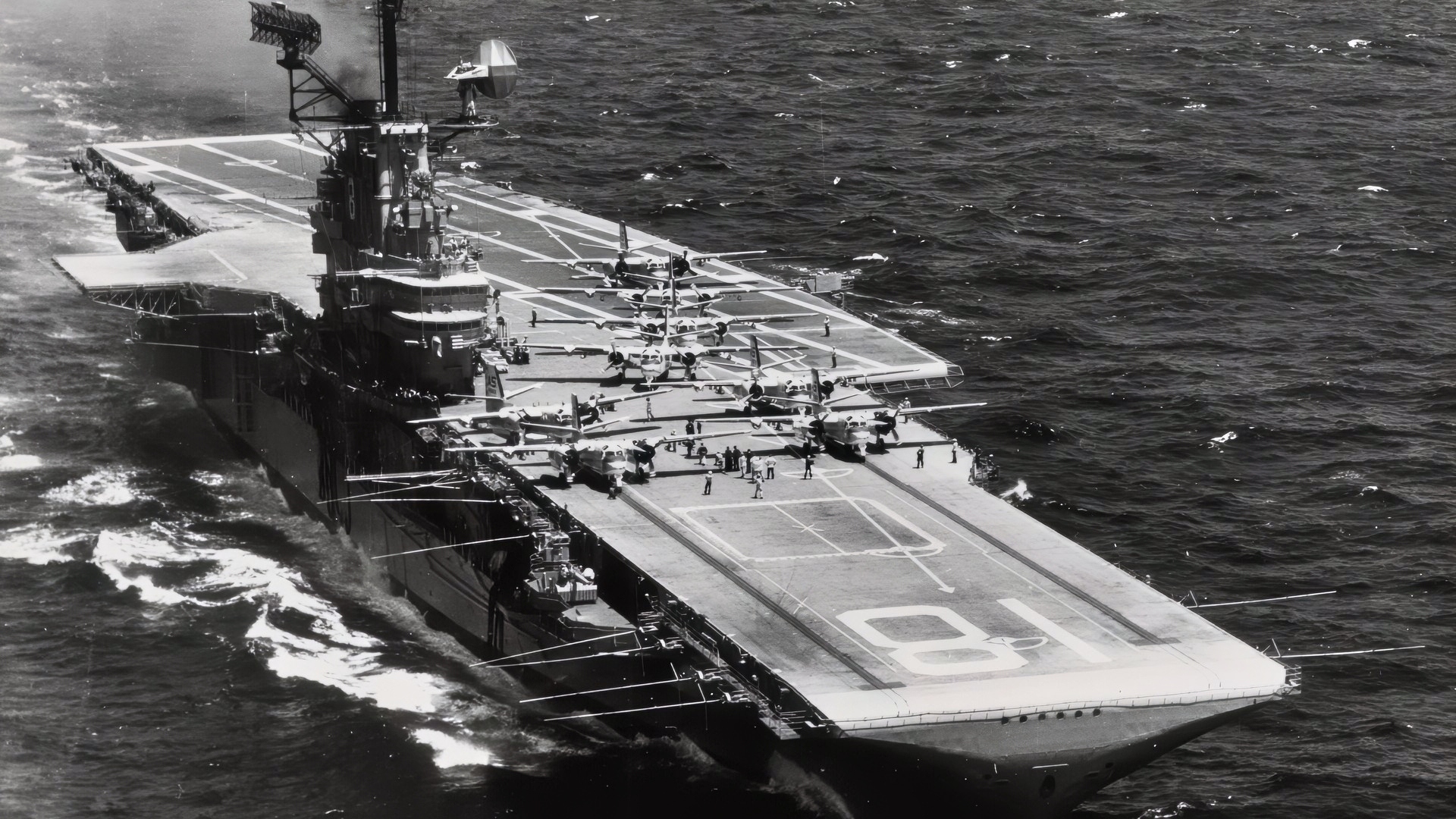
USS Wasp CV-18 Aircraft Carrier Creative Commons.
The intention was for each country to have enough ships to patrol and protect its far-flung interests, while establishing a relative parity that made an offensive war less likely.
These treaties, initially known as the Washington Naval Conference, were renegotiated repeatedly until 1936, with nations joining, leaving, or refusing to sign certain conditions until only the US, the UK, and France remained.
Every other power went right back to building warships as fast as they could.
The US Navy Squeezed The USS Wasp Into Tonnage Limits That Compromised Its Design
The United States’ seventh aircraft carrier, the USS Wasp (CV-7), was a product of that failed naval arms treaty. Under the treaty’s limits, the US could build and maintain a fleet of aircraft carriers with a total tonnage of 135,000.
The massive, armored carriers USS Lexington (CV-2) and USS Saratoga (CV-3) consumed 66,000 tons of that allotment.
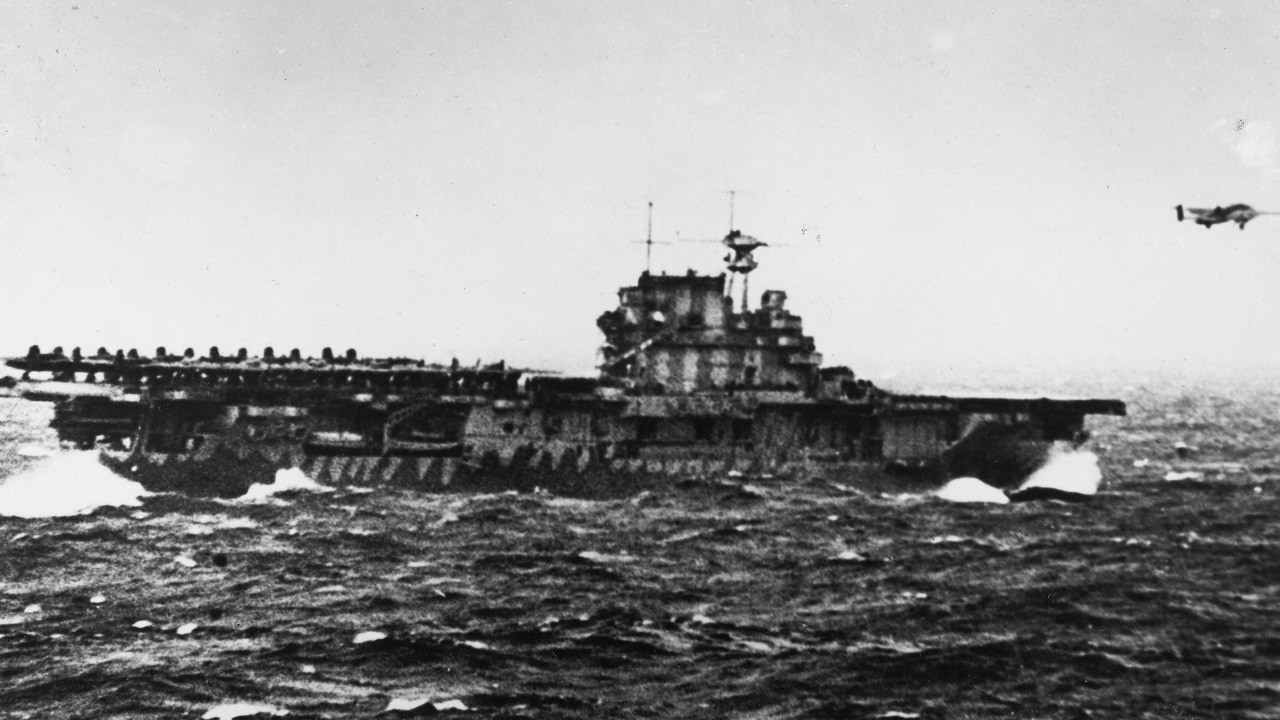
USS Wasp was hit by one Japan’s Long Lance Torpedo. Creative Commons Image.
The Navy intended to use the remaining 69,000 tons to build 5 more light aircraft carriers at 14,500 tons each. Within the Navy, two competing philosophies shaped aircraft carrier design.
One favored large, heavily armored carriers with multi-purpose air wings as offensive strike platforms.
The other wanted to keep carriers as light scouting elements, the eyes of a line of battle ships, cruisers, and destroyers seeking a main fleet engagement.
Both views had merit.
In wargames, the Navy learned to expect heavy attrition to both aircraft and carriers, so several smaller carriers made more sense than one or two large ones.
The first of these small carriers was the USS Ranger (CV-4), displacing 14,500 tons.
The USS Ranger Should Have Taught The Navy Something About The Limitations Of Small Carriers
When the Ranger put out to sea, the problems with the small-carrier idea became apparent.
Her speed topped out at 29 knots, making her too slow to operate with the big fleet carriers.
As she took on fuel and aircraft, she slowed even more.
Ranger’s armor was described as mostly “moral support,” and her lack of torpedo protection made her a sitting duck for submarines.
When Ranger was designed, naval carrier aircraft were still biplanes; now, with bigger, heavier, and faster monoplane designs in the fleet, it was clear that aircraft carriers needed to be larger, faster, better protected, and equipped with island structures that could direct their air groups.
The Navy abandoned the Ranger-class and put its design money into three 19,000-ton Yorktown-class carriers, which addressed all the Ranger’s deficits.
The Navy looked again at the tonnage it had left under the treaty and found it had 14,500 tons left to build another aircraft carrier. So, it decided to build another light carrier.
This time, Navy designers believed it could cram a full complement of aircraft onto the Wasp, which was only 75% as large as a Yorktown-class carrier.
To pull this off, they would have to make major design compromises.
This was the origin of the USS Wasp (CV-7), and it proved that some compromises are better left unmade for aircraft carriers.
The USS Wasp Was a Stripped-Out Yorktown-class Carrier
Wasp was basically a Yorktown-class carrier trimmed by 5,000 tons.
That weight reduction was realized at the expense of armor protection.
On Wasp, the armor was thinned out everywhere.
While the Yorktown and Lexington carriers had armor protection for magazines and machinery spaces, Wasp would have none.
Yorktown featured a triple-hull, triple-bottom design, making it very resistant to catastrophic torpedo damage.
Wasp had a single hull with no torpedo protection, and not even the speed to evade one.
Because the Wasp was 5,000 lighter, her propulsion plant was reduced to 75,000 ship, versus Yorktown’s 120,000 shp steam turbines.
When WWII started, the Navy could not increase Wasp’s armor protection without also reducing her speed, which was vital to a carrier’s ability to launch aircraft.
When the Wasp went to sea in June 1940, the same problems inherent in the Ranger resurfaced.
Wasp was nearly 4 knots slower than Yorktown and could not serve effectively with the big fleet carriers in the Pacific, which could move only as fast as the slowest ship in the task force.
Her lack of armor and structural weakness made her a liability in a potential carrier battle with the Japanese.
The decision was made to keep Wasp operating off the US East Coast, as the Ranger was also deemed incapable of combat operations in the Pacific.
In the opening months of WWII, the Wasp served well in the Atlantic and Mediterranean, escorting convoys and even delivering British Spitfires to Malta.
Then the carrier battles of 1942 occurred at the Coral Sea and Midway, and the loss of two fleet carriers, the Lexington and Yorktown.
That left just 3 aircraft carriers in the Pacific; the Navy planned landings on Guadalcanal on August 7th, 1942.
The Wasp would have to go to the Pacific.
Desperation Sends USS Wasp To Her Doom
Almost as soon as she arrived, her engines began to fail.
The starboard turbine began to fail, reducing speed to 15 kts until repairs were made on Tonga Island.
Wasp could not make her full speed of 29 knots but could manage 27, 5 kts slower than the Enterprise and the new Hornet, but it would have to do.
Wasp was present at Guadalcanal for the invasion on August 7th, 1942, and continued to conduct air operations in support of the campaign.
The meat grinder of the larger Solomons Campaign had begun, and casualties among US aircraft carriers began to mount.
On August 24th, 1942, USS Enterprise (CV-6) was damaged by 3 bombs and had to return to port for extensive repairs.

The U.S. Navy aircraft carrier USS Enterprise (CV-6) underway off Pearl Harbor, Hawaii, on 2 August 1944. She is painted in Camouflage Measure 33 Design 4Ab.
A week later, the carrier USS Saratoga (CV-3) was torpedoed by a Japanese submarine and had to be towed to Pearl Harbor for repairs.
For at least several weeks, Wasp and USS Hornet (CV-8) would be the last two US carriers in the Pacific.
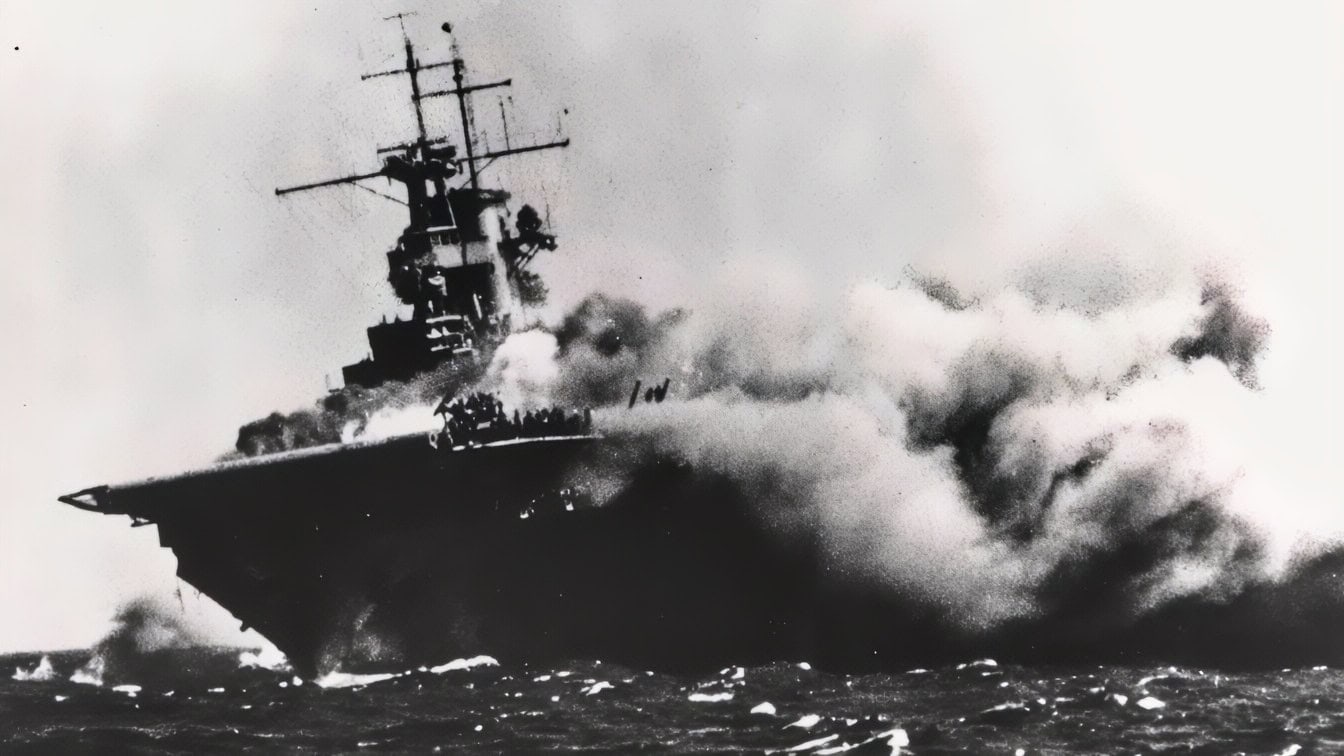
On September 14, 1942, all the compromises made to build the Wasp came to a head.
Wasp and Hornet were escorting a troop convoy to Guadalcanal.
At dawn, Wasp had planes on deck being armed and fueled to replace combat air and anti-submarine patrols already in the air.
The Japanese submarine I-19 launched a spread of 6 torpedoes at the Wasp.
After an alert lookout spotted their wakes, Wasp turned to evade them.
It didn’t work.
Wasp was fatally struck by two torpedoes (There is a dispute over whether a third also hit the Wasp). Another hit the battleship North Carolina; another still hit the destroyer, O’Brien.
Design Compromises crushed USS Wasp
Without any torpedo protection, the two torpedoes did maximum damage to the carrier.
Explosions began rocking the ship forward, and numerous fires fed by ruptured aviation fuel lines roared.
The blasts severed Wasp’s firefighting water mains so that they couldn’t fight the fires, and she was flooding.
Her 15-degree list sent a river of burning oil and gasoline into the sea, setting it on fire as well.
Within the hour, gas vapors set off three more large explosions, and her captain decided further firefighting efforts were futile and ordered the crew to abandon ship.
While the Wasp was gutted by fire and explosions, some of her watertight integrity remained, and a U.S. destroyer fired 3 torpedoes into the burning hulk to sink her on September 15th.
In Three Words: Worst Carrier Ever?
Wasp suffered 559 killed and wounded, almost one-third of her crew.
The Navy also learned a few things about trying to make small carriers do the work of a fleet carrier.
While it would build dozens of light carriers and escort carriers for convoy protection and anti-submarine warfare, its fleet carriers would get even larger, with more armor, speed, and torpedo protection.
The Navy would go on to produce 24 Essex-class carriers that were 10,000 tons heavier than Yorktown, 50 feet longer and 10 feet wider.
They also carried more aircraft and were heavily armored, with layers of damage-control systems.
The USS Wasp Is Reborn
One of these new fast Essex-class carriers was to be named USS Oriskany and was laid down in March 1942.
She was commissioned in November 1943, but not as the Oriskany; her name was changed to USS Wasp (CV-18).
A 500 lb. bomb off Okinawa would hit this new Wasp in March 1945.
This time, instead of being consumed by fire, flood, and explosions, Wasp’s damage control parties quickly doused the flames, and Wasp launched and recovered aircraft again within 27 minutes.
About the Author: Sean Spoonts
Sean Spoonts is the former Editor-In-Chief of SOFREP.com. He is a military analyst, writer, and commentator whose work has appeared in Newsweek, CNS News, Ukrinform, and various military/veteran media networks and professional publications, including the Military Intelligence Professional Bulletin. He is a U.S. Navy veteran, having served as an Aviation Anti-Submarine Warfare Operator and Search and Rescue Helicopter Aircrewman.