
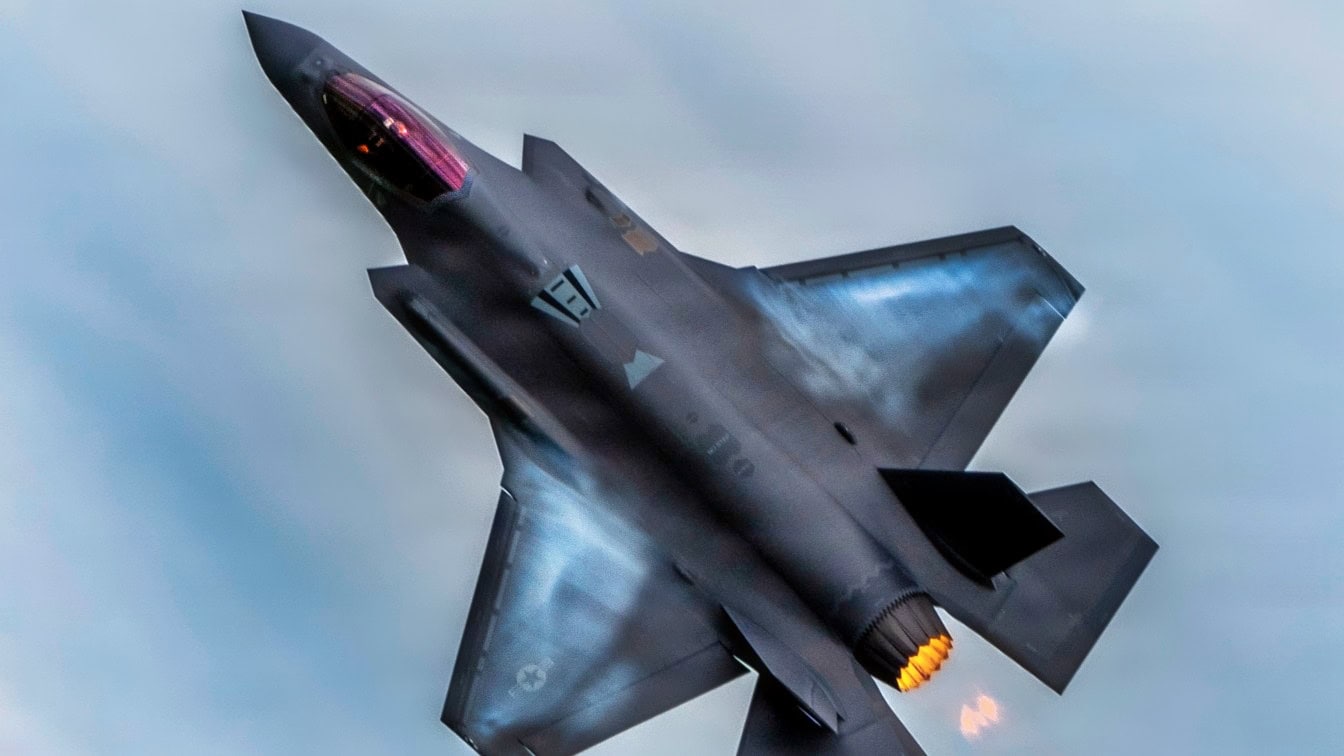
Canada’s fighter debate just hit a wall of people. Retired Lt. Gen. Alain Pelletier, who served as deputy commander of NORAD in Colorado Springs from 2020 to 2023, told the National Post this week that the Royal Canadian Air Force doesn’t have the pilots, technicians, or trainers to stand up a mixed fleet of Lockheed Martin F-35s and Saab JAS 39 Gripen-Es at the same time.
His bottom line was about as blunt as a former Hornet pilot gets. “You cannot duplicate people. You cannot clone people.”
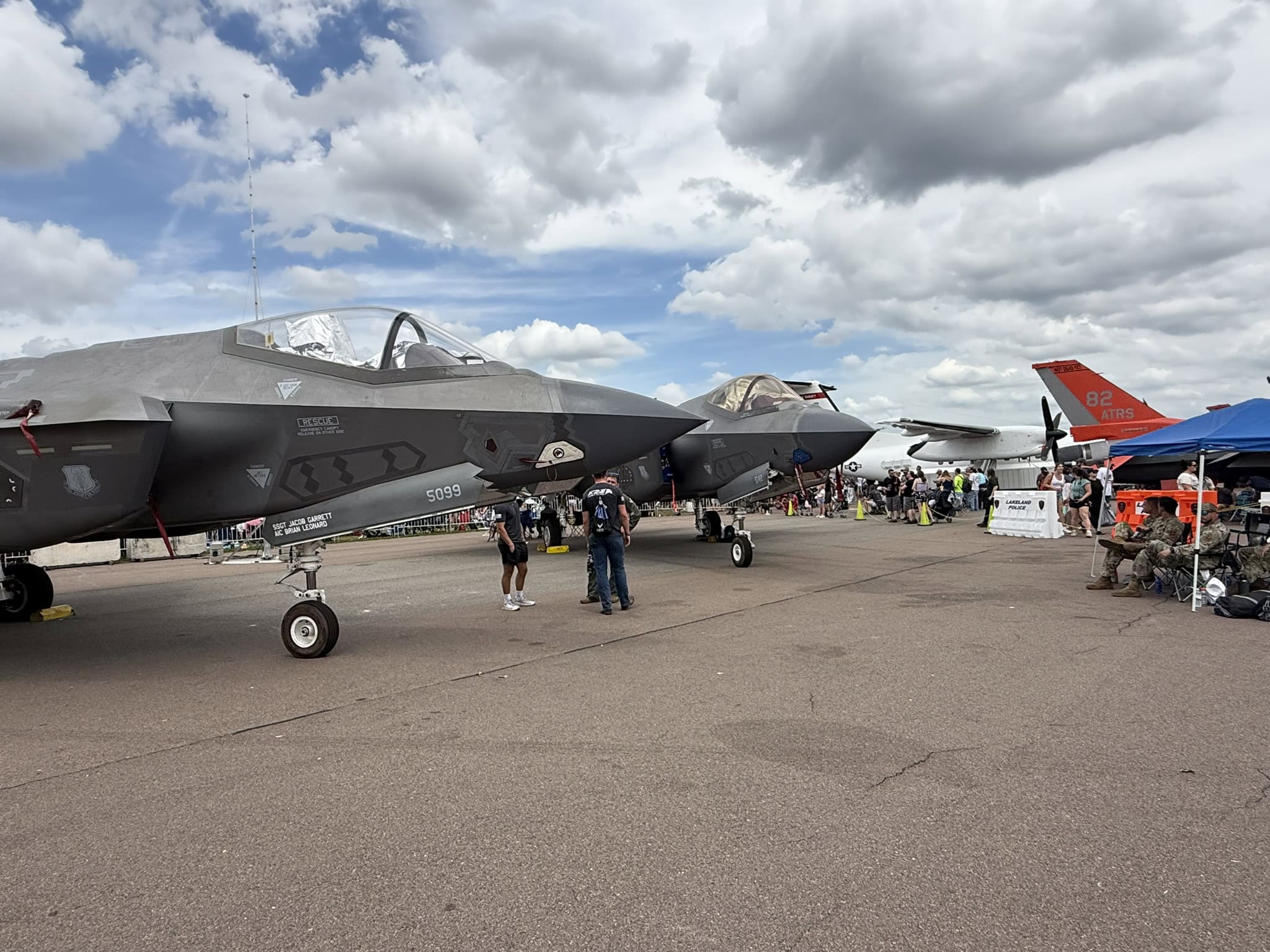
F-35 at Lakeland, Florida Air Show. 19FortyFive Photo.
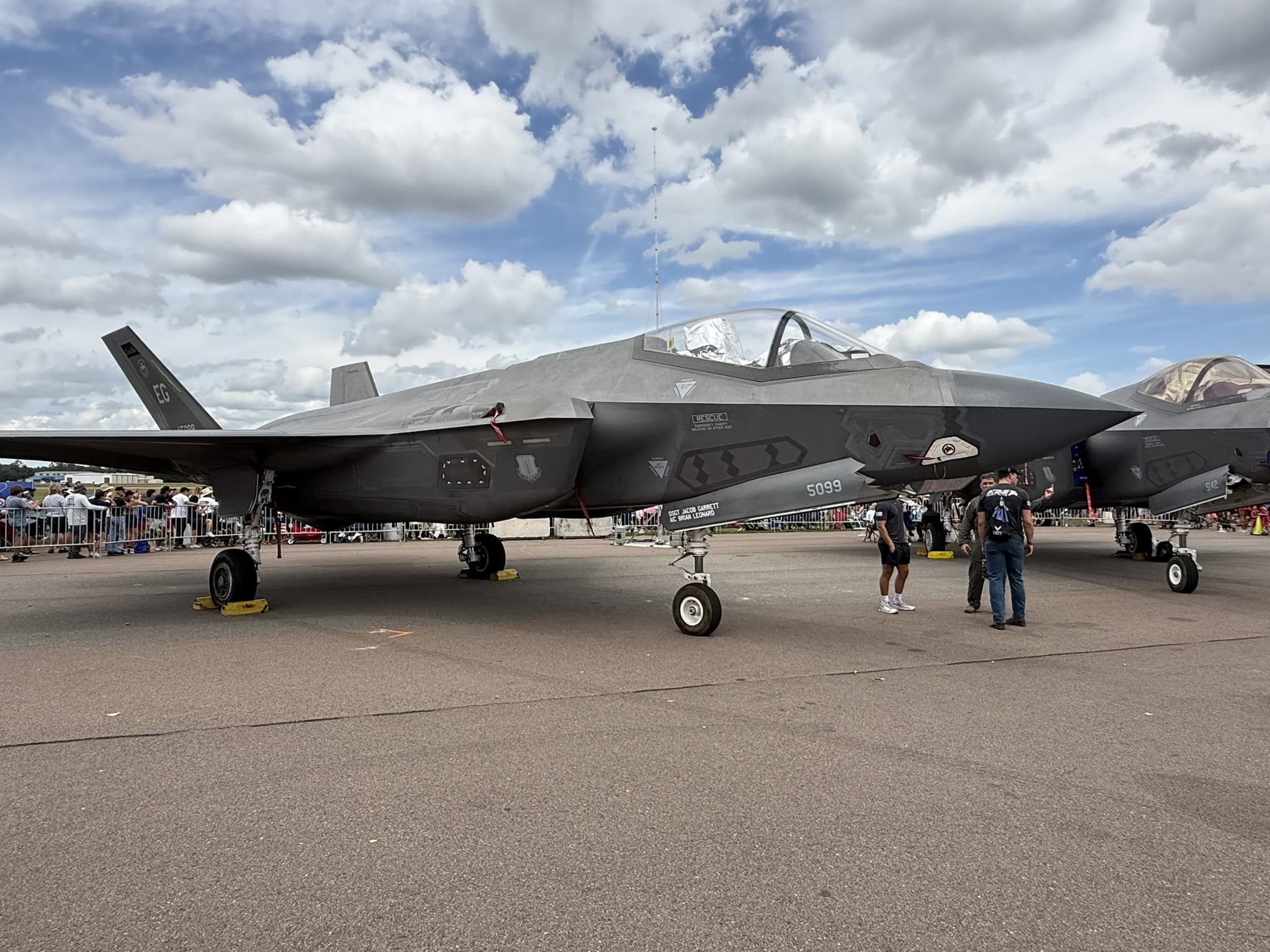
F-35 at Lakeland, Florida Air Show. 19FortyFive Photo.
That’s the whole argument in eight words.
Ottawa Still Hasn’t Made Up Its Mind
The CF-18 Hornets are scheduled to retire in 2032-33. The plan on paper still calls for 88 F-35As.
However, Canada has placed a firm order for only 16 jets and has started paying for critical equipment on 14 more.
Prime Minister Mark Carney ordered a review of the buy in March 2025 as the trade war with Washington heated up, and a year later he was still telling reporters a decision would come “at the right time.” It still hasn’t.
He framed it as looking for alternatives to American-built weapons.
But it was really about thumbing his nose at Trump, whose election platform was the same. The fact that GE makes Saab’s engine for the Gripen is lost in the equation.
Saab has used that vacuum well.
The company has lined up CAE for a domestic training and simulation program, GE Aerospace and Magellan have signed a conditional engine maintenance agreement, and Saab has pitched a Canadian production line that could also produce Gripens bound for Ukraine.
Ottawa is already negotiating with Saab for the GlobalEye airborne surveillance aircraft. The dual-fleet option is very much alive.
Say what you want about the trade war and the politics of buying American right now.
That’s beside the point. The question Pelletier raised is simpler.
Who will fly and fix these airplanes?
The Manpower Math Is The Trade-Off
Transitioning an air force to a new fighter is painful even when you only do it for a single aircraft.
You pull experienced pilots and maintainers off the old jet to convert to the new one, while the old jet still has to hold the NORAD alert.
Pelletier’s point is that Canada would be running two conversions simultaneously.
Two training pipelines, two sets of instructors, two maintenance trades, two supply chains, all built by an air force that is already shorthanded.
He called it a growing pain.
I’d call that generous.
The numbers back him up.
As of February, the RCAF fighter force was at roughly two-thirds of required strength, and the Department of National Defense has flagged the pilot and technician gap as a primary risk to the F-35 program on its own, according to a recent breakdown of the program’s staffing problem.
That’s one fleet. CBC reported last year that only 40 percent of the air force’s inventory was considered serviceable and ready to fight.
In the same report, retired Gen. Tom Lawson, a former chief of the defense staff, said the air force doesn’t want two fighter types because of the enormous cost of separate training and supply systems, hangars, and infrastructure would be enormously expensive.
None of this is new. In 2016, when Ottawa wanted 18 “interim” Super Hornets, two former RCAF commanders warned there wouldn’t be enough pilots to fly them. Retired Lt. Gen. Rod Pennie said the air force lacked the personnel depth to run two fleets without significant growth. Ten years later, same warning, different airplane.
The growth never came.
“Humans Are More Important Than Hardware”
Anyone who came up in Special Forces knows the SOF Truths.
The first is that humans matter more than hardware. Another is that you can’t build competent forces after an emergency.
I’ve always believed that those apply to every high-skill military community, and fighter aviation is the textbook case.
You can sign an airplane contract on Monday.
You can’t sign one for a seasoned four-ship flight lead.
The same goes for the hangar floor.
The avionics tech who knows the F-35’s sensor suite inside and out doesn’t automatically know the Gripen’s. Every specialty gets split in two, and in a small air force, that means every shop gets thinner.
Pelletier also made the operational case for the jet Canada already picked, twice. The F-35 fuses data from its own sensors with feeds from other aircraft, warships, and satellites into one picture, letting a pilot detect a threat before it detects him.
The U.S., the UK, Australia, Denmark, Finland, and Norway all went the same way.
So Why Keep The Gripen Door Open?
It is a fair question. Plenty of air forces run two fighter types, and a second fleet does hedge against political and technical risk. In my opinion, that’s Gripen supporters’ strongest argument, and it isn’t a bad one.
However, as 19FortyFive pointed out this summer, a mixed fleet means two of everything for as long as both jets stay in service. Do it halfway, and you end up with two boutique fleets that add up to less than one. I’ve written about this several times and the math doesn’t get any easier.
The nations that make dual fleets work built the bench first. Canada is proposing to do it the other way around.
Last May, US Ambassador to Canada Pete Hoekstra spoke about NORAD security. “If you buy fighters that don’t integrate with the latest technology and the best airplane in the world, they don’t really count as full airplanes,” Hoekstra said. “They’re capable and all that, but if they don’t link to an F-35, that’s a problem.”
And the mission isn’t waiting. Pelletier noted that Russian aircraft routinely fly up to the edge of North America’s air defense identification zone and parallel it until NORAD reacts.
Chinese aircraft have pushed close to Alaskan airspace during exercises, as they now claim Arctic status. Every one of those intercepts needs a jet on alert, a pilot strapped in, and a crew chief who got the airplane ready.
Canada lacks those people right now.
Ottawa can buy airplanes from Fort Worth or Linköping. It can’t buy the people to fly them from anyone.
Pelletier said it best. You cannot clone people.
About the Author: Steve Balestrieri
Steve Balestrieri is a National Security Columnist. He served as a US Army Special Forces NCO and Warrant Officer. In addition to writing on defense, he covers the NFL for PatsFans.com and is a member of the Pro Football Writers of America (PFWA). His work was regularly featured in many military publications.