
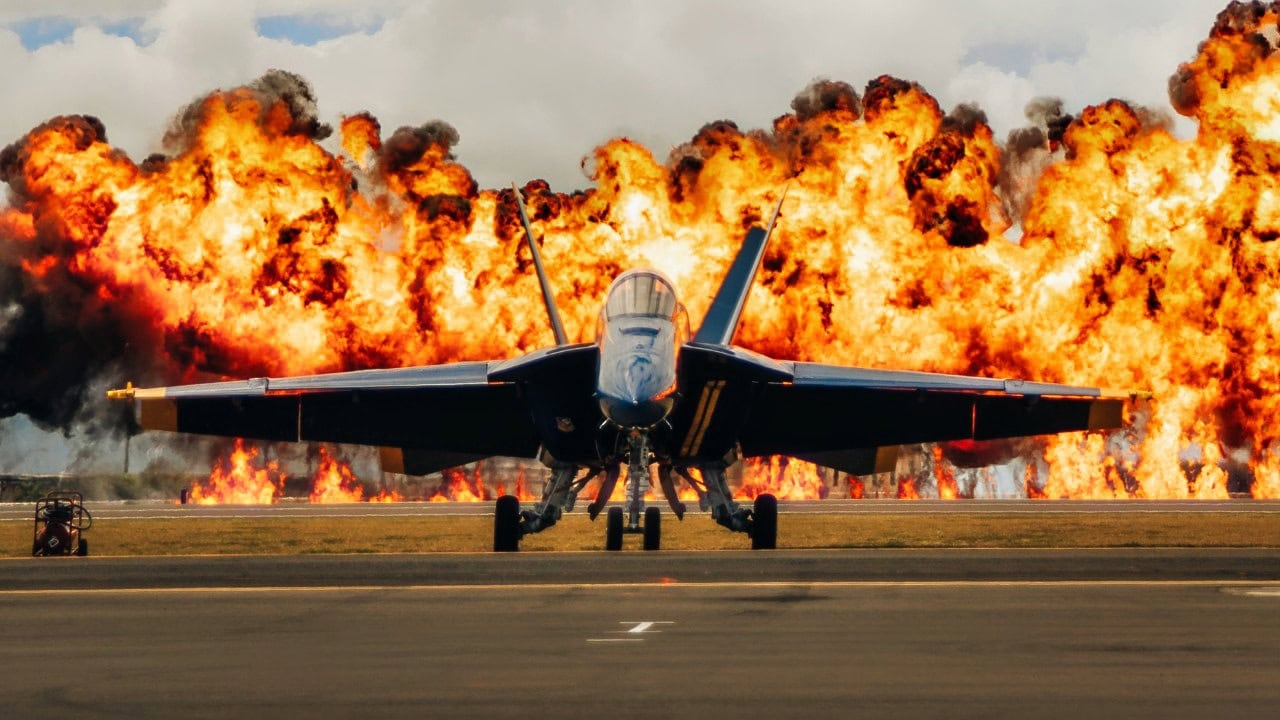
The U.S. Navy Flight Demonstration Squadron, better known as the Blue Angels, is world-famous for good reason, thanks to their aircraft’s distinctive livery of their aircraft and the incredible stunts they perform.
Their current aircraft of choice is Boeing’s F/A-18E/F Super Hornet 4.5 Generation fighter, giving the Super Hornet—or, as her U.S. Navy crews unofficially and affectionately nickname her, the “Rhino”—a boost of real-world fame on top of the fictitious cinematic fame she gained from “Top Gun: Maverick.”
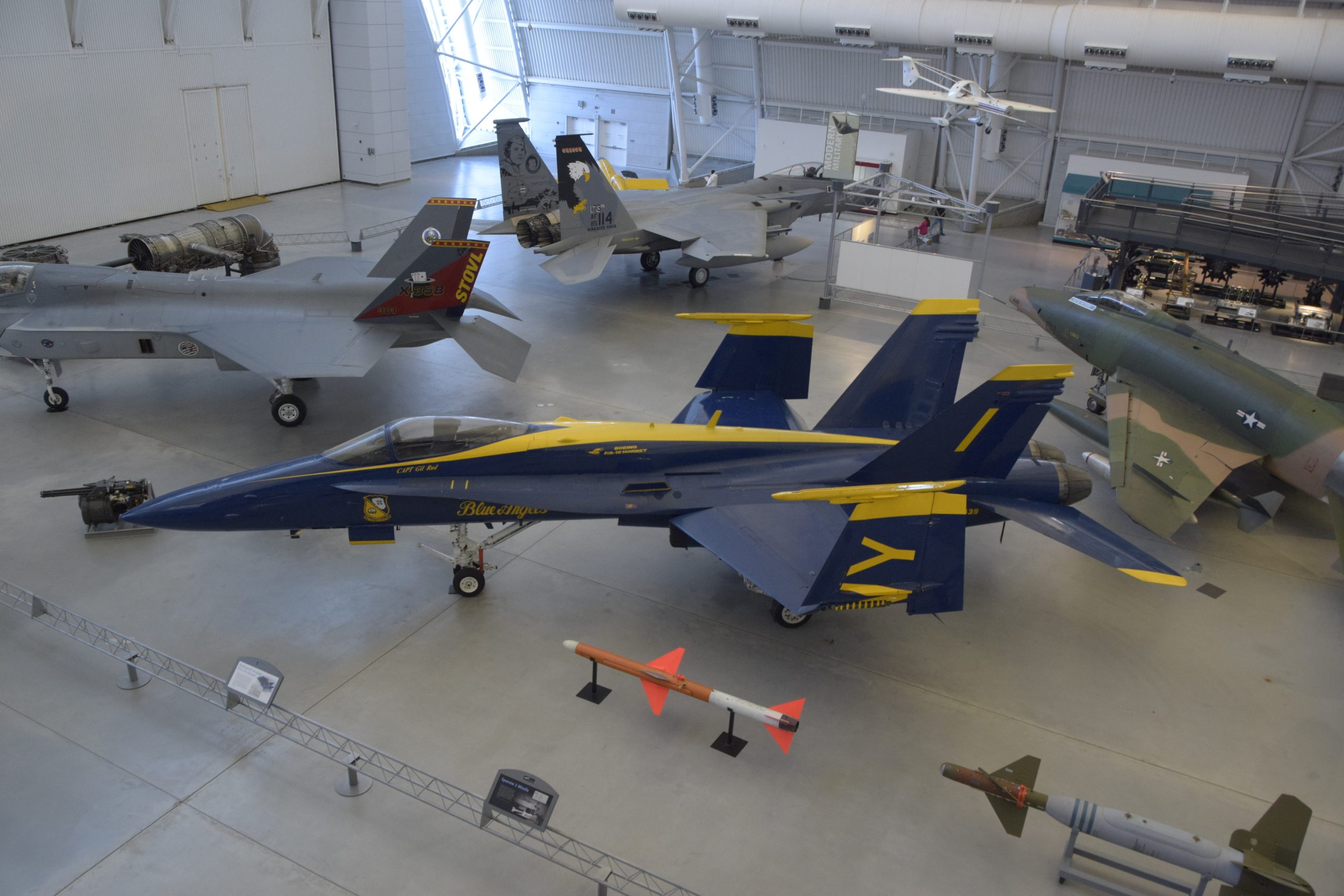
F/A-18 Hornet from the Blue Angels. 19FortyFive Photo from Staff Photo Shoot.
So what kind of Super High Intensity Training do the Blue Angels go through to pull off stunts that wow and amaze the general public at air shows?
By the Numbers
Before we get into some of the specifics of the Blue Angels’ training, let’s look at their workforce numbers to appreciate what an elite, highly selective, and tight-knit community this is.
First of all, the commissioned officers include those who do the actual flying, as well as key support crew on the ground. As noted by the Blue Angels official website, “A total of 17 officers voluntarily serve with the Blue Angels. Each year the team typically selects three tactical (fighter or fighter/attack) jet pilots, two support officers, and one Marine Corps C-130J [“Fat Albert”] pilot to relieve departing members.”
Those support officer roles consist of a maintenance officer, an assistant maintenance officer, a flight surgeon, and a supply officer.
Then there are the enlisted team members, who may not get to go up in the birds or garner any glory, but without whom the “Rhinos” could never safely take off. To cite the official Blue Angels site again, “The Blue Angels’ enlisted maintenance and support team is comprised of approximately 100 Sailors and Marines.
Alternating crews of about 45 team members travel to each show site. All career-oriented enlisted Sailor or Marine applicants come recommended for Blue Angels duty by their current commanding officer.
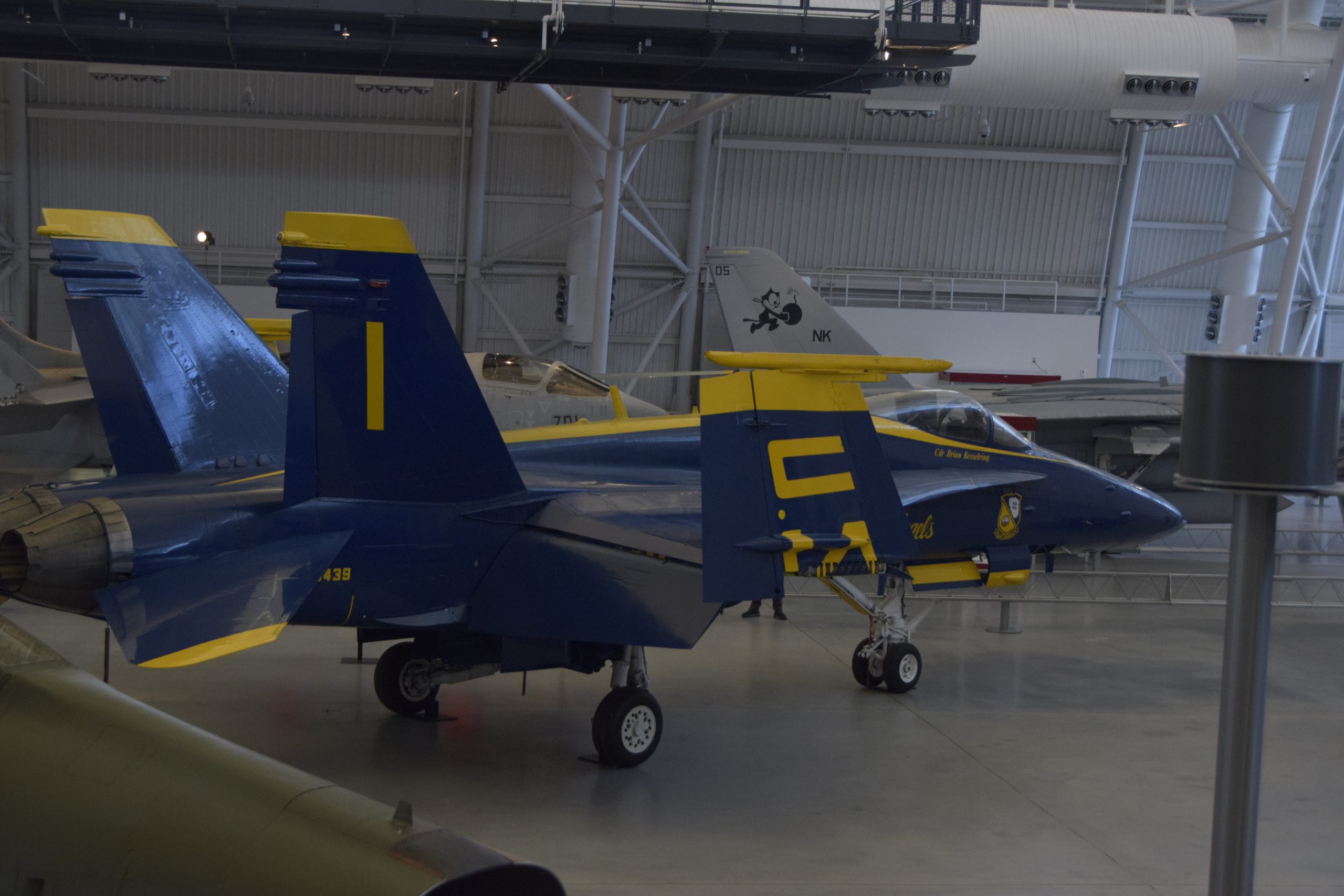
F/A-18 Hornet from the Blue Angels. 19FortyFive Photo from Staff Photo Shoot.
Applicants go through extensive screening, including interviewing with the members of each of the 15 squadron work centers.”
If they make the final cut, commissioned officers on the Blue Angels team generally serve two to three years, while enlisted sailors serve three to four years; afterward, they return to the fleet.
Training Locations and Time Commitment
The majority of the training—March through October, with practice demonstrations held on Tuesdays and Wednesdays—is conducted at the Angels’ home facility, Naval Air Station (NAS) Pensacola, on the northwest “Panhandle” of Florida; this is the same base where the excellent National Naval Aviation Museum is located. Meanwhile, Naval Air Facility (NAF) El Centro, located in the heart of Southern California’s Imperial Valley, serves as the winter training site.
Their practice sessions typically last for about 2-3 hours a day, five days a week. However, during peak season, these sessions can stretch to 6-7 hours a day. Typically, a Blue Angels aviator undergoes 18 months to three years of training.
Blue Angels Training Maneuver Type #1: “High Show”
The 2026 Blue Angels Maneuvers Manual divides its training maneuvers into three categories: High Show, Low Show, and Flat Show.
The highest-altitude stunt is the vertical roll, performed by the Opposing Solo up to 15,000 feet, and the lowest is the Sneak Pass, performed by the Lead Solo as low as 50 feet.
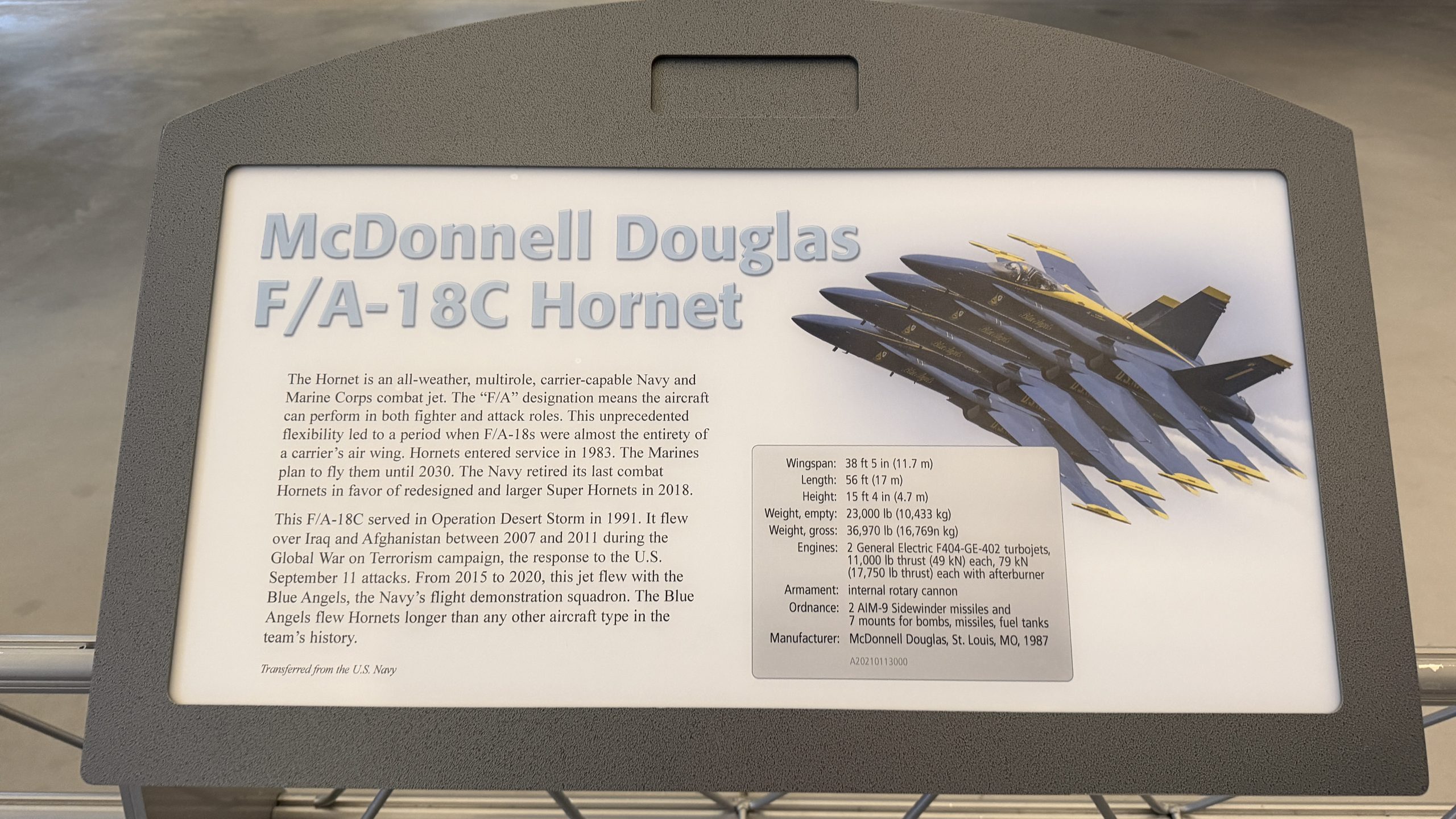
F/A-18 Hornet from the Blue Angels. 19FortyFive Photo from Staff Photo Shoot.
For the High Show category alone, there are 44 different stunt maneuvers listed, and spatial limitations prevent us from describing all of them in full detail here. Hey, c’mon, give us a break; our publication isn’t a big honkin’ Tom Clancy novel after all!
To narrow it down to just one High Show example, one whose name caught this writer’s eye is “Diamond Half-Cuban Eight,” which calls for a minimum altitude of 0 feet AGL (above ground level), a maximum altitude of 9500 feet AGL, an entry airspeed of 0 knots, and an exit airspeed of 380 knots: “If the clouds are biased to crowd left to the point that a Half-Cuban 8 can be accomplished but the backside loop cannot, then a Half-Cuban 8 Break Out can be done.
As the formation passes through the horizon at approximately 500′ AGL, they will split in three separate directions. 1 and 4 will exit out the show line, while 2 and 3 will egress 90° in front of and behind the crowd, respectively. The rendezvous will be conducted crowd left.”
If you, dear readers, are having trouble visualizing that aviator-speak, turn to page 2-11 of the hyperlinked Maneuvers Manual for the diagram; a picture is worth 1,000 words, right?
Blue Angels Training Maneuver Type #2: Low Show
This category lists only 32 such maneuvers. The deadliest-sounding nickname belongs to the Opposing Knife Edge. Pictured on p. 2-16, this maneuver calls for a minimum altitude of 100 feet AGL, a maximum altitude of 1,500 feet AGL, with both entry and exit airspeed set for 400 knots: “At CP [control point], each pilot will roll his aircraft into a 90° angle of bank before the cross. After the cross, both aircraft will roll upright and clear in front of the crowd.”
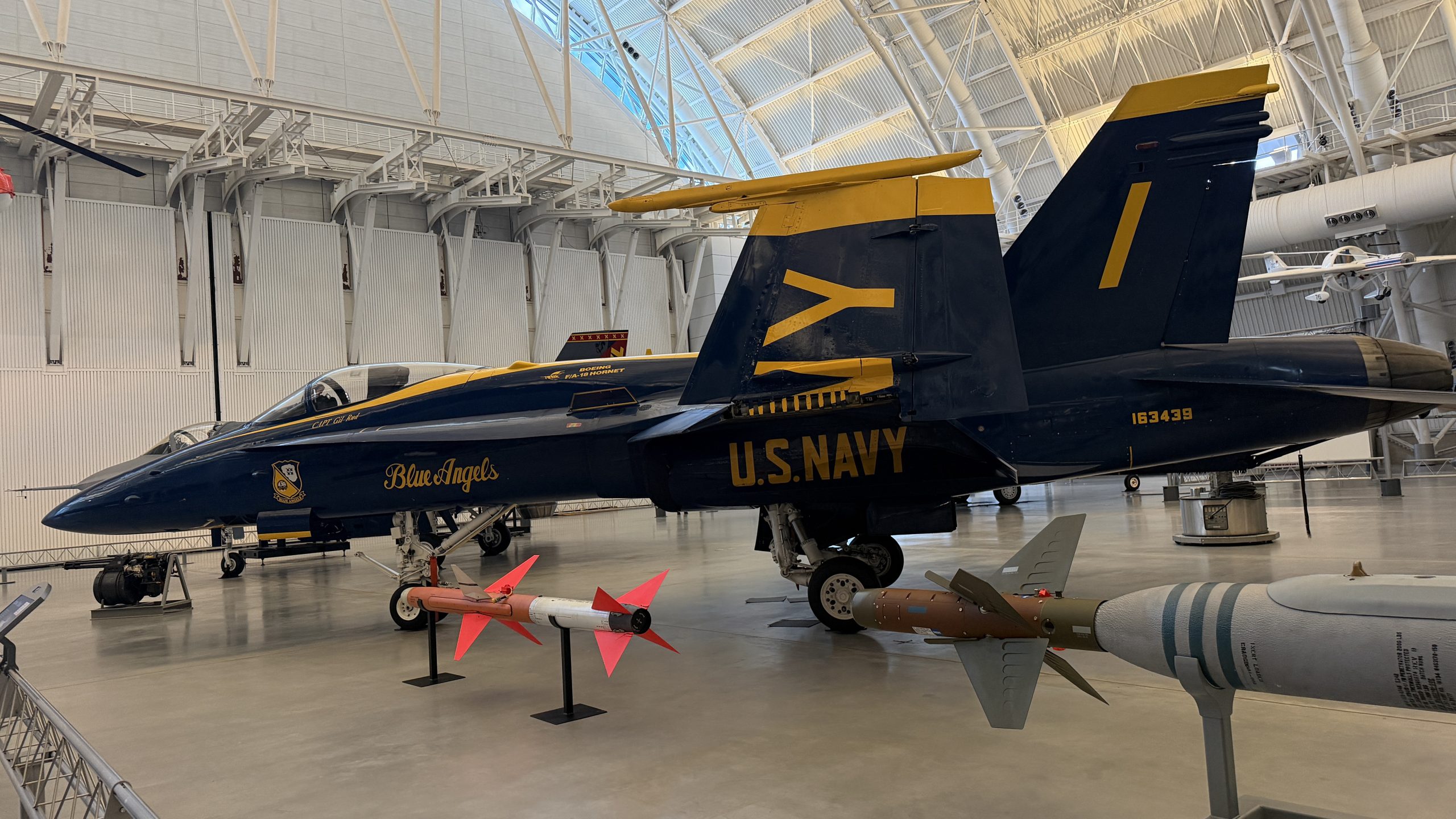
F/A-18 Hornet from the Blue Angels. 19FortyFive Photo from Staff Photo Shoot.
Blue Angels Training Maneuver Type #3: Flat Show
29 such options here. One, listed on p. 3-5, stands out due to its paradoxical name of “Dirty Clean Flat Pass”: “In the Diamond formation, all four aircraft will execute a flat pass down show line with the landing gear and hooks extended. Meanwhile, #6 will overtake the diamond as it approaches the center point. #6 will then climb to 1000’ AGL and execute a right-hand turn to clear behind the crowd.”
This maneuver calls for a minimum and maximum altitude of 200 feet AGL, with both entry and exit airspeeds set for 240/500 knots.
NOTE: Thanks to the author for the great photos from the Smithsonian included in this piece.
Christian D. Orr, Defense Expert
Christian D. Orr is a Senior Defense Editor. He is a former Air Force Security Forces officer, Federal law enforcement officer, and private military contractor (with assignments worked in Iraq, the United Arab Emirates, Kosovo, Japan, Germany, and the Pentagon). Chris holds a B.A. in International Relations from the University of Southern California (USC) and an M.A. in Intelligence Studies (with a concentration in Terrorism Studies) from American Military University (AMU). He is also the author of “Five Decades of a Fabulous Firearm: Celebrating the 50th Anniversary of the Beretta 92 Pistol Series,” whose second edition was recently published.