
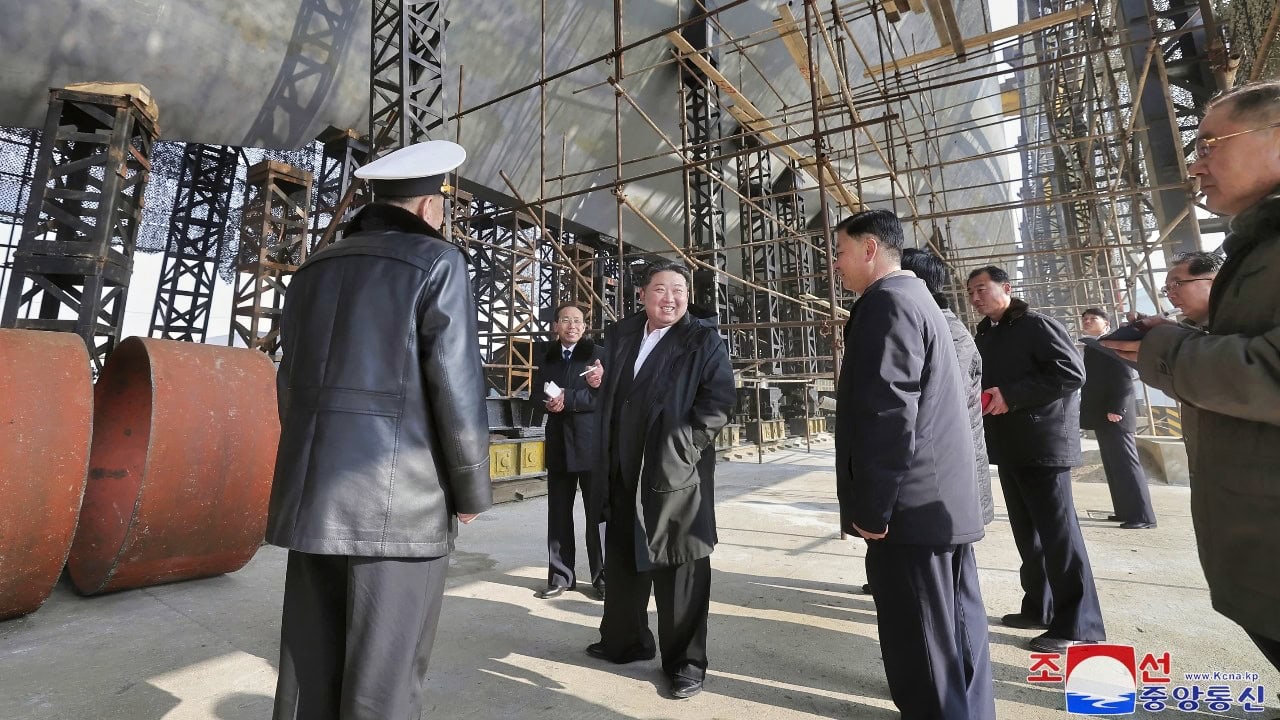
It looks like North Korea is building a nuclear-powered submarine. Two days ago, North Korean state media announced the project, showing Supreme Leader Kim Jong-un inspecting the still-under-construction hull of the new boat. If successful, the project will give Pyongyang a new tool for antagonizing its neighbors and for creating doubt and uncertainty in the minds of Japanese, South Korean, and American military planners.
North Korea’s Nuclear Powered Submarine: Not Impressive?
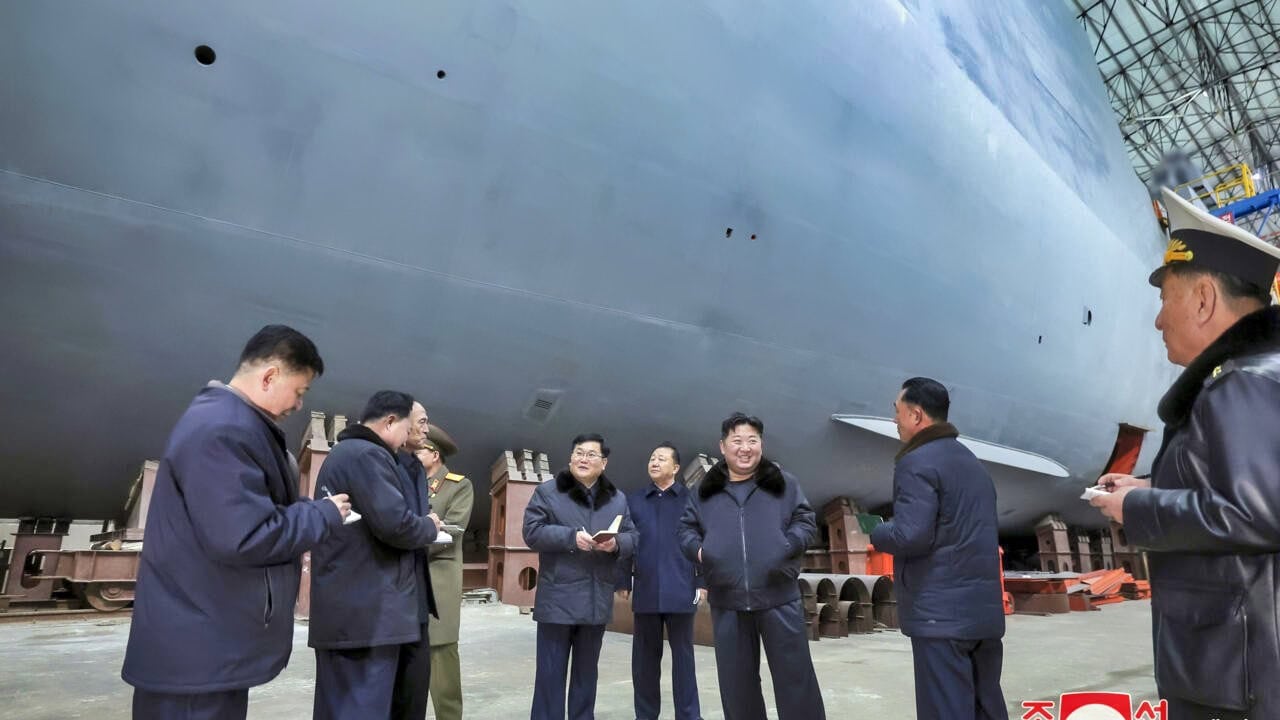
North Korea Submarine KCNA Media Photo.
Nuclear propulsion is an impressive industrial feat, especially for a small and poor country like North Korea, but it isn’t exactly cutting edge.
The United States commissioned USS Nautilus, the world’s first operational nuclear powered submarine, in 1954. The first Soviet nuclear submarine entered service in 1959, followed by the British in 1962, the French in 1971, and the Chinese in 1974.
Mastering technology that China developed fifty years ago is an achievement, but it should not be regarded as a stunning technological feat.
Nor is North Korea new to the idea of using a submarine to launch nuclear-capable ballistic missiles, a feat it achieved in 2016 and built upon in 2023 with a bizarrely modified post-Soviet diesel-electric sub.
The Mystery North Korean Missile Submarine
We know very little of the technical characteristics of North Korea’s new boat. Still, we should assume that it is being constructed to provide for a more effective nuclear deterrent.
Based on images from North Korean television, one South Korean military analysts suggested that the boat could displace some 7,000 tons and carry perhaps ten missiles, putting it on the smaller side of global SSBN fleets. North Korea has some experience building submarines, but nothing with this degree of sophistication or size.
In other words, North Korea is building a boomer in order to shore up its capacity to survive a nuclear or conventional first strike. Less reliant than a conventional submarine on access to friendly bases, a North Korean boomer could theoretically operate independently at some distance from its home port, complicating the problems of targeting and crisis response.
North Korea is generally not regarded as having a survivable second strike capability, in part because of the small size of its arsenal, and in part because of perceived inadequacies in its system of command and control. The new nuclear boat will not resolve the second problem, but it takes steps towards managing the first.
A Waste of Resources for North Korea?
Analysts are mixed on whether the boat will actually contribute to North Korea’s military capabilities.
Nuclear submarines are complicated beasts that require considerable training and careful handling, and when mistakes happen, they can sink in dramatic ways.
To be sure, any North Korean boomer that leaves port will immediately come under the scrutiny of surveillance of the Japanese, South Korean, and American naval and air forces (assuming that the United States does not detach itself from its alliance obligations in Northeast Asia).
Command and control will be especially tricky. During the Cold War, the leadership of the Soviet Union worried constantly about the dangers of delegating responsibility over the use of nuclear weapons to submarine commanders. Likely, the clique of gangsters that forms Kim Jong-un’s inner circle will have the same kinds of concerns about the DPRK’s submarine commanders, especially if the latter enjoy the freedom implicit to a nuclear submarine which can travel long distances without the need to return to base.
Did Russia Help Build This Submarine?
We don’t yet know the extent of Russian support for this project, but given the close security relationship that has developed between Russia and the DPRK, it is difficult to dismiss the likelihood of collaboration.
Russian design, technical assistance, and material assistance could easily accelerate the North Korean program and provide for a more secure, reliable warship. Given that North Korean soldiers are currently dying in service of the Russian war effort in Ukraine, it is probably safe to assume that Russians are supporting Pyongyang’s submarine construction efforts.
A Patchwork of Nuclear Detterrence
No part of the North Korean nuclear arsenal is secure, exactly. This submarine (and any sisters that North Korea decides to build) will be part of a patchwork of deterrence intended to create uncertainty on the part of South Korean, Japanese, and American decision-makers in a period of crisis.
It is doubtful that any of the three will struggle to track the North Korean boat or, in case of war, destroy her. Nonetheless, she is intended to give North Korean leadership options in a time of crisis, representing a new tool to generate doubt in the minds of allied leadership.
North Korea is getting paid for its commitment to Russia’s war in Ukraine, and it’s turning that payment into a new nuclear toy for Kim Jong-un.
About the Author: Dr. Robert Farley, University of Kentucky
Dr. Robert Farley has taught security and diplomacy courses at the Patterson School since 2005. He received his BS from the University of Oregon in 1997, and his Ph. D. from the University of Washington in 2004. Dr. Farley is the author of Grounded: The Case for Abolishing the United States Air Force (University Press of Kentucky, 2014), the Battleship Book (Wildside, 2016), Patents for Power: Intellectual Property Law and the Diffusion of Military Technology (University of Chicago, 2020), and most recently Waging War with Gold: National Security and the Finance Domain Across the Ages (Lynne Rienner, 2023). He has contributed extensively to a number of journals and magazines, including the National Interest, the Diplomat: APAC, World Politics Review, and the American Prospect. Dr. Farley is also a founder and senior editor of Lawyers, Guns and Money.