
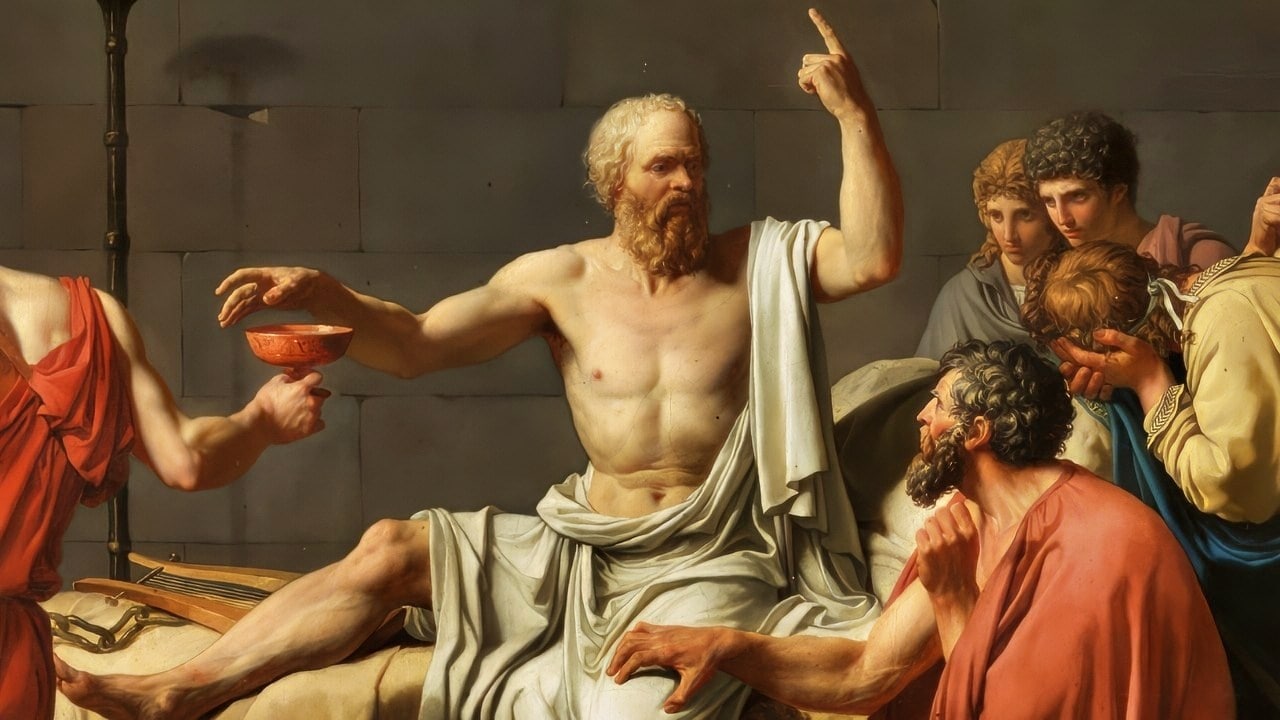
Summary and Key Points – A quote attributed to Socrates frames war as a fundamentally material pursuit, tied to money, appetite, and the temptation to build a life around indulgence rather than virtue.
-That argument fits within a wider Socratic worldview: the good life is disciplined, ordered, and focused on the soul, not status or wealth.
-Despite his reputation as a detached thinker, Socrates also served as a hoplite during the Peloponnesian War, enduring hardship and earning a reputation for composure and courage.
-His method—relentless questioning to expose contradictions—fed a moral mission that ultimately collided with Athenian politics, ending in trial, conviction, and death.
“All Wars Are Fought for Money”: Socrates Had a Warning Modern America Still Ignores
“All wars are fought for money,” – Socrates says in Plato’s Phaedo.
His point in saying this is part of a larger argument that the good life should not be pursued for money. Wars are fought for the sake of money, and money is required for the indulgence of one’s base passions, which are the antithesis of what Socrates considered a well-ordered life. Despite his fame as a philosopher, Socrates served as a soldier, participating in numerous campaigns during the Peloponnesian War.
Early Life and Background
The vast majority of historical information we have about Socrates comes from Plato’s writings, as Socrates himself never wrote anything. He was born around 469 BCE in or near Athens, likely in the deme of Alopece. His father, Sophroniscus, worked as a stonemason or sculptor, while his mother, Phaenarete, practiced midwifery.
These modest origins distinguished Socrates from many wealthy or aristocratic Athenians and influenced his view that wisdom and virtue were not dependent on social class or material success.
Very little is known about his formal education, though it is reasonable to assume that he received the standard Athenian training in music, poetry, gymnastics, and basic literacy. Ancient accounts suggest that he may have initially learned his father’s trade, but eventually abandoned manual labor to devote himself entirely to philosophical inquiry.
Socrates lived simply, owning little and often going barefoot, a lifestyle that coincided with his belief that concern for the soul should take precedence over material possessions.
Military Service and Civic Duty
Despite his dedication to, Socrates fulfilled his civic obligations. He served as a hoplite in the Athenian army during several campaigns in the Peloponnesian War, including the battles of Potidaea, Delium, and Amphipolis. Accounts preserved by Plato describe Socrates as unusually disciplined, capable of enduring hunger, cold, and physical hardship with remarkable composure (although little else is available on his military exploits beyond these short descriptions). He was also known for his courage, particularly at Potidaea, where he reportedly saved the life of the young nobleman Alcibiades.
These experiences contributed significantly to Socrates’ reputation. They demonstrated that his philosophical questioning did not stem from cowardice or disengagement from public life. Instead, he combined military service with an unwavering commitment to ethical reflection, reinforcing his conviction that virtue must be practiced, not merely discussed.
The Philosophical Mission
According to tradition, Socrates’ lifelong philosophical mission began with a statement from the Oracle at Delphi. When a friend of Socrates asked the oracle whether anyone was wiser than Socrates, the oracle replied that no one was.
Socrates was deeply troubled by this response because he believed he possessed no exceptional wisdom. In attempting to understand the oracle’s meaning, he began questioning those reputed to be wise, including politicians, poets, and craftsmen.
Through these investigations, Socrates discovered that while many people possessed technical skill or practical expertise, he was disappointed to find that they possessed little in the way of true wisdom. He concluded that the oracle’s message lay in his awareness of his own ignorance. Unlike others, Socrates did not claim knowledge he did not have. This recognition became the cornerstone of his philosophical identity.
The Socratic Method
Socrates is best known for the conversational approach that came to be called the Socratic method. Rather than lecturing or offering doctrinal answers, he engaged individuals in dialogue, asking a series of carefully constructed questions. These conversations often began with a simple inquiry such as “What is justice?” or “What is virtue?” As the discussion progressed, contradictions and inconsistencies in the interlocutor’s answers were revealed.
The goal of this process was not humiliation (though it often seems that way thanks to his somewhat brash personality), but intellectual awakening. By exposing false confidence and unexamined assumptions, Socrates aimed to bring his conversation partners into a state of productive confusion, known as aporia. From this state, genuine inquiry and self-knowledge could begin. Socrates likened himself to a gadfly, stinging the complacent horse of the Athenian state into alertness and reflection.
Ethical Philosophy
Although Socrates never wrote down his ideas, several core ethical principles consistently appear in Plato’s accounts of him. Central among these is the belief that virtue is a form of knowledge and that wrongdoing results from ignorance rather than deliberate evil.
Socrates argued that if a person truly understood what was good, they would necessarily act accordingly. This led to his claim that no one willingly does wrong.
Equally important was his emphasis on care of the soul. Socrates urged his fellow citizens to prioritize moral integrity over wealth, fame, or political power. He believed that true happiness arose not from external success but from living a just and examined life.
His famous assertion that the unexamined life is not worth living captured this conviction and remains one of the most enduring ideas in the history of philosophy.
Trial and Confederation
In 399 BCE, Socrates was brought to trial on charges of impiety and corrupting the youth of Athens. It is here that historical context ought to be considered. Athens had recently suffered defeat and political upheaval, and several figures associated with Socrates had played controversial roles in past regimes.
At his trial, Socrates refused to abandon his philosophical mission or appeal for sympathy.
As Plato recounts in the Apology, he defended himself by arguing that he served Athens by encouraging moral reflection and intellectual honesty. When convicted by a narrow margin, he was allowed to propose an alternative punishment.
He did so with characteristic irony, suggesting that he deserved free meals for life given his service to the city. This response angered the jury, leading to a death sentence by hemlock.
Socrates spent his final days in prison, continuing philosophical conversations with his friends. He calmly discussed death and the immortality of the soul, expressing confidence that no harm could come to a good person, either in life or after death.
When the time came, he drank the poison without resistance, urging his companions to remain composed.
About the Author: Isaac Seitz
Isaac Seitz, a Defense Columnist, graduated from Patrick Henry College’s Strategic Intelligence and National Security program. He has also studied Russian at Middlebury Language Schools and has worked as an intelligence Analyst in the private sector.