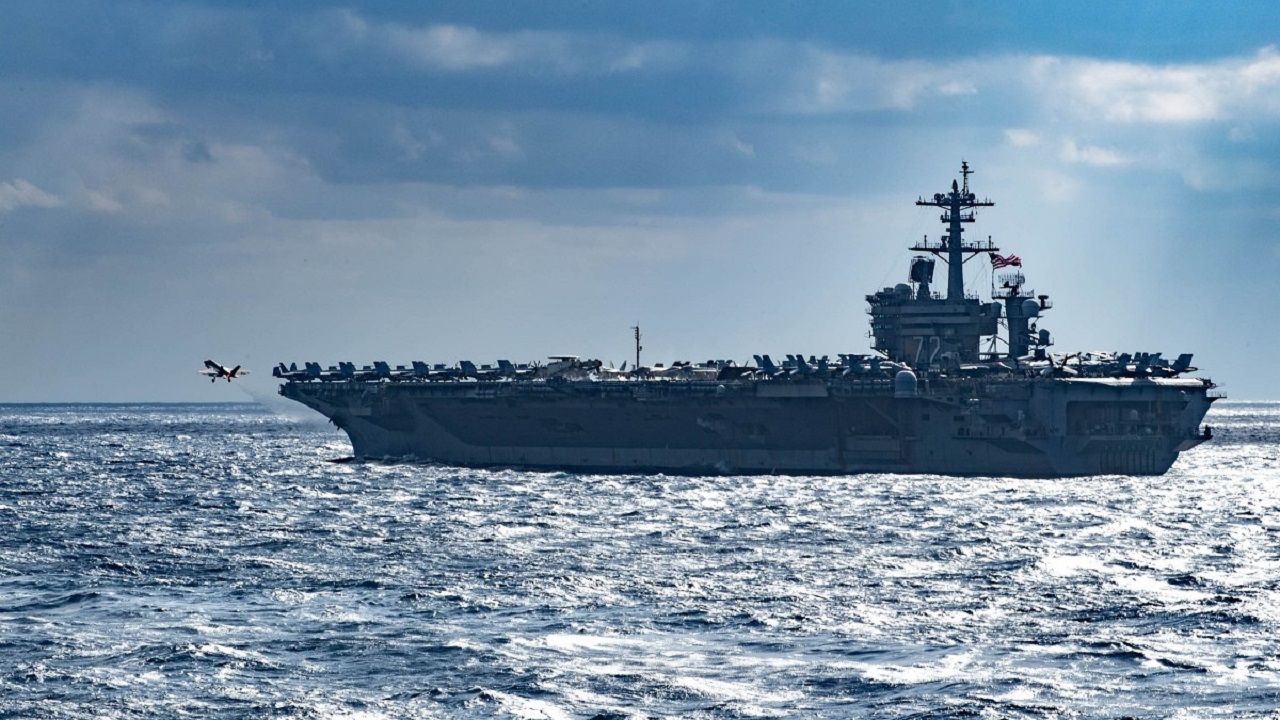
Key Points and Summary – The USS Abraham Lincoln “supercarrier” has been conducting live-fire drills and flight operations in the contested South China Sea since late December.
-Accompanied by three guided-missile destroyers and launching stealthy F-35C jets, the strike group performed combat readiness exercises, including the use of the Phalanx Close-In Weapon System.
-While the Navy officially labels the deployment “routine,” the operation serves as a strategic show of force to bolster U.S. influence and deter Beijing following China’s recent aggressive maneuvers near Taiwan.
US Supercarrier Drills: USS Abraham Lincoln Conducts Live-Fire Exercises in South China Sea
A U.S. aircraft carrier has undertaken exercises in an area controversially claimed by China.
The so-called “supercarrier”, the USS Abraham Lincoln, has carried out live-fire drills and flight operations in the South China Sea in recent weeks.
The Nimitz-class aircraft carrier has been operating in this contested area since the end of December, having departed San Diego for its Indo-Pacific patrol on 24 November.
While naval officials are publicly framing the deployment as “routine”, it is obviously an effort to bolster American influence in the region as tensions with China swirl.
Over the past fortnight, the strike group has conducted replenishment-at-sea, damage-control drills and explosive ordnance disposal training, activities that are essential to keeping such ships operational for as long as possible. On 8 January, the Abraham Lincoln also held a live-fire exercise using its Phalanx Close-In Weapon System.
This system would be the ship’s last-line defence against a number of threats, including unmanned aerial vehicles, cruise missiles, and fast attack craft. Imagery released by the Navy suggests the carrier remained in the South China Sea until 9 January.
The carrier is also continuing flight operations such as launches and mock combat training using stealthy F-35C jets.
The Abraham Lincoln is also accompanied by guided-missile destroyers, including the USS Spruance, USS Michael Murphy, and USS Frank E. Petersen Jr. Together, they make up a formidable carrier strike formation offering combined air, surface, and missile capabilities.
The timing is hard to separate from the wider regional context, with China having also recently overseen live-fire exercises close to Taiwan.
Beijing argues that the nearby island is its rightful territory, and justifies its nearby manoeuvres as “punitive and deterrent” actions to secure its sovereignty.
The South China Sea is hotly contested, with China, the Philippines, Malaysia, Vietnam, Brunei and Taiwan all laying claim to various, and often overlapping, parts of it.
Beijing’s aggressive claims include globally recognized economic zones. Naturally, any military conflict there would threaten international supply chains and freedom of shipping.
Deployment of a sophisticated aircraft carrier is no small feat, and such beefy naval assets do not often operate around disputed reefs or islands; instead, they take part in global, blue-water missions. But unlike destroyers generally equipped for such roles, carriers are essentially floating air bases.
This means they bring unrivalled surveillance capabilities, massive air power, and deterrence into the same patch of ocean, exemplifying the idea that these waters are not off-limits to international navies. Calling deployments like this “routine” is deliberate.
The U.S. aims for its presence to deter Beijing from military misadventures in the West Pacific, whilst avoiding provocations that could cross major Chinese red lines and spark open conflict.
About the Author: Georgia Gilholy
Georgia Gilholy is a journalist based in the United Kingdom who has been published in Newsweek, The Times of Israel, and the Spectator. Gilholy writes about international politics, culture, and education. You can follow her on X: @llggeorgia.