
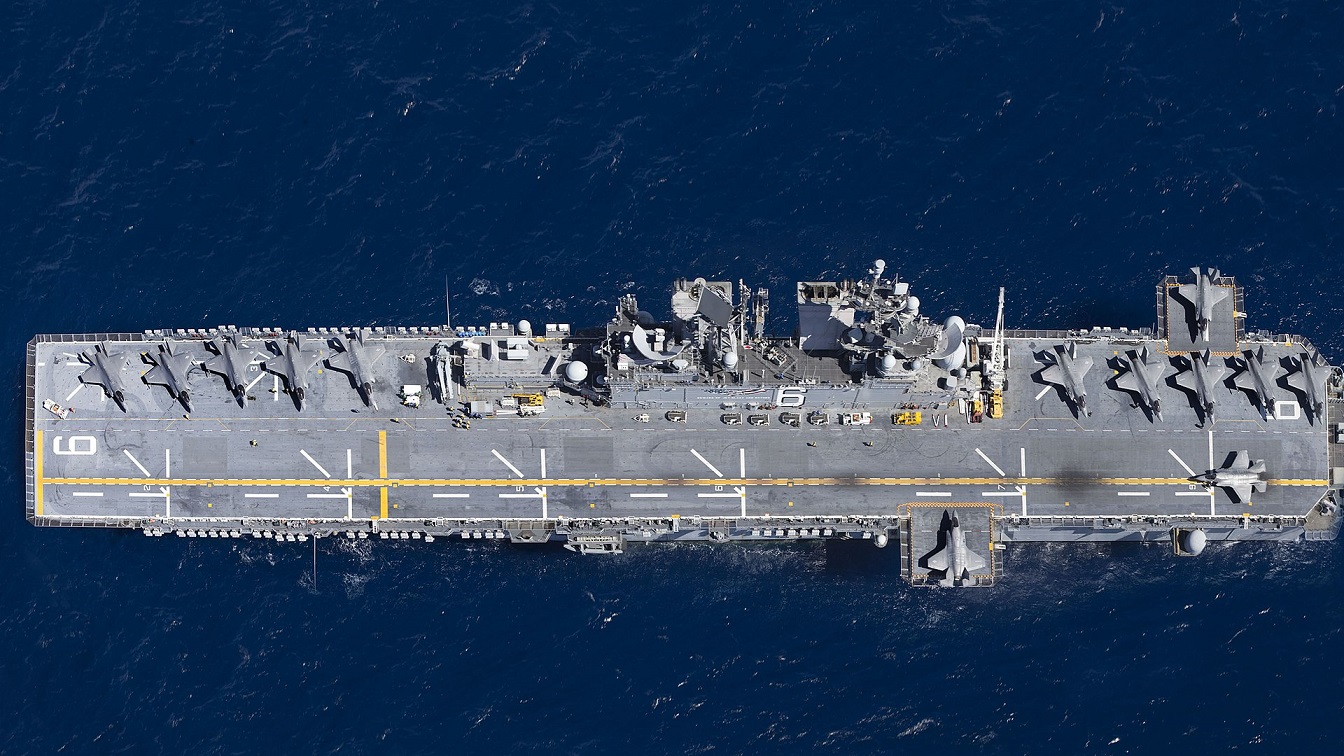
Summary and Key Points: U.S. Navy warship USS Iwo Jima (LHD-7) is scheduled for a $204.2 million modernization overhaul at Norfolk Naval Shipyard starting June 2026.
-This maintenance follows its high-profile role in Operation Southern Spear, where it served as the transport vessel for captured Venezuelan leader Nicolás Maduro in early 2026.
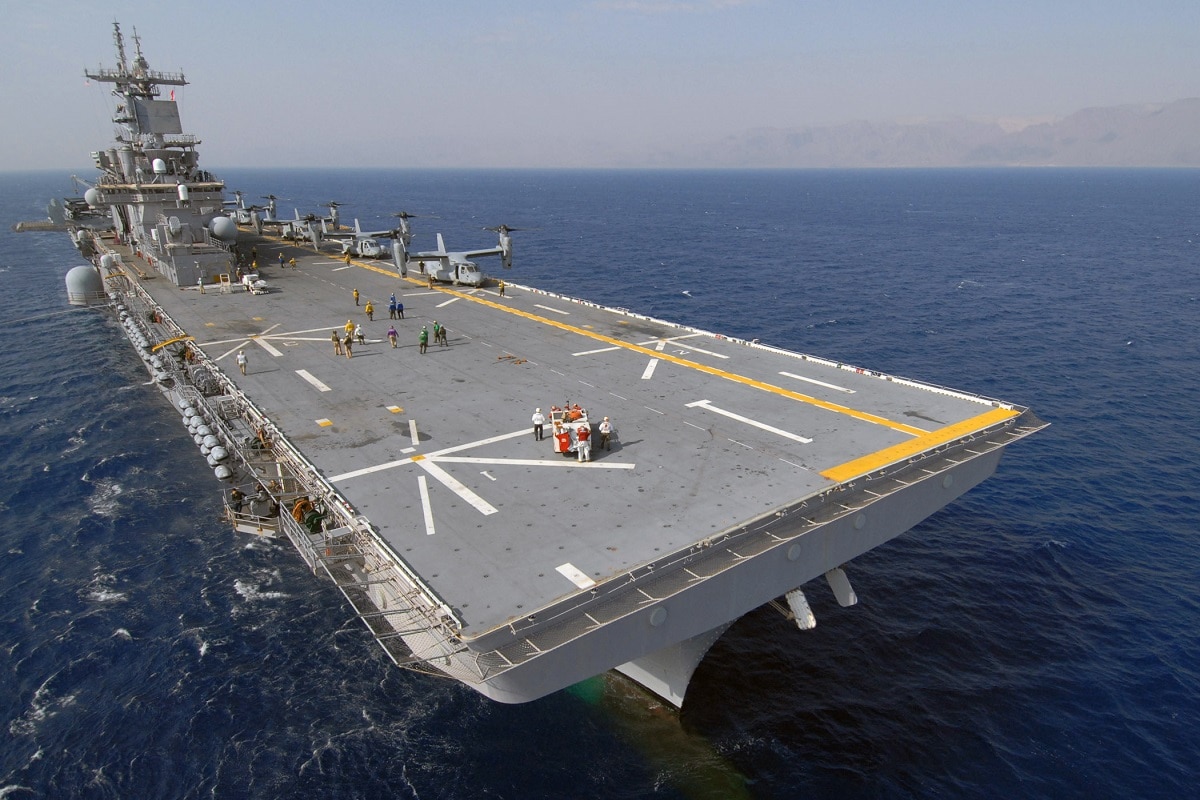
GULF OF AQABA (Oct. 4, 2007) – U.S. Marine Corps MV-22 Ospreys, assigned to Marine Medium Tiltrotor Squadron (VMM) 263, Marine Aircraft Group 29, prepare for flight on the deck of the multipurpose amphibious assault ship USS Wasp (LHD 1). Wasp is on surge deployment to the Middle East carrying the Osprey to its first combat deployment. U.S. Navy photo by Mass Communication Specialist 2nd Class Zachary L. Borden (RELEASED)
-The two-year project, awarded to BAE Systems, will include critical structural repairs and F-35B support upgrades.
-While essential for long-term readiness, the availability gap until 2028 further strains an already tight amphibious fleet, especially following the 2020 loss of the USS Bonhomme Richard.
How the Iwo Jima Overhaul Strains the “Lightning Carrier” Fleet for the U.S. Navy
The USS Iwo Jima (LHD-7)—the amphibious assault ship that transported captured Venezuelan leader Nicolás Maduro to New York last month—is set to enter a major modernization and maintenance period beginning in June at Norfolk Naval Shipyard.
According to a Department of Defense contract announcement, BAE Systems was awarded an initial $204.2 million contract for the work, with the total potentially rising to $255.8 million if all options are exercised. The overhaul is expected to run until 2028.
The result is far from ideal for the U.S. Navy: It will be down another flattop at a time when global naval demand is high. While the Iwo Jima’s recent role in the Maduro operation brought unusual public attention to the ship, observers had long expected LHD-7 to enter a scheduled maintenance cycle sometime after the operation came to an end, whenever that might be.
The news, therefore, should come as no surprise; the maintenance period was always coming, and while that means the Navy has had time to prepare, it doesn’t change the fact that maritime demands are currently high.
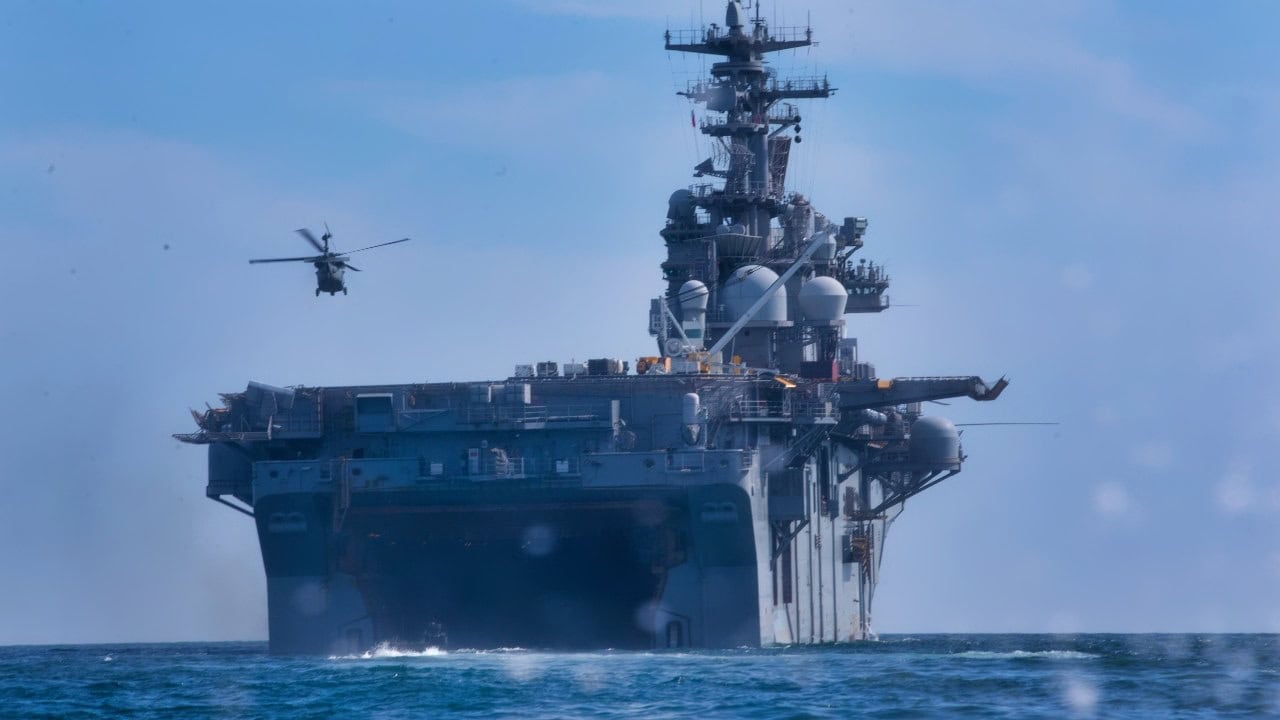
U.S. Marines with Bravo Company, 2d Assault Amphibious Battalion, 2d Marine Division approach the USS Wasp (LHD 1) in assault amphibious vehicles off of Onslow Beach during a three-day ship-to-shore exercise on Camp Lejeune, N.C., June 27, 2020. During the exercise, the Marines conducted amphibious maneuvers and dynamic ship-to-shore operations with the USS Wasp (LHD 1). (U.S. Marine Corps photo by Lance Cpl. Jacqueline Parsons)
The Iwo Jima
Commissioned in 2001, the USS Iwo Jima is a Wasp-class amphibious assault ship built by Ingalls Shipbuilding. At 844 feet long and displacing more than 40,000 tons when fully loaded, it is essentially a small aircraft carrier optimized for Marine Corps operations.
Unlike nuclear-powered supercarriers such as the USS Gerald R. Ford (CVN-79), Wasp-class ships are designed to carry Marines, helicopters, tiltrotor aircraft such as the MV-22 Osprey, and short takeoff/vertical landing F-35B Lightning II fighters. They can also transport landing craft and armored vehicles for amphibious assaults. Each ship typically embarks more than 1,000 sailors and can carry a Marine Expeditionary Unit of roughly 2,200 Marines.
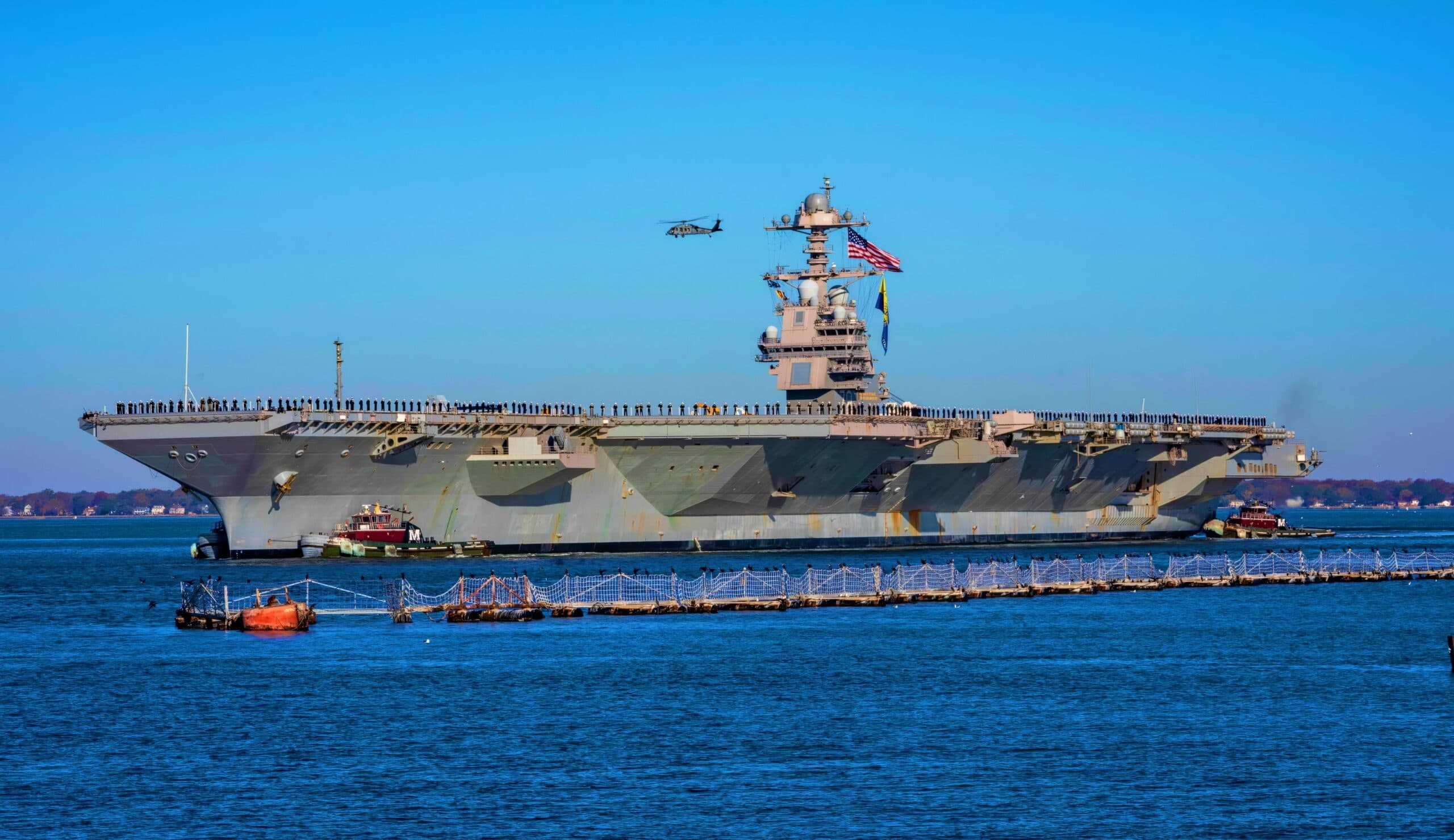
NORFOLK (Nov. 26, 2022) The USS Gerald R. Ford (CVN 78) returns to Naval Station Norfolk after completing their inaugural deployment to the Atlantic Ocean with the Gerald R. Ford Carrier Strike Group (GRFCSG), Nov. 26. The GRFCSG, returned to Naval Station Norfolk following a scheduled deployment with Allies and partners in an effort to build strategic relationships and contribute to a stable and conflict-free Atlantic region, while also showcasing the U.S. Navy’s most advanced class of aircraft carrier. (U.S. Navy Photo/Video by Mass Communication Specialist First Class Nathan T. Beard)
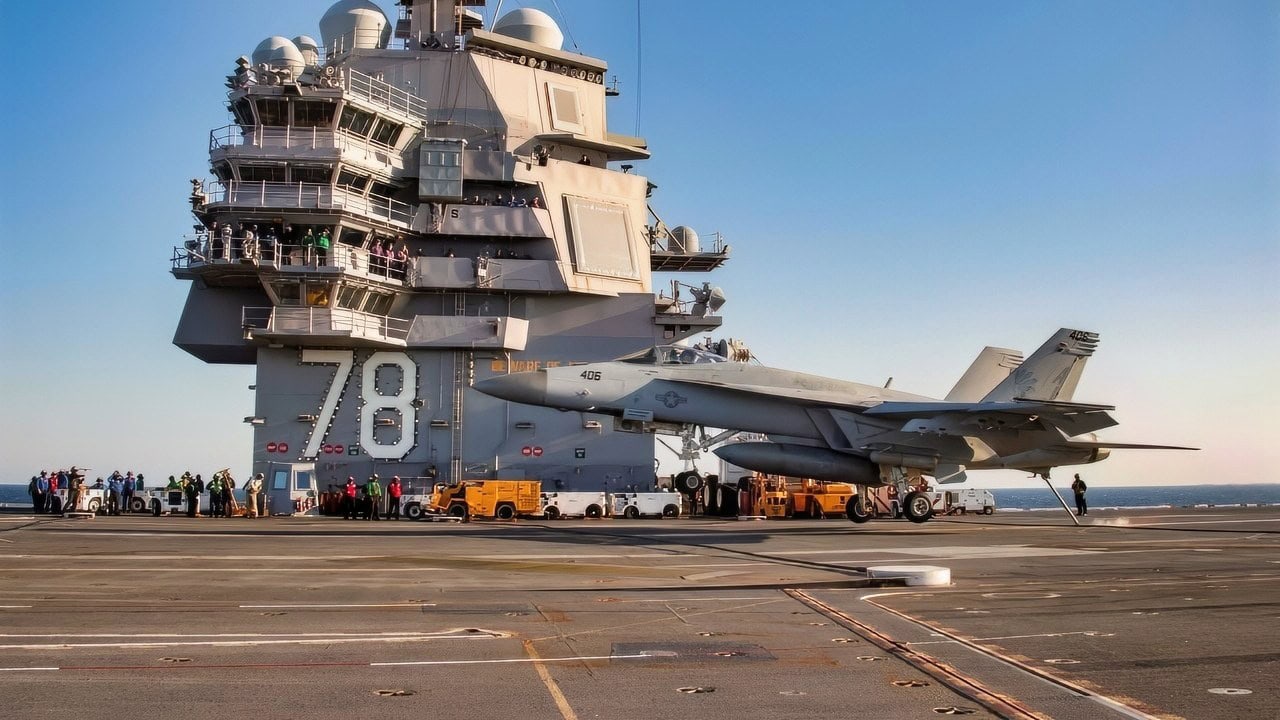
USS Gerald R. Ford Supercarrier Flight Deck. Image Credit: Creative Commons.
In recent years, the ships have increasingly been used as “Lightning carriers,” deployed with expanded F-35B detachments to provide fixed-wing strike capability in regions in which full-size aircraft carriers are unavailable. That kind of flexibility is what has made vessels such as the Iwo Jima central to crisis response and deterrence missions.
The Venezuela Operation
The Iwo Jima left its home port in mid-August 2025 as part of a major U.S. military buildup in the Caribbean Sea under the banner of Operation Southern Spear, a campaign launched by the U.S. government aimed at “detecting, disrupting, and degrading transnational criminal and illicit maritime networks,” particularly those allegedly tied to Venezuelan drug trafficking and narco-terrorism claims.
The ship joined a large naval contingent that included destroyers and support vessels in what became one of the largest U.S. naval presences in the region in decades, with more than 4,500 sailors and Marines involved.
Throughout late 2025, the Iwo Jima Amphibious Ready Group operated off the coast of Venezuela, participating in sanctions enforcement and counternarcotics efforts alongside other U.S. naval and Air Force assets.
On January 3, U.S. forces carried out a coordinated military strike inside Venezuela, resulting in the capture and arrest of President Nicolas Maduro and First Lady Cilia Flores. Following the raid, Maduro and Flores were transported by helicopter to the Iwo Jima, where they were taken into U.S. custody before being transferred to New York to face charges.
What Happens Now: Assault Ship Shortage for the Navy?
The maintenance plan is officially described as a “$204,160,189, firm-fixed-price (FFP) contract action for maintenance, modernization and repair of USS IWO JIMA (LHD 7) Fiscal Year 2026 Selected Restricted Availability (SRA).”
That means that BAE Systems Maritime Solutions will embark on a $204 million maintenance project that is labor-intensive and short-term, designed to allow for repairs, upgrades, and modernization. These forms of maintenance ensure the vessel remains combat-ready by addressing specific maintenance requirements before full overhauls.
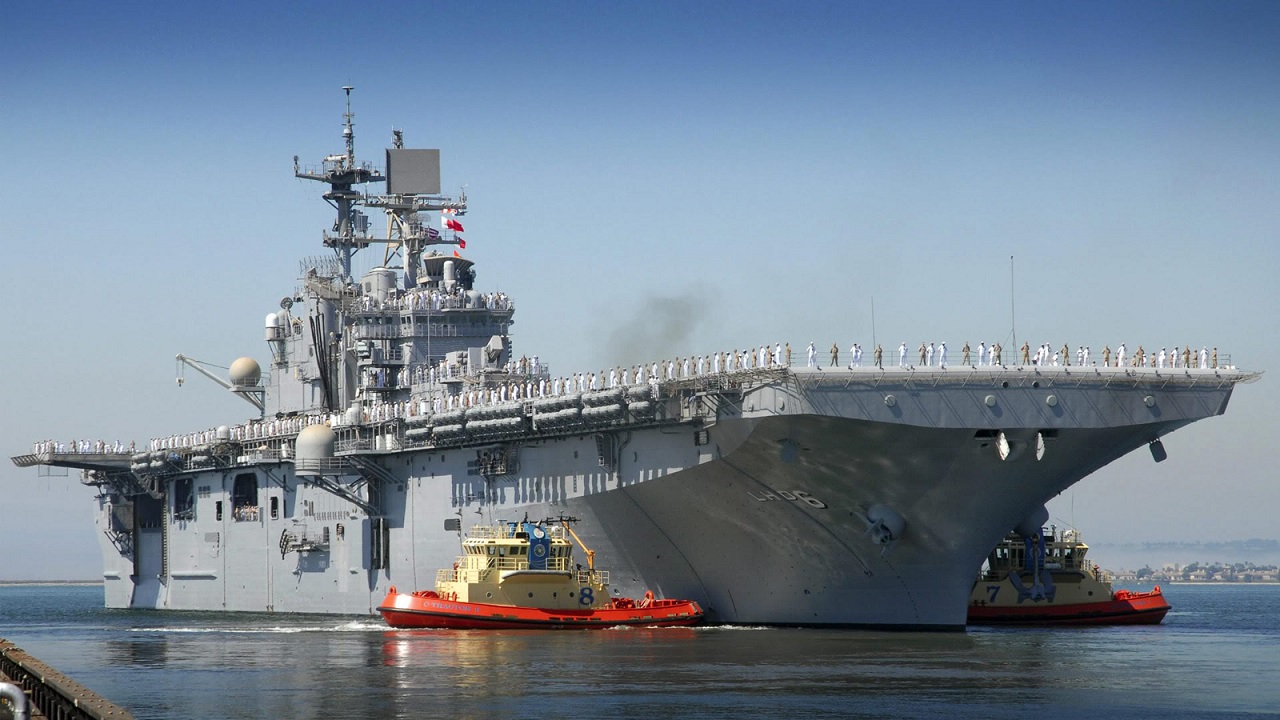
U.S. Navy Assault Ship. Image Credit: Creative Commons.
“The scope of this acquisition includes all labor, supervision, equipment, production, testing, facilities, and quality assurance necessary to prepare for and accomplish the Chief of Naval Operations (CNO) Availability for critical modernization, maintenance, and repair programs,” the official description continues.
A similar modernization program for the USS Wasp (LHD-1) lasted approximately 18 months, concluding in July 2022, and included F-35B support upgrades, structural improvements, and major system maintenance.
In December, maintenance teams from the Mid-Atlantic Regional Maintenance Center completed at-sea repairs on the Iwo Jima, including structural fixes and non-destructive testing to ensure compliance with fleet standards—an effort to remediate issues when it is neither plausible nor possible to move a ship into a shipyard.
After the work is complete, the Iwo Jima will undergo post-refit sea trials before returning to operational deployment.
With seven Wasp-class ships originally built—and the USS Bonhomme Richard (LHD-6) decommissioned after a fire in 2020—the amphibious fleet is already tight, and now is set to get a little tighter.
About the Author: Jack Buckby
Jack Buckby is a British researcher and analyst specialising in defence and national security, based in New York. His work focuses on military capability, procurement, and strategic competition, producing and editing analysis for policy and defence audiences. He brings extensive editorial experience, with a career output spanning over 1,000 articles at 19FortyFive and National Security Journal, and has previously authored books and papers on extremism and deradicalisation.