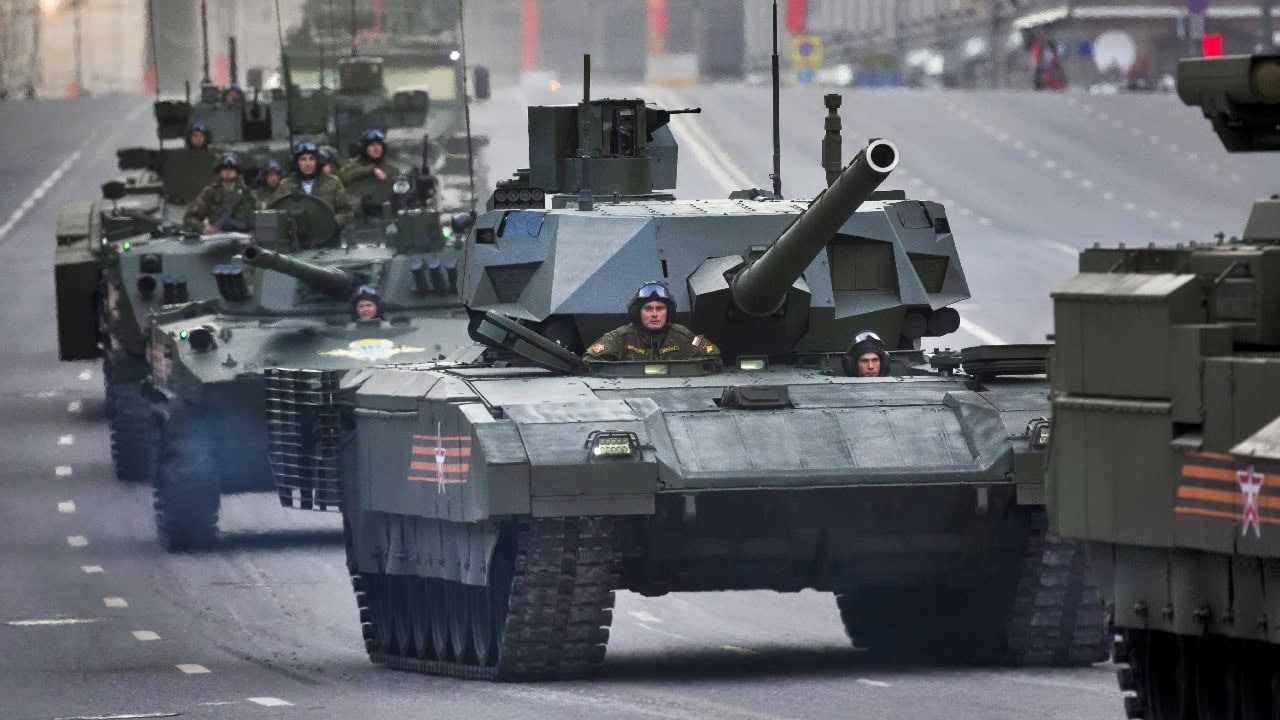
Summary and Key Points: The T-14 Armata, developed by Uralvagonzavod, represents a radical departure from Soviet tank doctrine with its unmanned turret and armored crew capsule.
-Despite advanced features like the Afghanit active protection system and a 1,500-horsepower engine, the platform remains a “niche capability” in 2026.
-High production costs—ranging from $5 million to $9 million per unit—have led Rostec to prioritize the more cost-effective T-90 for the ongoing conflict in Ukraine.
-While conceptually formidable against the M1 Abrams, the Armata remains limited by industrial constraints and a Russian defense budget focused on refurbishing legacy T-72 fleets.
The T-14 Armata Paradox: Why Russia’s Most Advanced Tank is Still a “Parade Vehicle” in 2026
Russia’s T-14 Armata is Moscow’s newest main battle tank.
It is the centerpiece of a larger family of armored vehicles developed by Uralvagonzavod. The T-14 was first publicly unveiled during rehearsals for Moscow’s 2015 Victory Day Parade. It was the first new battle tank design Russia introduced after the Soviet period.
Origins
The T-14 is the culmination of Russia’s efforts in the 2000s to design and field a replacement for its legacy Soviet- and Soviet-derived tanks, such as the T-72, T-80, and T-90. Those platforms followed several broad design philosophies, including a low silhouette; a three-man crew using an autoloader to load the 125-mm main gun; and an overall compact footprint with relatively broad tracks and good off-road mobility.
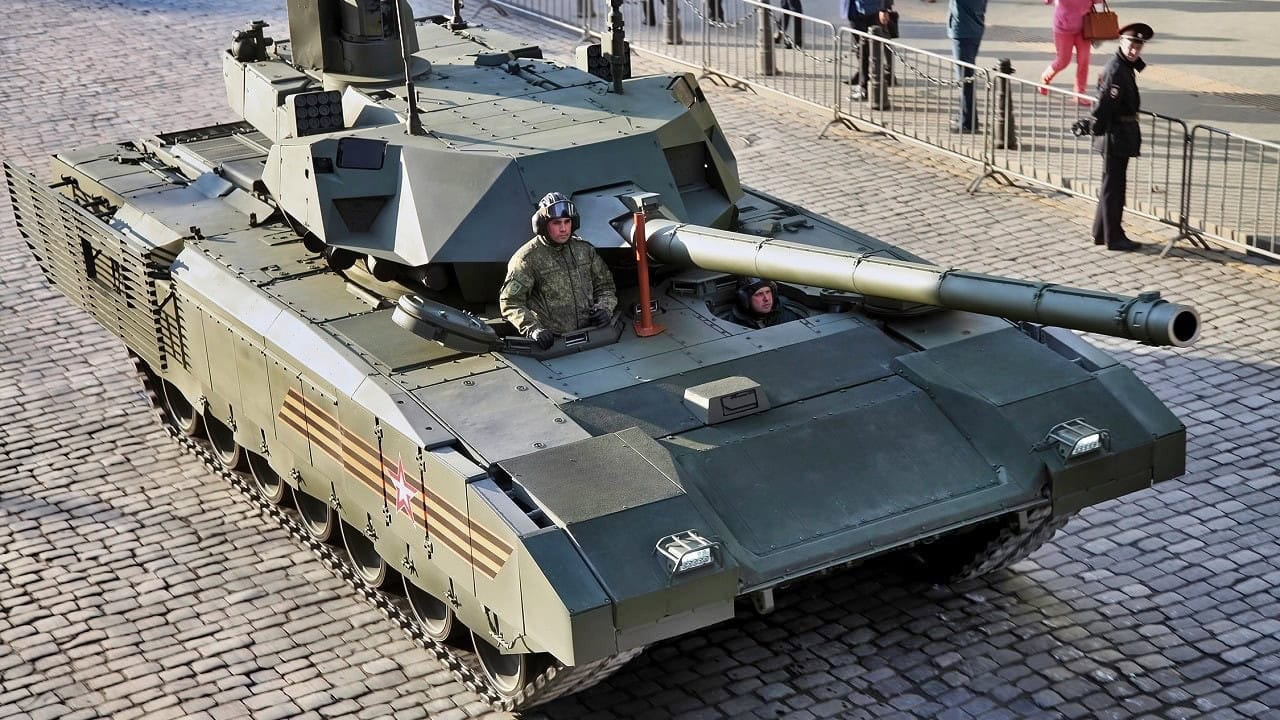
T-14 Armata Tank.
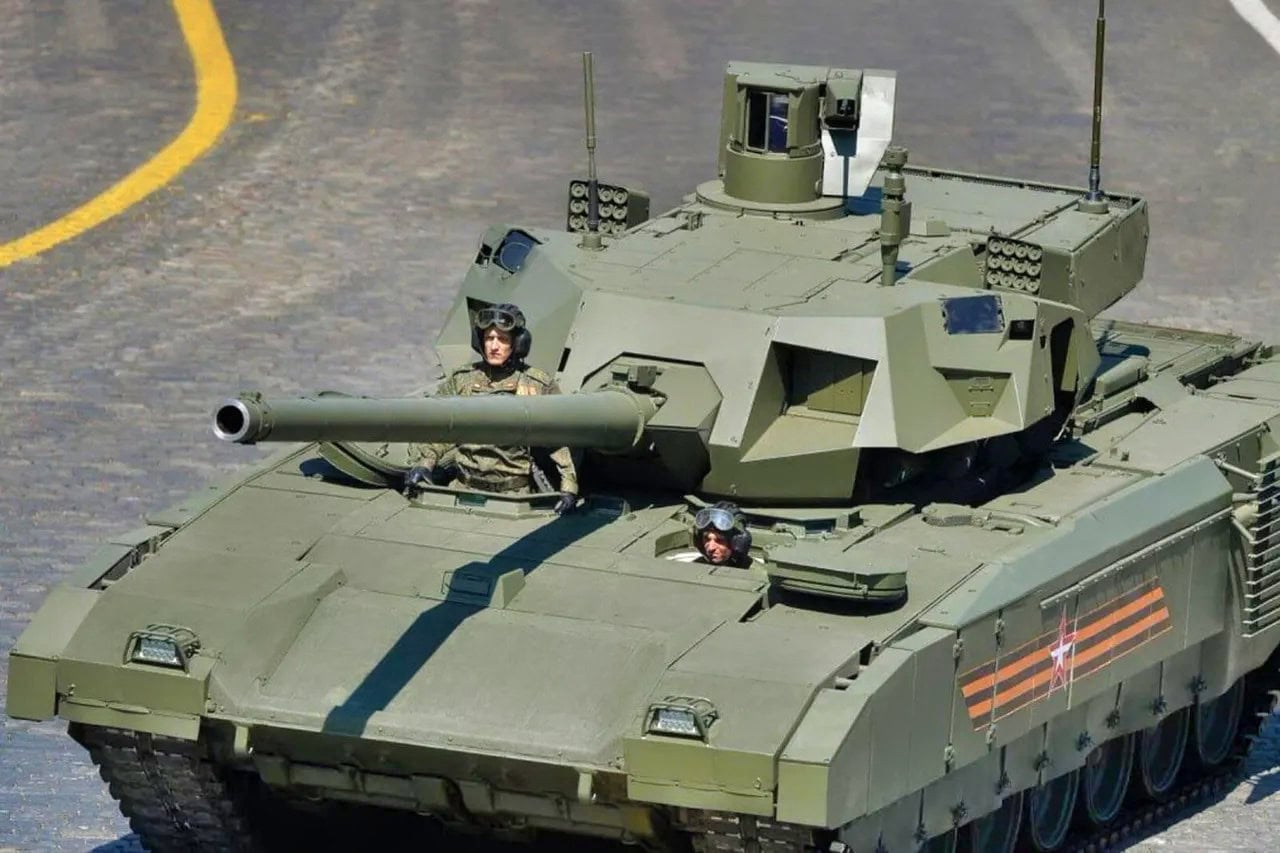
Russian T-14 Armata Tank. Image Credit: Social Media Screenshot.
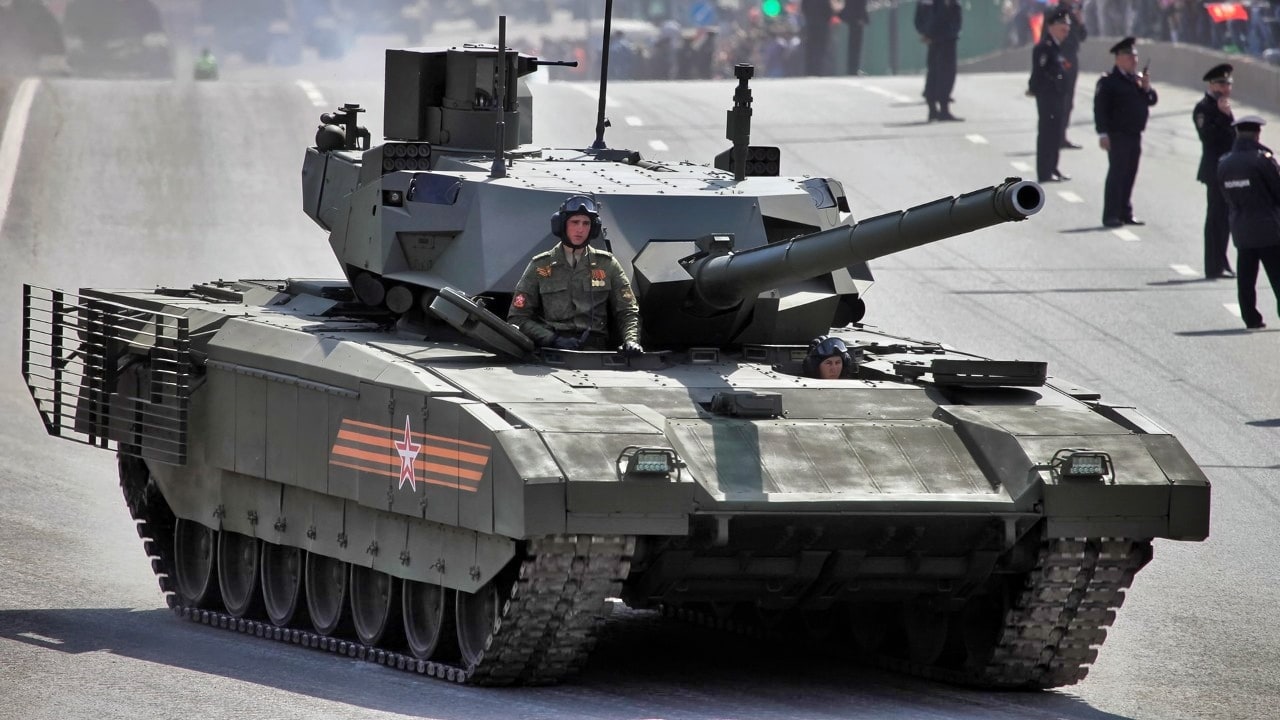
T-14 Armata Tank from Russia
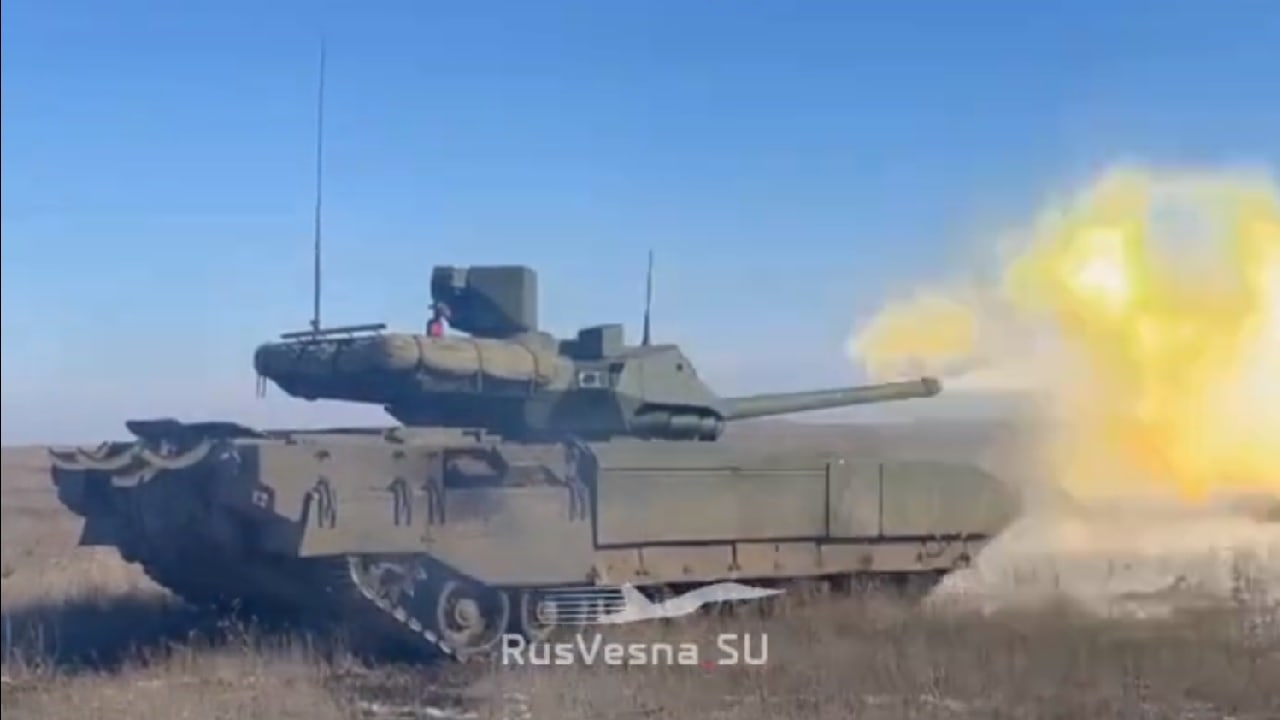
T-14 Armata Screenshot
For the T-14, designers at Uralvagonzavod sought something different. Instead of another incremental improvement that would have built on the T-90 design, the Armata was to be a universal tracked platform to provide the basis for several other armored vehicles, including the T-15, a heavy infantry fighting vehicle, and the T-16, a repair and recovery vehicle. High standardization across platforms, including the engine, chassis components, and electronics, simplifies production and logistics.
Features and Improvements
One of the T-14’s most distinctive features is its unmanned turret, which places the tank’s three crew members—commander, gunner, and driver—in an armored capsule in the front of the hull. Sensors and cameras give the crew compartment eyes and ears, and ammunition blowout panels improve crew survivability. This is a radical departure from prior Russian and Soviet main battle tank designs that risk catastrophic internal detonation if ammunition stored in a carousel autoloader ignites.
The Armata purportedly has new composite armor, as well as Malachit explosive reactor armor intended to defeat kinetic projectiles. Its Afghanit active protection system kinetically intercepts incoming anti-tank projectiles and rockets. The T-14’s engine is thought to produce about 1,500 horsepower, and given its combat weight of 48 to 55 tons, its power-to-weight ratio is respectable.
When compared to some Western main battle tanks, such as the U.S. M1 Abrams or Germany’s Leopard 2—both widely in service across the NATO alliance—the T-14 significantly reduces the gap between Soviet/Russian tanks and their Western counterparts. Given equal training levels, the T-14 would present a challenge to Abrams and Leopard main battle tanks. On paper, the T-14 is formidable. But perhaps its most limiting factor has been low production numbers.
Future Prospects
Writing for The Jamestown Foundation one expert questioned the future of the T-14 platform. “Despite the testing of the Armata in military operations in Syria, as well as the efforts by its designers to promote the new tank’s credentials, there continue to be influential skeptics within Russian defense circles. The first deputy chairperson of the Duma defense committee, Alexander Sherin, for example, has argued that the T-14 tank is of a completely different generation, but it is highly expensive, so its purchase has been temporarily stopped,” the author opined.
“If the procurement has been suspended due to its costs, it is likely that the introduction of the T-14 into Russia’s Ground Forces could face delays of up to several years. In any case, the defense ministry order of 132 platforms, combined with its orders for upgraded T-90s, suggest that the military leadership does not plan larger-scale orders in the future. If this proves to be the case, the T-14 Armata may turn out to be a niche capability for the Russian Ground Forces, though an exceptionally expensive one.”
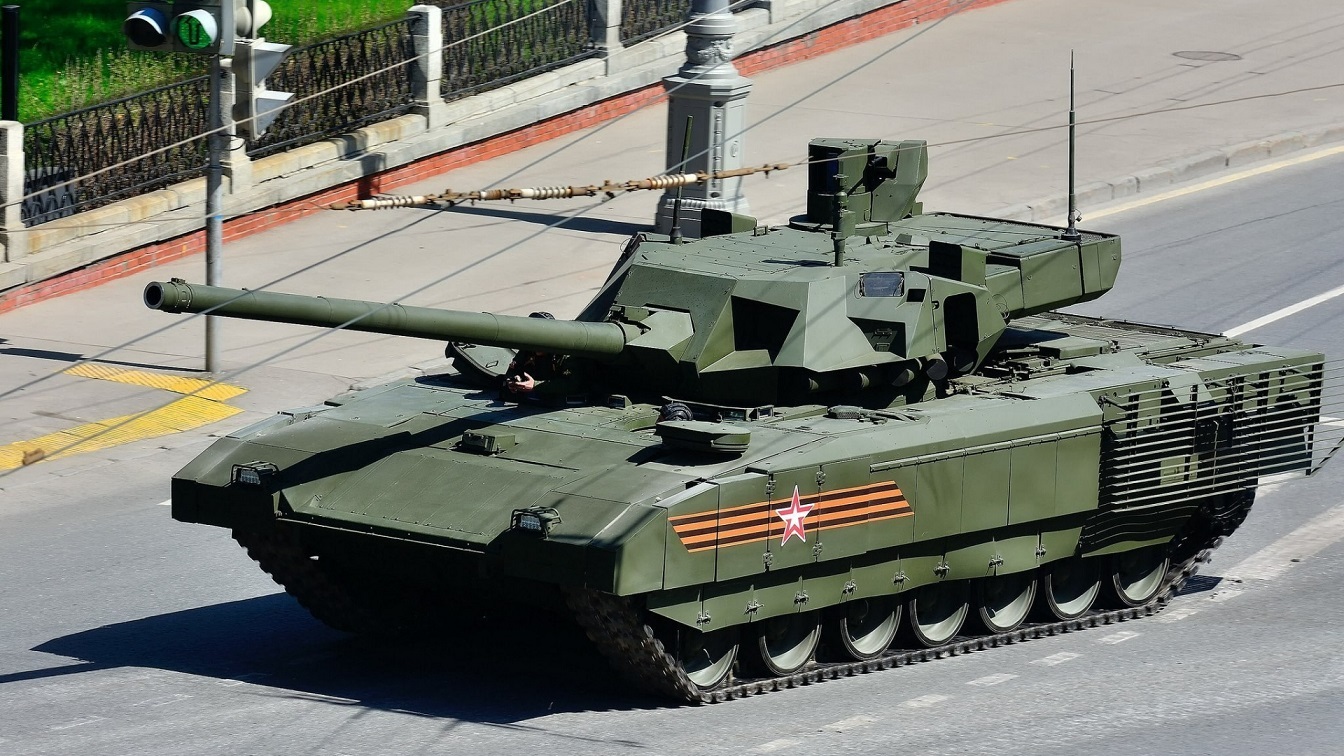
T-14 Armata Tank. Image Credit: Creative Commons.
The T-14’s capabilities, impressive as they are, are difficult to justify—though Jamestown made an attempt to quantify the tank’s costs. “In 2015–2016,” the T-14’s unit cost “ranged between 400 million to 700 million rubles,” or $5.38 million-9.42 million. While that is not exceptionally expensive when compared to the newest M1 Abrams variant, it is roughly double the price per unit of the T-90.
When the Armata debuted in 2015, Russian officials initially suggested that the new tank would be acquired in the hundreds or potentially thousands of units. But several technical hurdles have conspired to limit the tank’s production. Today, Russia seems more keen to bring older T-72 tanks out of storage and refurbish those for the fight in Ukraine rather than build new T-14s—and the T-14 has seen limited combat deployment.
It is partially thanks to the costs that the T-14 has been produced in low numbers. Given the immense strain currently placed on the Russian defense budget during its grinding campaign in Ukraine, there is little interest, and indeed precious few rubles available for pricy defense projects. The T-14’s future is unclear.
About the Author: Caleb Larson
Caleb Larson is an American multiformat journalist based in Berlin, Germany. His work covers the intersection of conflict and society, focusing on American foreign policy and European security. He has reported from Germany, Russia, and the United States. Most recently, he covered the war in Ukraine, reporting extensively on the war’s shifting battle lines from Donbas and writing on the war’s civilian and humanitarian toll. Previously, he worked as a Defense Reporter for POLITICO Europe. You can follow his latest work on X.