
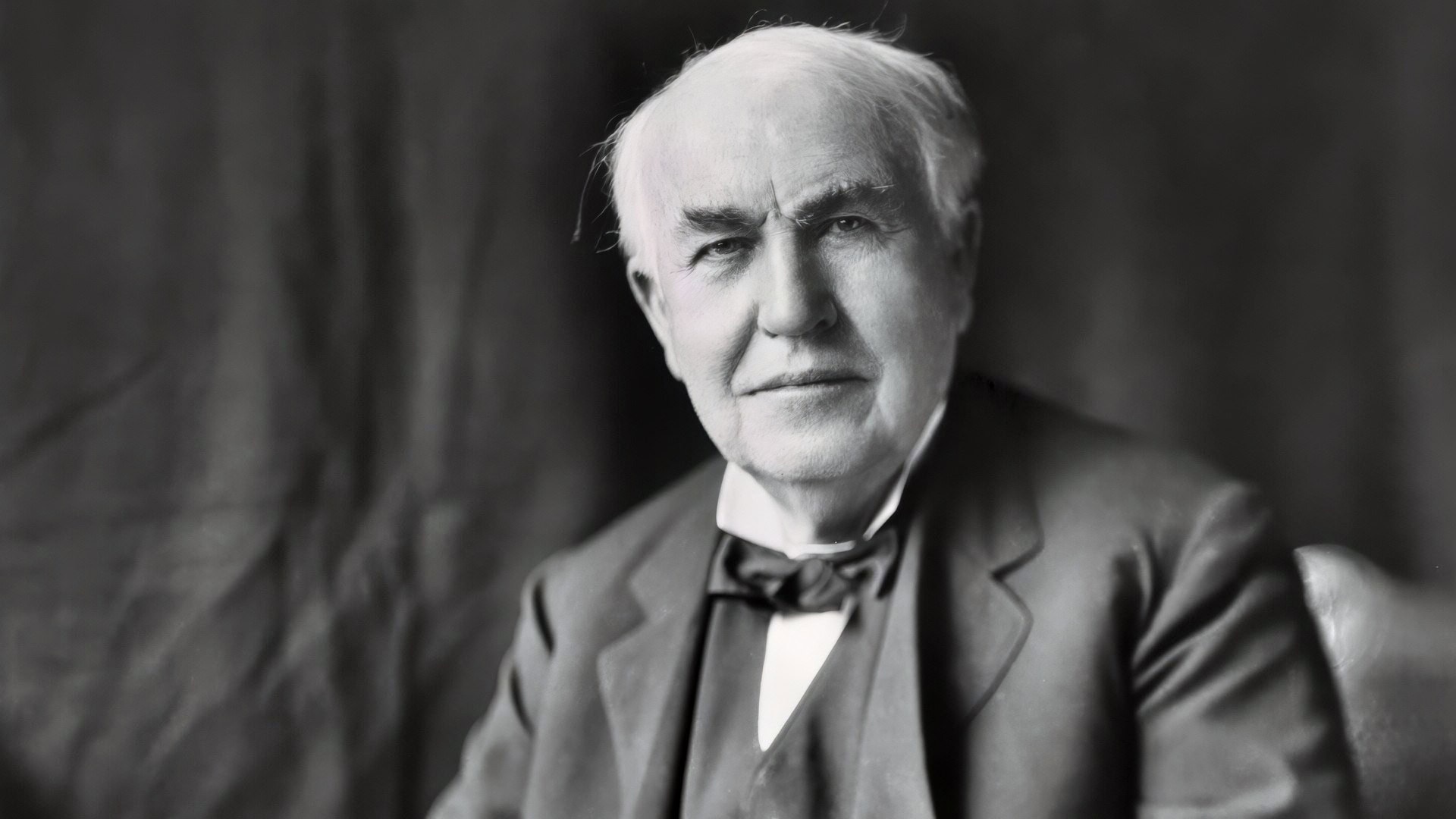
Summary and Key Points: Acclaimed writer and book author Christian D. Orr evaluates the technological pillars of Thomas Edison‘s career through the prism of one key quote.
-This report analyzes how Edison transitioned from a lone inventor to a founder of General Electric, focusing on his 1879 practical lightbulb, the 1877 phonograph, and the 1891 Kinetoscope.
Orr explores Edison’s competitive refusal of Eadweard Muybridge’s partnership, choosing instead to develop a proprietary “family of systems” for motion pictures.
-He concludes that Edison’s legacy—marked by a refusal to accept failure during nearly 3,000 lightbulb experiments—remains the foundational benchmark for American “hard work” over mere intellect.
“Genius is 1 Percent Inspiration and 99 Percent Perspiration.” – Thomas Edison
The above quote belongs to Thomas Alva Edison (February 11, 1847 – October 18, 1931)—arguably the greatest inventor of all time with more than 1,000 patents to his name.
Edison’s quote affirms that in order for a genius to be truly successful—as opposed to languishing in ignominy and poverty like, for instance, William James Sidis—it takes hard work in addition to mere book smarts.
We now take a brief look at what are arguably Edison’s top three most enduring contributions to society—inventions that sprang forth from his mixture of inspiration and perspiration.
Enduring Edison Legacy #1: The Electric Lightbulb
This is probably the first thing that comes to mind when most casual history buffs think of Edison.
After all, many present-day entities named in his honor have an electrical theme, such as Southern California Edison (SCE), which is the primary electric utility company for much of Southern California.
There was also the English pop band Edison Lighthouse, best known for their 1970 hit “Love Grows Where My Rosemary Goes.”
And though it doesn’t bear his name, there’s a certain multinational conglomerate Thomas Edison co-founded back in 1892 that you may have heard of: General Electric.
Interestingly enough, however, as Edison’s Ducksters mini-bio points out, “Although he did not invent the first electric light, Edison made the first practical electric light bulb that could be manufactured and used in the home. He also invented other items that were needed to make the light bulb practical for use in homes including safety fuses and on/off switches for light sockets.”
As a side note, Englishman Joseph Wilson Swan publicly demonstrated his own carbon filament bulb in 1878; this in turn enabled London’s Savoy Theatre to become the first public building in the world to be entirely lit by electricity.
Another famous saying of Mr. Edison’s was, “I have not failed 10,000 times—I’ve successfully found 10,000 ways that will not work.”
Well, in the case of his lightbulb, it was actually a mere 2,774 times according to his records.
Enduring Edison Legacy #2: The Phonograph
This should perhaps be the first item on this list, as it was Thomas Edison’s first major invention and the one that made him famous among his contemporaries.
This was the first machine able to record and play back sound. He uttered the words to “Mary had a little lamb” as the first recorded voice on the device.
What makes the invention even more remarkable is that its inventor was completely deaf in one ear and could barely hear in the other—shades of Ludwig von Beethoven.
Edison would later listen to a music player or piano by clamping his teeth into the wood to absorb the sound waves into his skull.
Enduring Edison Legacy #3: Motion Pictures
As was true of the electric lightbulb, Thomas Edison wasn’t the sole inventor of cinematography; after all, the English-born American Eadweard J. Muybridge (April 9, 1830 – May 8,1904; born Edward James Muggeridge) deserves credit as well.
However, Edison contributed plenty toward the creation of the motion picture camera and a practical process of filmmaking.
Indeed, Muybridge reached out to Edison with a proposition to combine the former’s Zoopraxiscope (invented in the summer of 1879) with the latter’s phonograph.
However, Edison turned down the partnership proposal, deeming it too impractical and inefficient. Instead, Edison decided to patent his own device for the then-fledgling art of cinematography.
As described by the Library of Congress:
“In an attempt to protect his future inventions, Edison filed a caveat with the Patents Office on October 17, 1888, describing his ideas for a device which would “do for the eye what the phonograph does for the ear” — record and reproduce objects in motion. Edison called the invention a ‘Kinetoscope,’ using the Greek words ‘kineto’ meaning “movement” and ‘scopos’ meaning ‘to watch’…A patent for the Kinetograph (the camera) and the Kinetoscope (the viewer) was filed on August 24, 1891.”
About the Author: Christian D. Orr, Defense Expert
Christian D. Orr is a Senior Defense Editor. He is a former Air Force Security Forces officer, Federal law enforcement officer, and private military contractor (with assignments worked in Iraq, the United Arab Emirates, Kosovo, Japan, Germany, and the Pentagon). Chris holds a B.A. in International Relations from the University of Southern California (USC) and an M.A. in Intelligence Studies (concentration in Terrorism Studies) from American Military University (AMU). He is also the author of the newly published book “Five Decades of a Fabulous Firearm: Celebrating the 50th Anniversary of the Beretta 92 Pistol Series.”