
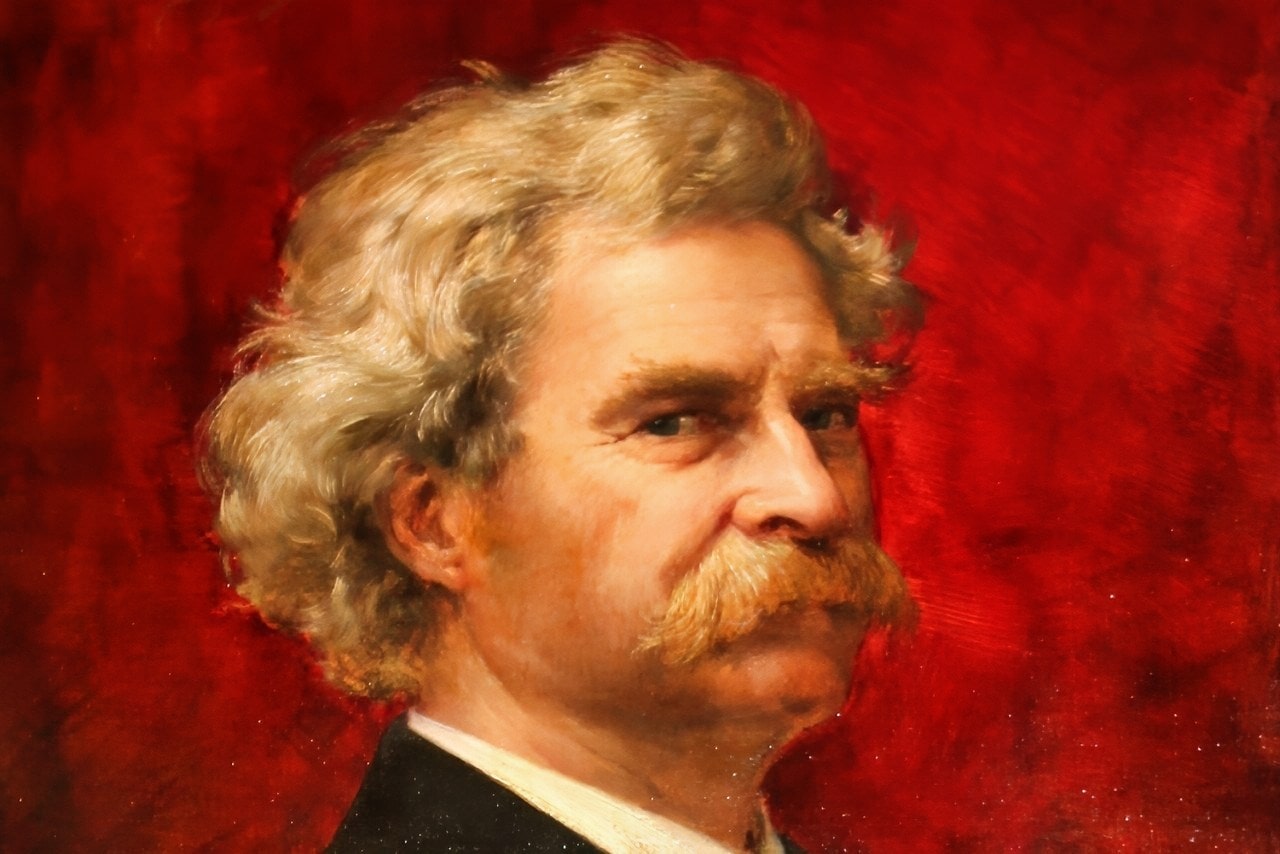
Summary and Key Points: Isaac Seitz, a Defense Columnist and intelligence analyst, evaluates the high-stakes financial cycle of legendary author Mark Twain.
Mark Twain’s life was a masterclass in the American “boom and bust” cycle. And one quote from his work explains it perfectly.
-While he famously quipped that being rich was more worry than it was worth, his own life was a relentless pursuit of the next big score—often followed by a crushing financial defeat.
-His legacy remains a cautionary yet inspiring tale of how wit and personal honor can salvage a reputation from the depths of bankruptcy.
Quote of the Day – The Paige Compositor Fiasco: How Mark Twain Lost Millions on a Single Invention
In The Adventures of Tom Sawyer, Mark Twain wrote that “[B]eing rich ain’t what it’s cracked up to be. It’s just worry and worry, and sweat and sweat, and a-wishing you was dead all the time.”
Despite being one of the most influential American authors in history, Mark Twain was no stranger to financial hardships. Even at the height of his career, he faced hardships—some caused by his own poor financial judgment—and often struggled to make ends meet. But Twain carried on with his head held high.
With his humor, wit, and strong command of the English language, Mark Twain cemented himself as a household name for generations.
Early Life
Twain grew up in Hannibal, Missouri, a bustling river town that later formed the backdrop of The Adventures of Tom Sawyer and Adventures of Huckleberry Finn. His father’s early death forced him to leave school young and find work to support the family. He began as a printer’s apprentice, learning the trade of typesetting and gaining early access to books, newspapers, and the written word. These years laid the foundation for his literary career, though they offered little financial stability.

Mark Twain Black and White. Image Credit: Creative Commons.
During the 1850s, Twain traveled to cities such as New York, Philadelphia, and Cincinnati, working in print shops and newspapers while living frugally and fueling a growing ambition for a better future.
His first taste of real prosperity came when he trained as a Mississippi River steamboat pilot. The position brought respect and excellent wages. By 1859 he was earning more than he had ever imagined possible in his youth, and he embraced the life of river navigation with enthusiasm.
Yet this newfound success proved to be short-lived. With the outbreak of the Civil War in 1861, the river trade collapsed, and his career ended abruptly. It was the first time his income vanished overnight, though not the last.

Abraham Lincoln 19FortyFive Image. Taken at the National Portrait Gallery in Washington, DC by Dr. Brent M. Eastwood on 1/23/2026.
The Height of Mark Twain’s Career
Seeking opportunity, Twain followed his brother west to the Nevada Territory that same year. Like many hopeful adventurers, he tried his hand at silver mining, but he lacked the patience and luck required to succeed. Rather than striking it rich in the mines, he drifted back into journalism, where he found both talent and opportunity.
His humorous writing captured attention across the West, and in 1865 his short story The Celebrated Jumping Frog of Calaveras County brought him national fame. With this breakthrough, his fortunes improved dramatically once again.

Cannon Firing. Image Credit: Creative Commons.
During the 1870s and 1880s, Twain reached the height of his career. He married Olivia Langdon in 1870, entering a well-connected family that provided emotional support and cultural refinement. Settling eventually in Hartford, Connecticut, Twain built an extravagant home that reflected his confidence in his growing wealth.
His books sold widely, his lectures attracted huge audiences, and his reputation soared. For a time, it seemed that financial security was finally permanent.
Bad Financial Decisions
But Twain’s weakness was an unyielding optimism that bled into his business ventures. He believed deeply in progress and innovation, and this faith often clouded his judgment. The most disastrous example was his long involvement with the Paige Compositor, a typesetting machine designed by inventor James W. Paige.
Twain was convinced it would revolutionize the printing industry and yield enormous profits. Over the course of two decades, he poured the equivalent of several million modern dollars into its development. Yet the machine was prone to constant mechanical failure and was far too complex to be practical. Simpler, more reliable competing technologies ultimately overtook it.
Twain once joked that the device could do anything “except put the paper in and take it out,” but the humor masked a devastating reality: The investment drained his finances almost completely.
At the same time, his publishing firm, Charles L. Webster & Company, struggled. Although it began with remarkable success (most notably with the publication of Ulysses S. Grant’s Personal Memoirs) the company soon faltered. Twain’s enthusiasm led to overly ambitious print runs, poor management, and unwise business decisions.
Losses accumulated rapidly. By the early 1890s, the combined weight of the Paige Compositor fiasco and the collapse of his publishing house pushed Twain to the brink of ruin.
Contentment in the Face of Uncertainty
Yet Twain’s determination and sense of honor propelled him toward an extraordinary recovery. Although legally freed from his obligations after declaring bankruptcy, he was adamant about repaying every creditor. To do so, he embarked on a physically demanding around-the-world lecture tour beginning in 1895.
Traveling across the United States, Canada, Australia, India, South Africa, and Europe, he entertained enormous audiences who came to hear his wit and storytelling. The tour was exhausting, but financially it was a triumph. His subsequent travel narrative, Following the Equator, added further income.
In the final decade of his life, Twain enjoyed a measure of stability, though not the carefree wealth he had once imagined. His later writings reveal the scars left by his financial trials. Works such as The Man That Corrupted Hadleyburg and The Mysterious Stranger reflect a darker perspective on human greed, folly, and the fragility of fortune.
Personal tragedies continued to shadow him, with the deaths of two of his daughters and eventually his wife. By the time Twain died on April 21, 1910, he had endured more than most, but he had also secured a lasting literary legacy and reclaimed his reputation.
About the Author: Isaac Seitz
Isaac Seitz, a Defense Columnist, graduated from Patrick Henry College’s Strategic Intelligence and National Security program. He has also studied Russian at Middlebury Language Schools and has worked as an intelligence Analyst in the private sector.