
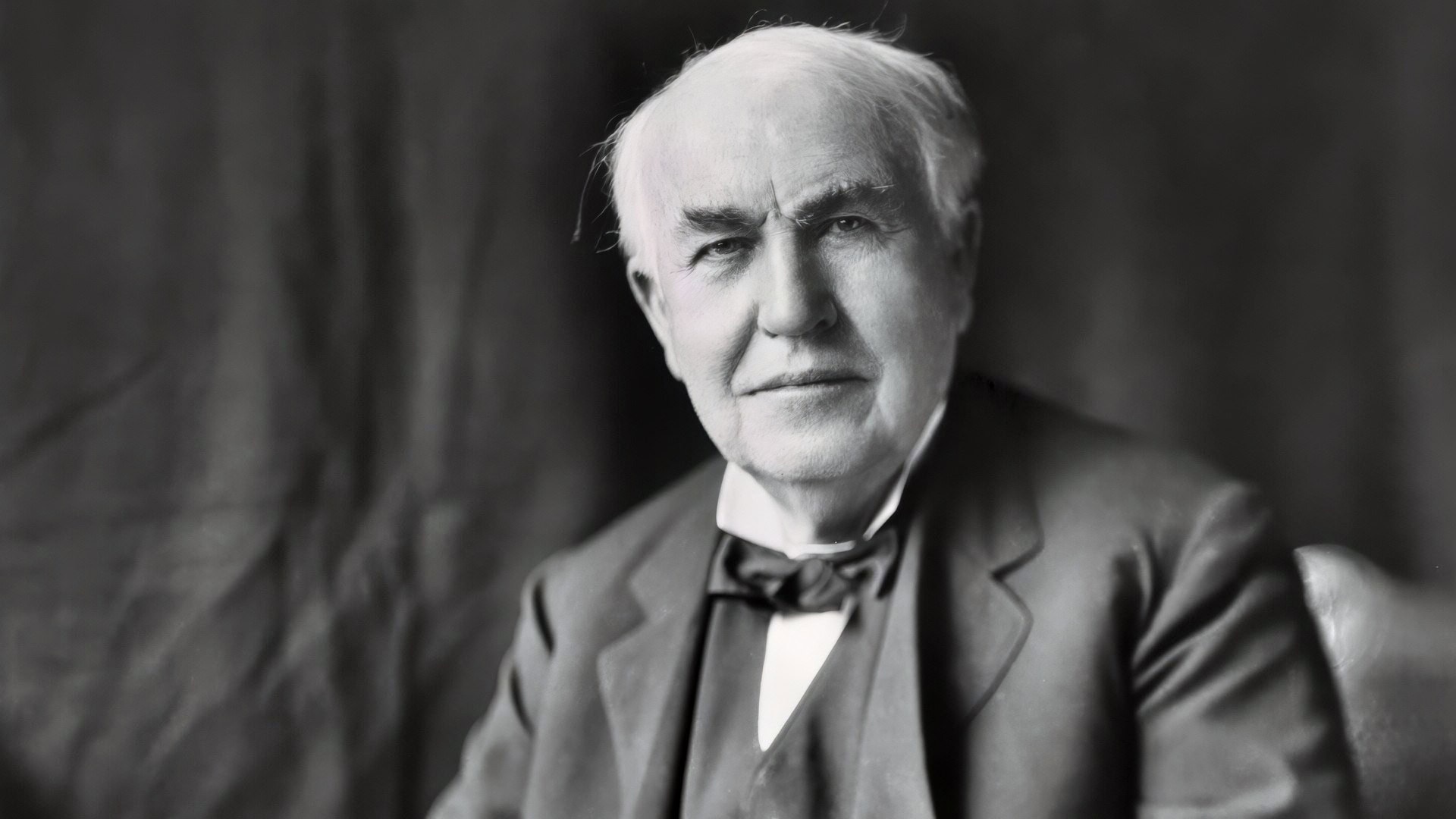
Summary and Key Points: Thomas Alva Edison’s career is a study in persistence—an inventor who kept iterating until an idea became practical, scalable, and useful.
-Born in 1847, Edison struggled in formal school, was taught at home, and built an early lab as a child.
He later launched one of the first research laboratories devoted solely to invention, producing breakthroughs that reshaped daily life: the phonograph, practical home lighting systems, and key motion picture technologies.
-Even as hearing loss complicated his work, Edison leaned into experimentation as a method. His legacy endures through electrification, modern communications, and institutions like General Electric.
Quote Of The Day: Thomas Edison’s “10,000 Ways” Line Explains How Winners Handle Failure
“I have not failed. I’ve just found 10,000 ways that won’t work.”—That quote belongs to Thomas Edison, quite possibly the greatest inventor of all time, with over 1,000 patents (1,093 US patents to be precise) to his name (best known to most for the first practical electric lightbulb).
It brings to mind a quote from another famous historical figure we’ve recently profiled: Winston Churchill’s “Never give in” admonition (a principle that served Sir Winston well during his “wilderness years”).
It also brings to mind Abraham Lincoln and Ulysses S. Grant, both of whom experienced multiple failures in their lifetimes, only to eventually become President of the United States (not to mention Grant serving as the victorious commander of the Union Army during the Civil War along the way).
We now take a brief look at Mr. Edison’s remarkable life and career.
Early Life
Thomas Alva Edison was born on February 11, 1847, in Milan, Ohio, but moved with his family to Lake Huron, Michigan, in 1854. (A foreshadowing of the Ohio State Buckeyes vs. Michigan Wolverines college sports rivalry, perhaps?). He was the seventh and final child of Samuel Ogden Edison Jr. (originally from Nova Scotia) and Nancy Matthews Elliott (a New Yorker); in reference to his middle name, his family nicknamed him “Al.”
As noted by his Ducksters mini-bio, “Surprisingly, he did not do well in school and ended up being home-schooled by his mother. Thomas was an enterprising young man who sold vegetables, candy, and newspapers on trains. One day, he saved a child from a runaway train. The child’s father repaid Edison by training him as a telegraph operator. As a telegraph operator, Thomas became interested in communications, which would be the focus of many of his inventions.”
As the one joke goes (which also has a ring of truthful seriousness), “Don’t let school get in the way of your education.” Young Al’s struggles with formal schooling notwithstanding, the precocious lad set up his first lab in his parents’ basement at the age of 10.
Getting Started … and Keeping It Going
It was in 1876 (America’s 100th birthday, appropriately enough) that Edison established the first of his research laboratories—which were the first businesses or institutions with the sole purpose of inventing—at Menlo Park, New Jersey. ‘Twas these research labs that spawned the following inventions:
-The Phonograph: This was actually Edison’s first major invention and the one that made him famous. Though not as relatable to the current generation, which iPhones and iTunes have spoiled, it was the first machine to record and play back sound. He uttered the words to “Mary had a little lamb” as the first recorded voice on the device.
What makes this particular invention even more remarkable is the fact that its inventor was completely deaf in one ear and could barely hear in the other! Edison would later listen to a music player or piano by clamping his teeth into the wood to absorb the sound waves into his skull.
-Light Bulb: As Ducksters points out, “Although he did not invent the first electric light, Edison made the first *practical* electric light bulb that could be manufactured and used in the home. He also invented other items that were needed to make the light bulb practical for use in homes, including safety fuses and on/off switches for light sockets.” [emphasis added] (As a side note, Englishman Joseph Wilson Swan publicly demonstrated his own carbon filament bulb in 1878; this in turn enabled the London Savoy Theatre to become the first public building in the world to be entirely lit by electricity.
As for the “10,000 ways that won’t work” quoted at the beginning of this article, it wasn’t technically accurate regarding Mr. Edison’s lightbulb; it was actually 2,774 times, according to his records (but, eh, why nitpick).
-Motion Pictures: Though he certainly wasn’t the sole inventor, Edison contributed plenty toward the creation of the motion picture camera and a practical process of filmmaking.

Top Gun: Maverick Promo Photo.
Harrier Jet from True Lies. Image Credit: True Lies Movie Screenshot.
Personal Life
On Christmas Day 1871, at the age of 24, Edison married his first wife, Mary Stilwell, who was 16 at the time (she was an employee at one of his shops). Mary bore him three children:
-Marion Estelle Edison, nicknamed “Dot”
-Thomas Alva Edison Jr., nicknamed “Dash”
-William Leslie Edison, an accomplished inventor in his own right and alumnus of the Sheffield Scientific School at Yale
Sadly, Mary died at the age of 29 due to what her death certificate labelled “congestion of the brain” (with the benefit of 20/20 hindsight, probably a brain tumor).
On February 24, 1886, now 39-year-old Thomas Edison married 20-year-old Mina Miller, daughter of the inventor Lewis Miller. Unlike the ill-fated Mary, Mina outlived her husband by 16 years, bearing him three more children (Madeleine, Charles, and Theodore Miller Edison) along the way.
Death and Burial
Thomas Edison died of diabetes complications on October 18, 1931, in Llewellyn Park, New Jersey, and was laid to rest at the Thomas Edison National Historical Park, West Orange, NJ.
Lasting Legacy
It stands to reason that many present-day entities named in his honor have an electrical theme or nexus. For example, Southern California Edison (SCE) is the primary electric utility serving much of Southern California.
There was also the English pop band Edison Lighthouse, best known for their 1970 “one hit wonder” song “Love Grows Where My Rosemary Goes” (a song which attained a brief revival of popularity thanks to its use in the 2001 film “Shallow Hal” and being mentioned during Steven Wright’s voiceovers in the 1992 Quentin Tarantino movie “Reservoir Dogs”).
Last but not least, though it doesn’t bear his name, there’s a certain wee-bitty multinational conglomerate that Thomas Edison co-founded back in 1892: General Electric (GE). Perhaps you’ve heard of it.
About the Author: Christian D. Orr, Defense Expert
Christian D. Orr is a Senior Defense Editor. He is a former Air Force Security Forces officer, Federal law enforcement officer, and private military contractor (with assignments worked in Iraq, the United Arab Emirates, Kosovo, Japan, Germany, and the Pentagon). Chris holds a B.A. in International Relations from the University of Southern California (USC) and an M.A. in Intelligence Studies (concentration in Terrorism Studies) from American Military University (AMU). He is also the author of the newly published book “Five Decades of a Fabulous Firearm: Celebrating the 50th Anniversary of the Beretta 92 Pistol Series.”