
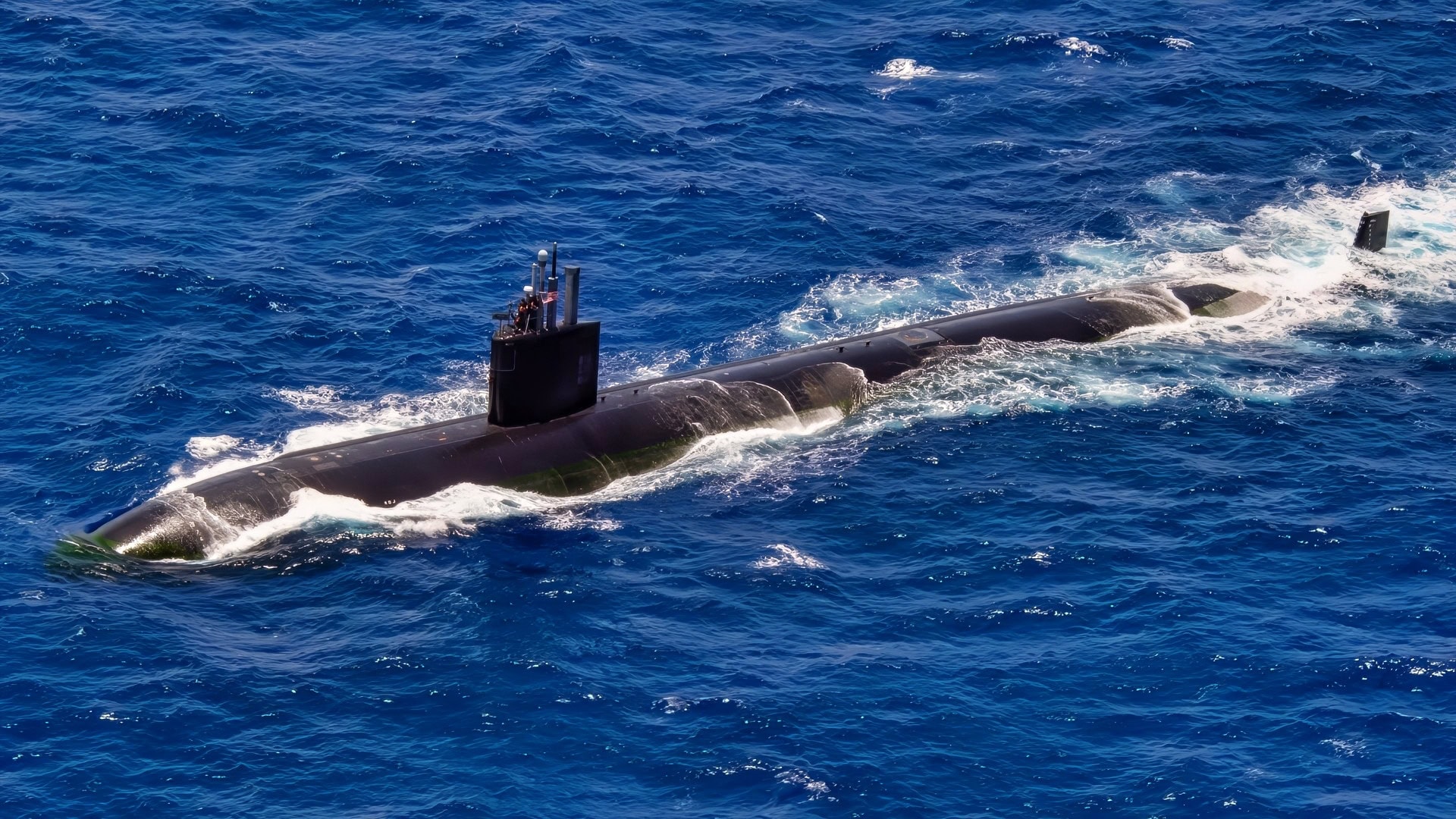
Idaho (a name long incorrectly assumed to have been derived from a Shoshone Native American tribe word meaning “gem of the mountains”) is the 43rd state of the Union. Officially known as “The Gem State,” the name has been bestowed upon the newest gem in the United States Navy’s fleet of nuclear-powered fast-attack submarines (SSNs). The USS Idaho (SSN-799) just became the 26th ship of the Virginia-class SSNs to be commissioned. And the timing couldn’t be better for the sake of the USN submarine force.
Bottom Line Up Front (BLUF): Idaho Is In It! (Official Service, That Is.)
This latest exciting news comes to us from Georgina Jedikovska in an April 27, 2026, article for Interesting Engineering (IE) titled “US Navy commissions giant 7,800-ton nuclear-powered attack submarine USS Idaho.” The commissioning ceremony took place two days prior to the article’s publication. As Hung Cao, former naval officer and current Acting Secretary of the Navy, stated at the ceremony, “We are a maritime nation, bordering on both the Atlantic and the Pacific. Our commerce depends on safe and secure sea lanes of communication.”
In addition to being the 26th overall ship of the Virginia class, SSN-799 is also the eighth of the class built to the more advanced Block IV configuration.
The Block IV boats improve upon Block III predecessors by allowing the subs to spend less time in the yard — from four major maintenance periods to three — and to squeeze an extra deployment out of the design.
USS Idaho had her keel laid on August 24, 2020, christened on March 16, 2024, and launched from General Dynamics Electric Boat’s (GDEB) shipyard on August 6, 2024.
Why Idaho’s Commissioning Matters
To repeat what was said at the beginning of this piece, the timing of the USS Idaho’s arrival on-scene couldn’t be better for the U.S. Navy’s sake.
This is because America’s “near-peer”/Great Power competitors, Russia and China, continue to expand and modernize their submarine fleets; the Russian Navy now has the Khabarovsk (Project 09851), whilst the People’s Liberation Army Navy (PLAN) is coming out with the 09IIIB class and future 09V class.
Meanwhile, America’s own submarine force is left trying to play catch-up ball:
-Only 23 of the original 62 Los Angeles-class subs currently remain in service, and three more of the venerable boats—USS Scranton (SSN-756), USS Alexandria (SSN-757), and USS Annapolis (SSN-760)— are in the process of being retired.
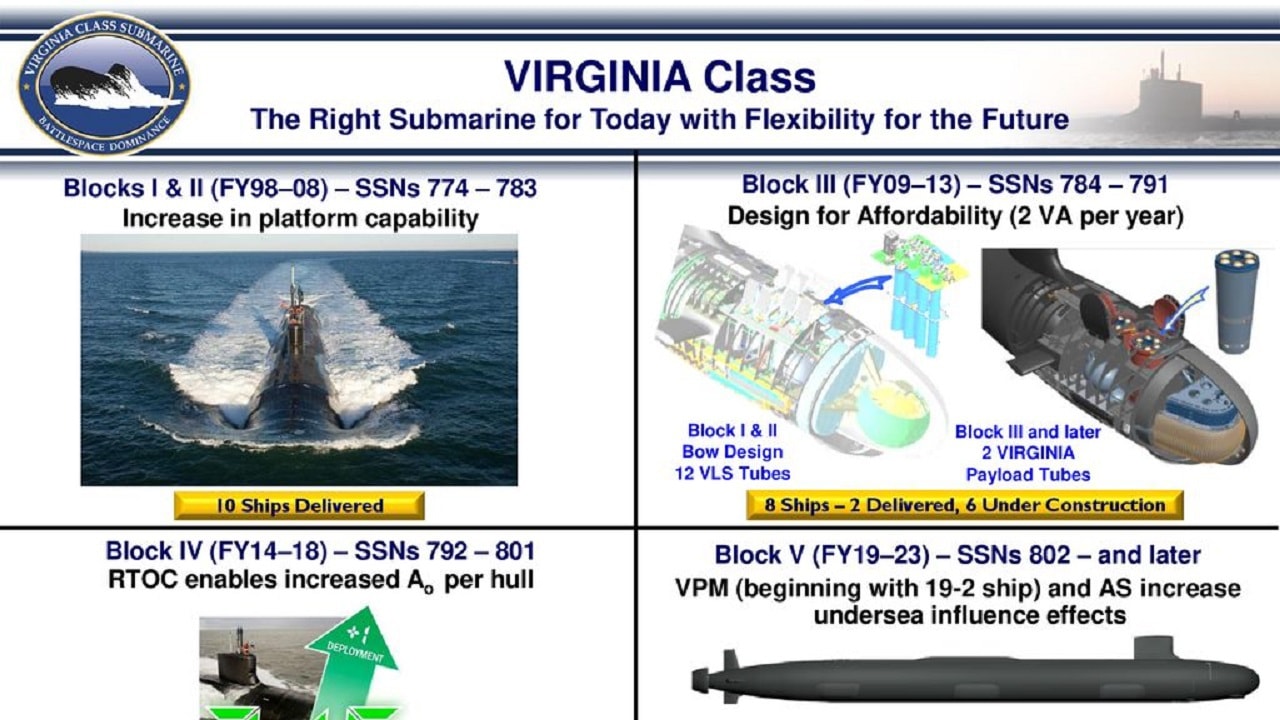
(FY98–08) – SSNs 774 – 783. Block III (FY09–13) – SSNs 784 – 791. Increase in platform capability. Design for Affordability (2 VA per year) Block I & II Bow Design. 12 VLS Tubes. Block III and later 2 VIRGINIA Payload Tubes. 10 Ships Delivered. 8 Ships – 2 Delivered, 6 Under Construction. Block IV (FY14–18) – SSNs 792 – 801. Block V (FY19–23) – SSNs 802 – and later. RTOC enables increased Ao per hull. VPM (beginning with 19-2 ship) and AS increase undersea influence effects. 10 Ships – 5 Under Construction, 5 Under Contract. In Design Phase, FY19 Construction Start. 16.
-As for the originally intended successors to the Los Angeles class, that being the Seawolf-class subs, only three of them—USS Seawolf (SSN-21), USS Connecticut (SSN-22), and USS Jimmy Carter— out of the originally planned 29 hulls were built and commissioned between 1997 and 2005.
-The Navy is falling well short of the estimated 100,000 skilled workers needed to build the new boats, so they’ve been running a BuildSubmarines recruiting push since November 2022.
It also reflects on a general shipbuilding manpower malady that’s dragging down America’s maritime industry as a whole, which motivated President Donald John Trump to sign an April 9, 025, Executive Order titled “Restoring America’s Maritime Dominance,” which is an excellent plan in theory but has a long way to go in practice and execution.
The Way Forward for the USS Idaho and the Virginia Class as a Whole
USS Idaho is to be homeported at Naval Submarine Base New London in Groton, Connecticut, which also happens to be the location of her commissioning ceremony. It remains to be seen if she will be called into action in support of Operation Epic Fury.
Meanwhile, an additional eight Virginia-class boats (two of Block IV, six of Block V) are currently being built, and many more hulls are on order.
The next ship in line is USS Arkansas (SSN-800), launched on July 2, 2025, and slated for commissioning sometime in 2028.
What’s In A Name: Idaho Semantic Sidenote
A total of four previous USN warships have borne the USS Idaho moniker:
– The first USS Idaho was a 3,241-ton wooden steam sloop commissioned in 1864 (the penultimate year of the American Civil War) and later converted to a full-rigged sailing ship, serving until it was sold in 1874.
– USS Idaho (BB-24) was a Mississippi-class pre-dreadnought battleship, launched on December 9, 1905, and sold to Greece on July 30, 1914 (just before World War I kicked off).
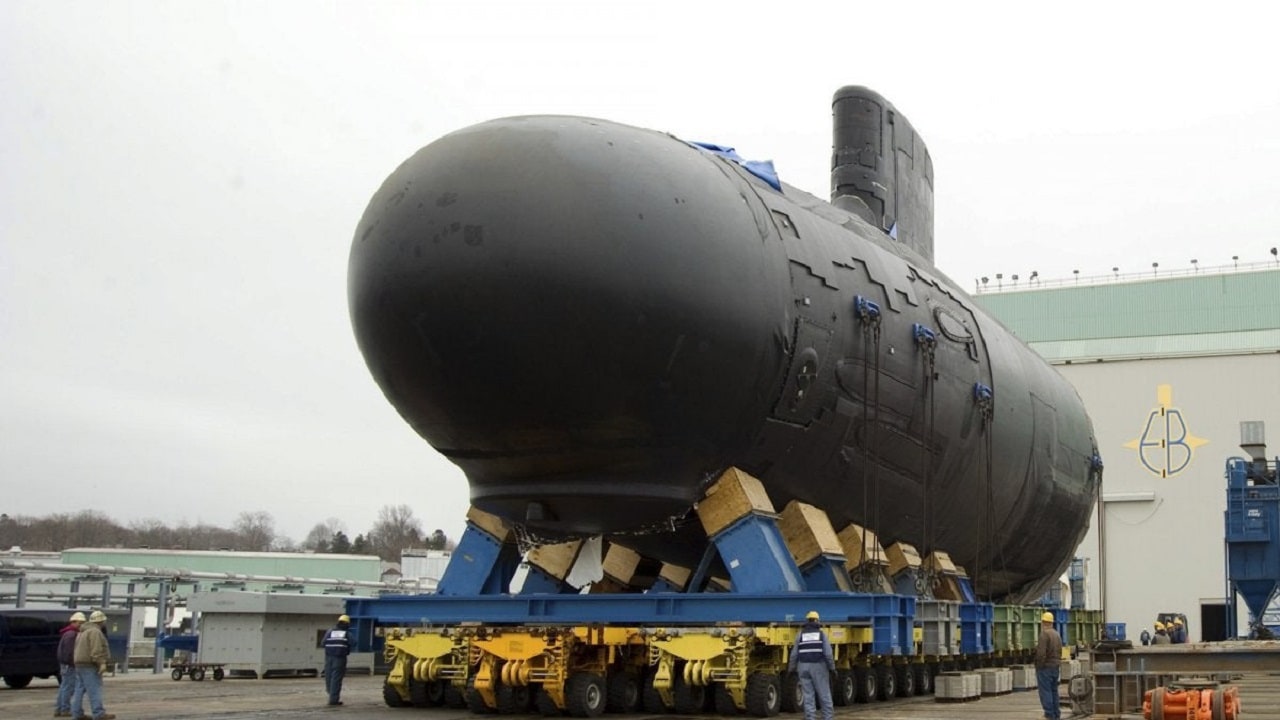
Image of Block III US Navy Virginia-class Submarine.
– USS Idaho (SP-545) was a mere lowly motorboat, a 60-footer built in 1907 and purchased by the U.S. Navy in June 1917. On November 30, 1917—19 days after the WWI armistice was signed—she was returned to her original private sector owner, W. W. Vensel of Pittsburgh, Pennsylvania
-The fourth USS Idaho (BB-42), being a New Mexico-class battleship, restored the bigness to the Idaho naval naming convention. She was commissioned in 1919 and, as noted by the USS Idaho Commissioning Committee Inc., “served with distinction in the Battles of Iwo Jima and Okinawa and was present in Tokyo Bay during the signing of the formal surrender by the Empire of Japan on September 2, 1945.” BB-42 was sold for scrap in 1947.
As for the current USS Idaho, her name is entirely apropos, because, to cite the USS Idaho Commissioning Committee again, much of the boat’s advanced acoustic stealth technology came from the Naval Surface Warfare Center Carderock Division’s Acoustic Research Detachment (ARD) in Bayview, Idaho, on Lake Pend Oreille, which is also home to the largest unmanned submarine in the world.
About the Author: Christian D. Orr
Christian D. Orr is a Senior Defense Editor. He is a former Air Force Security Forces officer, Federal law enforcement officer, and private military contractor (with assignments worked in Iraq, the United Arab Emirates, Kosovo, Japan, Germany, and the Pentagon). Chris holds a B.A. in International Relations from the University of Southern California (USC) and an M.A. in Intelligence Studies (with a concentration in Terrorism Studies) from American Military University (AMU). He is also the author of the book “Five Decades of a Fabulous Firearm: Celebrating the 50th Anniversary of the Beretta 92 Pistol Series,” the second edition of which was recently published.