
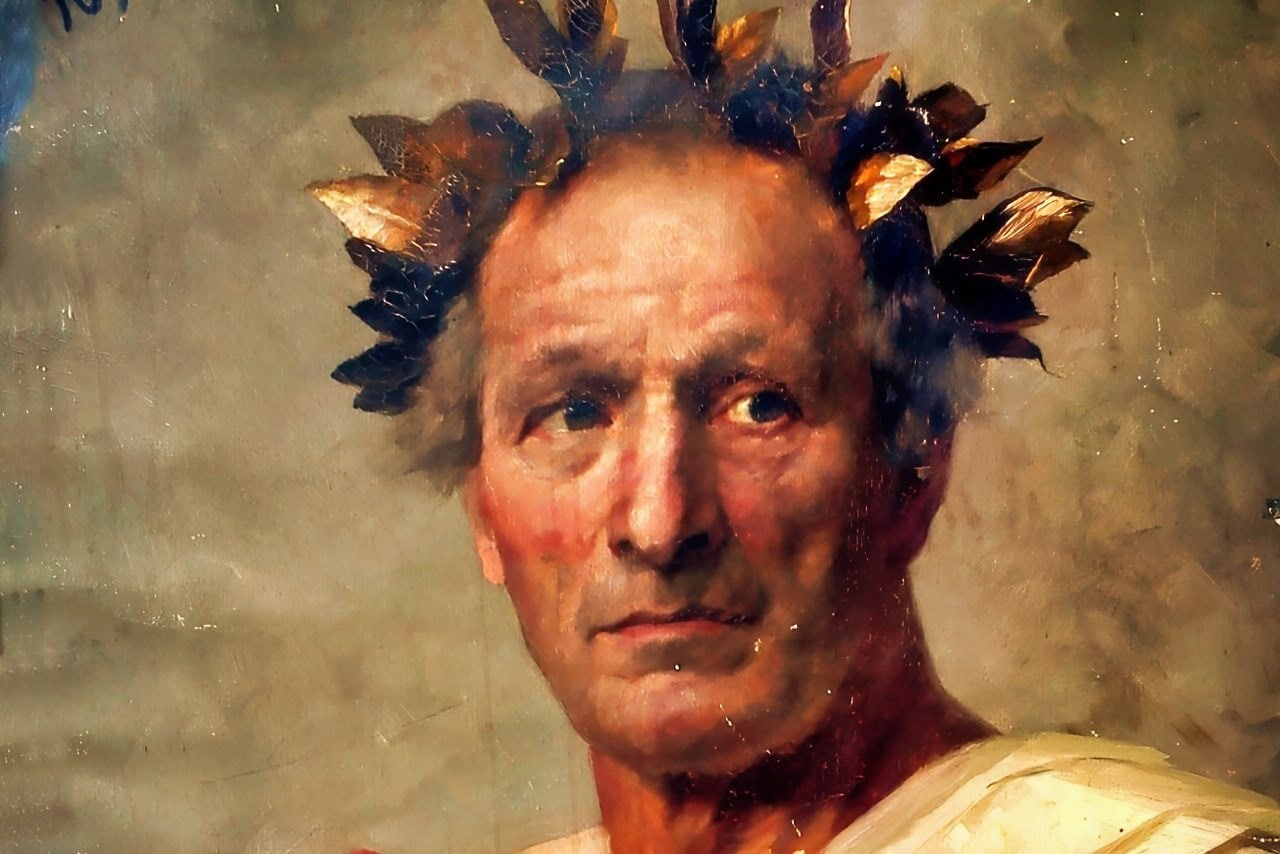
Summary and Key Points: Defense columnist Isaac Seitz evaluates the strategic ascendancy of Gaius Julius Caesar, detailing his survival during Sulla’s proscriptions and his early military honors, such as the corona civica.
-This report analyzes Caesar’s deep familial ties to the populares leader Gaius Marius and his tactical refinement under Apollonius Molon.
-Seitz explores the formation of the First Triumvirate with Pompey the Great and Crassus, which secured Caesar’s consulship in 59 BCE.
-Ultimately, Caesar’s synthesis of military prestige, populist oratory, and political alliances is presented as the catalyst for Rome’s imperial transformation.
Quote of the Day: “It is better to suffer once than to be in perpetual apprehension.” – Julius Caesar
Gaius Julius Caesar is one of the most legendary figures in all of history. He fought and won multiple legendary battles throughout his military career and fundamentally transformed the political fabric of Rome. He turned Rome from a republic into an empire, whereby changing the course of European history.
Caesar, however, was not created in a vacuum. Prior to his ascendency has emperor, he gained popular recognition through his military exploits, his political connections, and his own cunning and ambition. When the time was right, he utilized these skills and more to seize power and reshape Rome.
Early Life and Family Connections
Caesar was born in July 100 BCE into the household of the gens Julia, an ancient patrician family whose mythic origins supposedly connected them to the Trojan prince Aeneas and the goddess Venus. Although the family name carried immense prestige, the Julii of Caesar’s time did not possess the wealth or political influence that had once belonged to their ancestors.
His father, also named Gaius Julius Caesar, served respectably as a provincial governor, but he never achieved the highest offices of the state. Caesar’s mother, Aurelia Cotta, came from a distinguished plebeian lineage and was known for her capability, strength, and intelligence. Many ancient historians believed she played a crucial role in shaping the discipline and ambition of her son.

Vercingetorix throws down his arms at the feet of Julius Caesar, painting by Lionel Royer in 1899. Musée Crozatier, Le Puy-en-Velay, France. Imave Credit: Creative Commons.
Another defining element of Caesar’s background was his family’s close connection to Gaius Marius, his uncle by marriage. Marius, a celebrated general and seven-time consul, stood as a towering figure among the populares, the political faction that positioned itself as champions of the common people. His rivalry with the conservative optimates, led by Lucius Cornelius Sulla, plunged Rome into civil conflict. Caesar’s upbringing occurred during the final, violent throes of the Republic’s long-standing political tensions, and his familial ties would soon draw him into the heart of the struggle.
Hardened Youth: Early Signs of the Man to Come
The danger came swiftly. In 82 BCE, when Caesar was still a teenager, Sulla emerged victorious and imposed a dictatorship backed by ruthless purges known as the proscriptions. As Marius’s relative through his aunt Julia, Caesar was marked as an enemy of the regime.
Sulla ordered him to divorce his wife, Cornelia, who was the daughter of Cinna, a former ally of Marius.
Caesar refused, displaying even at eighteen a steadfastness that defied the wishes of the most powerful man in Rome. His refusal resulted in immediate punishment: the loss of his priesthood, the forfeiture of Cornelia’s dowry, the stripping of his own inheritance, and a warrant for his life. For months, Caesar hid among sympathetic allies or fled from place to place, narrowly avoiding Sulla’s soldiers.
His survival depended on interventions from influential figures and perhaps on Sulla’s grudging respect for his determination. According to later accounts, Sulla finally relented but warned that he saw many “Mariuses” in Caesar, implying that the young man possessed the same potential for upheaval and challenge to aristocratic authority.
Whether the statement is literal or not, it reflects the political intuition many Romans possessed at the time: Caesar was marked for significance.
Early Political and Military Career
After temporary exile and danger, he sought refuge in the Roman army. Military service offered both safety and opportunity, and Caesar proved himself quickly. In Asia and Cilicia, he distinguished himself during campaigns and earned the corona civica, one of Rome’s highest honors for saving a fellow soldier’s life.
Such awards were typically bestowed upon older, more experienced men, making Caesar’s achievement as a young aristocrat particularly noteworthy. The early military experience provided him not only with confidence but also with insight into leadership, organization, and the loyalty of troops, skills that would eventually define his greatness.
When Sulla died in 78 BCE, Caesar returned to Rome and embarked upon a career in law and politics. He began by prosecuting corrupt governors who had abused their authority in the provinces. His oratory, already impressive, would later be further refined through studies with the celebrated teacher Apollonius Molon on the island of Rhodes.
Caesar’s speeches blended force, style, and theatricality, capturing the public’s attention and building his reputation as an eloquent advocate. He cultivated a persona that appealed to the Roman masses, embracing a political identity aligned with the populares without alienating allies among the elite.
Road to Dictatorship
By 60 BC, Caesar had successfully gained public approval, but he realized that to achieve the consulship and implement his political agenda, he needed powerful allies.
He orchestrated an unprecedented alliance with Pompey the Great and Marcus Licinius Crassus, uniting military prestige with immense wealth and political skill.
This unofficial coalition, later called the First Triumvirate, allowed the three men to dominate Roman politics. With their support, Caesar won the consulship for 59 BCE and used his authority to pass legislation beneficial to his partners and supporters.
At the end of his consulship, he secured a lucrative and extended military command in Gaul. This appointment would propel him into the next, more dramatic phase of his career and ultimately alter the fate of the Roman Republic.
Yet the foundation of his power, the reputation, alliances, experience, and ambition, had been built long before he conquered Gaul or proclaimed himself emperor.
About the Author: Isaac Seitz
Isaac Seitz, a Defense Columnist, graduated from Patrick Henry College’s Strategic Intelligence and National Security program. He has also studied Russian at Middlebury Language Schools and has worked as an intelligence Analyst in the private sector.

