
Summary and Key Points: Dr. Brent M. Eastwood analyzes the growing public anxiety over a potential military draft for Operation Epic Fury.
-Despite the Trump administration’s refusal to rule out “boots on the ground” in Iran, a return to mass conscription is highly unlikely.
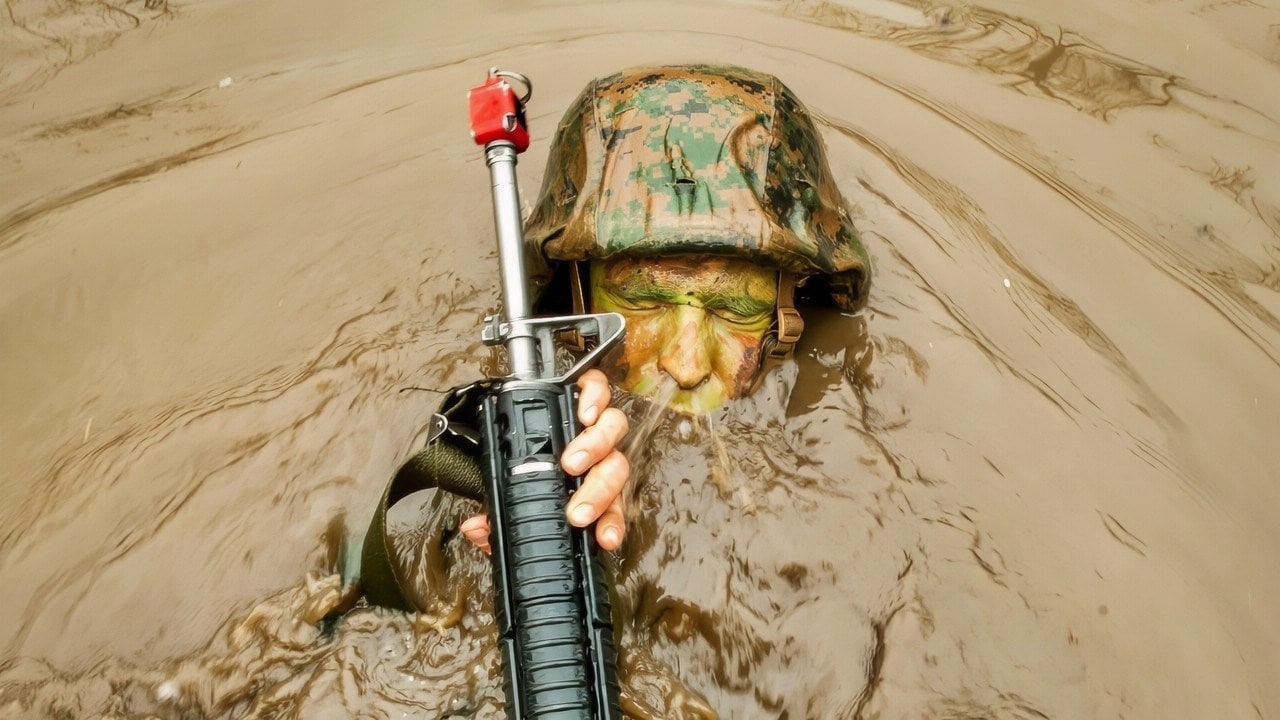
A candidates assigned to Delta Company, Officer Candidates Class-221, breaks the surface of the murky water of ‘The Quigley’ at Brown Field, Marine Corps Base Quantico, Va., on March 15, 2016. The mission of Officer Candidates School (OCS) is to “educate and train officer candidates in Marine Corps knowledge and skills within a controlled, challenging, and chaotic environment in order to evaluate and screen individuals for the leadership, moral, mental, and physical qualities required for commissioning as a Marine Corps officer.” (U.S. Marine Corps Photo by Cpl. Patrick H. Owens/Released)
-Not only would a draft require an act of Congress and face massive public resistance, but the U.S. military also lacks the infrastructure to train hundreds of thousands of unwilling recruits before the 90-day window of the War Powers Act expires.
The Draft Debate: Why Operation Epic Fury in Iran Won’t Trigger Mass Conscription
The last time the United States had a military draft, the Vietnam War was raging. Critics have maintained over the decades that this mass conscription program from 1964 to 1973 was undemocratic and unfair. There were many exceptions to the draft. If you were attending college, you could receive a deferment. This was seen as favoring wealthier people who could afford university, while less endowed families were forced to see their sons drafted who could not afford college. This meant that lower-income whites and minorities were assigned dangerous jobs like front-line infantry service that had more casualties.
The Wealthy Knew How to Avoid the Draft
Also, there were numerous ways to avoid the draft with physical ailments and medical disqualifiers. Wealthier families were able to get doctors to ensure potential draftees received medical deferments. Also, those well-off knew how to get their sons into the part-time National Guard and ensure they would not be deployed to Vietnam. Others completely dodged the draft by going to other countries. The draft was considered highly flawed.
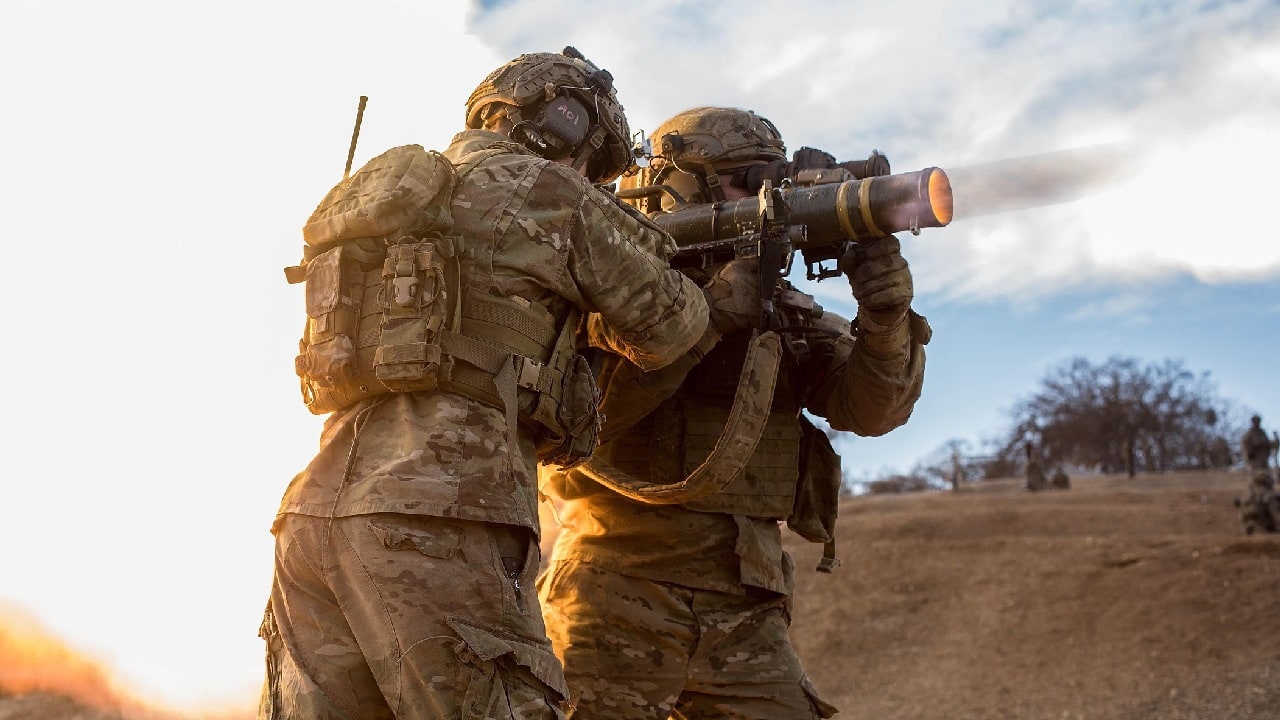
U.S. Army Rangers assigned to 2nd Battalion, 75th Ranger Regiment, fire off a AT-4 at a range on Camp Roberts, Calif., Jan 26, 2014. Rangers use a multitude of weaponry during their annual tactical training. (U.S. Army photo by Pfc. Rashene Mincy/ Not Reviewed)
Now It’s An All-Volunteer Force
The draft finally ended in 1973, when the military transitioned to a volunteer force. However, people would still have to register for the draft if Congress declared war.
Congress Would Have to Declare War
To revert to mass conscription, Congress would have to change the Military Selective Service Act since the president cannot continue to deploy personnel to the Middle East in support of Operation Epic Fury against Iran for over 90 days without Congressional approval and authorization of military force.
Young Men Must Still Register for the Selective Service
As it stands now, all men between the ages of 18 and 25 must register for the Selective Service System. This doesn’t mean there will be a full draft, but it is the first step toward creating a non-volunteer force that would bolster the number of personnel the volunteer force already provides.
The Trump Administration Has Not Fully Ruled Out the Draft
Speculation about the draft has percolated since the beginning of Operation Epic Fury. President Donald Trump has refused to say that ground troops would not be required. Even his Press Secretary Karoline Leavitt when asked about the possibility of a draft would not rule it out and said the president has all options on the table. Leavitt was speaking to Fox News “Sunday Morning Futures” with Maria Bartiromo on March 8. She said there were no immediate plans for deployment of boots on the ground, but Trump “wants to continue to assess the success of this military operation.”
This Lack of Certainty Is Causing Unneeded Worry
This is not reassuring to many young men and women who have no desire to fight a war. Families are always concerned about an open-ended conflict that could evolve into a need for hundreds of thousands of troops with high levels of casualties.
Secretary of Defense Pete Hegseth has not ruled out a draft. He spoke to CBS News and said that “we’re willing to go as far as we need to in order to be successful.”
How Would a Draft Be Declared?
The War Powers Act of 1973 requires Congressional approval for any conflict lasting more than 90 days. The president would need to prolong the war for more than 3 months for the War Powers Resolution to trigger. He could approach Congress and seek an authorization for use of military force (AUMF) before then, but it is not clear if Trump would have the votes necessary for an AUMF.
The Operation Will Probably Wrap Up Before 90 Days
Thus, an official wartime declaration is not likely, and there were reports on March 23 that Trump may engage in some form of negotiations leading to a ceasefire or a pause of bombing. Iran has so far denied that any peace efforts have taken place, but it is probable that the operation against Iran would end within 90 days.
Drafting would be difficult after the war was officially declared. The draft works through a public, complex lottery.
America’s Got Talent 2.0
“According to the Selective Service System, numbers would be drawn in a nationally televised and livestreamed lottery. The numbers 1 to 366 correspond to days of the year, including leap years. The number one would mean January 1, 70 would be March 10, and so on. If the number drawn corresponds to your birthday, you’re drafted,” according to the Daytona Beach News-Journal.
It Is Not Likely to Happen
A draft would be highly unlikely. There is little political support for it either by ordinary Americans or their Members of Congress. Most young people have no desire to serve in the military. There would probably be a mass uprising against the draft.
It Would Be Difficult to Execute
Plus, militarily, it would not be prudent, even if Congress ordered conscription. No military leader wants to command people who do not want to serve. This unwillingness would be a huge detriment to morale and effectiveness.
The next problem would be how to train so many people being drafted. There are currently only a few American bases that handle new recruits and provide basic combat training. To accommodate such a large influx of personnel, new infrastructure, including barracks and dining facilities, would be required. This would take ample time to create, and the war would be over by the time the military could train and house all the draftees.
I’ll Make Another Prediction
While in graduate school for political science, I was asked by a local newspaper about a potential draft during the Second Gulf War. I told them that a draft would not happen anytime soon. One of my professors reminded me that political scientists do not make predictions, but I will make another prediction now as a political scientist: there will not be a draft for the war in Iran.
About the Author: Brent M. Eastwood
Author of now over 3,000 articles on defense issues, Brent M. Eastwood, PhD, is the author of Don’t Turn Your Back On the World: a Conservative Foreign Policy and Humans, Machines, and Data: Future Trends in Warfare , plus two other books. Brent was the founder and CEO of a tech firm that predicted world events using artificial intelligence. He served as a legislative fellow for US Senator Tim Scott and advised the senator on defense and foreign policy issues. He has taught at American University, George Washington University, and George Mason University. Brent is a former US Army Infantry officer. He can be followed on X @BMEastwood.